
Breach · guide
Free credit monitoring: what the bureaus and the agencies say
By Alberto Gulotta · Updated · 15 min read
Free credit monitoring from TransUnion and Experian watches that bureau's own report, and the CFPB says most monitoring services alert you after details are stolen rather than protect them. The FTC lists what is free: a weekly report from each bureau, a yearly one by law, a credit freeze and fraud alerts, with warnings about look-alike sites.
| Question | Answer | Where it comes from |
|---|---|---|
| What does a free plan watch? | TransUnion and Experian each describe alerts on their own credit report | TransUnion, Experian |
| Does monitoring stop fraud? | The CFPB says monitoring services mostly alert you after the details are stolen; Experian says it cannot stop a credit application in your name | CFPB, Experian |
| What is free? | A report every week from each bureau under a program the bureaus extended, one every 12 months by federal law, a credit freeze and fraud alerts | FTC, CFPB, AnnualCreditReport.com |
| Does a credit freeze cost anything? | No: the FTC says there is no cost to place or lift one | FTC |
| Where do the free reports come from? | AnnualCreditReport.com, the one site the FTC says is authorized to fill them | FTC, AnnualCreditReport.com |
What the free plans watch
The CFPB describes a credit monitoring service as a commercial service that charges a fee to watch your credit reports and alert you to changes to the accounts listed on them. Its page was last reviewed on 5 September 2025. It says the alerts usually arrive by email, text message or phone, and that prices and service options vary widely, with some services costing over $15 a month. The free plans below are the bureaus’ own, and each page says what its plan covers.
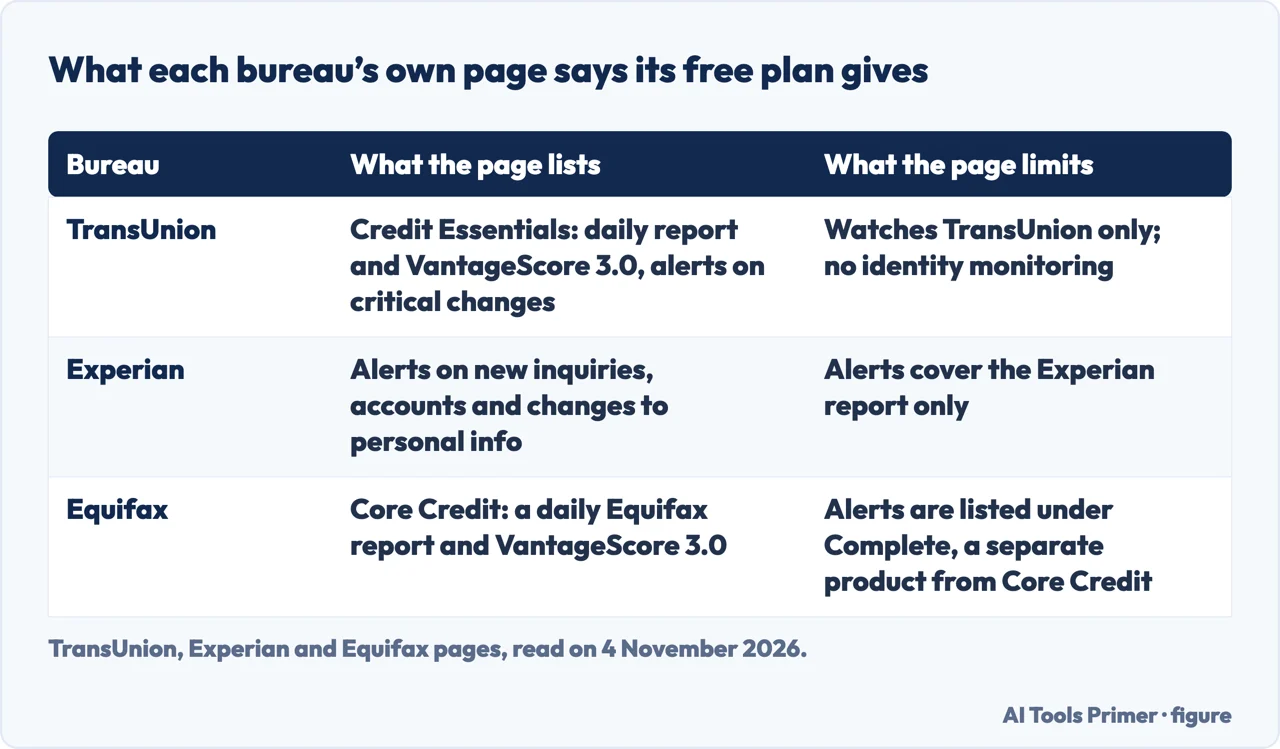
TransUnion’s Credit Essentials is a free subscription that asks for no credit card. It gives a daily TransUnion credit report and a VantageScore 3.0 score, and it alerts you to what the page calls critical changes: late payments, new accounts opened in your name, hard inquiries and big drops in the score. The page ties the monitoring to accounts reported to TransUnion, so it is a watch on one bureau’s file.
Experian’s page puts “No credit card required” beside its sign-up buttons and describes alerts about new inquiries, new accounts and changes to personal info. Its answer on what the service covers says the free plan gives alerts for changes to your Experian credit report. It adds that you can upgrade at any time to monitor all three bureaus, lock your credit report, scan the dark web for your personal data and receive an identity theft insurance policy that covers up to one million dollars.
Equifax words it differently. Its answer on free reports says you can create a myEquifax account and get six free Equifax credit reports each year, and that Equifax Core Credit gives a free daily Equifax report and a daily VantageScore 3.0 score. Alerts of key changes to the Equifax report are listed under Equifax Complete, a product the page presents apart from Core Credit; the page text we read gives no price for it. A banner on the same page says value plans include one-bureau score access, a report lock and alerts, and that plans start at free. We could not tell from the page which of those the free plan has.
What monitoring does not do
The CFPB says most monitoring services do not protect your personal information from being stolen; they alert you after it has been stolen. A tip box on the same page says some consumers use credit or identity protection services believing they will protect against identity theft before it can happen, and says this is not the case.
Experian, which sells monitoring, gives a similar warning about its own category. Its page says credit monitoring does a lot but cannot fully protect you from fraud, and it lists four things a service will not be able to do: stop phishing emails, keep your information safe from data breaches, prevent someone from applying for credit in your name, and fix errors on your report for you. Because that statement comes from a seller, it is worth reading as the seller’s own account of the limit.
TransUnion is direct about a neighbouring product. Asked whether Credit Essentials offers identity monitoring services, its page answers that the free plan does not. Experian separates the two: it calls credit monitoring one part of identity theft protection, which also looks at places such as bank accounts, the dark web and criminal databases. Experian’s free offers on the same page include a one-time dark web scan for a Social Security number, email and phone number, and a one-time personal privacy scan for people finder sites. For what a dark web scan checks and what an alert can and cannot lead to, see dark web scans; for the paid bundles, identity theft protection services.
Two smaller points come from the same pages. Experian says monitoring has no impact on your credit scores, because the soft inquiries it can cause do not affect them. TransUnion says watching a credit report can help you catch signs of fraud early, such as an address change you do not recognize, a new account you did not open or an inquiry you did not make. Neither statement is about preventing the theft itself.
The free reports the law points to
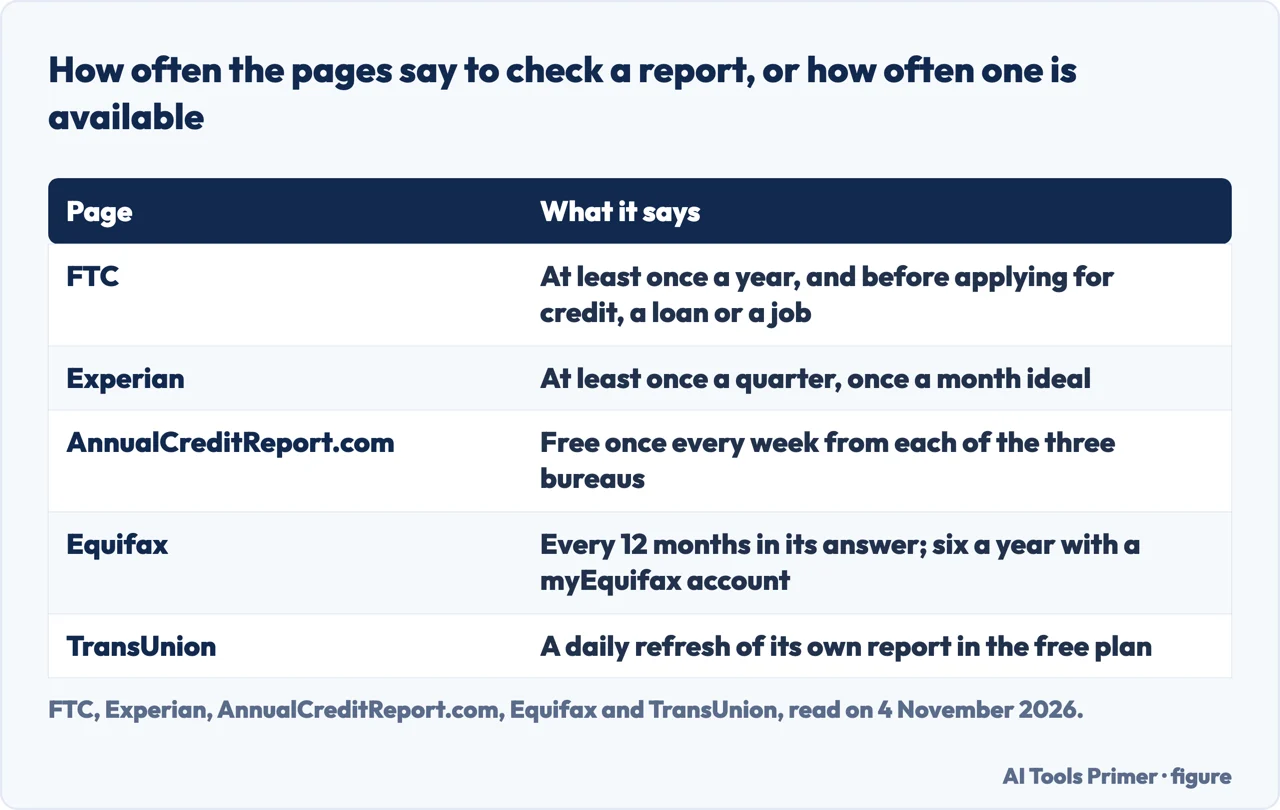
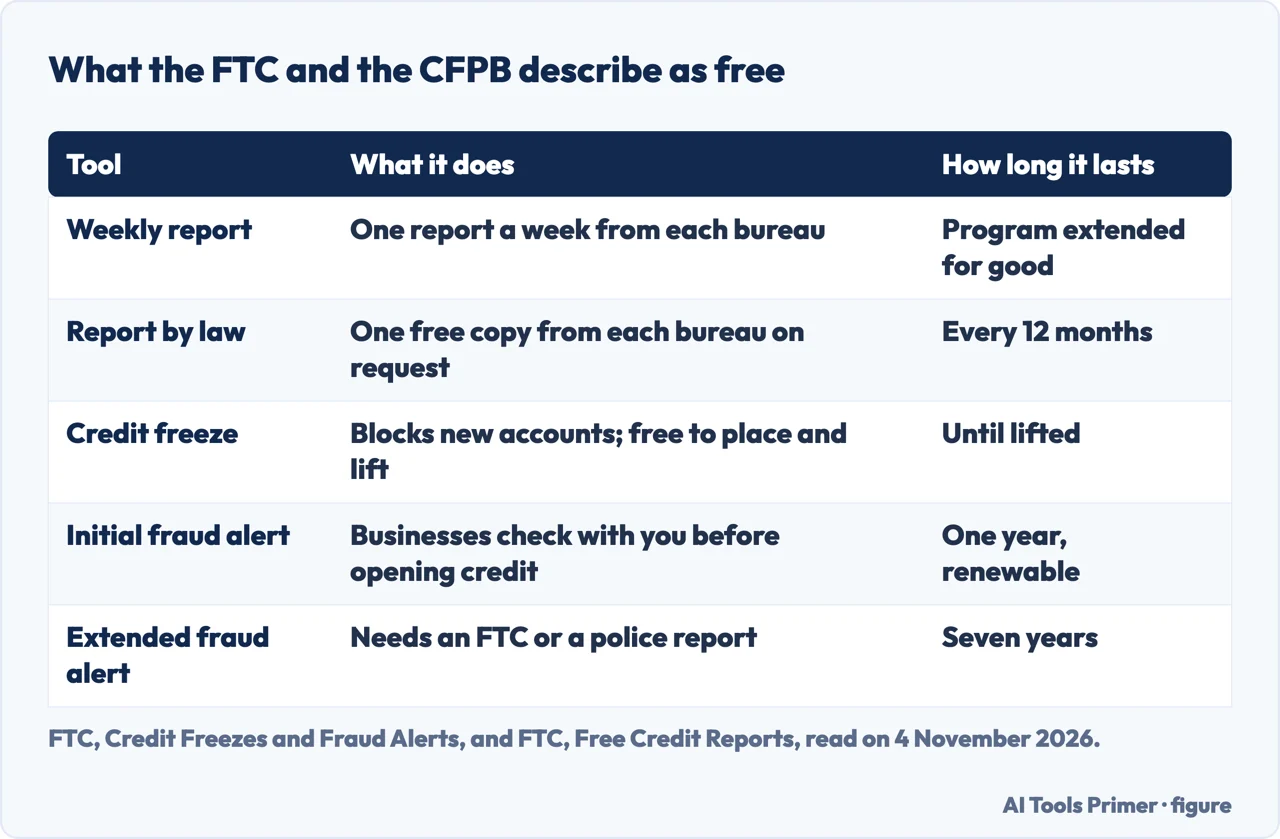
The FTC says all three nationwide credit bureaus have permanently extended a program that lets you check your report from each of them once a week for free at AnnualCreditReport.com. It adds that federal law, the Fair Credit Reporting Act, requires each bureau to give you a free copy once every 12 months if you ask. AnnualCreditReport.com says the weekly reports come with no credit card, subscription or hidden fees, and that checking your own report is a soft inquiry that does not affect your scores.
The FTC says only one website, AnnualCreditReport.com, is authorized to fill orders for the free annual reports you are entitled to by law, and that you can also call or mail a request form. Online access is immediate; the FTC and the site both say a phone or mail request is mailed within 15 days. The site says you can order from one, two or all three bureaus and need not do it all at once. You give your name, Social Security number, date of birth and current address, and a previous address if you have lived at the current one for less than two years. The FTC adds that each bureau asks its own security questions, even when the three reports are requested together.
The FTC lists other cases where federal law gives you another free report: you receive an adverse action notice and ask within 60 days, you are unemployed and plan to apply for a job within 60 days, you are on public assistance, your report is inaccurate because of fraud, or you have a fraud alert on your file. The CFPB, for its part, frames the weekly report as the do-it-yourself alternative: a request to each nationwide bureau every week, in place of a paid service.
The FTC also says to review the report from all three bureaus, because each may get its information from different sources, so one report may not match the other two. That is the point the single-bureau free plans above leave to you.
The freeze and the alerts
The CFPB lists a security freeze among its free alternatives, after the weekly report, and says it will generally prevent new credit from being opened in your name. The FTC says there is no cost to place or lift a credit freeze and that it does not affect your credit score. While it is in place, a new credit account cannot be opened in your name, including by you; to apply for credit or a job, rent a home or buy insurance, you lift it for a while and put it back. The FTC says a freeze lasts until you lift it, that anyone can place one for any reason, and that you do not have to wait for a data breach. It also says to contact all three bureaus, and, to lift one, to find out which bureau a lender will use and lift the freeze at that one. For the freeze against a credit lock, see freeze or lock.
Fraud alerts are different. The FTC says an initial fraud alert tells businesses to check with you before opening a new account, lasts one year and can be renewed, and is placed by contacting one of the three bureaus, which must tell the other two. Unlike a freeze, an alert does not stop businesses from seeing your report. Placing an initial alert also entitles you to a free copy of your report from each bureau. An extended alert lasts seven years and needs an FTC identity theft report or a police report. The CFPB puts the same difference briefly: an alert does not prevent a lender from opening credit in your name, but the lender has to take steps to verify your identity first.
The FTC says active duty servicemembers and National Guard members can also get free electronic credit monitoring, and that you sign up by contacting each of the three bureaus. For a child under 16, it says to request a free credit freeze; the bureaus give separate instructions for a minor. What a child’s case involves is on child identity theft.
Free offers to read twice
The CFPB says some companies offer “free” credit monitoring, and that before accepting such an offer you should check for any hidden fees or cancellation requirements. It also suggests checking with your local consumer protection agency and State Attorney General office to see whether complaints have been filed against the company.
The FTC warns about look-alike sites. It says some pretend to be associated with AnnualCreditReport.com or claim to offer free credit reports, free credit scores or free credit monitoring, that they use terms like “free report” in their names, and that some have URLs which purposely misspell AnnualCreditReport.com in the hope that you mistype it. The FTC says a visit can end on sites that want to sell services or collect and then sell or misuse your personal information. The FTC says AnnualCreditReport.com and the bureaus will not email you asking for your Social Security number or account information, and that an email, pop-up or phone call claiming to come from them is probably a scam.
The bureaus’ own pages carry commercial notes of their own. TransUnion’s free plan includes personalized credit card offers through Bankrate’s CardMatch tool, and an advertiser disclosure says Bankrate provides advertising revenue to TransUnion Interactive when consumers interact with the offers, and that this revenue affects how and where the offers appear. The same disclosure says TransUnion does not endorse or recommend any lender or provider. The page also says the app is for people aged 18 or over, and describes the subscription as one you can cancel any time.
Where the pages disagree and what they leave out
The pages do not agree on how often to look. The FTC and AnnualCreditReport.com say weekly reports are free. The FTC says to check at least once a year and before applying for credit, a loan, insurance, housing or a job, while Experian says at least once a quarter, with once a month ideal. Equifax says both things on one page: its answer on free reports mentions free copies every 12 months, while its menu offers a free weekly credit report. It adds six a year with a myEquifax account and a daily report with Core Credit.
They also differ on what “free” covers. The free plans described by TransUnion and Experian watch their own bureau, and Experian puts three-bureau monitoring in its paid upgrade. The Equifax page lists three-bureau monitoring under its Equifax Complete Family Plan, apart from the free Core Credit. The pages we read do not give the price of the Experian upgrade or of the Equifax Complete plans. The only figure for cost is the CFPB’s, which says some services cost over $15 a month.
Some things the pages we read do not say. They do not report how often free monitoring catches fraud, and they do not measure whether it stops a theft. TransUnion’s list of what the free plan includes has a line about a service center to manage a credit freeze, dispute and fraud alert, and the page does not say more about it. The pages do not mention monitoring that a company offers after its own breach; for the wider picture of what a leak means, see data breach.
All seven pages are about the United States and its three bureaus, and the pages we read do not say what applies to readers elsewhere. The CFPB page was last reviewed in September 2025 and the FTC page on credit freezes and fraud alerts is dated August 2025, so those two are the oldest of the seven. The TransUnion, Experian and Equifax pages describe their own products, and we read them as that and nothing more.
Where to start
Six ways in.
- “What does the free plan watch?”
- What the free plans watch — watches
- “Does it stop fraud?”
- What monitoring does not do — cannot
- “How do I see my report for free?”
- The free reports the law points to — reports
- “Should I freeze it?”
- The freeze and the alerts — freeze
- “Is the offer really free?”
- Free offers to read twice — twice
- “Where do the pages disagree?”
- What the pages leave out — gaps
Freezes, children and paid protection
What a freeze does, what a child needs, and what the subscriptions add.
Watching for leaked details
Dark web alerts, what is sold, and what a number can be used for.
Questions people also ask
What is the best free credit monitoring service?
The pages we read do not rank the free plans or name a best one. TransUnion and Experian each describe a free plan that alerts on its own credit report, and Equifax lists a free daily report and score. The CFPB points instead to free alternatives: a weekly report from each bureau, a security freeze and fraud alerts.
What is free credit monitoring?
The CFPB defines monitoring as a service that charges a fee to watch your reports and alert you to changes. TransUnion’s free plan, which needs no credit card, gives a daily report and score and alerts on critical changes to its own file. Experian describes alerts on new inquiries, accounts and personal info.
Is there a way to check credit for free?
Yes. The FTC says AnnualCreditReport.com is the one authorized site, with a free report every week from each of the three bureaus, and that you can also ask by phone or mail. AnnualCreditReport.com says checking your own report is a soft inquiry that does not affect your scores.
Is Experian really free?
Experian’s page offers free monitoring with “No credit card required”, with alerts for changes to your Experian credit report. Its upgrade is a separate plan that monitors all three bureaus, locks your report, scans the dark web and adds an insurance policy. The page text we read does not give the upgrade’s price.
Not covered here. We opened no account and requested no report. The statements come from the CFPB, the FTC (two pages), AnnualCreditReport.com, TransUnion, Experian and Equifax, all read on 4 November 2026.
The search volume and difficulty behind this page come from a Semrush reading of 29 August 2026, older than the 60 days the site normally allows.
Sources
- CFPB — What is a credit monitoring service? (last reviewed 5 September 2025) — www.consumerfinance.gov, read 4 November 2026.
- FTC — Free Credit Reports — consumer.ftc.gov, read 4 November 2026.
- FTC — Credit Freezes and Fraud Alerts — consumer.ftc.gov, read 4 November 2026.
- AnnualCreditReport.com — home page — www.annualcreditreport.com, read 4 November 2026.
- TransUnion — Free Credit Monitoring — www.transunion.com, read 4 November 2026.
- Experian — Free Credit Monitoring — www.experian.com, read 4 November 2026.
- Equifax — Do any Equifax products provide access to a free credit report? — www.equifax.com, read 4 November 2026.
Written by Alberto Gulotta
Founder and editor of AI Tools Primer, writing from Palermo, Italy. Thirty-five years of taking computers apart, starting with a Commodore 64 — the long version is on the about page.
Something wrong on this page? Write to aitoolsprimer@gmail.com and it gets fixed.
Written on 4 November 2026.
Independence and limits
No affiliate links and no paid placements anywhere on this site. Nobody pays to appear here, and no company has seen this page before you did.
This is general information, not professional advice. Where a page touches money, health, safety or the law, it names its source and the date it was read — and your situation may still differ. See the privacy page and the cookie policy.