
Scams · guide
What is sextortion? What the FBI, FTC and NCMEC say
By Alberto Gulotta · Updated · 20 min read
What is sextortion? The FBI describes it as online sexual exploitation in which victims are coerced into providing explicit images or videos, often under threats to post them or send them to friends and family. The pages we read describe four forms. The FTC says to ignore and block the blackmailer and not to pay.
| Question | Answer | Where it comes from |
|---|---|---|
| What is it? | Blackmail with intimate images or videos: a threat to share them unless you pay or send more | FBI, Cybertip.ca, FTC |
| What do the threats ask for? | More sexual content, sexual activity, or money, gift cards and other payment | NCMEC, UNICEF |
| Is the webcam email real? | The FTC calls its claims about a webcam and software “all talk”, though the password it quotes may be a real old one | FTC, 2020 |
| Should I pay? | The FTC, Cybertip.ca and Penn State say not to; NCMEC says paying rarely stops the blackmail | FTC, Cybertip.ca, Penn State, NCMEC |
| Can the images come down? | Take It Down covers images from before age 18, and the Take It Down Act sets a 48-hour window for platforms | NCMEC, FTC |
What the word covers
The FBI’s Charlotte field office described sextortion in a note of 20 June 2016 as a type of online sexual exploitation in which individuals coerce victims into providing sexually explicit images or videos of themselves, often under threats to post the images publicly or send them to the victims’ friends and family. Cybertip.ca says it in plainer words: sextortion is blackmail, someone online threatening to send a sexual image or video to other people unless you pay or provide more sexual content. The FTC’s consumer alert of October 2026 gives it one line: someone threatens to share your intimate images unless you pay.
UNICEF’s parenting pages carry an interview with Dr. Michael Seto of the University of Ottawa, who describes the threat of releasing sexual content, whether sexual chats, nude images or videos, unless the person complies with a request. Sometimes the request is for more sexual content; sometimes it is for money, gift cards or another payment. NCMEC, the National Center for Missing & Exploited Children, calls it a form of child sexual exploitation in which the blackmailer demands more sexual content, sexual activity or money. The UNICEF page also adds a note on the word itself: it calls “sextortion” an informal term that is not suited to professional child protection contexts, and says it uses the word so that its guidance reaches parents and caregivers who search for it.
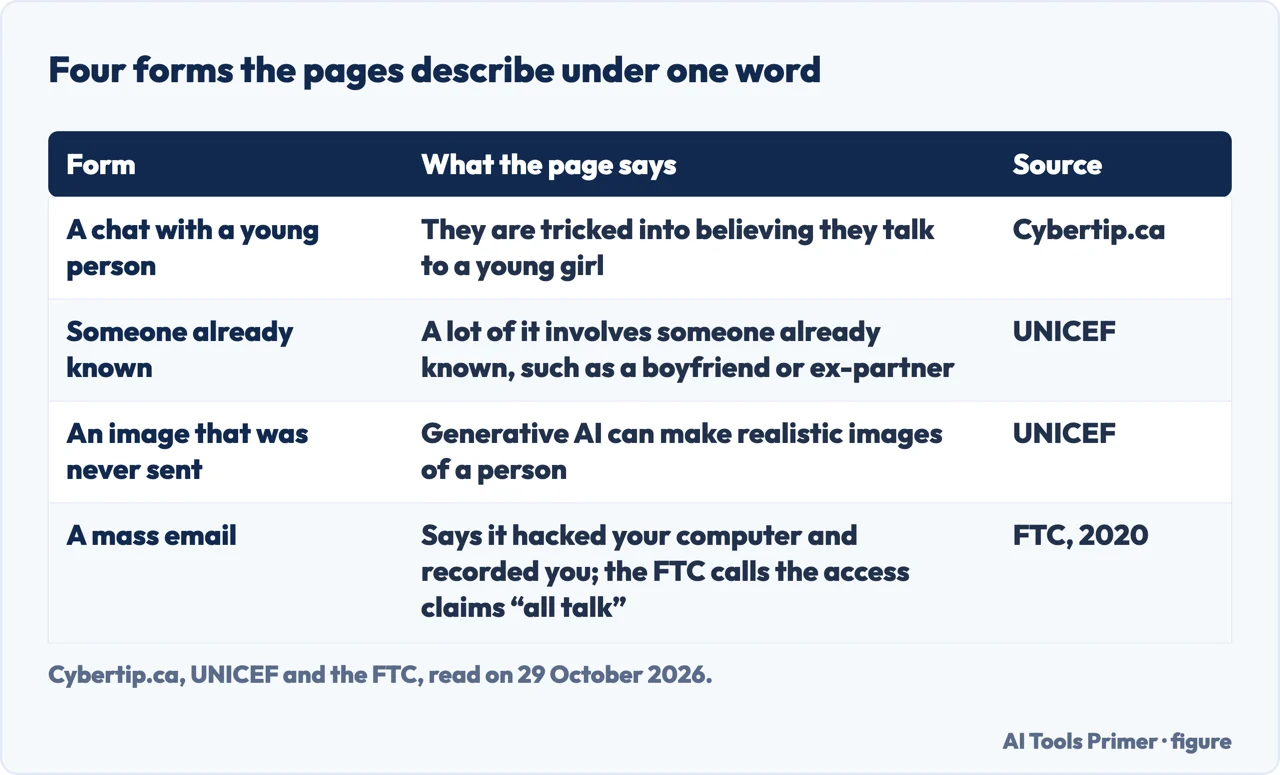
Read together, the pages describe four situations that sit under the one word, and the figure below puts them side by side.
- A chat with a young person. Cybertip.ca says young men in particular are often tricked into believing they are talking to a young girl. NCMEC says teenage boys have been the most common targets in the recent cases it sees, and that in many cases the blackmailers may have stolen or taken images of another person and communicate through a fake account.
- Someone the young person already knows. In the UNICEF interview, Dr. Seto says people tend to think of strangers, and that does happen, but a lot of this extortion actually involves somebody already known to the young person. The examples given are a boyfriend who demands more pictures or threatens to share them with friends, and an ex-partner who threatens to send the nude photos from the relationship to friends at school.
- An image that was never sent. Before generative AI, the same interview says, the person had to come into possession of a nude photo for the extortion to happen. With generative AI and “nudify” apps, the threat can now be made even when the other person never shared a nude photo, because realistic images and videos that look like the person can be created. NCMEC’s list of tactics also includes threatening to create sexual images with digital-editing tools.
- A mass email. The message says the sender hacked your webcam. The FTC describes it as a scam, and it has its own section below.
The pages are also written for different readers. The FBI note says it has seen a significant increase in sextortion against children who use the internet, typically ages 10 to 17, while adding that a child of any age can become a victim. Penn State’s police page says sextortion affects people of all ages, including college students, and that people between 18 and 24 have historically been considered the main targets. The FTC’s 2020 page on the webcam email speaks to adults who receive it.
How the chat version runs
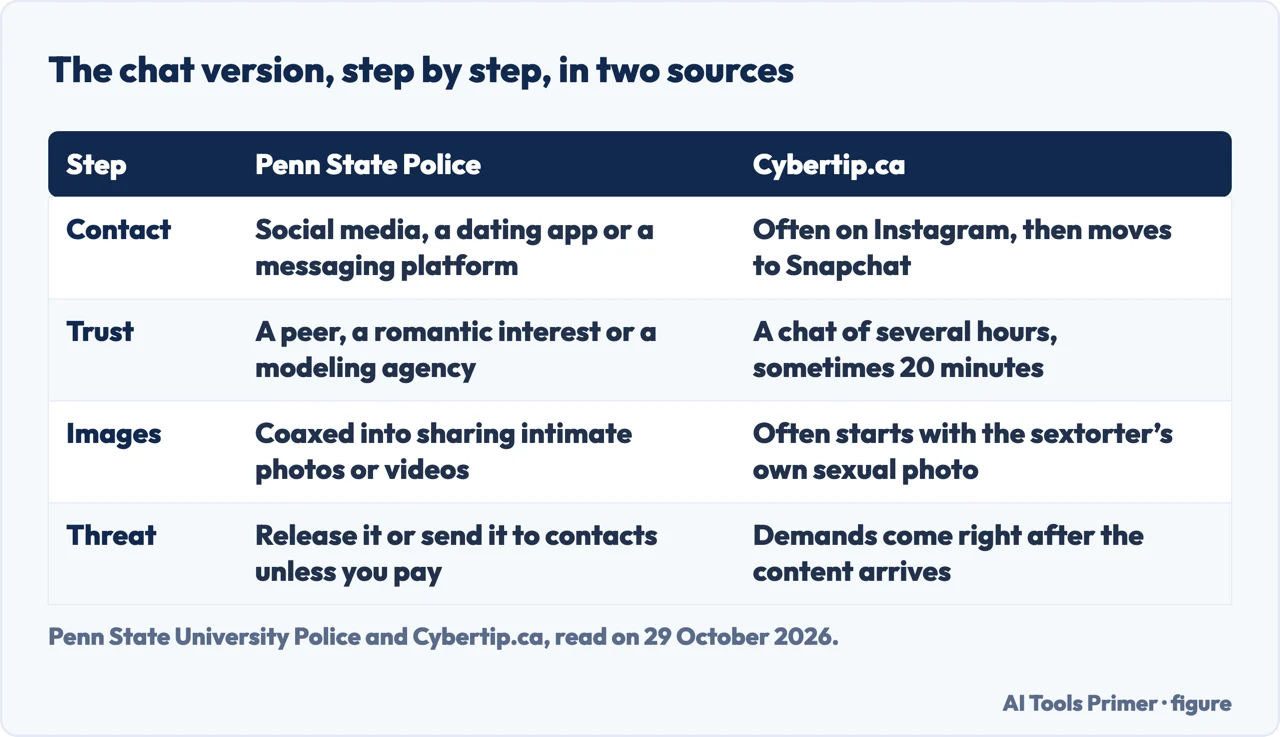
Penn State’s police page says sextortion schemes often follow a predictable pattern with four steps. An unknown individual contacts you on social media, a dating app or a messaging platform. Trust or intimacy is built quickly, sometimes by posing as a peer, a romantic interest or a modeling agency. You are encouraged or coerced into sharing intimate photos or videos. Once the content is received, the threat is to release it publicly or send it to your contacts unless you pay. Cybertip.ca describes the same sequence for young people, with the timing added: the chat lasts usually several hours, in some cases as little as 20 minutes, and the sextorter often starts the trade by sharing a sexual photo first.
The young person then sends a photo or video, or is tricked into exposing or engaging in a sexual act over a livestream and is recorded unknowingly. Cybertip.ca says the demands come immediately after the sexual content arrives. If the person is a girl, the sextorter typically demands additional sexual photos and videos; if a boy, Cybertip.ca says, they almost always demand money instead. It adds that it is common for the offender to share screenshots of the young person’s contacts or other identifying information, such as the school or the home address, to frighten the young person into sending photos or money.
The amounts Cybertip.ca lists run from as little as $9, which was what one young person had in a bank account, up to $7,500. The payment routes it names are online payment providers such as PayPal, Western Union and MoneyGram, online gift cards for Amazon, Google Play, Steam or VISA, and e-transfers direct from bank accounts. Penn State names wire transfers, gift cards and cryptocurrency. Cybertip.ca also says sextorters will sometimes barter and accept a lower amount if the young person says payment is not possible, and that the money demands often come from international organized criminal networks.
The warning signs overlap across the pages. NCMEC and Penn State both list approaching someone after researching their interests, friends, school or family, asking for nudes quickly after connecting, and moving the conversation from one platform to another, for example from social media to a private video chat or messaging app. The tactics include reciprocity (“I’ll show you, if you show me”), pretending to be younger or to be of the opposite sex, using several false identities, pretending to work for a modeling agency, and, in NCMEC’s list, getting into a child’s online account without authorization and stealing sexual images from it. Cybertip.ca adds offering a gift for content, targeting siblings or friends, creating several accounts so that it seems more than one person is involved, and turning more aggressive, for instance by threatening the family or animals, if the young person does not comply quickly. It also lists threats to send the image to a school or to newspapers, news outlets and TV stations.
The FBI note makes two further points. Sending just one inappropriate image could become the catalyst, and an offender can come into possession of an image the child sent to a known person on purpose, if that recipient is sextorted or puts the image on the internet. Younger children can also be targeted when a friend or sibling is being sextorted. NCMEC’s data release of June 2026 says many offenders are moving conversations more quickly to private messaging and encrypted apps, which it says makes related cases harder to detect and connect.
On scale, each page counts something different. NCMEC says it received more than 50,000 reports of financially motivated sextortion in 2025, an average of 137 a day, up significantly from more than 36,000 reports in 2024, and that when the relationship to the victim is known, 94 percent of public reports came from the child or a parent. Penn State, citing NCMEC in 2024, says reports of financial sextortion nearly tripled from 2022 to 2023. The years differ, so these figures describe a trend, not a single count. Cybertip.ca counts yet another thing: for 1 January to 31 December 2024 it reports an average of six sextortion reports a day and more than 2,300 in the year; where gender was known, 83 percent of victims were male, and where the platform was known, 63 percent of incidents occurred on Instagram or Snapchat, with contact often starting on Instagram and moving to Snapchat. These are Canadian figures from one reporting line, not a measure of all cases.
The email that says it recorded you
The second kind arrives with no chat at all. In a consumer alert of 29 April 2020, the FTC said reports of Bitcoin blackmail scams had taken a big jump in the previous few weeks. The emails, it said, claim to have hacked into your computer and recorded you visiting adult websites, and threaten to distribute the video to your friends and family within hours unless you pay into a Bitcoin account. The FTC’s instruction is short: stop, do not pay anything, delete the message. It calls the message a scam.
The FTC also explained why a message like this might reach you. Based on the timing of that spike, it said, you may get one because your email address was exposed in a recent data breach. The senders may say they have access to your computer or webcam, or installed clever software, and the FTC calls that “all talk”. But they may really know one of your old or recent passwords, and they put it in the message to prove it. When you see that, the FTC says, it is time to update the password on that account and to consider updating other passwords too. It asks people who get such a message to report it at ReportFraud.ftc.gov.
That page dates from 2020, and it is the only one we read on this form. It does not say how many of these messages are sent or how the senders choose addresses beyond the data-breach point. The comments under it are reader stories, and we did not use them. The FTC files that page under phishing scams; our page on the phishing email covers the checks that apply to any message that arrives by email.
Do they follow through?
This is the question that follows, and the pages we read do not answer it. We searched the ten pages we read for phrases such as “follow through” and “carry out” and the phrases do not appear; we found in them no statement of how often a threat is carried out. What they do offer are pieces, each about something slightly different, and it is better to keep them apart than to join them into a probability.
For the mass email, the FTC says the claims about a webcam and software are “all talk”, with the caveat above about the password. That is a statement about that message, not about a person who is talking to you in a chat and holds a real image. For paying, NCMEC says cooperating or paying rarely stops the blackmail; Cybertip.ca says that in the thousands of cases it has seen, responding makes the harassment worse; UNICEF’s interviewee says that giving in usually means even more demands. The FBI note says victimization may last for years, that victims have reported meeting demands multiple times per day, and that a sextortion offender may have “hundreds of victims around the world”.
Penn State adds figures from a 2025 study by Digital Forensics Corp. of nearly 1,000 cases: 40 percent of victims who paid received daily threats afterwards, and more than 25 percent were targeted weekly. In a separate sentence the same page, citing the same company, says that approximately 98 percent of sextortion cases go unreported to law enforcement. Treat this with care. It is a company’s study as reported by a university police page, and we could not read the study itself. The FTC page we cite below names a company called Digital Forensics in a lawsuit; the names are close and neither page links the two, so we do not treat them as settled to be the same. The FTC’s allegation concerns the help that company sells, and its page does not mention any study.
So the sources agree on what paying rarely does, while the pages we read do not state how many threats are carried out. We have left that number out rather than guess it.
The steps the sources give
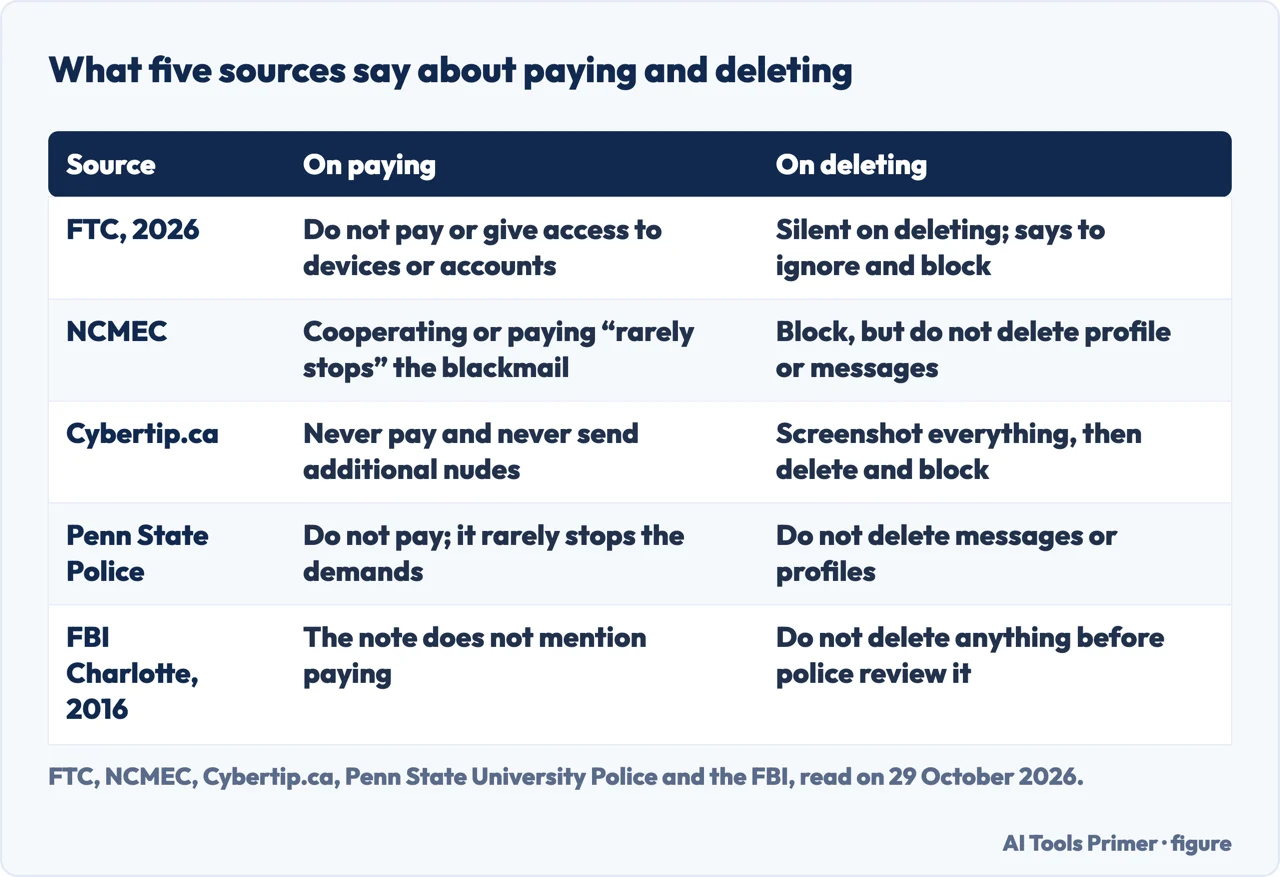
The five sources that give steps overlap on a core. The FTC’s 2026 alert says to ignore and block the blackmailer, not to pay or give access to your devices or financial accounts, to talk with someone you trust, and to report to your local police and to the FBI (fbi.gov, 1-800-225-5324). If a minor is involved, it says to report through NCMEC’s CyberTipline. Penn State’s steps are to stop all communication, not to pay, to document usernames, profile links and contact information, and to report to the police, to the FBI’s Internet Crime Complaint Center at ic3.gov and to NCMEC at cybertipline.org or 1-800-THE-LOST.
NCMEC’s advice is to get help before deciding whether to pay money or otherwise comply with the blackmailer, to report the account through the platform’s safety feature, and to block the suspect without deleting your profile or messages, because that can help in stopping the blackmailer. Cybertip.ca tells young people to stop talking to the sextorter immediately and screenshot every message, and says that if money has already been sent, to check whether it has been collected and to cancel the payment quickly if it has not. Cybertip.ca forwards every sextortion report to police, and says it often contacts services such as Instagram and Snapchat to get the sextorters’ accounts disabled.
The sources differ on deleting, as the figure shows. NCMEC, Penn State and the FBI note say not to delete messages or profiles, and the FBI adds that nothing should be deleted before law enforcement can review it. Cybertip.ca says “delete and block the sextorter” while also telling the reader to screenshot everything first. The pages we read do not reconcile the two.
Two things the pages say about blame. NCMEC and Penn State both say the blackmailer is to blame, not you, even if you made a choice you regret. The FBI note says it is not a crime for a child to send sexually explicit images to someone if compelled to do so, and that the FBI does not treat a child as an offender in the production of child pornography as a result of sextortion or coercion. It adds that children typically have to come forward to a parent, teacher, caregiver or law enforcement for the victimization to stop, and that embarrassment is what usually prevents it.
If the person is known, the advice shifts. In the UNICEF interview, Dr. Seto says that with a stranger the advice might be to block them and lock down security, but that blocking is less helpful with somebody the young person knows, because it does not change the fact that they can still talk to each other in person. The interview does not offer one solution; it describes parents establishing a connection with the child so they can find out what is going on, which may mean going to law enforcement or the child’s school. It says many teens do not tell their parents because they expect to lose the phone or the platform.
Getting images down, and the paid help
The FTC’s 2026 alert says that if someone shared your intimate images without your permission, you should report it directly to the platform. The Take It Down Act, it says, requires online platforms to remove intimate images within 48 hours of your request, for free; if a platform does not, report it to the FTC at TakeItDown.ftc.gov. UNICEF’s interview is more cautious about the result: if images go out into the wild, Dr. Seto says, they are hard to get rid of because people can make infinite copies of a digital file.
Take It Down, a free service from NCMEC, is aimed at nude, partially nude or sexually explicit images or videos taken before the person turned 18. It is anonymous, and the image does not leave your device: the service creates a hash, a digital fingerprint, and only that is provided to NCMEC. It works on public or unencrypted platforms that have agreed to take part, and NCMEC asks people not to share the images on social media after submitting them, since they could be flagged. Its page says plainly that online platforms may have limited capabilities to remove content already posted in the past. For explicit images from the age of 18 or older, it points to stopncii.org. NCMEC’s blog also says that reporting to its CyberTipline gives the option of being connected with a person who keeps you updated on the takedown request and refers you to counseling, legal guidance and peer support.
The same FTC alert warns about paid help. People searching for it may find companies offering quick fixes for a price that do not deliver. The FTC’s lawsuit, it says, alleges that Digital Forensics, behind websites such as BlackmailHelpline.com, DigitalForensics.com, CyberBlackmail911.com and SecurityBreach911.com, falsely promised to stop sextortion threats, prevent explicit material from spreading online and report the perpetrators to criminal authorities, and charged customers thousands of dollars. That is an allegation, not a ruling. The FTC’s advice is to check any company that claims to remove images for a fee by searching its name with words like “scam,” “review” or “complaint” and to scroll past the paid search results. Our page on getting rid of blackmailers covers the paid “assistance” companies and the 48-hour removal at more length.
For support, the FTC lists the National Center for Missing and Exploited Children at 1-800-843-5678 for minors and the National Domestic Violence Hotline at 1-800-799-7233 for adults.
Where to start
Four ways in.
- “What does the word mean?”
- What the word covers — meaning
- “I got the webcam email.”
- The email that says it recorded you — email
- “Will they really send it?”
- Do they follow through? — follow
- “What do I do now?”
- The steps the sources give — todo
Other doors for the same trick
Email, calls and texts each have a page.
When someone holds an image
The general blackmail page, for when someone holds an image.
Questions people also ask
What is sextortion?
The FBI calls it a type of online sexual exploitation in which individuals coerce victims into providing explicit images or videos, often under threats to post them or send them to friends and family. Cybertip.ca says it is blackmail; the FTC says it is a threat to share intimate images unless you pay.
Do sextortionists follow through on their threats?
The pages we read do not say how often. The FTC calls the webcam claims in a mass email “all talk”, while NCMEC and Cybertip.ca say paying or responding rarely stops the blackmail or makes the harassment worse.
What should you do if you are being sextorted?
The FTC says to ignore and block the blackmailer, not to pay or give access to devices or accounts, to talk with someone you trust, and to report to the police and the FBI. Cybertip.ca and Penn State add keeping screenshots or records; NCMEC and the FBI say not to delete messages.
Can sextortion images be removed from the internet?
UNICEF says it is hard because digital files can be copied without limit. The FTC says the Take It Down Act requires platforms to remove intimate images within 48 hours of a request, and NCMEC’s Take It Down service covers images taken before age 18.
Not covered here. We tested nothing on a device. The statements come from the FBI Charlotte field office (2016), UNICEF, Penn State University Police, Cybertip.ca, the FTC (2026 and 2020), three NCMEC pages and the Take It Down service, all read on 29 October 2026. Most of them are written for parents and young people in the United States or Canada, and so are the reporting routes.
The FBI’s current sextortion page returned only a short notice to our reader, so we cited its 2016 note instead. The NCMEC table of reports by year did not come through in the text we could read, so we did not use it.
The search volume and difficulty behind this page come from a Semrush reading of 29 August 2026, older than the 60 days the site normally allows.
Sources
- FBI Charlotte — Sextortion Affecting Thousands of U.S. Children (20 June 2016) — www.fbi.gov, read 29 October 2026.
- UNICEF — What is sextortion? — www.unicef.org, read 29 October 2026.
- Penn State University Police — Sexual Extortion (Sextortion) — www.police.psu.edu, read 29 October 2026.
- Cybertip.ca — Online Harms: Sextortion — cybertip.ca, read 29 October 2026.
- FTC — How to avoid deceptive sextortion assistance services and find real help (13 October 2026) — consumer.ftc.gov, read 29 October 2026.
- FTC — Scam emails demand Bitcoin, threaten blackmail (29 April 2020) — consumer.ftc.gov, read 29 October 2026.
- NCMEC — Sextortion — www.missingkids.org, read 29 October 2026.
- NCMEC — NCMEC Releases New Sextortion Data (25 June 2026) — www.missingkids.org, read 29 October 2026.
- NCMEC — Can You Remove Nudes from the Internet? (23 July 2025) — www.missingkids.org, read 29 October 2026.
- NCMEC — Take It Down — takeitdown.ncmec.org, read 29 October 2026.
Written by Alberto Gulotta
Founder and editor of AI Tools Primer, writing from Palermo, Italy. Thirty-five years of taking computers apart, starting with a Commodore 64 — the long version is on the about page.
Something wrong on this page? Write to aitoolsprimer@gmail.com and it gets fixed.
Written on 29 October 2026.
Independence and limits
No affiliate links and no paid placements anywhere on this site. Nobody pays to appear here, and no company has seen this page before you did.
This is general information, not professional advice. Where a page touches money, health, safety or the law, it names its source and the date it was read — and your situation may still differ. See the privacy page and the cookie policy.