
Footprint · guide
Paid data removal services: what one study found
By Alberto Gulotta · Updated · 18 min read
Data removal services are subscriptions that scan people-search sites and data brokers for your personal details and send removal requests on your behalf. The one independent test we read, by Consumer Reports, found 35% of profiles gone after four months, against about 70% for opting out by hand. We add what four vendors say and the free routes.
| Question | Answer | Where it comes from |
|---|---|---|
| What does a service do? | Scans people-search sites and data brokers for your details and sends removal requests for you | Consumer Reports, Marketplace, vendor pages |
| How well did the one independent test find they work? | 35% of 332 profiles were gone after four months; opting out by hand removed about 70% | Consumer Reports |
| Which did best? | Optery’s Ultimate Tier at 68% and EasyOptOuts at 65% after four months | Consumer Reports |
| What did the seven tested services cost? | From $19.99 to $249 a year, at July 2024 prices | Consumer Reports |
| Is there a free route? | Yes: opting out site by site, and for California residents the DROP request | FTC, CalPrivacy |
| Does an opt-out erase public records? | No: the FTC says it does not delete your information from public records | FTC |
What a removal service does, and what it does not touch
In this page a removal service means a paid subscription that tries to take personal data off the internet, not a hauling company. Consumer Reports calls people-search sites one type of data broker, a company that specializes in collecting personal data and selling it to third parties. It says the profiles can include home and email addresses, phone numbers, educational and employment histories, lists of purported relatives and properties, and court proceedings, with out-of-date information often mixed in with current. The FTC describes the same sites as collecting information from a variety of sources, compiling it into a report and selling the report to anyone willing to pay.
Yael Grauer of Consumer Reports told Marketplace that these companies sell opt-out services and say they will find your information on those sites and get it removed on your behalf. She added that some ask for a copy of your ID and places you have lived. The vendors describe the same routine. Incogni’s page says it scans people-search sites, sends removal requests when it finds records, then re-scans and sends fresh waves regularly; to start it asks for your name, email address and home address, and an online form that authorizes it to act for you. Optery’s page lists monthly scans and removals on its Core plan. DeleteMe’s page says its team searches data brokers and people-search sites, submits opt-out requests and removes your information regularly. These are the vendors’ own descriptions.
The target is the broker or people-search site, not Google and not the public record. DeleteMe’s help page says it cannot delete Google results without first removing the source, because Google is a directory and the page has to come down at the original website; for a page that has already changed, it points to Google’s URL removal tool. The FTC adds that opting out of people-search sites does not delete your information from public records. Google’s own tool for personal contact details has its own page here.
What the one independent test found
The test we read is Consumer Reports’ report Data Defense, run with the digital safety organization Tall Poppy between May and September 2023. It used 32 volunteers from California and New York, recruited from Community Reports, seven services (Confidently, DeleteMe, EasyOptOuts, IDX, Kanary, Optery and ReputationDefender) and 13 people-search sites. Each service was assigned to four volunteers, one from each of four groups of eight: New York owners, New York renters, California owners and California renters. The eighth volunteer in each group was opted out by hand at all 13 sites, as a baseline. Consumer Reports checked the sites one week, one month and four months after sign-up.
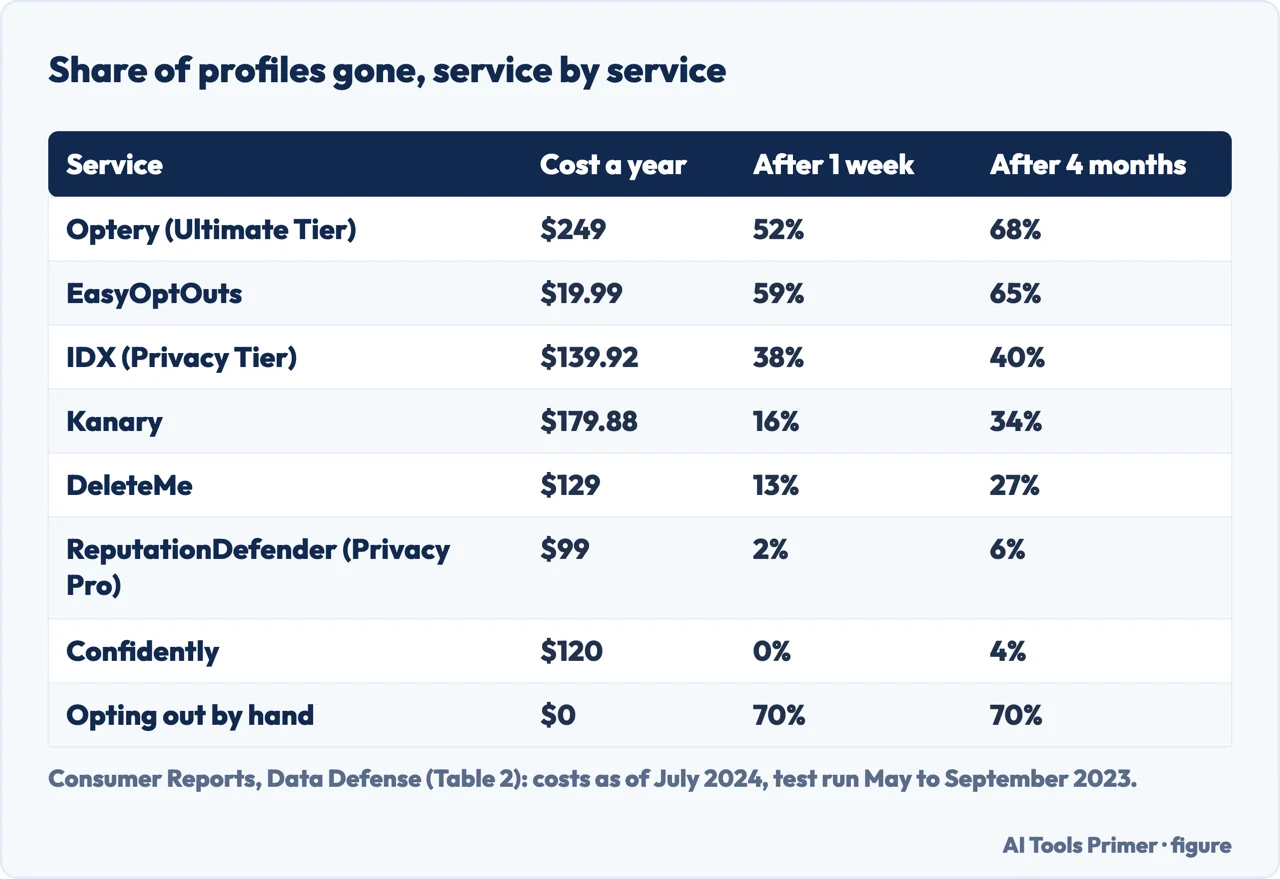
It found 332 instances of information about the 28 volunteers who were given a service. Of these, 117, or 35%, were gone within four months: 86 (26%) within a week and 100 (30%) within a month. Consumer Reports says that at every check some information about each participant was still on some of the 13 sites. It names EasyOptOuts and Optery as the best performers, DeleteMe, IDX and Kanary as midlevel and Confidently and ReputationDefender as the worst. The table below gives each service’s price and result.
For the four volunteers opted out by hand, Consumer Reports found 47 profiles. Thirty-three were gone after the first week, three more after the first month and no more by four months, a success rate it puts at about 70%. It concludes that not even the time-consuming work of filling out opt-out forms is likely to clear the profile data completely. Counting the manual group too, it found 379 instances and 150 removals: 119, almost 80%, within a week, 14 more within a month and 17 more by four months.
The sites differed. Services had the most trouble with CheckPeople (16% removed after four months), PublicDataUSA (19%) and Intelius (20%), and did best with PeopleFinders (66%), ClustrMaps (59%) and ThatsThem (58%). Renters and owners differed little in Consumer Reports’ view: 40% of New York owners’ profiles were removed against 46% of renters’, and 34% of California owners’ against 38% of renters’. The Record reports that 6% more New York volunteers saw data removed than California volunteers; Consumer Reports’ table gives four groups, and we did not recompute that gap.
The report lists its limits. The sample was small and not random, so Consumer Reports does not consider the results statistically significant or nationally representative. The services received only a name, a current address and a date of birth, not previous addresses, relatives’ names or a driver’s license, and the report says some services leave information online when they are unsure it is yours, so more detail might have helped. The volunteers did not check dashboards or answer follow-up questions, and Consumer Reports did not recheck profiles that were gone for reappearance. ReputationDefender’s chief executive told Consumer Reports that its executive services, which cost upward of $1,000 a year, are more comprehensive than the $99 Privacy Pro tier tested, and a Confidently spokesperson said the company had shifted its focus to corporate customers.
This is a single test. The Record, Marketplace and Ars Technica report Consumer Reports’ numbers, and the pages we read include no second independent test. The test ran in 2023 and the prices are from July 2024; the pages we read do not say whether current services do better.
What four services charge and claim, as their pages read in October 2026
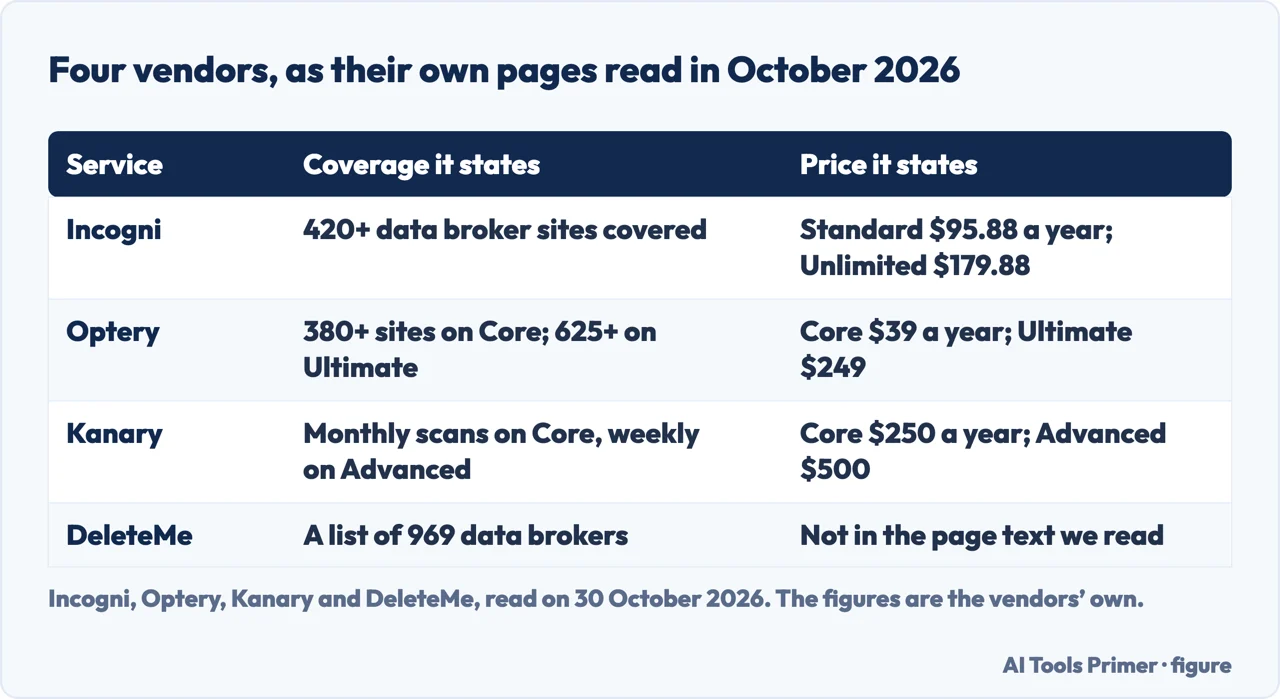
These figures are the vendors’, read on 30 October 2026, and the pages we read include no outside check of them beyond the Deloitte verification that Incogni says it has. Incogni lists Standard at $7.99 a month, $95.88 billed annually, and Unlimited at $14.99 a month, $179.88 billed annually; Unlimited adds unlimited custom removal requests, an Exposure Scanner, a Privacy Score and live phone support. Both plans list 420+ data broker sites covered and a 30-day money-back guarantee. The page says Deloitte independently verified the removals from 420+ brokers; we read no Deloitte report. Incogni’s about page says it is owned by Surfshark and covers US, EU and Canadian data brokers.
Optery lists a free Basic plan for self-service opt-outs, Core at $3.99 a month or $39 billed yearly, Extended at $149 a year and Ultimate at $249 a year. Automated removals are listed from 380+ sites on Core (150+ without its Expanded Reach setting), 555+ on Extended (330+) and 625+ on Ultimate (395+). Core is fully automated with no human Privacy Agent; Extended adds one and a removals report with screenshots about every 90 days; Ultimate adds unlimited custom removal requests for 940+ sites in total, after 30 days. Kanary lists Core at $250 a year per account, with monthly scans and removal requests, and Advanced at $500, with weekly scans and requests; family members are half price. Its page is aimed at people who need to manage doxxing, impersonation, phishing or physical risk, and our page on doxxing covers that situation.
DeleteMe’s plans page loads its prices by script, so the text we read has no current price. The last price we can source is Consumer Reports’ July 2024 figure of $129 a year for one person, or $209 for two years. The page lists plans for one person, two people and a family of four, says they are for U.S. residents only and renew automatically unless canceled, and says every plan includes quarterly privacy reports. It also advertises an average of 15 public Google-able listings removed within days, which is DeleteMe’s claim.
The site counts cannot be compared. Incogni says 420+, Optery 625+ or 395+, DeleteMe a list of 969 data brokers updated on 17 September 2026, and Consumer Reports reported 1,000-plus sites scanned for Kanary in 2024. DeleteMe’s own page asks whether list size is the best measure of a removal service and answers: not always. Consumer Reports says EasyOptOuts removes data from 134 brokers directly and 42 indirectly, and that ReputationDefender names more than 900 brokers but covers about 50 sites at the $99 tier. The test used 13 sites, whatever each service advertised. We did not read EasyOptOuts’ own site: its $19.99 a year and its removals every four months come from Consumer Reports, and Marketplace’s transcript gives $19.95. Consumer Reports’ Kanary price also differs, $179.88 in the table and $179.98 in the appendix.
Kanary’s page says sites have 90 days under US privacy legislation to respond, that members who check in for five minutes a month see 90-95% removal rates in 90-120 days, and that a “set it and forget it” member averages 60-80%. Those are Kanary’s statements. Consumer Reports measured 34% for Kanary at four months with no intervention from its volunteers, at a different price and period, so the two are not like for like.
The fine print and the conflicts
Consumer Reports found that some removal services advertise on, or partner with, people-search sites. After it removed one volunteer’s data from ClustrMaps it saw an ad for the removal service Onerep, and after an opt-out request PeopleFinders recommended its partner BrandYourself. The report says it sees this as an implicit endorsement of the people-search ecosystem; in the Consumer Reports article Grauer adds that at worst it is a perverse incentive to keep the system running. Ars Technica adds that Mozilla dropped OneRep as the provider for its Mozilla Monitor Plus bundle after Brian Krebs reported that OneRep’s chief executive had ties to the people-search industry.
The report also read the vendors’ privacy policies as of July 2024. It says the policies of DeleteMe, IDX’s owner ZeroFox, Optery and ReputationDefender allow subscribers’ data to be transferred in a merger, acquisition or sale of assets, and that some privacy-minded subscribers might not want that. Optery says users get at least 30 days to delete an account before such a transaction closes. Consumer Reports also reports that IDX’s link for verifying email addresses did not support HTTPS when it evaluated the service.
Signing up has conditions. Optery, Incogni and Kanary each list a 30-day money-back guarantee, Kanary’s on the first month and Optery’s for individual accounts only; DeleteMe lists a satisfaction guarantee. Grauer told Marketplace that services may ask for a copy of your ID or places you have lived, and the FTC says that whether you opt out yourself or use a service, you may have to give some information to verify your identity.
The work you can do yourself, and the free routes
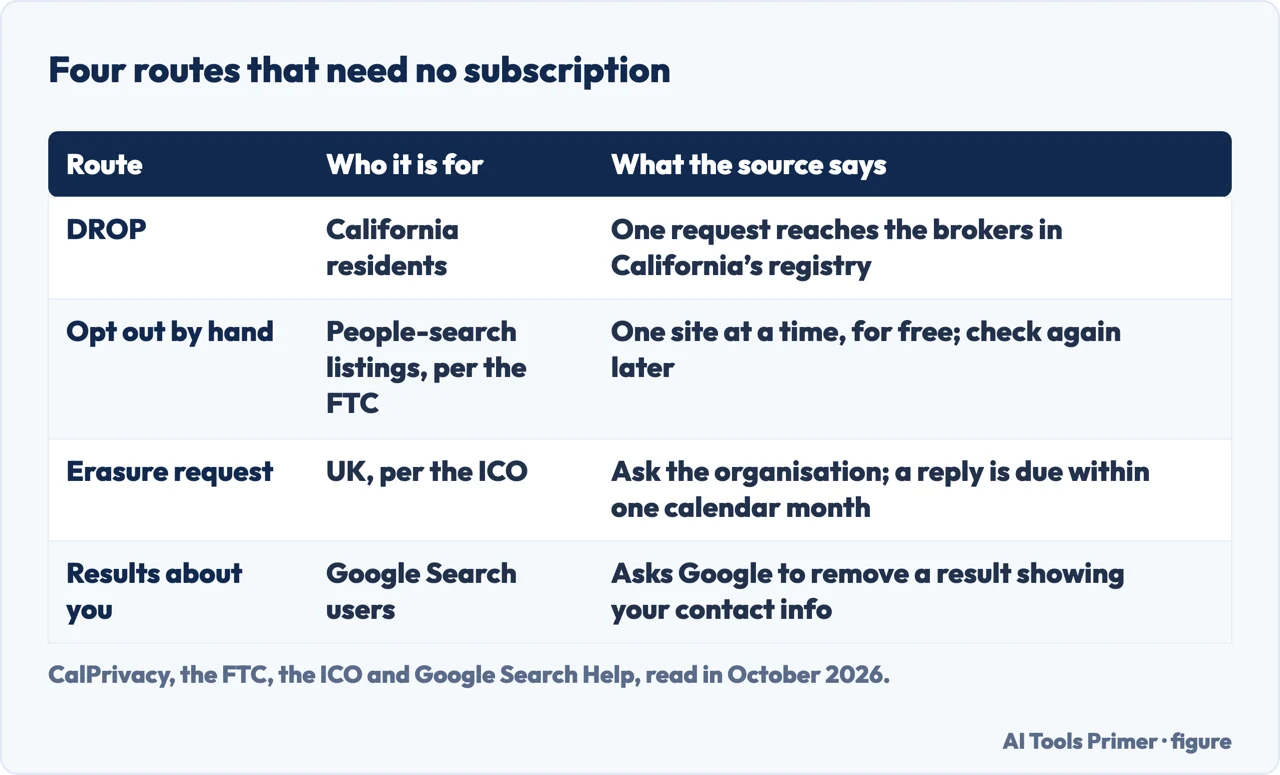
The FTC gives two ways to opt out: do it on your own, one site at a time, for free, or pay a service. Its steps are to search for your name or other identifying details, starting with a phone number or address; look for an opt-out link in any report that shows your information; search for the site’s name with phrases such as “opt out” if you cannot find one; repeat the steps site by site; and check again periodically, filing a new request if something new appears. Its limits are that your information may still appear in the reports of relatives, neighbors or associates, that it can reappear if your public records change, and that some information, such as sex offender status, cannot be opted out. The article is from July 2022.
Consumer Reports’ article of 8 August 2024 says opting out manually is likely the most effective and least expensive approach, takes from several hours to several days, and that much of what you delete may eventually reappear, so privacy experts suggest treating it as a twice-a-year task. Grauer keeps a list of more than 50 data brokers with opt-out links, 22 of them marked high-priority, and suggests notes on where you left off, grouping similar opt-outs and blacking out a license or Social Security number before sending ID. Grauer also told Marketplace that a service might not opt you out of everything, so it helps to check what is still out there, and that you can tell a service your information is still online. Before you sign up, the FTC says to find out how many websites a service covers, whether it will give you a report of the sites it has opted you out of, and how often it will scan and delete information that has reappeared.
California residents have a free route. Under the Delete Act, passed in 2023, CalPrivacy built DROP, which it says lets residents ask more than 600 data brokers to delete their data in one request. It launched in January 2026 and brokers began processing requests in August 2026. A request needs a name, date of birth and ZIP code, residency is checked through the California Identity Gateway, and you receive an 8-digit DROP ID. CalPrivacy says brokers have up to 90 days to report and must re-check and delete new matching data at least every 45 days. First-party data, exempted data and publicly available data are not deleted. EFF adds that DROP does not stop companies that are not registered data brokers, such as Google, and does not end future collection. EFF and Privacy Rights Clearinghouse found, in April 2025 data, 291 companies registered as brokers in another state but not in California, and say brokers that registered nowhere are not counted. Our page on data broker opt-outs walks through DROP.
Elsewhere the picture is thinner. Consumer Reports says no federal law gives a right to opt out of people-search sites and that some state laws exempt public information. EFF says DROP only works for California residents. In the UK, the ICO says you can ask an organisation to delete your data verbally or in writing, gives a letter template, and says the organisation has one calendar month to respond, with up to two more months in certain circumstances. Article 17 of the GDPR sets out the right to erasure, which our page on the right to be forgotten explains. The pages we read do not say whether DROP makes a paid service unnecessary for a Californian; EFF says only what DROP covers and what it leaves out.
The sources give no ranking of the three routes, only their trade-offs. Consumer Reports’ article says doing the work yourself is more effective than any of the seven services it tested, but costs hours to days and has to be repeated about twice a year. Grauer told Marketplace that a service might not opt you out of everything, and that people often opt out by hand and also sign up for a service, then tell the service when their information is still online. The FTC’s questions about coverage, reports and rescans are the check to run before paying.
What we did not use
We tested nothing: we signed up for no service and sent no request to any broker or to DROP. We did not read EasyOptOuts’, Confidently’s, IDX’s or ReputationDefender’s own pages, so what this page says about them comes from Consumer Reports. We read no Deloitte report. The pages we read do not say how many subscribers get their data removed after a year, how any service handles data that comes back, or how current services compare on price in an independent test.
Where to start
Four ways in.
- “Do they work?”
- What the one independent test found — test
- “What do they cost?”
- What four services charge and claim — prices
- “What is the catch?”
- The fine print and the conflicts — fineprint
- “Can I do it myself?”
- The work you can do yourself — yourself
Getting it removed
Brokers, search results and legal rights.
Beyond the subscription
Harassment and paid protection.
Questions people also ask
What is the minimum charge for junk removal?
The pages we read are about services that remove personal data and give no junk removal charge. For data removal, the lowest annual price in the Consumer Reports table is $19.99, for EasyOptOuts, at July 2024 prices.
What's the average cost for got junk removal?
The pages we read do not cover 1-800-GOT-JUNK? or any hauling company, and they give no average for data removal. The seven services in the Consumer Reports table ranged from $19.99 to $249 a year.
What is the most trusted moving company?
The pages we read do not rank moving companies. For data removal services, Consumer Reports says Optery and EasyOptOuts performed the best of the seven it tested, at 68% and 65% of profiles removed after four months.
What items will junk removal services not take?
The pages we read list no items for a hauler. For personal data, the FTC says opting out does not delete public records, and CalPrivacy says DROP does not delete first-party data, exempted data or publicly available data.
Not covered here. We tested nothing on a service. The statements come from Consumer Reports, The Record, Marketplace, Ars Technica, the FTC, CalPrivacy, EFF, the ICO, Google and the pages of Incogni, Optery, Kanary and DeleteMe, all read on 30 October 2026.
The search volume and difficulty behind this page come from a Semrush reading of 29 August 2026, which expired on 28 October 2026, past the 60 days the site normally allows, and is used with the owner’s authorisation until it is read again.
Sources
- Consumer Reports — Data Defense: Evaluating People-Search Site Removal Services (report) — innovation.consumerreports.org, read 30 October 2026.
- Consumer Reports — Services That Delete Your Data From People-Search Sites — www.consumerreports.org, read 30 October 2026.
- The Record — Consumer Reports study finds data removal services are often ineffective — therecord.media, read 30 October 2026.
- Marketplace — Do paid data-removal services pay off? — www.marketplace.org, read 30 October 2026.
- Ars Technica — It’s not worth paying to be removed from people-finder sites, study says — arstechnica.com, read 30 October 2026.
- FTC — What To Know About People Search Sites That Sell Your Information — consumer.ftc.gov, read 30 October 2026.
- CalPrivacy — How DROP works — privacy.ca.gov, read 30 October 2026.
- CalPrivacy — About DROP and the Delete Act — privacy.ca.gov, read 30 October 2026.
- EFF — Protect Your Privacy with California’s DROP Tool — www.eff.org, read 30 October 2026.
- EFF — Why Are Hundreds of Data Brokers Not Registering with States? — www.eff.org, read 30 October 2026.
- ICO — Your right to get your data deleted — ico.org.uk, read 30 October 2026.
- Google Search Help — Find and remove personal info in Google Search results — support.google.com, read 30 October 2026.
- GDPR-info.eu — Art. 17 GDPR, Right to erasure — gdpr-info.eu, read 30 October 2026.
- Incogni — home page and about page — incogni.com, read 30 October 2026.
- Optery — Pricing — www.optery.com, read 30 October 2026.
- Kanary — home page and pricing — www.kanary.com, read 30 October 2026.
- DeleteMe — Privacy Protection Plans, Sites We Remove From and help article — joindeleteme.com, read 30 October 2026.
Written by Alberto Gulotta
Founder and editor of AI Tools Primer, writing from Palermo, Italy. Thirty-five years of taking computers apart, starting with a Commodore 64 — the long version is on the about page.
Something wrong on this page? Write to aitoolsprimer@gmail.com and it gets fixed.
Written on 30 October 2026.
Independence and limits
No affiliate links and no paid placements anywhere on this site. Nobody pays to appear here, and no company has seen this page before you did.
This is general information, not professional advice. Where a page touches money, health, safety or the law, it names its source and the date it was read — and your situation may still differ. See the privacy page and the cookie policy.