
Scams · guide
Pig butchering scam: what ten agency and news pages describe
By Alberto Gulotta · Updated · 16 min read
A pig butchering scam starts with a message from a stranger and ends with a withdrawal that is refused. In between, the pages we read from the FTC, CFTC, FINRA, the Justice Department and others describe trust, a fake trading site, small early withdrawals and then fees.
| Question | Answer | Where it comes from |
|---|---|---|
| Where does the name come from? | Nextgov, FINRA and the FDIC inspector general give the image of fattening a pig before slaughter; the CFTC says the perpetrators use the name | Nextgov, FINRA, FDIC OIG, CFTC |
| How does it start? | An unrequested text, a social media message or a dating app, then a move to a chat app | FDIC OIG, FINRA, Secret Service |
| What does the victim see? | A site that looks real, with growth reports that are fake | FTC, FINRA, DOJ |
| What happens at withdrawal? | A refusal, a frozen account, or a demand for fees, a tax or a penalty | CFTC, FINRA, FDIC OIG, DOJ |
| Can a crypto payment be reversed? | The FTC says such payments typically are not reversible | FTC |
| What do the pages say to do after paying? | Tell the exchange or the bank at once, then report to the FTC, the IC3 or both | FTC, FDIC OIG, DOJ |
The name, and who uses it
Nextgov, in a report of 13 February 2025, says the name comes from the analogy of fattening a pig before slaughter, with scammers fattening their victims on false promises. The FDIC Office of Inspector General gives the same image and calls the scheme a confidence and investment fraud in which the victim is gradually lured into making increasing contributions, generally in the form of cryptocurrency, before the scammer disappears with the money. FINRA, in an article of December 2022, also says the name refers to fattening a pig before slaughter.
The CFTC puts the name in other mouths. It writes of relationship investment scams, called pig butchering by the perpetrators, and says they use dating apps, social media platforms, messaging apps and even random “wrong number” text messages to target possible victims. The Secret Service calls it one of the most common categories of cryptocurrency investment fraud, describes it as a billion-dollar industry that has victimized millions of Americans, and gives no year for that figure. The two FTC pages we read on crypto and investment scams do not use the phrase, but they describe the same pattern: contact on social media or a dating app, a website that looks real, and money that cannot be withdrawn.
Nextgov adds figures. It reports that the FBI had notified over 4,300 victims since launching an initiative, called Level Up, the year before; that around 76% of them were not aware they were being scammed; and that over $285 million was saved in the notification efforts. It also reports that the blockchain analysis company Chainalysis said scammers received at least $9.9 billion in stolen crypto the previous year, notably through sham, high-yield investment opportunities.
How it starts, and why it feels like a friendship
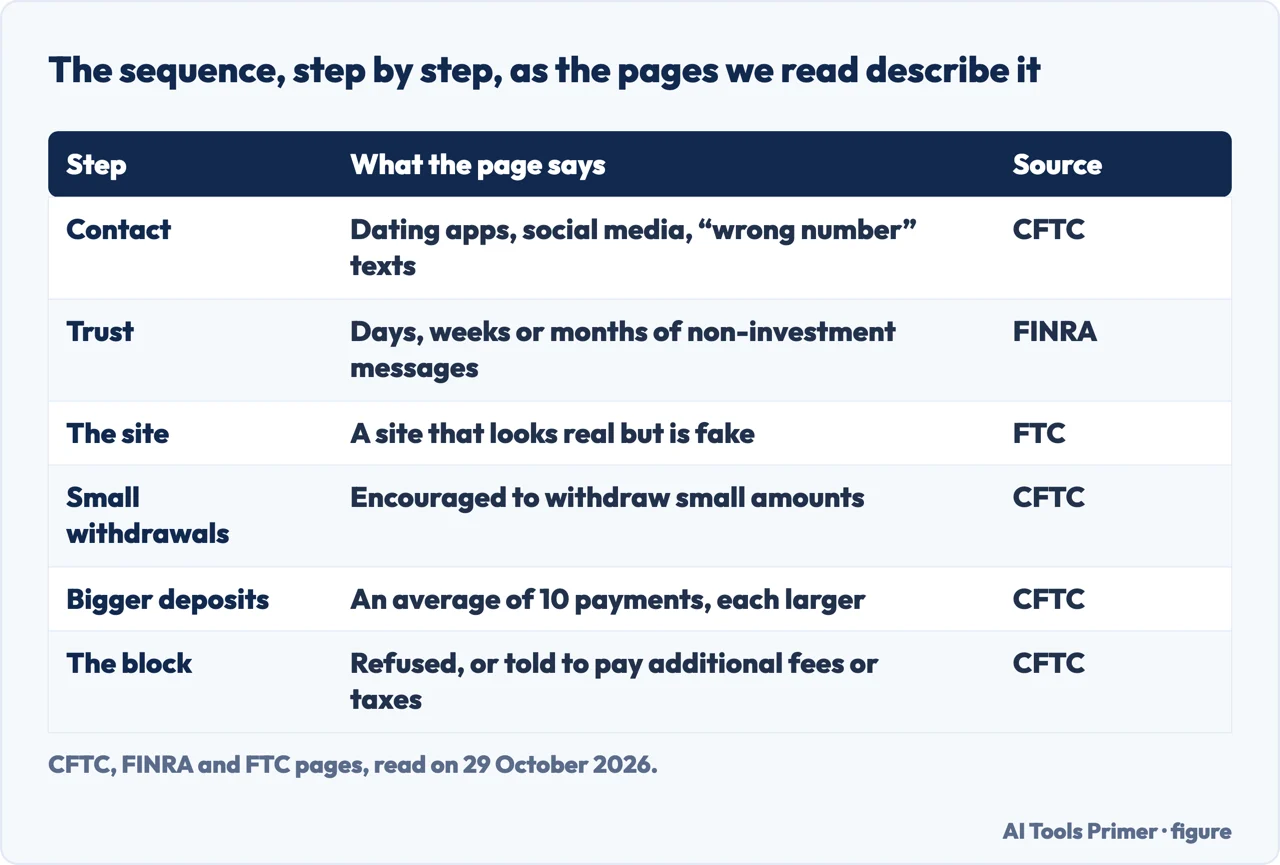
The FDIC inspector general says the perpetrators might contact you randomly by text message, dating app or social media platform, and then later switch to VOIP chat applications. They try to develop a meaningful relationship, gain your trust and offer a high-yield investment in virtual assets such as cryptocurrency. FINRA describes a stranger who writes out of the blue by text, on social media or on a messaging application such as WhatsApp or WeChat. The stranger might give an unusual explanation for the contact, such as having found your name in their contacts list, and often has an online profile with fake but realistic-looking photos.
FINRA says the messages that follow, over days, weeks or even months, are about personal topics that have nothing to do with investing. The fraudster might send pictures, talk about volunteering to show good character, or share invented life details that mirror yours, and might claim to be a widow, a single parent or a member of the US military living overseas. In the process the fraudster also seeks information to use later. Eventually the conversation turns to investing, often with a question about whether you have an investment or crypto account.
The pages differ on what the relationship looks like. The Secret Service stresses a fictitious romantic relationship: the schemes typically begin with a victim meeting someone on an online dating website, or with a random unsolicited message that eventually appears to turn romantic. FINRA says the stranger might come across as wanting a genuine friendship or a romantic relationship. The Justice Department release of 18 December 2025 says court filings describe criminals building trust through a business or romantic relationship, starting with a text message or an unsolicited message to a social media account or dating profile; in its examples the victims believed they were in a romantic relationship and wrote on WhatsApp and Telegram. The FTC adds that investment scams can also start with an unexpected text, email or call.
Two warning signs recur. The Secret Service lists friends or romantic partners met online who can seemingly never meet in person and avoid showing themselves on video calls, and FINRA lists a refusal to join video chats. The FTC gives a rule for dating: never mix online dating and investment advice, and a contact from a dating site or app who wants to show you how to invest in crypto, or asks you to send crypto, is a scam. The CFTC says people who live alone or spend a lot of time on social media or in discussion groups tend to be more vulnerable, and that awareness about specific scams can reduce victimization by up to 85 percent, citing a 2023 study. The Secret Service and the FDIC inspector general both tell victims not to be embarrassed.
The fake platform and the small withdrawals
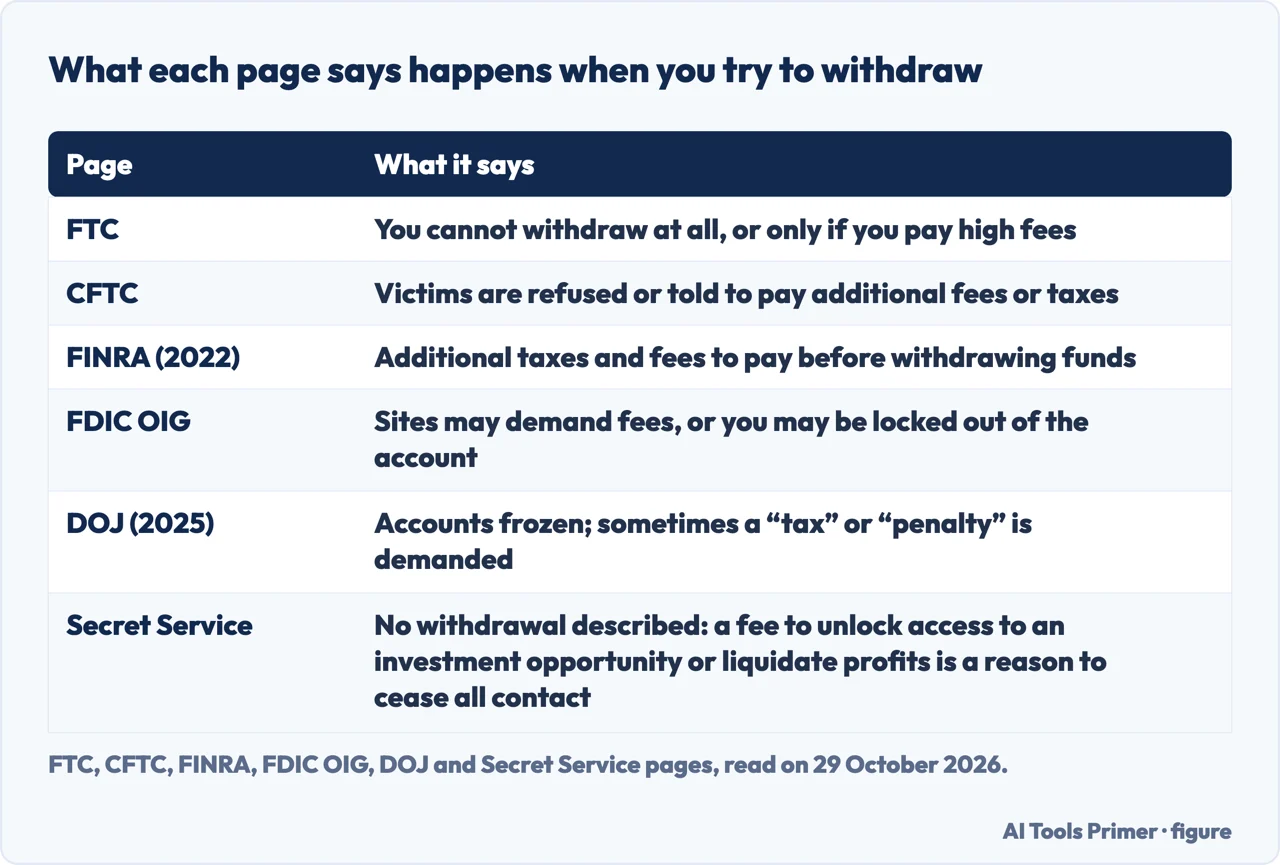
The CFTC says the new online friends claim to have made a lot of money trading cryptocurrency, precious metals or foreign currency, thanks to special knowledge or insider help, and then direct their targets to fraudulent trading platforms operated by the same organized criminal gangs. Victims are told to convert their dollars to cryptocurrency and send it to the scam website, where they see their balances grow substantially. The FTC describes a so-called investment manager who promises to grow your money if you buy crypto and transfer it into an online account; the website looks real, but it is fake, and you will not be able to withdraw at all, or only if you pay high fees.
The pages agree that what the victim sees on screen is made up. The FTC says you will see fake reports of how much your money is growing, and that once you have given money the scammers shut down the accounts and disappear. FINRA describes a falsified dashboard showing assets growing exponentially, and the Justice Department says the fake platforms displayed fabricated portfolios with abnormally large returns to entice victims to invest more. Nextgov quotes an FBI official who told reporters that victims may initially purchase crypto but the funds are immediately stolen and moved offshore, and that the victims are then shown fake account statements, often through apps or websites that mimic legitimate brokerages. The same official is quoted as saying the cryptocurrency is only the pitch.
Not every version involves crypto. FINRA describes a stock scenario in which the fraudster says a connection at a reputable financial institution gives lucrative advice, sends screenshots of an alleged brokerage account, asks you to confirm that your account can trade the security, and then gives the company, the quantity and the price, claiming the order must be placed immediately. FINRA adds that you might be using your own accounts and your own funds while the fraudster manipulates your decisions.
The small withdrawals are where the pages split. The CFTC says victims are encouraged to withdraw small amounts of money to spend on themselves, which it calls another ploy to build trust, and cites research that victims transfer an average of 10 payments, each larger than the last, until they are financially drained. FINRA says the schemes often start with solicitations of modest investments meant to bolster your confidence. The Secret Service and FINRA both speak of impressive gains from initial investments and of urging increasingly larger amounts, and the Secret Service page speaks of those gains rather than of withdrawals. For checking a promoter, the FTC points to Investor.gov, the Secret Service to the websites of federal and state regulators, and FINRA to its BrokerCheck tool.
The fee, the tax and the recovery offer
When the victim tries to take money out, the pages describe a block with several names. The Justice Department says the fraudsters refused and froze the accounts, and in some cases demanded a “tax” or “penalty” before the victims could reach their money. FINRA says the stranger might cite additional taxes and fees that you must pay before withdrawing your funds, especially in crypto. The FDIC inspector general says websites may demand additional fees, or you may be locked out of the account and never hear back. The CFTC says victims are refused or told they must pay additional fees or taxes. The Secret Service does not name the block; it says that anyone who claims you need to pay a fee or provide identifying documents to unlock access or liquidate profits is a reason to cease all communications.
The Justice Department list of precautions says that if you have already invested and believe you may be a victim, you should not pay any additional fees or taxes to withdraw your money, and it adds that you should cap your losses. It also says not to pay for services that claim to recover lost funds, and it calls that a trap.
The recovery offer is a second layer. The Justice Department says some fraudsters posed as a “cryptocurrency recovery firm” and offered to retrieve lost investments for an upfront fee. FINRA says a stranger confronted about the losses might express empathy and offer to help recover the money, perhaps by persuading you to invest in another stock. The FTC wrote in November 2022, after the failure of a crypto exchange, about recovery services in general: it says scammers impersonate the government, a company or another organization, tell you to pay a fee or give your financial information, and that if you do either your money will be gone. The FTC says that is not how government agencies work, and suggests that anyone still tempted search for the name online with words like complaint, scam or review. The Secret Service and FDIC OIG pages do not mention paid recovery, and the FDIC OIG and Nextgov pages do not mention taxes.
If money has already been sent
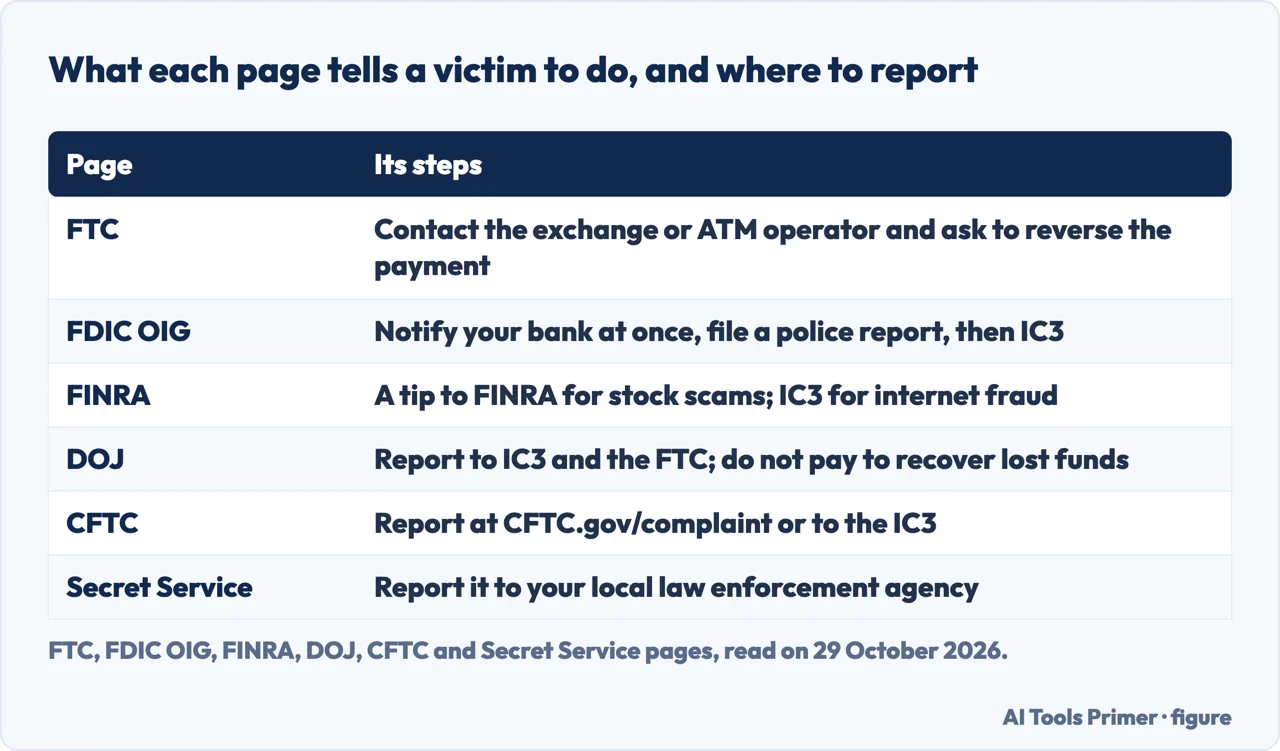
The FTC says cryptocurrency payments typically are not reversible, and that once you pay with crypto you can usually only get your money back if the person you paid sends it back. Its page on what to do if you were scammed, dated June 2026, says to contact the exchange or the cryptocurrency ATM operator immediately, tell them it was a fraudulent transaction and ask them to reverse it and refund your money, and then to report it to federal law enforcement at ReportFraud.ftc.gov. The same page says crypto payments lack the legal protections of credit and debit cards, so it can be hard to get money back, and that some states have passed laws that might help. The pages we read do not say how often an exchange agrees to reverse a payment.
The pages point to different places. The FTC lists the FTC, the CFTC at CFTC.gov/complaint, the SEC at sec.gov/tcr, the Internet Crime Complaint Center (IC3) and the exchange you used. The FDIC inspector general says to notify your bank immediately, file a police report and a complaint with the IC3, and to write to cryptofraud@usss.dhs.gov, which it says the Secret Service will refer to an appropriate field office. FINRA says to submit a tip to FINRA for a stock scam and to report internet fraud to the IC3. The Justice Department names the IC3 and the FTC. The Secret Service says to report the fraud to your local law enforcement agency.
The Justice Department release gives a sense of the work behind the reports. It says federal agents seized nearly $8.5 million worth of Tether that investigators traced to an address allegedly linked to money stolen from victims, and that since 2024 the FBI and the US Attorney’s Office for the Eastern District of North Carolina have seized over $15 million on behalf of victims of cryptocurrency investment fraud. It says the scammers immediately moved the funds through several other wallets. The release does not describe how a victim claims seized money. Nextgov says the FBI initiative contacts victims by email or phone to let them know they have been caught in a scheme.
What the pages we read do not say
We read ten pages on 29 October 2026 and tested nothing. We did not read the FBI’s own pages, which were blocked to us, or the page of California’s Department of Financial Protection and Innovation, which we could not open. We also did not open a Wikipedia article, a television news report or a bank’s guide on the subject.
The pages we read do not say how many victims get money back after reporting to an exchange, and they do not say how to recognise a recovery site beyond its request for a fee. Secret Service and FDIC OIG do not describe paid recovery, and FDIC OIG and Nextgov do not describe taxes. The FTC page on cryptocurrency scams carries a date of May 2022, the FTC page on investment scams a date of December 2023, FINRA’s article is from December 2022 and the FTC page on recovery is from November 2022, so older advice may have changed. The figures from Nextgov describe the year before its February 2025 report.
Where to start
Four ways in.
- “A stranger messaged me about investing.”
- How it starts, and why it feels like a friendship — start
- “The site shows my balance growing.”
- The fake platform and the small withdrawals — platform
- “I can only withdraw if I pay.”
- The fee, the tax and the recovery offer — fee
- “I already sent money.”
- If money has already been sent — after
Messages from a stranger
Texts, unknown numbers and the number on the screen.
Other scams that arrive by message
Email, the parcel text and the two words for the channels.
Questions people also ask
How to protect yourself from pig butchering?
The pages we read say to be wary of unsolicited investment advice from people met online and to check a promoter on Investor.gov or BrokerCheck. FINRA says to ask who controls a platform and how you can withdraw. The FTC lists guaranteed returns, few written details and pressure to act fast as red flags.
What is a brushing scam and how does it work?
The pages we read are about pig butchering and do not cover brushing, which is a different matter, so we do not answer it here.
Why am I getting packages that I didn’t order?
The pages we read do not cover unordered packages, so we do not answer it here.
My phone number was ported without my permission. What should I do?
The pages we read do not cover number porting, so we do not answer it here.
Not covered here. We tested nothing. The statements come from ten pages of the FTC, CFTC, FINRA, the Justice Department, the Secret Service, the FDIC Office of Inspector General and Nextgov, all read on 29 October 2026.
The search volume and difficulty behind this page come from a Semrush reading of 29 August 2026, older than the 60 days the site normally allows.
Sources
- CFTC — Help Warn Others About Relationship Investment Scams — www.cftc.gov, read 29 October 2026.
- Department of Justice, Eastern District of North Carolina — Agents Seize $8.5 Million in Cryptocurrency (18 December 2025) — www.justice.gov, read 29 October 2026.
- FDIC Office of Inspector General — Pig Butchering Scams — www.fdicoig.gov, read 29 October 2026.
- FINRA — ‘Pig Butchering’ Scams: What They Are and How to Avoid Them (syndicated copy, December 2022) — syndication.finra.org, read 29 October 2026.
- FTC — What To Know About Cryptocurrency and Scams — consumer.ftc.gov, read 29 October 2026.
- FTC — Investment Scams — consumer.ftc.gov, read 29 October 2026.
- FTC — Worried about crypto exchange losses? Don’t pay money for “help” recovering money (November 2022) — consumer.ftc.gov, read 29 October 2026.
- FTC — What To Do if You Were Scammed — consumer.ftc.gov, read 29 October 2026.
- Nextgov — FBI notified over 4,300 victims of pig butchering crypto scams in the past year (13 February 2025) — www.nextgov.com, read 29 October 2026.
- U.S. Secret Service — Investment Fraud and Pig Butchering — www.secretservice.gov, read 29 October 2026.
Written by Alberto Gulotta
Founder and editor of AI Tools Primer, writing from Palermo, Italy. Thirty-five years of taking computers apart, starting with a Commodore 64 — the long version is on the about page.
Something wrong on this page? Write to aitoolsprimer@gmail.com and it gets fixed.
Written on 29 October 2026.
Independence and limits
No affiliate links and no paid placements anywhere on this site. Nobody pays to appear here, and no company has seen this page before you did.
This is general information, not professional advice. Where a page touches money, health, safety or the law, it names its source and the date it was read — and your situation may still differ. See the privacy page and the cookie policy.