
Scams · guide
Should you call back unknown numbers, and what can a number tell you?
By Alberto Gulotta · Updated · 19 min read
Let unknown numbers go to voicemail: an Experian executive quoted by AARP says an important caller will probably leave a message. Do not return a missed call that rang once from a number you do not recognise, because the FCC’s US guide warns of per-minute fees. The FTC says caller ID is easy to fake.
| Fact | Source |
|---|---|
| Calling back a one-ring number can bring a connection fee plus significant per-minute fees | FCC, ‘One Ring’ Phone Scam (US; last reviewed 15 May 2019) |
| A returned missed call may reach a premium-rate service costing up to £15 per call | Report Fraud (UK only; partial transcription) |
| A number the caller has hidden shows as unknown, which is legal and not spoofing | FCC, Caller ID Spoofing (US) |
| Caller-name (CNAM) data only works in the US and Canada and is limited to 15 characters | SignalWire, which sells these services (US and Canada; blog, 7 April 2023) |
| During a call, CNAM information is not sent; the name comes from a database lookup | Bandwidth, which sells communications services (US; glossary, 1 June 2026) |
| STIR/SHAKEN is only operational in IP networks | FCC, Combating Spoofed Robocalls with Caller ID Authentication (US) |
Should You Answer a Number You Do Not Know?
Not by default, and the advice comes in two strengths. AARP, a US consumer association, quotes Michael Bruemmer of the credit-reporting company Experian saying that anyone who is not in your contacts should go to voicemail, because if the matter is important the caller will probably leave a message or call back again. That is one executive’s view as reported by AARP, not an official rule. The FCC’s guide to the one-ring scam (US; last reviewed 15 May 2019) goes further and advises you not to answer or return calls from numbers you do not recognise.
If you do pick up, the same executive, as reported by AARP, says to let the other person speak first. If the call turns out to be an illegal robocall, the FTC (US) says to hang up and not call back, and warns that pressing numbers to speak to someone or to be removed from the list will probably only lead to more robocalls. The FTC also says that no government agency will call you out of the blue and ask for sensitive information such as your Social Security number.
The setting that sends every number outside your contacts to voicemail is covered on silencing unknown callers; this page does not repeat the steps.
Should You Call Back a Missed Call?
It depends on which missed call. The two sources that speak to it cover different cases in different countries.
A phone that rings once and stops. The FCC’s ‘One Ring’ guide (US; last reviewed 15 May 2019) says that for illegal robocallers the goal is not always to get you to answer; sometimes it is to get you to call back. If you do not recognise the number, it says, “do not return the call”. Calling back, the guide warns, risks connecting you to a number outside the US, with a fee for connecting along with significant per-minute fees, which may show on your bill as premium services, international calling or toll-calling.
The CFCA, an industry association rather than a public body, describes the same pattern as Wangiri: a call from an unknown number that ends after one ring, perhaps several times over several days, with the returned call going to a spoofed international number that charges back fees. The FCC guide adds two tips: before calling an unfamiliar number, see whether the area code is international, and remember that scam numbers may begin with three digits that resemble US area codes, such as 232 (Sierra Leone) and 809 (Dominican Republic). It also describes a variation that relies on phony voicemail messages urging you to call a number with an unfamiliar area code.
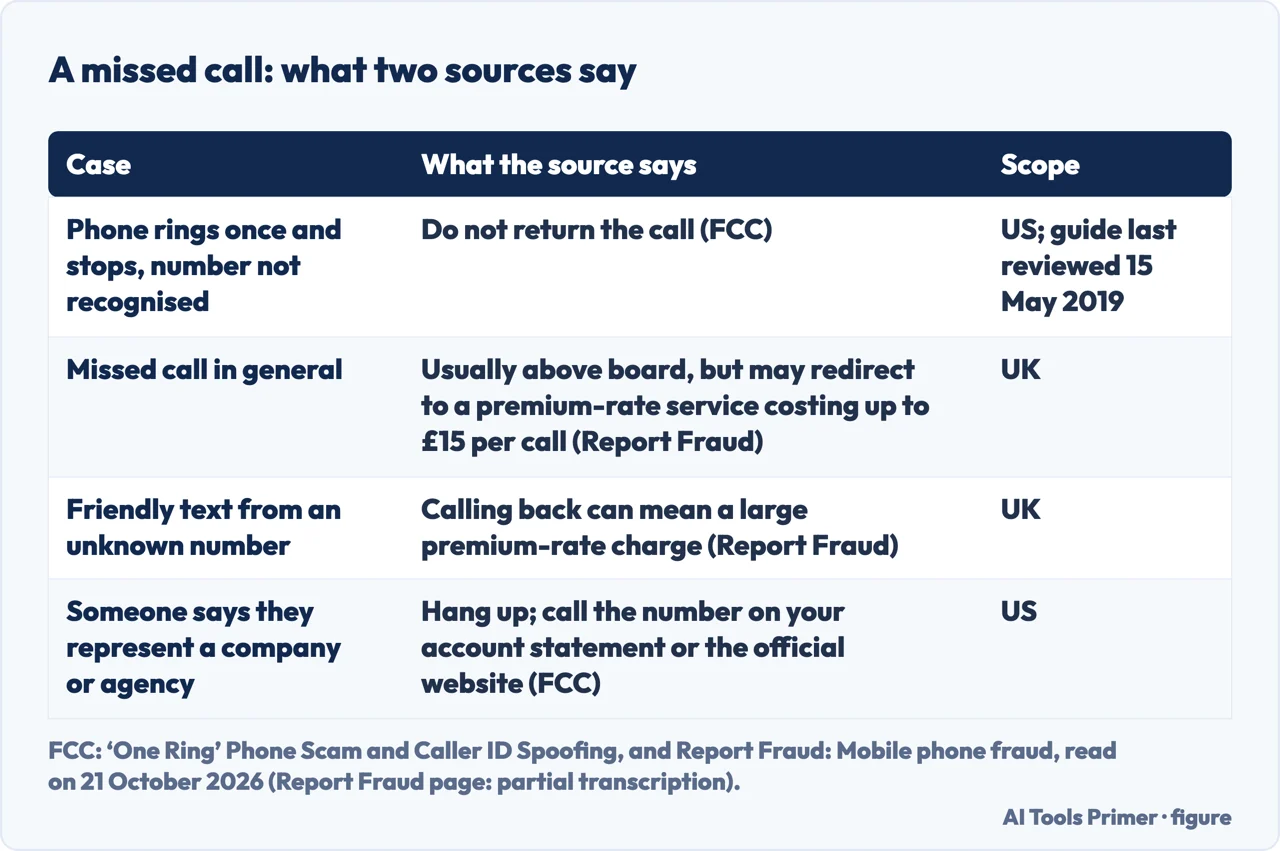
A missed call in general. Report Fraud (UK) describes a different case: your phone registers a missed call, you do not recognise the number and you ring it back. This page was read as a partial transcription, and it applies to the UK. It says that most of the time the call will be perfectly above board, but you may be redirected to a premium-rate service that can cost up to £15 per call. If a premium-rate service did not follow Ofcom’s rules, Report Fraud says you can challenge the charge with the provider of that service; it adds that Ofcom does not investigate or resolve individual complaints. Its protection advice also says not to respond to unknown numbers.
Put side by side, the FCC’s advice is for the one-ring pattern in the US as reviewed in 2019, and Report Fraud’s is for a missed call in general in the UK. Both advise against responding to numbers you do not know, but neither gives one rule for every missed call, and this page does not invent one.
What Does Unknown Mean on Your Screen?
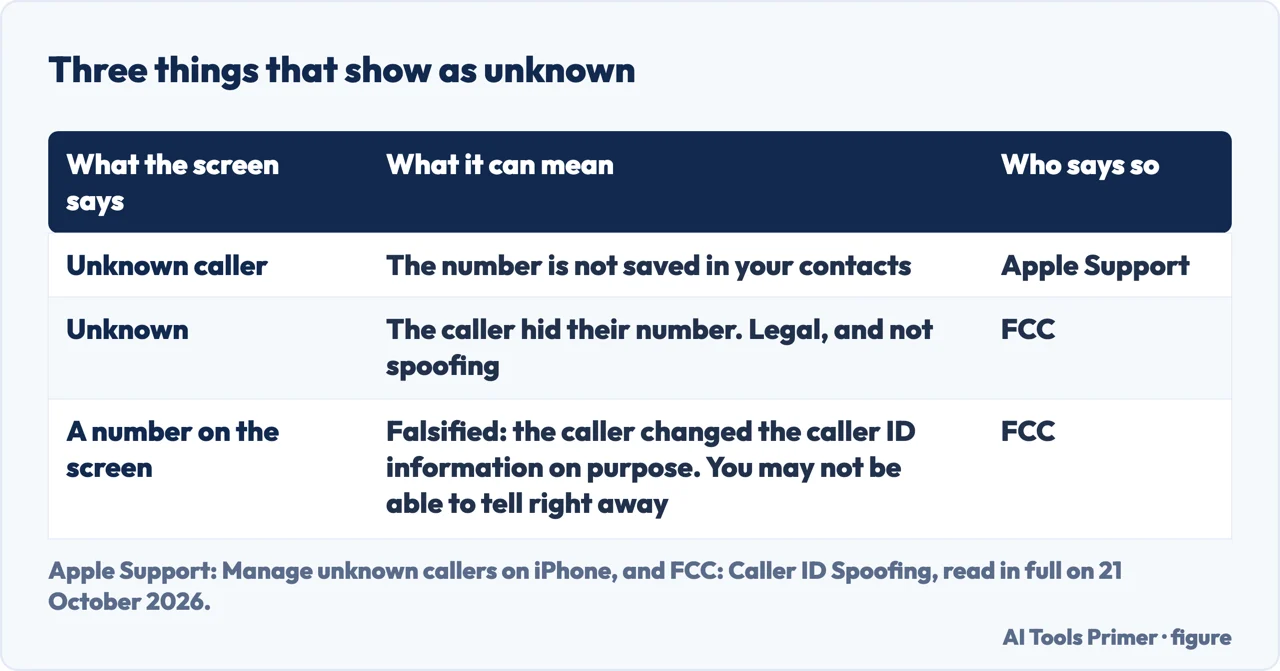
One word covers three different situations, and the screen does not say which. Apple’s support page for the Phone app on iPhone (dated 14 September 2026) defines unknown callers as phone numbers that are not saved in your contacts. That is a statement about your contacts list, not about the caller.
The FCC (US) describes a second meaning: you can legally block the transmission of your own number when you make calls, so that it appears as unknown, and doing so is not spoofing. The third is a falsified number. The FCC defines spoofing as “when a caller deliberately falsifies the information transmitted to your caller ID display to disguise their identity”. It adds that spoofing is not always illegal, since a doctor calling from a personal mobile may legitimately show the office number, and that you may not be able to tell right away whether an incoming call is spoofed.
Phones add their own layer. Google’s Phone app Help page, which covers Phone by Google and not every Android phone, says that with caller ID and spam protection on, a number outside your contacts is sent to Google to help identify its business name or decide whether the call is spam, and that the protection is on by default. The same page says its fake call detection alerts you if a caller hides their identity or impersonates a contact. How spoofing works, and what the person behind it does with your number, is on spoofed caller ID.
What Can a Lookup of the Number Return?
Three companies that sell number-lookup services publish documentation that shows what such a service can return. Every lookup company read for this page sells its service, so what a lookup returns is a vendor’s description of its own product, not a finding about who called.
Bandwidth, which sells communications services, separates two things. Caller ID, or CLID, is the actual phone number calling you; CNAM is a name, obtained by a database lookup using the caller’s number, and Bandwidth says that in the US CNAM information is not sent during a call. SignalWire, which also sells these services, says CNAM is not set up by default on any phone number on its platform, and that when the number is not in your contacts your carrier is responsible for looking up the CNAM associated with that caller ID. SignalWire lists the limits: CNAM does not work on toll-free numbers, works only for calls over the public telephone network, works only in the US and Canada, and is limited to 15 characters.
Twilio, which sells lookup services, says a line-type lookup identifies the carrier and the line type, such as mobile, landline, fixed VoIP, non-fixed VoIP or toll free. Its documentation defines fixed VoIP as a virtual number associated with a physical device, and non-fixed VoIP as a virtual number obtained online without a physical device. It also says carrier data is not available for personal, toll-free, premium, shared-cost, UAN, voicemail, pager or unknown number types.
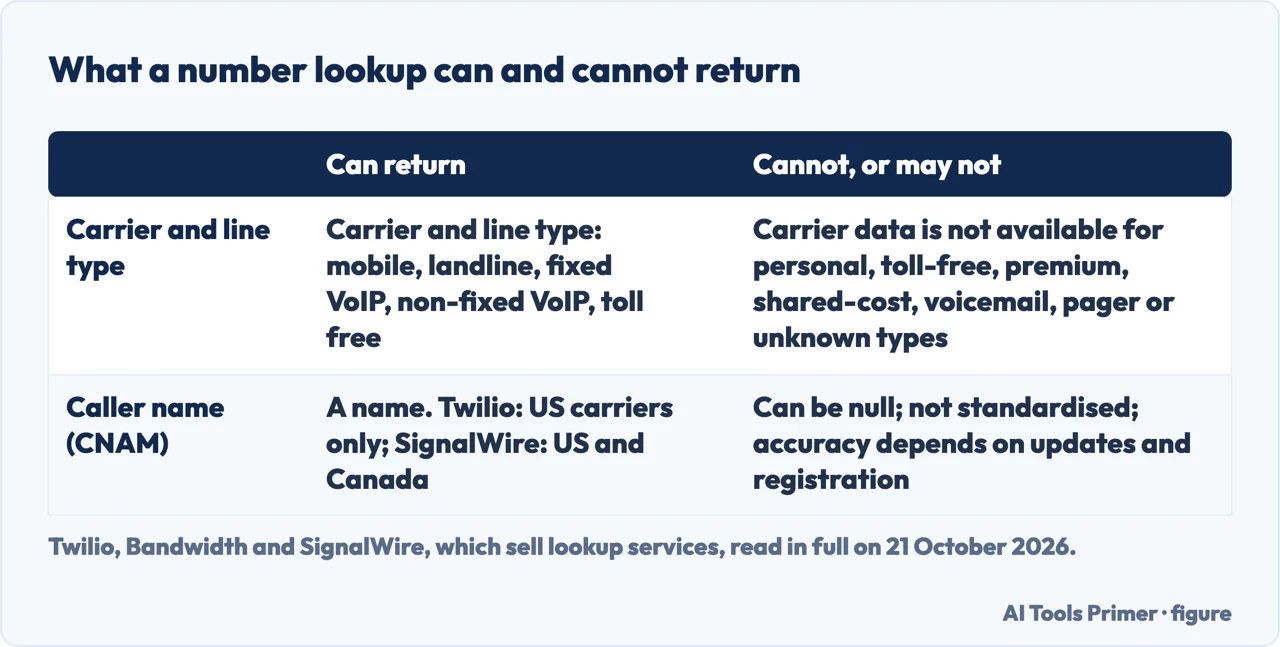
For a name, Twilio says its Caller Name lookup retrieves the caller’s name and type (business or consumer) for a mobile number, is available only for numbers owned by carriers in the United States, and takes its data from CNAM. The owner’s name is null if it is not available, and Twilio bills Caller Name per request even when no data is returned (requests for numbers outside the US return null and are not charged). Bandwidth says CNAM is not standardised across providers, so a carrier might not offer it, and that its accuracy varies with how often the database is updated and whether the caller has properly registered the number.
The FCC (US) says that a phone number can be kept when you change provider, a process called porting, and that this can be done between wireline, IP and wireless providers. The three lookup pages read for this page do not describe how a ported number is treated, so they do not say whether the carrier a lookup returns is the current one.
How Far Can You Trust the Number on Screen?
The FTC (US) puts the problem plainly: caller ID is easy to fake, so even a call that appears to come from nearby or from a company you know cannot be trusted. Elsewhere it says scammers can make any name or number show up on your caller ID. The FCC (US) names one version of this, neighbour spoofing, which displays a number similar to your own to increase the likelihood that you will answer.
Labels do not settle it either way. The FTC says that with call labelling, shady calls still come through, but you may see words such as spam or scam likely on the screen; the FCC says that if caller ID labels a call as spam or scam, it is possible the number has been spoofed. In the other direction, the FTC says not all scam calls will get flagged, so a call with no label is not cleared.
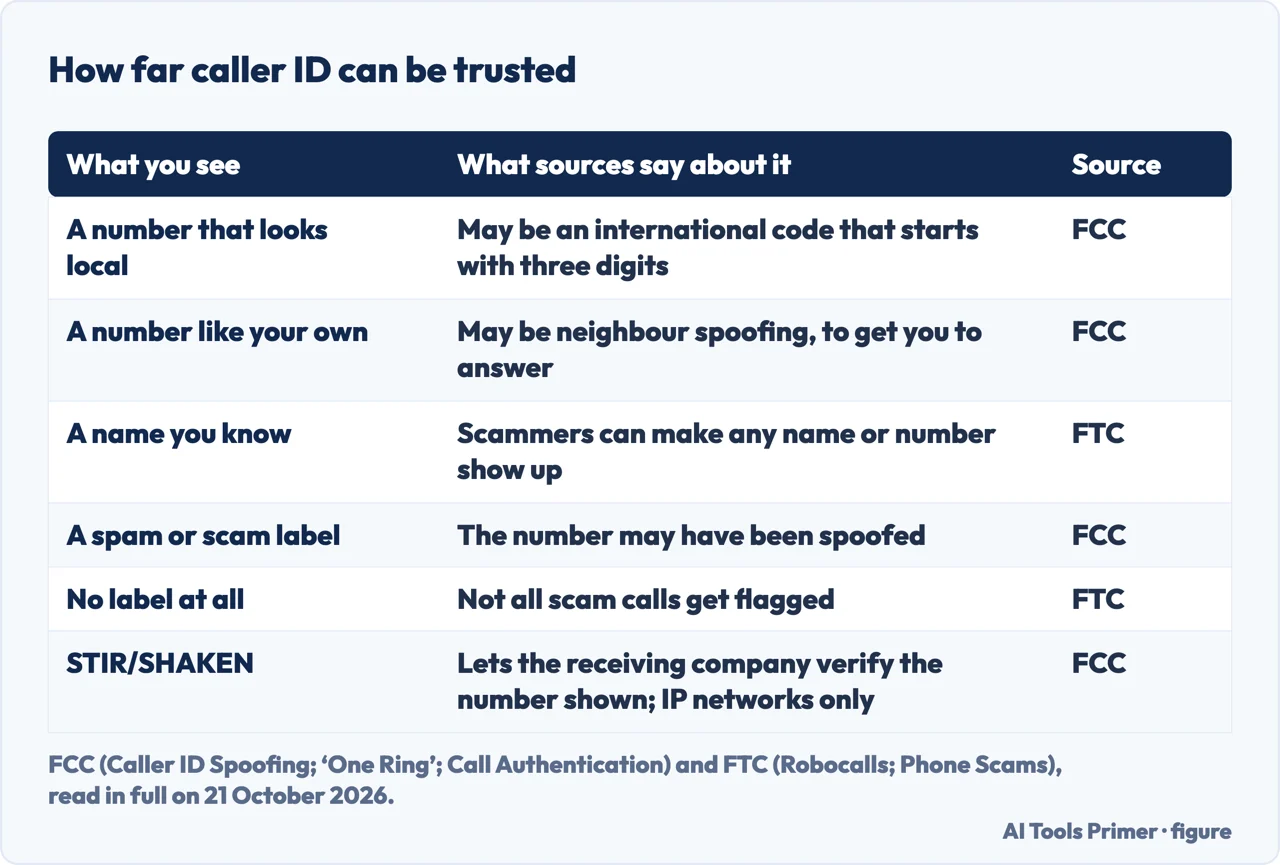
The FCC (US) describes STIR/SHAKEN, the call-authentication framework, as allowing the phone company of the person receiving a call to verify that the call is in fact from the number displayed on caller ID, and as giving subscribers more confidence that the information they receive is accurate. It also says the framework is only operational in IP networks, and that its rules require providers using older network technology either to upgrade to IP or to work on a solution that operates in non-IP networks. The FTC, on its own page, still says caller ID is easy to fake.
What If the Unknown Number Sends a Text?
The FCC (US) advises you not to respond to texts, or click on links, sent from numbers you do not recognise. The FTC’s April 2025 consumer alert (US) lists ‘wrong number’ texts and phony job opportunities among the ways scammers get you to respond, and says not to reply to unexpected text messages. An FTC article on spam texts adds that a text from an unknown sender could be a scammer trying to steal your personal and financial information.
The FTC’s May 2026 alert says that in its 2025 reports, more people reported that a scammer contacted them by text than any other way. In the UK, Report Fraud describes a text from a number you do not recognise that is worded as if from a friend: you call back to say they have the wrong person and are charged a large amount for a premium-rate call. What reduces the volume is on unwanted text messages; the difference between the two channels is on smishing and vishing; and the parcel-delivery version has its own page, the parcel text scam.
How Do You Check a Claim and Report the Number?
Do not use the number that called. The FCC (US) says that if someone says they represent a company or agency, you should hang up and call the number on your account statement, in the phone book, or on the organisation’s website. The FTC (US) asks you to report the caller ID number even if you think it is fake, and any number you were told to call back. Its May 2026 alert says to report an unwanted call at DoNotCall.gov and, if you lost money or have information about the scammer, at ReportFraud.ftc.gov.
Do not count on a registry or a filter alone. The FTC says scammers do not care whether you are on the National Do Not Call Registry. It also says call-blocking services might block some calls you want to get, and the FCC (US) warns that false-positive blocking may occur if a legitimate caller uses a pattern similar to those associated with unwanted or illegal robocalls. The steps for blocking are on blocking a number on an iPhone, blocking a number on Android and the spam-call settings on an iPhone.
Where to start
Six questions, each with the section that answers it.
- “Should I let it ring out?”
- Two strengths of advice — should you answer
- “Should I ring a missed call back?”
- Two cases, two countries — should you call back
- “What does unknown mean?”
- Three meanings — three meanings of unknown
- “What can a lookup tell me?”
- Straight to what it returns — what a lookup can return
- “Can I trust the number on screen?”
- Read the limits — what a number cannot prove
- “A stranger texted me.”
- Start here — texts from unknown numbers
Once you know the number is unwanted
The settings that stop the calls, which this page deliberately does not repeat.
When the number is not the whole story
The pages for what arrives through the number, and what the number itself exposes.
Questions people also ask
How do you find out an unknown number?
A lookup from a vendor such as Twilio, which sells it, can return the carrier, line type and, for US carrier numbers, a caller name that may be null. Bandwidth, also a seller, says the accuracy of CNAM data varies. None of it proves who is calling: the FTC says caller ID is easy to fake.
Why am I getting unknown numbers?
Three different things show as unknown. For Apple, it is a number not saved in your contacts. The caller may also have hidden their number, which the FCC says is legal. Or a scammer may have faked it. The FTC adds that robocalls are cheap and easy to make over the internet from anywhere in the world.
Block unknown numbers
This page does not repeat the steps: the settings are on the phone and differ between iPhone and Android, and the guides linked below cover them. The FTC warns that call-blocking services might block some calls you want to get.
Unknown numbers list
This page gives no list to check against, because the FTC says scammers can make any name or number show up on caller ID, so a list of numbers settles nothing. The FTC asks you to report the number even if you think it is fake.
Not covered here. It does not give a list of scam numbers, because the FTC says scammers can make any name or number show up on caller ID, so a list of numbers settles nothing. It does not recommend subscriptions, apps or paid lookup services, and it does not describe consumer reverse-lookup websites, since none of the sources read for it describes them. Nor does it repeat how to silence or block numbers, which the pages linked above cover, or go into cloned voices, which voice scams answers, or into what a stranger can do with the number itself, which what a number alone can do answers. It covers the US and, for missed calls, the UK, and says nothing about other countries.
Sources
- FCC — ‘One Ring’ Phone Scam (US; last reviewed 15 May 2019): the one-ring pattern, the advice not to return the call, the callback charges and the three-digit international codes — www.fcc.gov, read 21 October 2026.
- FCC — Caller ID Spoofing (US): the definition of spoofing, neighbour spoofing, the legal hidden number shown as unknown, spam and scam labels, and how to check a caller — www.fcc.gov, read 21 October 2026.
- FCC — Combating Spoofed Robocalls with Caller ID Authentication (US): what STIR/SHAKEN gives subscribers and the IP-network limit — www.fcc.gov, read 21 October 2026.
- FCC — Call Blocking Tools and Resources (US): carrier blocking and false-positive blocking — www.fcc.gov, read 21 October 2026.
- FCC — Porting: Keeping Your Phone Number When You Change Providers (US): moving a number between wireline, IP and wireless providers — www.fcc.gov, read 21 October 2026.
- FCC — Stop Unwanted Robocalls and Texts (US): texts from numbers you do not recognise — www.fcc.gov, read 21 October 2026.
- FTC — Robocalls (US): caller ID is easy to fake, labels, unflagged scam calls, what to do with an illegal robocall, and reporting — consumer.ftc.gov, read 21 October 2026.
- FTC — Phone Scams (US): any name or number can show on caller ID, and government agencies do not call out of the blue — consumer.ftc.gov, read 21 October 2026.
- FTC — How To Block Unwanted Calls (US): the Do Not Call Registry, call labelling, hanging up on an illegal robocall and the risk of blocking wanted calls — consumer.ftc.gov, read 21 October 2026.
- FTC — Is that unexpected text a scam? (US, April 2025): ‘wrong number’ texts and the advice not to reply — consumer.ftc.gov, read 21 October 2026.
- FTC — How are scammers trying to reach you? (US, May 2026): contacts by text in 2025 reports and where to report — consumer.ftc.gov, read 21 October 2026.
- FTC — How to Recognize and Report Spam Text Messages (US): texts from unknown senders — consumer.ftc.gov, read 21 October 2026.
- Report Fraud (UK) — Mobile phone fraud (United Kingdom; page read as a partial transcription): returned missed calls, premium-rate charges and texts from a fake friend — www.reportfraud.police.uk, read 21 October 2026.
- AARP — Do Not Answer the Phone from Unknown Numbers (US consumer association): the advice of an Experian executive to let unknown callers go to voicemail and to let them speak first, reported as that executive’s view and not an official rule — www.aarp.org, read 21 October 2026.
- CFCA — The International Problem of Scam Phone Calls (13 August 2024; an industry association, not a public body): the Wangiri description — cfca.org, read 21 October 2026.
- Apple Support — Manage unknown callers on iPhone (iPhone, Phone app; 14 September 2026): what Apple calls an unknown caller — support.apple.com, read 21 October 2026.
- Google — Use caller ID & spam protection, Phone app Help (Phone by Google only): what is sent to Google, the default setting and fake call detection — support.google.com, read 21 October 2026.
- Twilio, a seller of lookup services — Line Type Intelligence: what its line-type lookup returns and where carrier data is unavailable — www.twilio.com, read 21 October 2026.
- Twilio, a seller of lookup services — Caller Name: what its caller-name lookup returns, US carrier numbers only, from CNAM — www.twilio.com, read 21 October 2026.
- Bandwidth, a seller of communications services — What Is CNAM? Caller ID Name Defined (glossary, updated 1 June 2026; US): CLID against CNAM and the limits of CNAM data — www.bandwidth.com, read 21 October 2026.
- SignalWire, a seller of communications services — Caller ID vs CNAM, what’s the difference? (blog, 7 April 2023; US and Canada): CNAM set-up and limits — signalwire.com, read 21 October 2026.
Written by Alberto Gulotta
Founder and editor of AI Tools Primer, writing from Palermo, Italy. Thirty-five years of taking computers apart, starting with a Commodore 64 — the long version is on the about page.
Something wrong on this page? Write to aitoolsprimer@gmail.com and it gets fixed.
Written on 21 October 2026.
Independence and limits
No affiliate links and no paid placements anywhere on this site. Nobody pays to appear here, and no company has seen this page before you did.
This is general information, not professional advice. Where a page touches money, health, safety or the law, it names its source and the date it was read — and your situation may still differ. See the privacy page and the cookie policy.