
Audio · guide
Grandparent scams: the call now sounds exactly right
By Alberto Gulotta · Updated · 10 min read
Every defence against grandparent scams used to have the same thing underneath it: the assumption that a person on the telephone can be recognised. The Federal Trade Commission now describes, in one sentence, how little it takes to remove that.
“All he needs is a short audio clip of your family member’s voice — which he could get from content posted online — and a voice-cloning program.”
That is the Federal Trade Commission, and it is the whole technical story in one sentence. There is no break-in and no clever access: the raw material is content that was already posted online — which is why narrowing who can see a Facebook profile, or locking it outright, is the one part of this supply chain a reader controls. The FCC describes the same supply chain from the other end — scammers who “gain access to consumers’ personal information” by mining social media or purchasing data from cyber thieves, and use it to build a story that fits your family in particular.
So the question this guide answers is not how to detect a fake voice. It is what to rely on instead, given that the voice, the number and the story can all now be right at the same time.
The script, as two federal agencies describe it
Every element below is quoted or paraphrased from the FTC’s or the FCC’s own description of the call.
- An accident or an arrest. The FTC’s example: “Grandma, I need money for bail.” The FCC: “Often the imposter claims to have been in an accident or arrested.”
- Urgency. The FTC: the caller says it is urgent, and they “pressure you to send money before you have time to think.”
- Secrecy. The FTC: the caller “tells you to keep it a secret.” The FCC gives the actual words: “please don’t let mom and dad know.”
- A second voice with authority. The FCC: the scammer “may hand the phone over to someone posing as a lawyer or a court official seeking immediate payment.”
- The number looks right. The FCC: callers sometimes “spoof” the caller ID “to make an incoming call appear to be coming from a trusted source.” What the screen can and cannot tell you is its own page.
- The voice sounds right. The element both agencies added most recently, and the one that removes listening as a test.
- It arrived as a call, which is the part with no evidence in it. A scam delivered by telephone has a name — vishing — and the name is worth something for one reason: a call leaves nothing behind to forward or examine, unlike an email or a text.
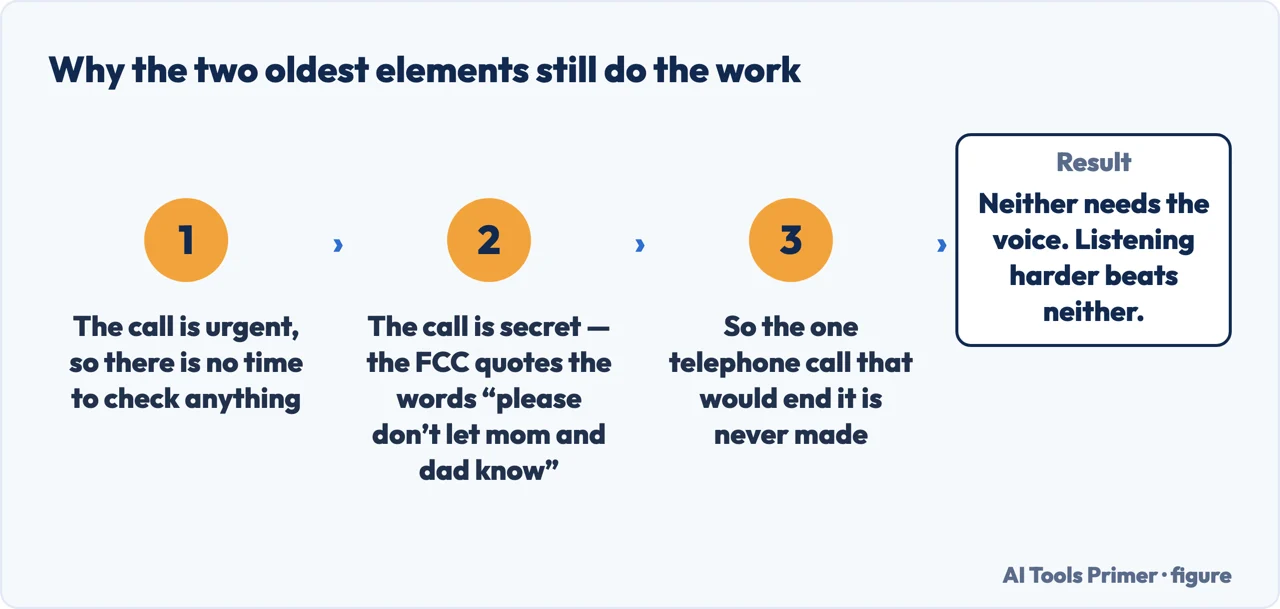
Two of those six are worth pausing on, because they are the ones that survive every technical improvement. Urgency and secrecy are not side effects of the scam; they are the mechanism. The request not to tell the rest of the family is not embarrassment — it is the step that stops you making the one phone call that would end it. Read that way, “please don’t let mom and dad know” is not a detail of the story. It is the attack.
“Consider using a ‘safe word’ that only you and your family members know and have chosen ahead of time. If the caller can’t remember the safe word, it may be a scammer.”
That is the Federal Communications Commission, and it is the one piece of advice here that cannot be followed during the call. It has to exist beforehand, which makes it the thing to do today rather than the thing to remember in the moment.
Notice what it is designed to survive. It does not depend on the voice being wrong, on the number being wrong, or on the story being implausible — all three of which the script above is built to get right. It asks for a fact that was never posted anywhere, which is precisely the material a cloned voice cannot supply.
The other reliable signal is not in the voice at all. It is in how you are asked to pay.
The FTC’s framing of that list is the useful part: these are ways to send money “that make it hard to get your money back”. That is a property of the payment method, not of the person asking for it — which is why it stays true no matter how convincing the call is. It is also the part of the call you can question without knowing anything about the caller: whatever the emergency turns out to be, ask what makes it one that has to be settled with gift card numbers read aloud over the telephone.
Both agencies give the same instruction, and both give it in the same shape: hang up first. The FTC: “Don’t trust the voice. Call the person who supposedly contacted you and verify the story. Use a phone number you know is theirs.” The FCC: “Write down details, then hang up and call the relative who is supposed to be in trouble. Use the number you have saved in your contacts.”
The repeated phrase is doing the work. Not the number that called you, and not a number the caller gives you — one you already had. It is worth knowing why a number on the screen proves nothing: displaying somebody else’s is legal in ordinary cases and free in all of them, which is part of what can be done with a phone number. And if you cannot reach the person, both agencies say the same next thing: try another family member. The FTC’s public-education version is four words long, which is about as short as a defence gets: “Stop. Check it out.”
One practical note on reporting, because it is the step people skip once the money is gone or the call has been survived. The FTC asks that scams be reported at ReportFraud.ftc.gov, and takes reports by telephone on 1-877-FTC-HELP. A report from somebody who did not fall for it is still worth filing.
And one about who this page is really for. The FTC publishes its version of this warning inside a programme built around a single instruction — pass it on — with printable articles and bookmarks meant to be handed to somebody else. That is a reasonable model for this guide too. The person most likely to receive this call is not necessarily the person reading this page, and the safe word only works if the conversation happens before the call does.
The guides below take it three ways: how the voice is made, the script itself and the two signals that survive it, and the arrangements to make in advance.
Where to start
Three ways in.
- “Could someone really clone a voice?”
- Start at how the voice is made
- “I am on the call right now.”
- Go to the script and the signals
- “I want to protect a relative.”
- That is what to arrange first
How the voice is made
A short clip from something already posted, and a cloning program. The FTC states the input; the FCC describes where the surrounding personal detail comes from.
The script and the signals
Six elements, two federal descriptions, and the two signals that do not depend on the voice: what you are asked to keep secret, and how you are asked to pay.
What to arrange first
The safe word cannot be invented during the call. Neither can a saved number. Both are five-minute jobs that only work if they are done in advance.
Not covered here. It will not teach you to spot a cloned voice by ear. Both agencies quoted here give the same instruction instead — do not trust the voice — and a guide that offered listening tips would be contradicting them.
It will not name detection products. What audio detection can and cannot do is a separate guide, and it is not the thing to reach for while a telephone is ringing.
And it will not present United States guidance as universal. The two sources here are the FTC and the FCC; the tactics travel, but the reporting routes and the law do not. What holds instead is simple: the safe word and the instruction to call back on a number you already have come from the two United States agencies quoted here, not from us.
Sources
- Federal Trade Commission, Consumer Alert — Scammers use AI to enhance their family emergency schemes, 20 March 2023 (that a scammer needs only a short audio clip of a family member’s voice, obtainable from content posted online, plus a voice-cloning program; the instruction not to trust the voice but to call back on a phone number you know is theirs; the payment methods named as ways that make it hard to get your money back — wire transfer, cryptocurrency, and gift card numbers and PINs; and the ReportFraud.ftc.gov reporting route) — consumer.ftc.gov, read 22 August 2026.
- Federal Trade Commission, Pass It On — Grandkid and Family Scams (the “Grandma, I need money for bail” opening, the claim of urgency and the instruction to keep it secret, the use of information from social networking sites or a hacked email account, the “Stop. Check it out.” instruction to look up the number yourself or call another family member, and the 1-877-FTC-HELP reporting line) — consumer.ftc.gov, read 22 August 2026.
- Federal Communications Commission, Consumer Scam Alert — “Grandparent” Scams Get More Sophisticated (that scammers mine social media or purchase data from cyber thieves; that callers sometimes spoof the caller ID to appear to come from a trusted source; that AI now allows voices of loved ones to be cloned; the claim of an accident or arrest; the “please don’t let mom and dad know” request; the handover to someone posing as a lawyer or court official; the instruction to write down details, hang up and call back using the number saved in your contacts; and the recommendation of a safe word chosen ahead of time) — www.fcc.gov, read 22 August 2026.
Written by Alberto Gulotta
Founder and editor of AI Tools Primer, writing from Palermo, Italy. Thirty-five years of taking computers apart, starting with a Commodore 64 — the long version is on the about page.
Something wrong on this page? Write to aitoolsprimer@gmail.com and it gets fixed.
Written on 22 August 2026 · last checked 23 September 2026.
Independence and limits
No affiliate links and no paid placements anywhere on this site. Nobody pays to appear here, and no company has seen this page before you did.
This is general information, not professional advice. Where a page touches money, health, safety or the law, it names its source and the date it was read — and your situation may still differ. See the privacy page and the cookie policy.