
Business · guide
Credit card processing fees for small business, by country
By Alberto Gulotta · Updated · 17 min read
Credit card processing fees for small business run from about 1.4% in person in the UK to 3.5% online in the US, split between an interchange fee the card’s bank keeps, a network assessment and the processor’s markup, and comparing providers by country and how the card is taken is the quickest way to see what you will pay.
| Provider | Country | Card present | Card not present | Source |
|---|---|---|---|---|
| Stripe | UK, GBP | 1.4% + 10p | 1.5% + 20p | Stripe, Pricing & Fees (UK) |
| Stripe | EEA, EUR | 1.4% + €0.10 | 1.5% + €0.25 | Stripe, Tariffe e commissioni (IT/SEE) |
| Square | US, USD | 2.6% + 15¢ | 3.3% + 30¢ | Square, Understanding Our Fees (US) |
| Square | UK, GBP | 1.75% | 1.4% + 25p | Square, Fee Schedule (UK) |
| PayPal | US, USD | — | 2.99% + $0.49 | PayPal, Fees — Merchant and Business (US) |
| PayPal | UK, GBP | — | 2.9% + £0.30 | PayPal, Merchant Fees: Seller Fees (UK) |
| SumUp | US, USD | 2.6% + 10¢ | 3.5% + 15¢ | SumUp, Pricing (USA) |
| SumUp | UK, GBP | 1.69% | 2.50% | SumUp, Pricing and fees (support centre, UK) |
What Small Businesses Actually Pay, per Transaction
The table above comes straight from four providers’ own pricing pages, read in full on 15 October 2026, and it already shows the pattern that runs through credit card processing fees for small business everywhere: taking a card in person is cheaper than taking it online, and the gap holds on both sides of the Atlantic. Stripe charges UK merchants 1.4% + 10p when a card is physically present at a Terminal card reader, rising to 1.5% + 20p for a standard domestic card paid online; the same split shows up in euros on Stripe’s EEA/Italy pricing, 1.4% + €0.10 in person against 1.5% + €0.25 online.
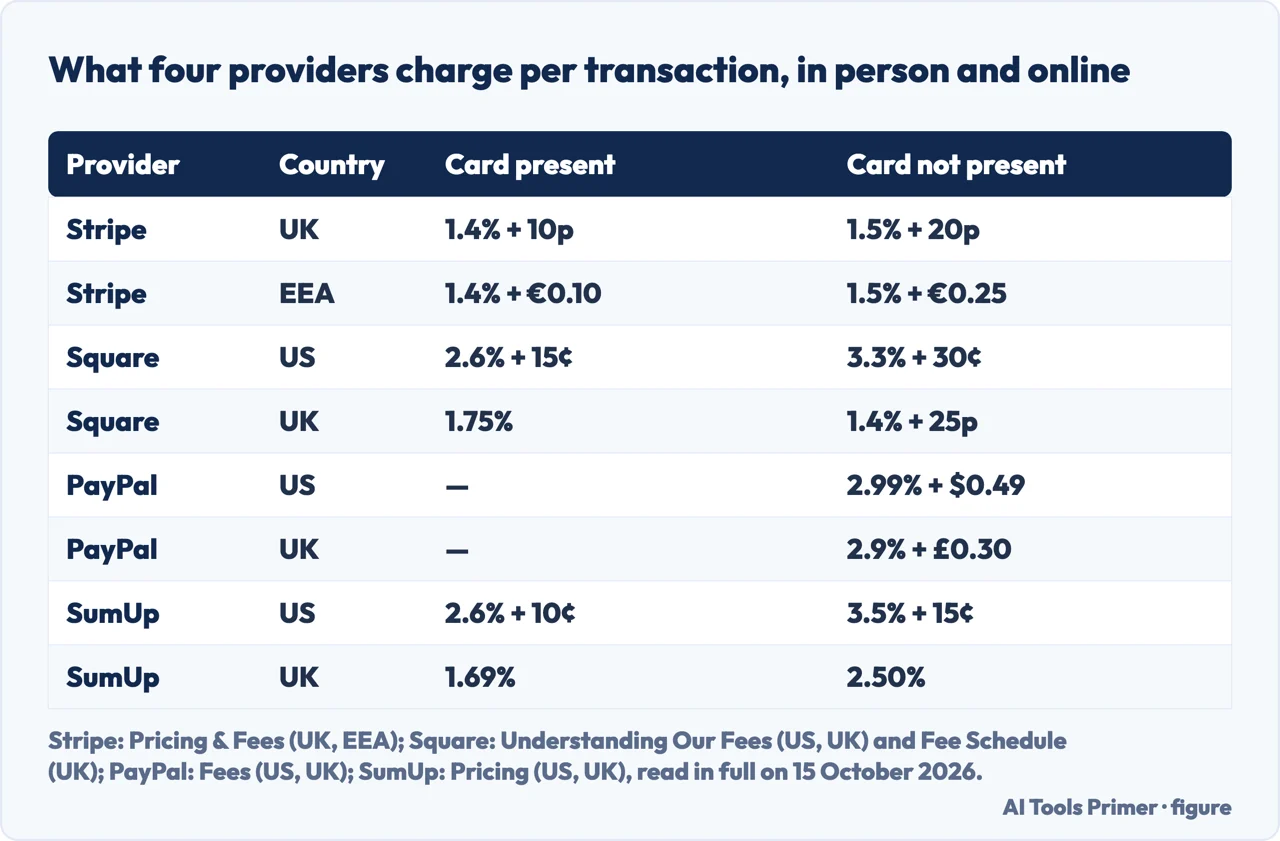
Square’s own numbers move the same way but at different levels. In the US, Square charges 2.6% + 15 cents for a tapped, dipped or swiped card and 3.3% + 30 cents for a payment made online or through an invoice — with a further 3.5% + 15 cents rate for a card number typed in manually or a card on file. In the UK, Square’s pricing page explains the in-person rate directly: “When a customer pays via tap, chip and PIN, or contactless payments with their card in person, you pay 1.75% per transaction”, against 1.4% + 25p online for a UK-issued card, or 2.5% + 25p for a card issued outside the UK.
PayPal mostly prices card-not-present payments, since it does not sell a card reader as its main US or UK product; SumUp, by contrast, centres its pricing on its own card readers. PayPal’s standard US card rate is 2.99% plus a fixed fee of $0.49; the UK table has no separate card line, so the closest match is PayPal UK’s “All Other Commercial Transactions” rate, 2.9% plus a fixed fee of £0.30. SumUp, which does sell its own card readers, charges 2.6% + 10 cents in person in the US, rising to 3.5% + 15 cents online or for a manually entered card; in the UK its Pay-as-you-go rate is 1.69% per transaction — confirmed separately on SumUp’s support-centre pricing page — falling to 0.99% on the £19-a-month Payments Plus subscription, with a 2.50% payment-link rate for a remote sale, per that same support-centre page.
Why In-Person and Online Rates Are Not the Same Number
Every card fee above is built from three pieces, as Square’s UK fees page lays them out, and only one of them is shaped by regulation here. The largest piece, interchange, goes to the bank that issued the customer’s card; the card networks collect what Square calls dues and assessments; what is left is the processor’s own markup — Stripe’s, Square’s, PayPal’s or SumUp’s cut for running the transaction. Square’s UK page also explains why online costs more: there is a lower risk of fraud when the cardholder is present, Square pays more for card-not-present transactions, and that increase goes directly to the card-issuing bank — the pattern the four providers above show.
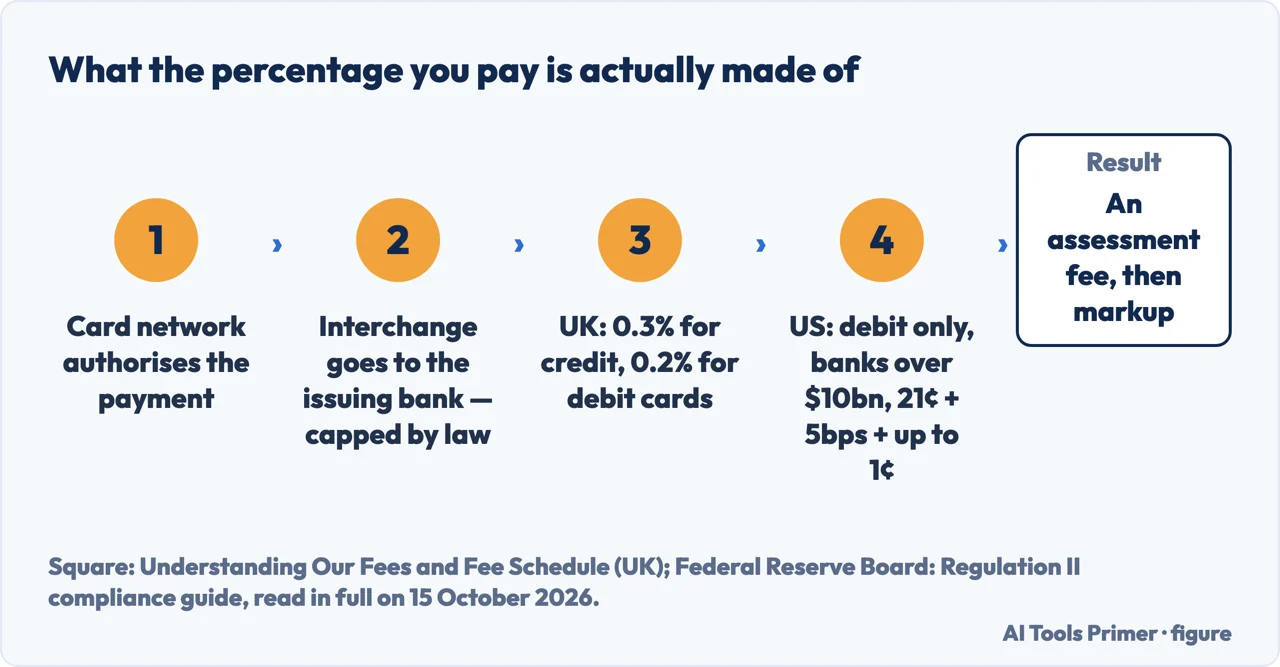
Of the sources read for this page, only one states an exact legal cap on interchange, and it is a UK figure. Square’s UK Fee Schedule, updated 2 February 2026, says interchange fees “are capped in the United Kingdom at 0.3% for credit cards and 0.2% for debit cards”. PayPal’s own UK pricing page is vaguer about the same cap, telling merchants only, under its own interchange fee rates note, “Approximately ranges from 0.2% to 2%” — a wide vendor estimate next to Square’s exact regulatory figure.
The US rule read for this page covers a narrower slice of the market. Under the Federal Reserve’s Regulation II, a covered debit card issuer’s interchange fee “does not exceed 21 cents plus a variable factor equal to 5 basis points multiplied by the value of the transaction”, plus up to a further cent for fraud prevention. The same rule “does not apply to interchange fees of debit card issuers with total assets below $10 billion”, and says nothing about credit cards. In short: the UK figure is a legal cap on interchange; the US one applies only to debit cards from the largest issuers, and says nothing about credit cards.
Can You Pass the Card Fee on to the Customer?
Whether a business can pass the card fee on to the customer depends entirely on which country it is in. In the UK, the answer is simply no for a consumer’s card: HM Treasury’s surcharge ban, in force since 13 January 2018, makes it unlawful for a retailer “to charge additional fees when someone uses a particular credit or debit card, or other payment systems like PayPal, to make a purchase”. The ban names PayPal specifically, not just plastic cards.
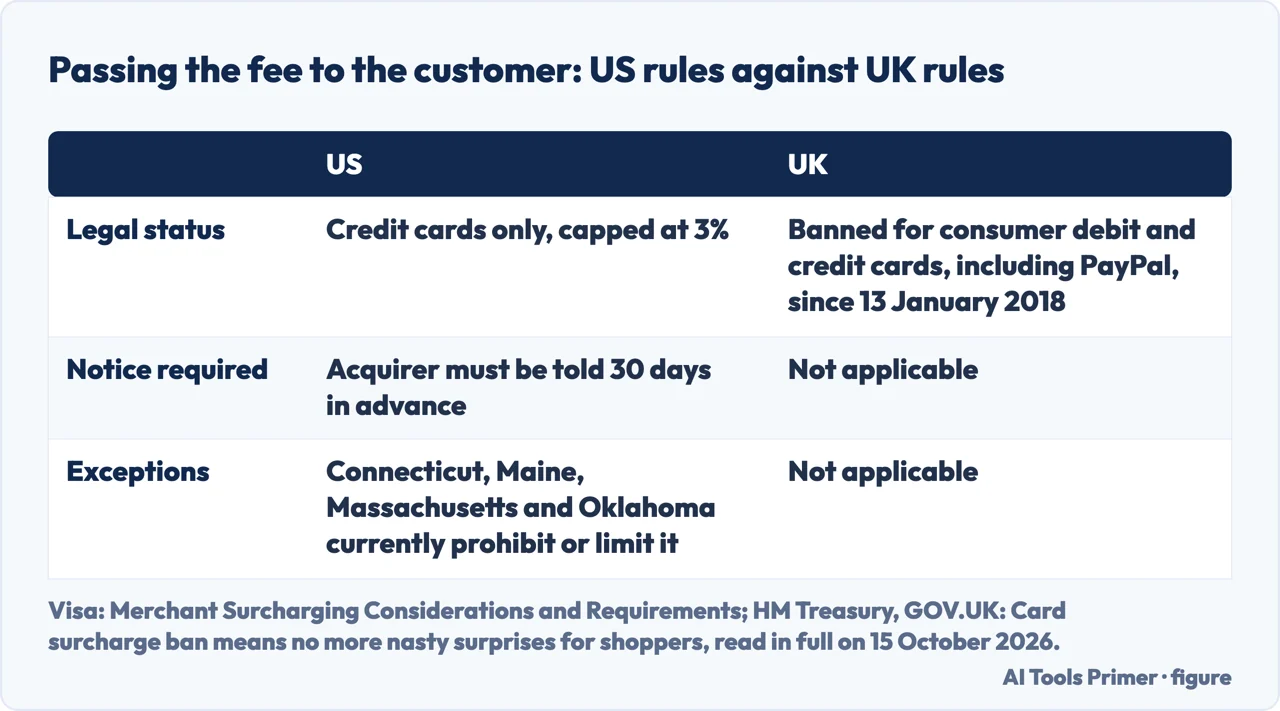
In the US, Visa’s own rules allow a merchant to surcharge, but on narrower terms than many assume. Visa’s Merchant Surcharging Considerations and Requirements, version 14 August 2023, limits surcharging to credit transactions only in the US and US territories, and sets a hard ceiling: “the merchant cannot assess a surcharge above 3%”, even where the cost of accepting cards runs higher. Before a merchant can start, Visa requires 30 days’ notice to its acquirer, and four states — Connecticut, Maine, Massachusetts and Oklahoma — currently prohibit or limit surcharging under their own law, on top of whatever Visa allows.
None of this is legal advice: Visa and HM Treasury set the rules each side publishes, but whether a specific surcharge is lawful for a specific business, in a specific state, is a question for a lawyer who knows that jurisdiction, not a comparison page. What the two rulebooks do make clear is who pays by default. Unless a business adds a surcharge — where that is even allowed — the processing fee comes out of what the processor pays the business, not an extra line added to the customer’s bill: the fee comes out of the payment itself; GoCardless, for one, says its fees are deducted from the payments it submits.
Getting Paid Without a Card at All
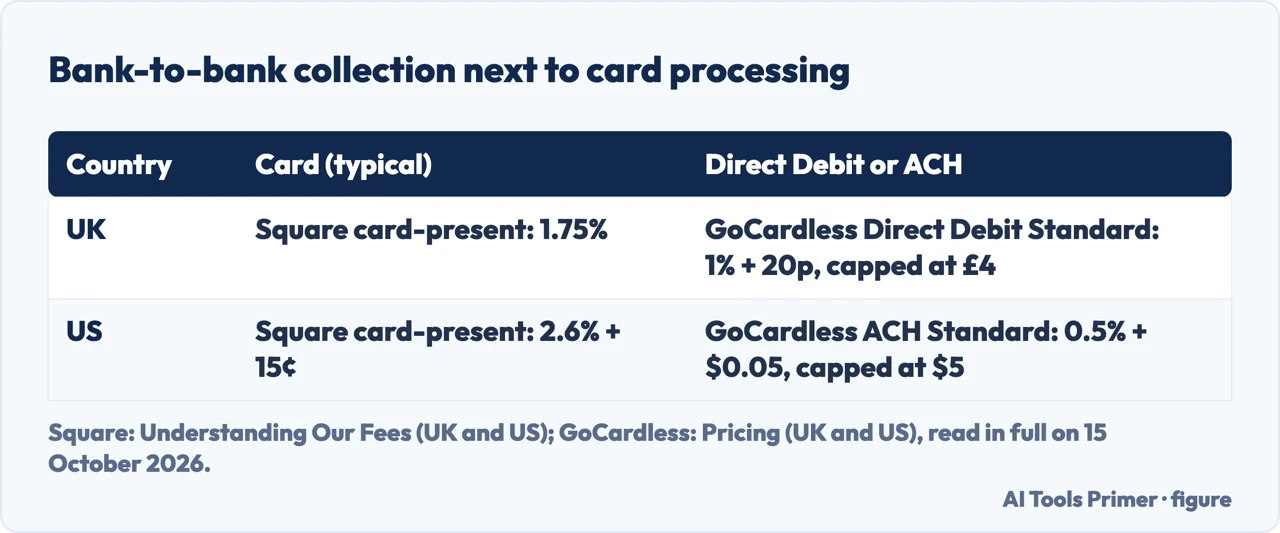
A card is not the only way to collect money from a customer, and in the two price lists compared here the alternative is cheaper. GoCardless, which sells Direct Debit collection in the UK and ACH collection in the US rather than card processing, caps its UK Standard plan at 1% + 20p per transaction with a £4 ceiling — well under Square’s 1.75% UK card-present rate on a typical invoice. Its US Standard plan charges 0.5% + $0.05 per domestic ACH transaction, capped at $5, against Square’s 2.6% + 15 cents for a card-present US payment.
Wise, which sells multi-currency business accounts rather than card acceptance, prices differently again: a one-off setup fee of “31 USD” in the US or “50 GBP” in the UK, then free receiving for domestic, non-wire payments in nine currencies including USD, EUR and GBP. Neither GoCardless nor Wise accepts a card at the till — GoCardless collects by bank mandate, Wise by account transfer — so the comparison only holds where a customer can pay from a bank account: GoCardless’s own US page lists one-off, invoice and subscription payments as what it collects, and a sale at a shop counter is not on that list. Where a bank payment works, how to write an invoice covers what a government requires on the document that asks for it.
How Long the Money Actually Takes to Arrive
The three systems that move the money once a fee is taken are run by three different operators, not by Stripe, Square, PayPal or any processor named above. In the UK, Pay.UK — which runs the Faster Payments scheme — says funds between two directly participating banks are “usually available almost immediately, although they can sometimes take up to two hours”, with a legal backstop under the Payment Services Directive that any such payment “must arrive by the end of the following business day at the latest”. Pay.UK also sets a scheme-wide ceiling: individual Faster Payments of up to £1 million are now possible.
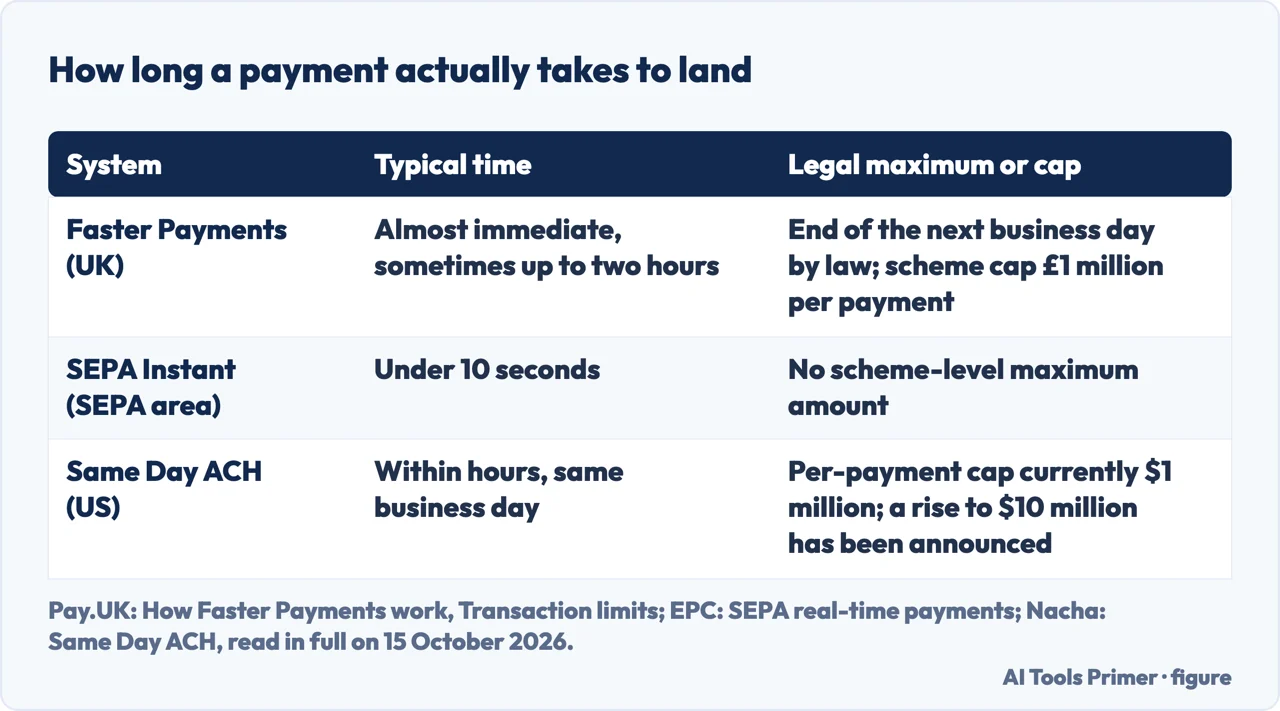
The European Payments Council describes its SEPA Instant Credit Transfer scheme in similarly fast terms: funds move “with the funds made available on the account in less than ten seconds”, and under the 2025 rulebook there is no scheme-level maximum amount at all — individual payment service providers set their own ceiling instead. In the US, Nacha — the association that governs the ACH network — describes Same Day ACH as moving money within hours on the same business day, slower than either European system; its per-payment cap, currently $1 million after rising from $100,000, is set to increase again to $10 million under an already-announced rule change.
What Crossing a Border Adds to the Fee
An international card or an international bank transfer adds a further charge on top of everything above, and the way providers structure that extra charge is not the same from one country to the next. Stripe’s UK pricing adds 2.5% + 20p for a European Economic Area card used online, rising to 3.15% + 20p for any other international card, plus a further 2% if currency conversion is required — three separate international tiers layered onto the domestic rate already covered above.
PayPal structures the same idea completely differently depending on which country’s pricing page is read. PayPal US adds a flat 1.50% on every commercial transaction received from abroad, regardless of the sender’s own region — one number for the whole world. PayPal UK instead tiers the same additional fee by where the payer is: 1.29% when the sender is in the EEA, against 1.99% for a payment from anywhere else — a lower rate for European customers than the flat US figure, and a higher one for everyone further afield.
GoCardless, which collects by Direct Debit rather than by card, adds its own international surcharge in a third shape again: a further 0.3% on UK Direct Debit collections once a transaction passes £2,000, and, on its US Standard plan, a jump from the domestic 0.5% + $0.05 ACH rate to 1.5% + $0.05 for an international ACH collection. Three providers, three different ways of pricing the same problem: a flat worldwide surcharge, a two-tier split by the sender’s region, and a threshold that only applies above a set amount.
Where to start
Six ways into this page.
- “What does each provider actually charge, per transaction?”
- Straight to the table — what small businesses actually pay per transaction
- “Why does online cost more than in person?”
- The three pieces of the fee — why in person and online rates differ
- “Can I just add 3% at checkout?”
- What Visa and HM Treasury actually allow — can you pass the fee on to the customer
- “Is there a cheaper way to get paid?”
- Direct Debit and ACH instead of a card — getting paid without a card at all
- “How fast does the money actually land?”
- Three settlement systems, compared — how long the money actually takes to arrive
- “What changes for an overseas customer?”
- Three providers, three different surcharges — what crossing a border adds to the fee
The paperwork around getting paid
The commissions above cover what a payment costs; three sister pages cover the paperwork around the same transaction.
Questions people also ask
Is it illegal to charge the 3% credit card fee?
It depends which country. In the UK, surcharging a customer for a debit or credit card — including through PayPal — has been banned since 13 January 2018. In the US, Visa allows a surcharge of up to 3%, but only on credit transactions, and four states currently prohibit or limit it.
How much does it cost a small business to process credit cards?
It depends on the provider, the country and how the card is taken. In-person rates run from about 1.4% in the UK to 2.6% in the US; online or manually entered cards cost more everywhere, up to around 3.5%. The table above gives the exact figures.
Why are businesses charging 3% to use a credit card?
Part of every card payment goes to the issuing bank as interchange, part to the card network as an assessment fee; the rest is the processor’s markup. Visa’s own US rules set 3% as the ceiling a merchant can pass on, which is why that figure recurs.
Who pays credit card transaction fees?
By default, the business does: the fee comes out of the payment itself rather than being added to the customer’s bill — GoCardless, for one, says its fees are deducted from the payments it submits. Passing some of it on is a surcharge, and whether that is allowed depends on the country.
Not covered here. It does not cover how to write or send the invoice behind these payments, which how to write an invoice sets out field by field, nor how long to keep the records of what you were paid, which how long to keep records answers for two tax authorities, nor the consent rules for emailing a customer about a payment, such as a chase on a late invoice, which consent and the rules covers on its own terms. What holds instead is simple: every number above is read from the page that actually publishes it, and every regulatory figure names the regulator that sets it.
Sources
- Federal Reserve Board — Regulation II: Debit Card Interchange Fees and Routing, compliance guide: the exact US debit-card interchange cap and the $10 billion threshold below which it does not apply — www.federalreserve.gov, read 15 October 2026.
- HM Treasury, GOV.UK — Card surcharge ban means no more nasty surprises for shoppers (13 January 2018): the UK ban on surcharging consumer debit and credit cards, including PayPal — www.gov.uk, read 15 October 2026.
- Pay.UK — How Faster Payments work: the typical and legal-maximum settlement time for a Faster Payment — www.wearepay.uk, read 15 October 2026.
- Pay.UK — Transaction limits: the £1 million scheme-wide ceiling on an individual Faster Payment — www.wearepay.uk, read 15 October 2026.
- European Payments Council — EPC scheme to make real-time payments in SEPA: the under-10-second settlement time for SCT Inst, and the absence of a scheme-level maximum amount — www.europeanpaymentscouncil.eu, read 15 October 2026.
- Nacha — Same Day ACH: the same-business-day settlement window and the per-payment cap, rising from $100,000 to $1 million and announced to rise again to $10 million — www.nacha.org, read 15 October 2026.
- Visa — Merchant Surcharging Considerations and Requirements (version 14 August 2023): the 3% US surcharge ceiling, the credit-only rule, and the four states that prohibit or limit it — usa.visa.com, read 15 October 2026.
- Visa — Credit Card Processing Fees & Interchange Rates (small business): the 30-day acquirer-notice requirement before a merchant can start surcharging — usa.visa.com, read 15 October 2026.
- GoCardless Ltd — Pricing (UK): the UK Direct Debit Standard-plan rate and cap, and the international Direct Debit surcharge above £2,000 — gocardless.com, read 15 October 2026.
- GoCardless Inc. — Pricing (US): the US ACH Standard-plan rate and cap, domestic and international — gocardless.com, read 15 October 2026.
- PayPal — Fees: Merchant and Business (US): the standard US card rate, the fixed USD fee, and the flat international surcharge — www.paypal.com, read 15 October 2026.
- PayPal — PayPal Merchant Fees: Seller Fees (UK): the UK card rate, the fixed GBP fee, the vendor’s own interchange estimate, and the EEA/rest-of-world international tiers — www.paypal.com, read 15 October 2026.
- Squareup Europe Ltd / Block, Inc. — Fee Schedule (Square UK, updated 2 February 2026): the exact UK interchange cap for credit and debit cards — squareup.com, read 15 October 2026.
- Squareup Europe Ltd / Block, Inc. — Understanding Our Fees (UK): the UK card-present and card-not-present rates — squareup.com, read 15 October 2026.
- Block, Inc. (Square) — Understanding Our Fees (US): the US card-present, online and manual-entry rates — squareup.com, read 15 October 2026.
- Stripe, LLC — Pricing & Fees (UK): the UK Terminal and online rates, and the international-card surcharge tiers — stripe.com, read 15 October 2026.
- Stripe, LLC — Tariffe e commissioni (EEA/Italy): the EEA Terminal and online rates, in euros — stripe.com, read 15 October 2026.
- SumUp Payments Limited — Pricing and fees (support centre, UK): the UK card-reader and payment-link rates — help.sumup.com, read 15 October 2026.
- SumUp Payments Limited — Pricing (UK): the Pay-as-you-go and Payments Plus subscription rates — www.sumup.com, read 15 October 2026.
- SumUp Inc. — Pricing (USA): the US card-present and online/manual-entry rates — www.sumup.com, read 15 October 2026.
- Wise Payments Limited — Wise Business Fees & Pricing (US): the one-off US account setup fee — wise.com, read 15 October 2026.
- Wise Payments Limited — Fees for Getting Paid & Adding Money (US): free domestic receiving in nine currencies — wise.com, read 15 October 2026.
- Wise Payments Limited — Wise Business Fees & Pricing (UK): the one-off UK account setup fee — wise.com, read 15 October 2026.
Written by Alberto Gulotta
Founder and editor of AI Tools Primer, writing from Palermo, Italy. Thirty-five years of taking computers apart, starting with a Commodore 64 — the long version is on the about page.
Something wrong on this page? Write to aitoolsprimer@gmail.com and it gets fixed.
Written on 15 October 2026.
Independence and limits
No affiliate links and no paid placements anywhere on this site. Nobody pays to appear here, and no company has seen this page before you did.
This is general information, not professional advice. Where a page touches money, health, safety or the law, it names its source and the date it was read — and your situation may still differ. See the privacy page and the cookie policy.