
Business · guide
How to write an invoice, and what the law requires on it
By Alberto Gulotta · Updated · 9 min read
Almost every page explaining how to write an invoice is published by a company that sells invoicing software. The separate question of what must legally appear on one, and what a generator fills in for you, has a guide of its own. Of the first seven results on Google today, five are payment or accounting firms and one is a design tool with an invoice generator attached. They give you a template, which is useful, and they mostly skip the part that decides whether the document works: what has to be on it, and who says so.
Governments say so, and they publish the list.
What an invoice must contain, in the United Kingdom
GOV.UK, “Invoices — what they must include”, read 21 August 2026. Nine items, and the first one is the one with no natural prompt.
- a unique identification number
- your company name, address and contact information
- the company name and address of the customer you’re invoicing
- a clear description of what you’re charging for
- the date the goods or service were provided (supply date)
- the date of the invoice
- the amount(s) being charged
- VAT amount if applicable
- the total amount owed
The unique identification number is the item people leave out, and it is first on the list for a reason. Without it you cannot refer to an invoice unambiguously in a chasing email, your customer cannot match it to a payment, and your own records stop reconciling the moment you have two invoices to the same client in the same month. It does not need to be clever. Sequential numbers starting at one are fine, and the only rule that matters is that no number is ever reused.
Now the part that the templates cannot help with, because it changes depending on where you are.
United Kingdom
One list, applying to invoices generally, with additions depending on whether you are a sole trader or a limited company.
VAT appears as a line on the same document when it applies, rather than changing what kind of document it is.
Australia
Two different documents. “Tax invoices – GST-registered businesses must use these… Regular invoices – businesses that aren’t registered for GST use invoices that don’t show any tax.”
And a threshold with a deadline attached: a tax invoice is required when “a taxable sale is more than $82.50 (including GST)”, or whenever “a customer asks for one (regardless of the amount) – you have 28 days to give it to them”.
That contrast is the practical warning on this subject. A template downloaded from a software company’s site is built for one jurisdiction, usually the one where most of its customers are, and the differences are not cosmetic — in Australia whether you are registered for GST changes which document you are issuing, not merely which line appears on it. Check your own tax authority before you trust any template, including the layout implied by this page.
The half nobody selling invoicing software puts on the page
- Your terms
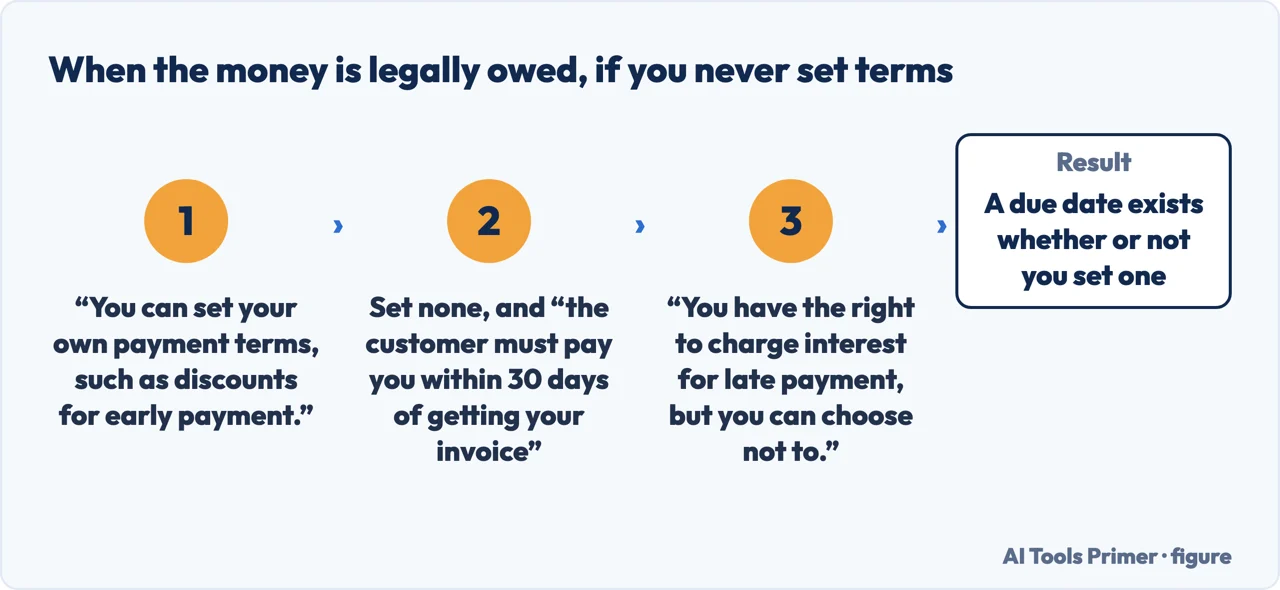
- “You can set your own payment terms, such as discounts for early payment and payment upfront.”
- If you set none
- “Unless you agree a payment date, the customer must pay you within 30 days of getting your invoice or the goods or service.” A default exists whether or not you knew about it.
- Late payment
- “You have the right to charge interest for late payment, but you can choose not to.”
- Formal demand
- “You can use a statutory demand to formally request payment of what you’re owed.”
- Card chargebacks
- A customer can have a card payment reversed, and you “can be charged up to 120 days after the transaction has been debited”.
What actually gets invoices paid, beyond the legal minimum. Three things, and none of them are in the requirements. Send it the day the work finishes rather than at the end of the month, because the gap between delivery and invoice is dead time you are financing. Put the payment method on the document itself, complete enough to act on without a reply. And name the due date as a date rather than as a period — “payable by 20 September” is acted on and “30 days” is filed.
Do you need software for this? Starting out, no. An invoice is a document with nine or ten specific things on it, and a word processor or spreadsheet produces one perfectly well. Software earns its price at the point where you are chasing several unpaid invoices at once, reconciling against a bank feed, or handling tax across periods — which is a real point, arriving at different times for different people, and it is not the first invoice you send.
That is a genuinely open question rather than a rhetorical one, and this guide does not answer it with a recommendation because we have not run the comparison that would justify one. The guides on the accounting tools in this section will, when they are built, and they will say what was tested.
What to keep. Both governments quoted here treat invoices as records rather than as correspondence. Keep every one you issue, in a form you can still open in several years, including the ones that were cancelled or corrected — a gap in a numbered sequence is the kind of thing that has to be explained later, and it is much easier to explain if the document still exists.
Everything on this page is quoted from two government sources on the date they were read. The UK list applies to the United Kingdom and the Australian rules to Australia; if you are anywhere else, the shape of the requirements will be familiar and the specifics will not be, and the right source is your own tax authority rather than any page selling you a tool.
Where to start
Four ways in.
- “I just need to send one invoice.”
- The list above is the whole answer — then see getting paid
- “They have not paid me.”
- Go to getting paid
- “I am keeping this in a spreadsheet.”
- See records and receipts
Getting paid
The invoice is the easy half. What happens after you send it is where the money actually is, and where the legal defaults matter.
Records and receipts
Both governments quoted on this guide treat these documents as records. What that means in practice for how you store them.
The document itself
An invoice is a document before it is a financial instrument, and the practical questions about producing and sending it are ordinary ones.
Not covered here. It will not give you a downloadable template. Templates are built for one country, and the two governments quoted above do not agree on what an invoice is — which is exactly the thing a template hides.
It will not tell you which invoicing tool to buy. We have not tested them, and on this page the honest answer for anyone starting out is that a document will do.
And it will not carry an affiliate link to accounting software, which — given that five of the first seven results are payment or accounting companies — is worth stating plainly here. What holds instead is simple: the requirements and payment rules on this page are quoted from two government sources, each with the date it was read, and neither applies outside its own country.
The rules on what you send and what you keep
What a small business has to put in writing: what you may send, what you must stop sending on request, and what you must keep.
- The same job, in the other places it comes up
- Email marketing laws, and the exception that does not exist
- How long to keep business records, by the people who ask for them
- How to unsubscribe from emails, which is not a favour
Sources
- GOV.UK — Invoicing and taking payment from customers: Invoices, what they must include, including the additional requirements for sole traders and limited companies — www.gov.uk, read 21 August 2026.
- GOV.UK — Invoicing and taking payment from customers: Payment obligations, on payment terms, the thirty-day default, interest on late payment and chargebacks — www.gov.uk, read 21 August 2026.
- business.gov.au — How to invoice, on the difference between tax invoices and regular invoices, the GST threshold and the twenty-eight day deadline — business.gov.au, read 21 August 2026.
Written by Alberto Gulotta
Founder and editor of AI Tools Primer, writing from Palermo, Italy. Thirty-five years of taking computers apart, starting with a Commodore 64 — the long version is on the about page.
Something wrong on this page? Write to aitoolsprimer@gmail.com and it gets fixed.
Written on 21 August 2026 · last checked 5 September 2026.
Independence and limits
No affiliate links and no paid placements anywhere on this site. Nobody pays to appear here, and no company has seen this page before you did.
This is general information, not professional advice. Where a page touches money, health, safety or the law, it names its source and the date it was read — and your situation may still differ. See the privacy page and the cookie policy.