
Docs · guide
How to unsubscribe from emails, which is not a favour
By Alberto Gulotta · Updated · 9 min read
Most guidance on how to unsubscribe from emails is about finding the link — scroll to the bottom, look for the grey four-point type. That is the easy part and it is the wrong frame. In the United States, a company sending marketing email is not doing you a courtesy by offering the option; it is meeting a legal requirement, and the requirement is specific.
What a legitimate sender is required to do
US Federal Trade Commission, CAN-SPAM compliance guidance — read 22 August 2026.
- Provide it
- The message “must include a clear and conspicuous explanation of how the recipient can opt out”, in a form “easy for an ordinary person to recognize, read, and understand”.
- All of it
- A sender may offer a menu of message types, “but you must include the option to stop all marketing messages”.
- Within 10 days
- “You must honor a recipient’s opt-out request within 10 business days.”
- For 30 days
- The mechanism “must be able to process opt-out requests for at least 30 days after you send your message”. A dead link in a month-old email is not compliant.
- Without cost
- “You can’t charge a fee, require the recipient to give you any personally identifying information beyond an email address, or make the recipient take any step other than sending a reply email or visiting a single page on an internet website as a condition for honoring an opt-out request.”
- And then
- “Once people have told you they don’t want to receive more messages from you, you can’t sell or transfer their email addresses, even in the form of a mailing list.”
Read that list as a checklist rather than as background. An unsubscribe process that makes you log in, answer questions, or click through several pages is not a compliant one — the FTC’s wording is a reply email or “a single page”. So is a link that has stopped working three weeks after the email arrived, and so is any version that asks for your name, your reason, or anything beyond the address itself.
The last item is the one worth knowing and almost never repeated: once you have opted out, the sender cannot sell or transfer your address. That is the opposite of the fear the warning below trades on is happening when they click.
Never click unsubscribe — it tells them you are real?
That warning circulates widely without anyone to attribute it to, and it is right about one case and wrong about the other. The distinction is not about the email. It is about whether the sender is operating inside the law or outside it.
The reason the folk advice spread is that the second case is genuinely bad and the first is genuinely fine, and nobody separated them. If you can name the company, unsubscribing is a documented right with a deadline attached. If you cannot, you were never dealing with somebody who was going to honour it.
There is a second requirement in the same guidance that gives you a way to tell the two apart before deciding. Every marketing message must “include your valid physical postal address”, and must “disclose clearly and conspicuously that your message is an advertisement”. A message with no postal address at the bottom is already outside the rules, and that is a check you can make in two seconds without clicking anything.
One more provision that surprises people who assumed a subscription changed things: the FTC is explicit that “subscribers and members don’t lose their ability to opt out of marketing emails from you simply because they have a subscription or membership.” Being a paying customer does not mean you agreed to the marketing.
And on the question of who is responsible when the email came from an agency rather than the brand: “even if you hire another company to handle your email marketing, you can’t contract away your legal responsibility to comply with the law.” Both the company being advertised and the company that sent it can be on the hook. There is no useful “it was not us” here.
Practically, then, the order to work in is short. Check the message names a real company and carries a postal address. Use its unsubscribe link. Give it ten business days rather than judging it the next morning. If mail keeps arriving after that, the sender is out of compliance and the next step is reporting rather than clicking again.
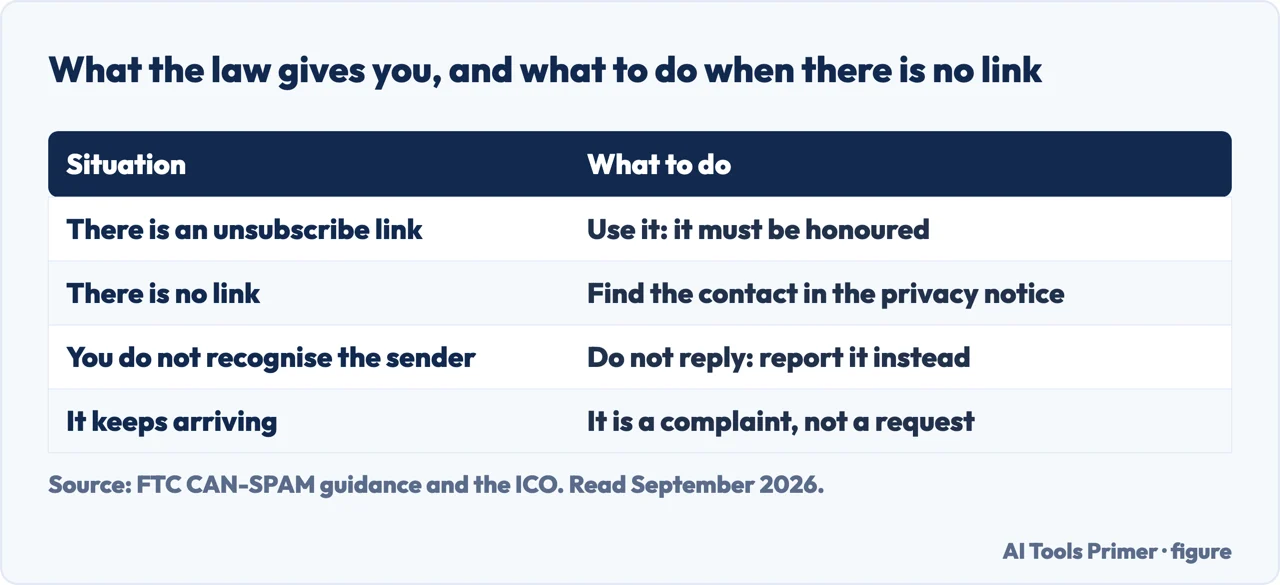
The other regime gives you a right rather than a courtesy, and a route when the link is missing. The UK regulator tells people to “follow any opt-out instructions within the email”, and then covers the case this page is really about: “if the email doesn’t provide any opt-out instructions, you should look for the organisation’s contact details on their website” — with the tip that a suitable address is usually in the privacy notice. It also warns against replying to mail from a sender you do not recognise, which is the line between unsubscribing and confirming that somebody reads the address.
The guides below take it four ways: doing it, the mail that is not marketing, cleaning up a mailbox that has years of it, and the wider question of where your address keeps coming from.
Where to start
Four ways in.
- “I get twenty of these a day.”
- Start at doing it
- “It is not really marketing.”
- Go to the mail that is not marketing
- “I want to clear years of it at once.”
- That is clearing a mailbox
- “How did they get my address?”
- That is where it comes from
Doing it
The link, the deadline, and how to tell a compliant process from one that is quietly refusing. All of it is checkable against published rules.
The mail that is not marketing
Some email is not covered by the opt-out rules at all, and telling the difference stops you waiting for something that is not coming.
Clearing a mailbox
Years of accumulated lists, and the tools that promise to handle it. Some of those tools want more access than the problem is worth.
Where it comes from
The address got onto those lists somehow. This wing is about the routes, and the ones you can close.
Not covered here. It will not tell you never to click unsubscribe. For a company you can name, the FTC’s rules make it a right with a deadline — and make selling your address afterwards unlawful.
It will not tell you to click it on unidentifiable mail either. Whoever sent that is already ignoring every requirement on this page.
And it will not recommend a mailbox-cleaning service. Most of them need access to everything in order to solve something smaller than that. What holds instead is simple: the ten-day deadline and the ban on selling addresses after an opt-out are the Federal Trade Commission’s published rules.
The rules on what you send and what you keep
What a small business has to put in writing: what you may send, what you must stop sending on request, and what you must keep.
- The same job, in the other places it comes up
- Email marketing laws, and the exception that does not exist
- How long to keep business records, by the people who ask for them
- How to write an invoice, and what the law requires on it
Sources
- US Federal Trade Commission — CAN-SPAM Act: A Compliance Guide for Business (the requirement to provide a clear opt-out, the option to stop all marketing messages, honouring requests within ten business days, keeping the mechanism working for at least thirty days, the ban on fees and on requiring information beyond an email address, the single-page limit, the ban on selling addresses after an opt-out, the physical postal address requirement, and that responsibility cannot be contracted away) — www.ftc.gov, read 22 August 2026.
- Information Commissioner’s Office — I keep receiving marketing emails and I want them to stop: what to do when there is no unsubscribe link, and when not to reply — ico.org.uk, read 4 September 2026.
Written by Alberto Gulotta
Founder and editor of AI Tools Primer, writing from Palermo, Italy. Thirty-five years of taking computers apart, starting with a Commodore 64 — the long version is on the about page.
Something wrong on this page? Write to aitoolsprimer@gmail.com and it gets fixed.
Written on 22 August 2026 · last checked 23 September 2026.
Independence and limits
No affiliate links and no paid placements anywhere on this site. Nobody pays to appear here, and no company has seen this page before you did.
This is general information, not professional advice. Where a page touches money, health, safety or the law, it names its source and the date it was read — and your situation may still differ. See the privacy page and the cookie policy.