
Business · guide
How long to keep business records, by the people who ask for them
By Alberto Gulotta · Updated · 12 min read
How long to keep business records has a published answer, from the organisations that would come and ask for them — and it is not a list of documents. The period belongs to the tax return a record supports, which is why the same invoice can be safe to shred or not.
| How long | When this applies | Source |
|---|---|---|
| 3 years | The ordinary case: “if situations (4), (5), and (6) below do not apply to you” | IRS |
| 3 years, or 2 from paying | “If you file a claim for credit or refund after you file your return” — whichever date is later | IRS |
| 4 years | Employment tax records, “after the date that the tax becomes due or is paid, whichever is later” | IRS |
| 6 years | “If you do not report income that you should report, and it is more than 25% of the gross income shown on your return” | IRS |
| 7 years | “If you file a claim for a loss from worthless securities or bad debt deduction” | IRS |
| Indefinitely | “If you do not file a return”, and “if you file a fraudulent return” | IRS |
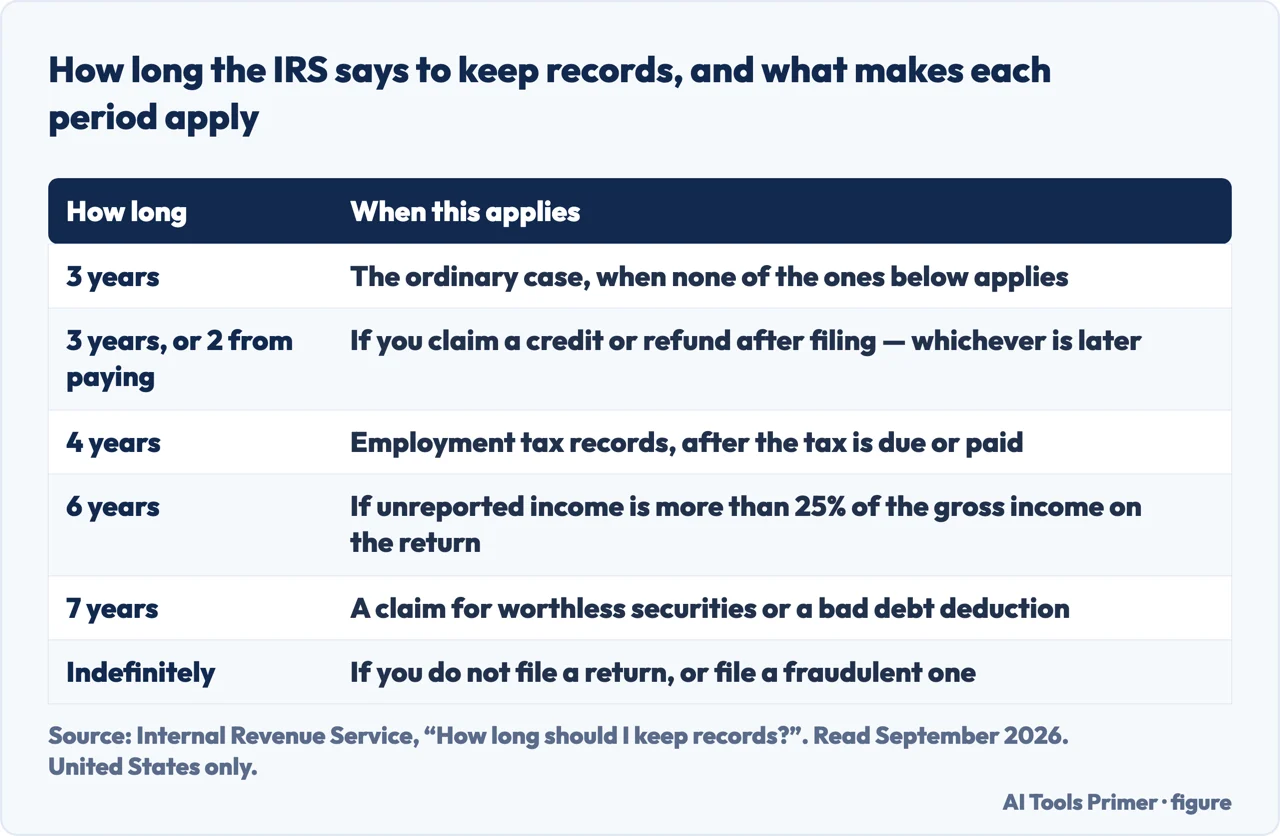
- Start from the return, not from the document. The IRS rule is about the tax return a record supports: “keep your records that support an item of income, deduction or credit shown on your tax return until the period of limitations for that tax return runs out.”
- Find which period applies to that return. Three years is the ordinary case; six if unreported income is more than a quarter of the gross income shown; indefinitely if no return was filed at all.
- Count from the right date. “Unless otherwise stated, the years refer to the period after the return was filed”, and a return filed early counts from the due date.
- Treat property separately. Keep those records “until the period of limitations expires for the year in which you dispose of the property” — which can be decades after you bought it.
- Before you throw anything away, ask who else wants it. The IRS says so itself: an insurance company or a creditor “may require you to keep them longer than the IRS does”.
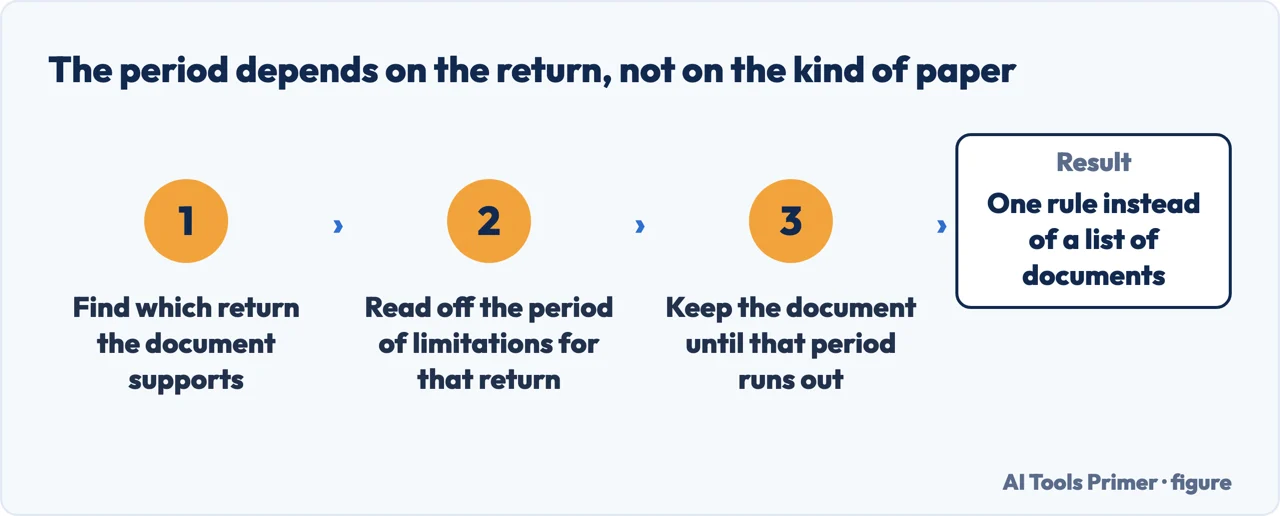
What the IRS actually says, in the United States
From “How long should I keep records?”, read 21 August 2026. The clock is not a filing convention — it is the “period of limitations”, the window in which you can amend a return or the IRS can assess more tax.
- 3 years
- The general case, where none of the situations below apply.
- 3 or 2 years
- “3 years from the date you filed your original return or 2 years from the date you paid the tax, whichever is later”, if you claim a credit or refund after filing.
- 4 years
- Employment tax records: “at least 4 years after the date that the tax becomes due or is paid, whichever is later”.
- 6 years
- “If you do not report income that you should report, and it is more than 25% of the gross income shown on your return”.
- 7 years
- “If you file a claim for a loss from worthless securities or bad debt deduction”.
- Forever
- If you do not file a return, or if you file a fraudulent one.
- Property
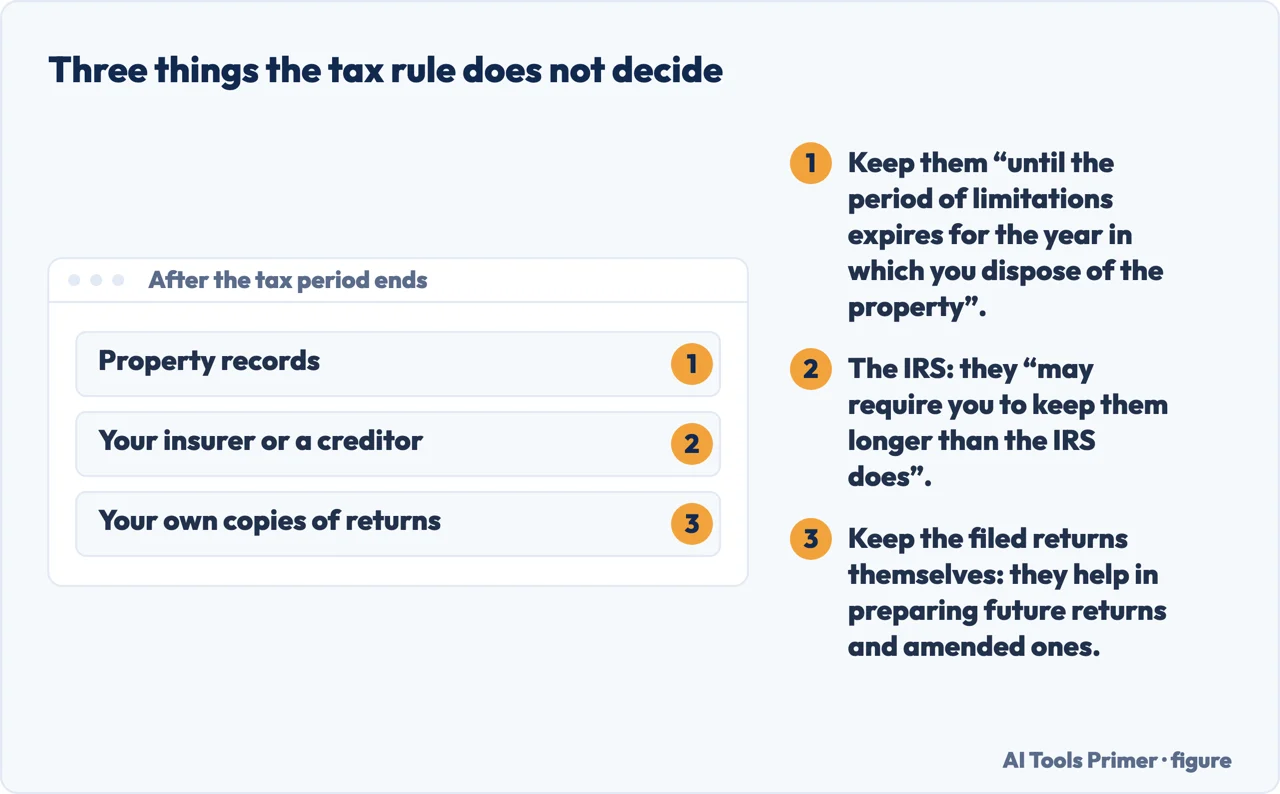
- Keep records “until the period of limitations expires for the year in which you dispose of the property” — because they are what establish gain, loss and depreciation.
Read the framing rather than only the numbers. The IRS is not telling you how long to keep paperwork as a matter of tidiness. It is telling you how long somebody can still ask questions about a particular return — and the records are what answer them. That is why the periods differ: the window is longer when the potential error is larger, and it never closes at all if no return was filed.
It also means the clock starts at the return rather than at the transaction, which is the whole argument for keeping receipts in an order you can search. A receipt from three years ago is not measured from its own date; it is measured from the filing of the return it appears on, and a return filed before its due date “is treated as filed on the due date”.
And the completely different shape of the same rule in the United Kingdom
“You must keep your records for at least 5 years after the 31 January submission deadline of the relevant tax year.” One number, running from a fixed date, rather than a set of situations.
GOV.UK’s own worked example: “If you sent your 2022 to 2023 tax return online by 31 January 2024, you must keep your records until at least the end of January 2029.”
With one exception: “If you send your tax return more than 4 years after the deadline, you’ll need to keep your records for 15 months after you send your tax return.”
Put the two side by side and the practical warning writes itself. The American rule is a set of situations and the British rule is a single period from a fixed date. Neither is a version of the other, and neither converts. A retention schedule copied from an American accounting firm’s blog is the wrong schedule for somebody filing in the United Kingdom, and the reverse is equally true — which is exactly the failure mode of a question answered almost entirely by companies rather than by authorities.
The sentence almost nobody copies across. The IRS ends its guidance by pointing outside its own authority: “When your records are no longer needed for tax purposes, do not discard them until you check to see if you have to keep them longer for other purposes. For example, your insurance company or creditors may require you to keep them longer than the IRS does.”
That caveat matters more than it looks, because it moves the decision. The tax period is a guide rather than a ceiling. Employment records, insurance claims, contracts under which somebody could still sue, and anything touching property or equipment all have their own clocks, and several of them run longer than the tax one.
The practical version, for somebody who just wants to know what to do. Work out your own tax period from the authority that applies to you, not from a blog. Treat that as the minimum. Keep anything connected to property, equipment or a loan until well after you have disposed of the thing, because those records are what establish what it cost you. And keep filed returns themselves indefinitely — the IRS suggests it in a note rather than a rule, and it costs nothing.
Digital copies. Both authorities accept records kept electronically, and the practical risk shifts accordingly: not fire or damp but format and access. A file you cannot open, a cloud account you have stopped paying for, or an export nobody ever tested is the modern version of a lost box. If you are keeping something for five or seven years, keep it in a format that will still open — a PDF or an image rather than the native file of a product that may not exist by then — and keep a copy somewhere that does not require a subscription to reach.
GOV.UK also says what to do if the worst happens, and it is calmer than the situation sounds: “If you cannot replace your records, you must do your best to provide figures”, telling HMRC at filing time which figures are estimated. Losing records is a problem to be declared rather than concealed, which is a useful thing to know before it happens.
Everything on this page is quoted from the two tax authorities, with the date each was read. Both apply only in their own country, and both change — which is why the date is on the page and why the right source for your own deadline is your own authority rather than any guide, including this one.
Where to start
Four ways in.
- “I just want the number.”
- The tables above — then see what to keep
- “I am closing the business.”
- The periods still run — what to keep
- “Where do I put all of it?”
- Go to storing it
What to keep
The periods above apply to records that support a return. Working out which documents those are is the other half of the question.
Storing it
Both authorities accept electronic records, which moves the risk from damp and fire to format and access.
The documents themselves
A record you cannot open in seven years is not a record. The practical side of keeping files readable for a long time.
Questions people also ask
How long should a small business keep records?
Three years covers the ordinary case, counted from when the return was filed. Six years if unreported income is more than 25% of the gross income shown on the return, seven for a claim from worthless securities or a bad debt, and indefinitely if no return was filed. These are the IRS periods, for the United States.
What business records should be kept for 7 years?
Only one category, in the IRS’s own wording: keep records for seven years “if you file a claim for a loss from worthless securities or bad debt deduction”. The often-repeated “seven years for everything” is not what the source says.
Why is the period different for different documents?
It is not, really. The period belongs to the tax return the record supports, not to the kind of paper: “keep your records that support an item of income, deduction or credit shown on your tax return until the period of limitations for that tax return runs out.”
Can I throw records away as soon as the tax period ends?
The IRS itself says to check first: “when your records are no longer needed for tax purposes, do not discard them until you check to see if you have to keep them longer for other purposes. For example, your insurance company or creditors may require you to keep them longer than the IRS does.”
Not covered here. It will not give you one number for everybody. Two tax authorities publish two completely different structures, and a single answer is only ever right in one country.
It will not tell you the tax period is the whole answer. The IRS itself says to check whether insurers or creditors need them for longer, and that sentence is quoted above because almost nobody carries it across.
And it will not sell you document storage or accounting software, which is what several guides on this question are ultimately for. What holds instead is simple: every period on this page is quoted from a tax authority — the Internal Revenue Service or GOV.UK — with the date it was read, and neither applies outside its own country.
The rules on what you send and what you keep
What a small business has to put in writing: what you may send, what you must stop sending on request, and what you must keep.
- The same job, in the other places it comes up
- Email marketing laws, and the exception that does not exist
- How to write an invoice, and what the law requires on it
- How to unsubscribe from emails, which is not a favour
Sources
- Internal Revenue Service — How long should I keep records?, including the periods of limitations, employment tax records and records connected to property — www.irs.gov, read 21 August 2026.
- GOV.UK — Business records if you’re self-employed: How long to keep your records, including the worked example and the rule for very late returns — www.gov.uk, read 21 August 2026.
Written by Alberto Gulotta
Founder and editor of AI Tools Primer, writing from Palermo, Italy. Thirty-five years of taking computers apart, starting with a Commodore 64 — the long version is on the about page.
Something wrong on this page? Write to aitoolsprimer@gmail.com and it gets fixed.
Written on 21 August 2026 · last checked 3 September 2026.
Independence and limits
No affiliate links and no paid placements anywhere on this site. Nobody pays to appear here, and no company has seen this page before you did.
This is general information, not professional advice. Where a page touches money, health, safety or the law, it names its source and the date it was read — and your situation may still differ. See the privacy page and the cookie policy.