
Chat · guide
ChatGPT limitations: OpenAI's list, the studies and GPT-5
By Alberto Gulotta · Updated · 16 min read
ChatGPT limitations are listed by OpenAI itself: wrong definitions, dates and facts, invented citations, confident answers to hard questions, and a knowledge cutoff. A review of 33 studies measured them, and OpenAI’s own GPT-5 figures report change. The pages we read do not give one error rate for ChatGPT today.
| Question | Answer | Where it comes from |
|---|---|---|
| Does OpenAI say ChatGPT can be wrong? | Yes: its Help Center lists wrong facts, invented references and overconfident answers to ambiguous or complex questions | OpenAI Help Center |
| Is there one error rate? | The pages we read do not give one for ChatGPT today; the review gives rates task by task, and 23 of its 33 studies do not name the version | Systematic review |
| What did the studies measure? | Accuracy, critical thinking, effects on learning, limits on input and output, and ethical questions; accuracy was the largest share | Systematic review |
| Has anything changed? | OpenAI reports fewer factual errors for GPT-5 than for GPT-4o and o3 in its own evaluations, and adds that more work remains | OpenAI, Introducing GPT-5 |
| What does OpenAI say to do? | Use ChatGPT as a first draft, not a final source, and verify quotes, data, technical information and references | OpenAI Help Center |
What OpenAI says ChatGPT cannot do
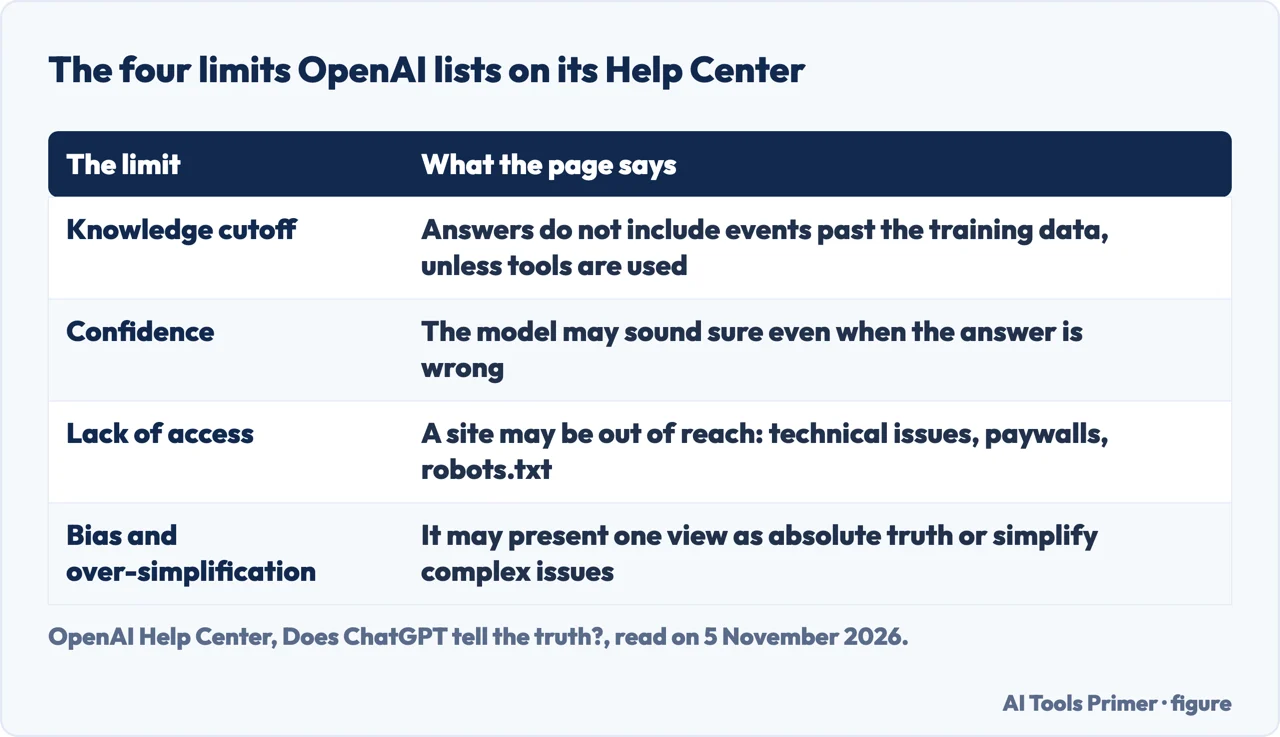
OpenAI’s Help Center page Does ChatGPT tell the truth?, which showed an update of 14 days earlier when we read it, says ChatGPT is designed to give useful responses based on patterns in the data it was trained on, but that it can produce incorrect or misleading outputs and may sound confident even when it is wrong. The page says this is often called a hallucination and gives three examples: incorrect definitions, dates or facts; fabricated quotes, studies, citations or references to sources that do not exist; and overconfident answers to ambiguous or complex questions.
Under a heading that says ChatGPT does not know everything, the page lists four limits. The first is a knowledge cutoff: the models are trained on data up to a certain point, and responses do not include events beyond it unless tools are used. The second is that confidence is not reliability. The third is a lack of access, because the model may not be able to get information from a website owing to technical issues, paywalls or preferences set through robots.txt. The fourth is bias and over-simplification: in some cases it may present a single perspective as absolute truth, oversimplify complex issues, or misrepresent the weight of scientific consensus or social debate.
The page also names tools that OpenAI says can improve factual accuracy, depending on the plan: Search, for current or niche information with cited answers; Code interpreter or Data analysis, for calculations, charts and structured logic; and Deep research, for multi-source cited answers. It says these tools are enabled for all models by default, and that without search the responses are based on what the model learned in training.
One limit concerns ChatGPT’s knowledge of itself. The page says it cannot reliably determine whether text was AI-generated or whether it wrote the text, and that it may make up answers to questions such as whether it wrote an essay. OpenAI calls those answers unreliable evidence of authorship.
The 2022 launch page and Coursera in 2026
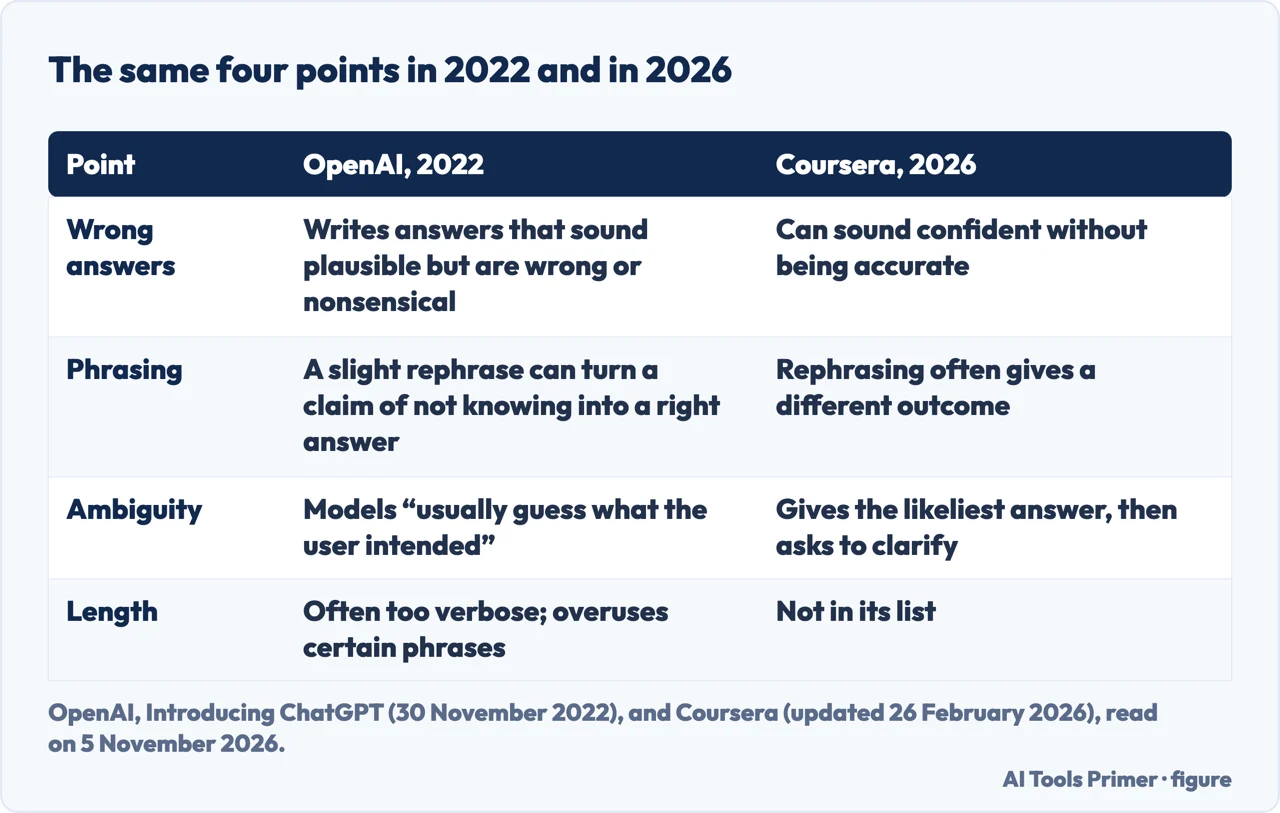
OpenAI’s Introducing ChatGPT, dated 30 November 2022, has a Limitations section. The page now carries a note saying that it introduced ChatGPT in 2022 and that ChatGPT has evolved substantially since. The section says ChatGPT sometimes writes plausible-sounding but incorrect or nonsensical answers, and gives three reasons why fixing this is challenging: there is currently no source of truth during reinforcement learning training; training the model to be more cautious makes it decline questions it can answer correctly; and supervised training misleads the model because the ideal answer depends on what the model knows, rather than on what the human demonstrator knows.
The same section says ChatGPT is sensitive to small changes in phrasing and to repeating the same prompt: with one phrasing the model can claim not to know the answer, while a slight rephrase gets a correct one. It also calls the model excessively verbose and says it overuses certain phrases, such as restating that it is a language model trained by OpenAI. OpenAI ties this to biases in the training data, where trainers prefer longer answers that look more comprehensive, and to over-optimization.
Coursera’s guide, updated on 26 February 2026, gives a longer list: inaccurate or outdated information, a lack of reasoning and deep understanding, sensitivity to prompt phrasing, trouble with ambiguous or contradictory inputs, bias, and no common sense or emotion. Its example of phrasing is a question about whether a bear makes a good pet based on its size, followed by the same question about a dog without restating it: Coursera says ChatGPT might answer only about the size of a dog.
The two pages overlap, and they differ in places. On ambiguity, OpenAI wrote in 2022 that ideally the model would ask clarifying questions, but that its current models “usually guess what the user intended”. Coursera writes that, rather than ask right away, ChatGPT gives the most likely answer and then asks for clarification, and that it does not understand irony or sarcasm. On the internet, Coursera says ChatGPT can search it for answers, while OpenAI’s Help Center says ChatGPT does not search the web unless specific tools are enabled, and that they are on by default. Coursera does not say which model its list describes. The pages we read do not say whether either description of ambiguity holds for every model today.
What 33 studies measured
A systematic review in the International Journal of Human-Computer Interaction, received on 15 December 2023 and published online on 8 May 2024, searched Scopus, Web of Science, ERIC and IEEE Xplore. It found 485 studies and selected 33 empirical ones. Its authors name five limitations: accuracy and reliability; critical thinking and problem-solving; effects on learning and development; technical constraints on input and output; and ethical, legal and privacy questions. Of the 33 studies, health made up 48.48 percent, education 15.15 percent and engineering 9.09 percent.
The review counts instances of limitations across the studies. Accuracy and reliability made up 47.06 percent of the instances, critical thinking and problem-solving 22.06 percent, ethical considerations 13.24 percent, understanding context and in-depth specialized topics 11.76 percent, and handling diverse inputs and outputs 10.29 percent. These are shares of the limitations the studies reported, not shares of ChatGPT’s answers that were wrong.
On versions, the authors write that 23 of the 33 studies (69.7 percent) did not report the version used. ChatGPT-3 appeared in 15.15 percent of the studies and version 3.5 in 12.12 percent, and one study combined 3.5 and 4. They say only one study on ChatGPT-4 was identified. The numbers below therefore come from studies that, in 23 cases, name no version; of the other ten, five name version 3, four version 3.5 and one a mix of 3.5 and 4.
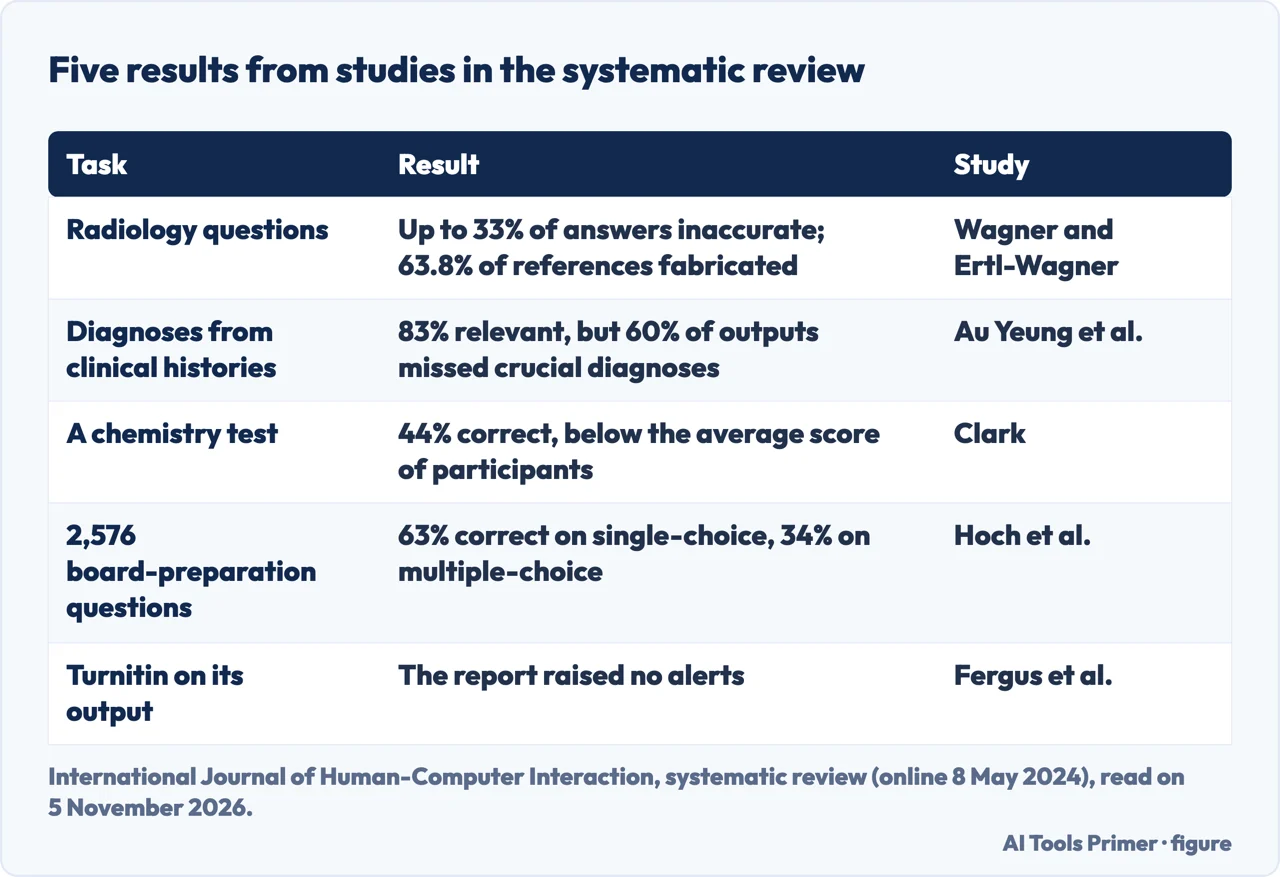
The review reports these results from the studies it covers. Wagner and Ertl-Wagner found up to 33 percent of responses to radiology questions inaccurate and 63.8 percent of the references fabricated. Au Yeung et al. asked ChatGPT to predict diagnoses from clinical histories: the responses scored 83 percent for relevance, but 60 percent of the outputs missed crucial diagnoses. Clark reported 44 percent correct on a chemistry test, below the average score of participants. Hoch et al. used 2,576 questions and found 63 percent accuracy on single-choice questions against 34 percent on multiple-choice ones, with 72 percent for allergology.
Other findings in the review are less numerical. In pharmaceutical chemistry, Fergus et al. found inconsistent answers, each containing a different error, and a Turnitin report on the generated text that raised no alerts. Giannos and Delardas reported more incorrect than correct answers on critical thinking and mathematical questions. Shoufan found inconsistent responses on code, with difficulty completing code, even code ChatGPT had generated. Lai found poor performance on advanced research questions, complex inquiries and queries involving locally specific information. Stojanov reports that the word limit on output can leave answers with incomplete information, and Sallam et al. say the word limit and the phrasing of prompts can affect how much information is generated.
The review lists its own limits. It does not assess the methodological quality of the studies, and it says it is unclear whether the limitations hold for more advanced versions such as ChatGPT-4. To that point it cites OpenAI (2023) acknowledging hallucinations, unreliability and a limited context window for GPT-4, and a study by Suchman et al. that found no demonstrable advantage for GPT-4 on a gastroenterology test.
What OpenAI reports has changed
OpenAI’s Introducing GPT-5, dated 7 August 2025, gives figures from OpenAI’s own evaluations. With web search enabled, on anonymized prompts representative of ChatGPT production traffic, GPT-5’s responses were about 45 percent less likely to contain a factual error than GPT-4o’s, and when thinking, about 80 percent less likely than OpenAI o3’s. On open-ended fact-seeking prompts from two public benchmarks, LongFact and FActScore, OpenAI says GPT-5 thinking has about six times fewer hallucinations than o3.
The page adds two figures on honesty. In a test on the CharXiv benchmark with every image removed from the prompts, OpenAI says o3 still gave confident answers about non-existent images 86.7 percent of the time, against 9 percent for GPT-5. On conversations representative of production ChatGPT traffic, it says rates of deception fell from 4.8 percent for o3 to 2.1 percent for GPT-5 reasoning responses, and that “more work remains to be done”. On prompts designed to provoke sycophancy, it reports a fall from 14.5 percent to under 6 percent.
These figures compare OpenAI’s newer models with its own older ones, on tests OpenAI chose. They cannot be added to the review’s percentages, which come from studies of versions 3 and 3.5, where they name one, in a review published in May 2024. The pages we read do not compare OpenAI’s figures with independent measurements of the newer models, and they do not give one error rate for ChatGPT today. The Help Center page, updated 14 days before we read it, still lists hallucinations and asks users to verify important information.
Where the pages flag trouble, and what they say to do
The pages we read do not give a list of tasks to avoid for each model. What they do contain can be read as five places where errors are reported.
- Who wrote a text. OpenAI says ChatGPT cannot reliably tell whether text was AI-generated or whether it wrote it, and that its answers on this are not reliable evidence of authorship.
- Quotes, studies and references. OpenAI lists fabricated ones among its examples, and the review reports 63.8 percent of the references in one set of radiology answers as fabricated. Our page on ChatGPT hallucinations looks at how to check each kind.
- Events after the cutoff. OpenAI says responses do not include events beyond the training data unless tools are used.
- Diagnoses from clinical histories. In the study the review cites, 60 percent of the outputs missed crucial diagnoses.
- Multiple-choice questions. In the 2,576-question study, accuracy was 34 percent on multiple-choice questions and 63 percent on single-choice ones; the review does not say here which version was tested, and most of its studies used versions 3 or 3.5 or name none.
For what to do, OpenAI’s Help Center says to use ChatGPT as a first draft, not a final source; to check important information; to verify quotes, data, technical information and references to external documents; and to use search or deep research and check sources by visiting the links directly when accuracy matters. Coursera gives four tips: fact-check outputs; break complicated tasks into several smaller prompts, which it calls chunking, because ChatGPT can become confused by too much information; ask in several different ways; and combine ChatGPT with human expertise to enhance human systems, not replace them. Our pages on accuracy and on asking properly go further on each.
A separate kind of limit is the allowance on a plan. OpenAI’s usage page, which showed an update of 4 days earlier when we read it, says that from December the usage allowance of Plus, Pro and Business plans will be shared across ChatGPT and Codex and measured in tokens, and that Instant chat will not draw from it. Coursera says the free tier limits use “within a five-hour period”. The two pages describe the allowance differently and we have not reconciled them; our page on free and paid plans takes that question up.
What we did not read for the ChatGPT limitations
We tested nothing in ChatGPT; every statement of fact here comes from the pages named at the foot of this page, read on 5 November 2026. The percentages from the studies are the review’s account of them: we did not open the studies it cites. The GPT-5 figures are OpenAI’s evaluations of its own models and we did not repeat them. We did not read OpenAI’s report on GPT-4, because our tools could not open the PDF. Google also listed a library guide that loaded as an empty shell, which we did not read, and a Northflank blog, a Reddit thread and an EssayDone page, which deal with plan limits, and the Google AI box was not read. We read a personal blog post from January 2023 and did not use it. We did not read OpenAI’s pages on account rules.
Where to start
Five ways in.
- “What does OpenAI say it gets wrong?”
- What OpenAI says ChatGPT cannot do — openai
- “Has the list changed since 2022?”
- The 2022 launch page and Coursera in 2026 — launch
- “What did the studies find?”
- What 33 studies measured — studies
- “Is it better now?”
- What OpenAI reports has changed — since
- “What should I double-check?”
- Where the pages flag trouble — avoid
Where the answers go wrong
Accuracy, hallucinations and bias.
Asking, paying, protecting
Asking well, plan limits and confidentiality.
Questions people also ask
Is there a limit using ChatGPT?
Yes, on plans. OpenAI’s usage page says the allowance for Plus, Pro and Business plans is measured in tokens and, from December, shared between ChatGPT and Codex, and that Instant chat will not draw from it. This page is about what ChatGPT gets wrong; our page on free and paid plans covers allowances.
Can you get banned from ChatGPT for NSFW?
The pages we read for this page do not mention bans or NSFW content; they cover the limits of the answers. We did not read OpenAI’s account rules, so we do not answer the question here.
What is the 5 hour limit in ChatGPT?
Coursera says the free tier limits how many times you can use ChatGPT within a five-hour period. OpenAI’s usage page, read the same day, speaks of an allowance in tokens and does not mention five hours. We have not reconciled the two; our page on free and paid plans takes up the question.
What shouldn’t you tell ChatGPT?
The pages we read on limits do not list things not to tell it. Coursera says ChatGPT raises security concerns because it can retain private and sensitive information, such as the phone number and email address used to log in, and in some cases information from past prompts. Our page on confidential information covers what OpenAI says.
Not covered here. We tested nothing in ChatGPT. The statements come from three OpenAI pages, OpenAI’s page on usage limits, a systematic review in the International Journal of Human-Computer Interaction and a Coursera guide, all read on 5 November 2026.
The search volume and difficulty behind this page come from an Ubersuggest reading of 5 November 2026, and the difficulty is Ubersuggest’s own score, not Semrush’s. The reading is not older than the 60 days the site normally allows.
Sources
- OpenAI Help Center — Does ChatGPT tell the truth? — help.openai.com, read 5 November 2026.
- OpenAI — Introducing ChatGPT (30 November 2022) — openai.com, read 5 November 2026.
- OpenAI — Introducing GPT-5 (7 August 2025) — openai.com, read 5 November 2026.
- OpenAI Help Center — Understanding ChatGPT and Codex usage limits — help.openai.com, read 5 November 2026.
- International Journal of Human-Computer Interaction — A Systematic Review of the Limitations and Associated Opportunities of ChatGPT (8 May 2024) — www.tandfonline.com, read 5 November 2026.
- Coursera — Understanding ChatGPT Limitations (updated 26 February 2026) — www.coursera.org, read 5 November 2026.
Written by Alberto Gulotta
Founder and editor of AI Tools Primer, writing from Palermo, Italy. Thirty-five years of taking computers apart, starting with a Commodore 64 — the long version is on the about page.
Something wrong on this page? Write to aitoolsprimer@gmail.com and it gets fixed.
Written on 6 November 2026.
Independence and limits
No affiliate links and no paid placements anywhere on this site. Nobody pays to appear here, and no company has seen this page before you did.
This is general information, not professional advice. Where a page touches money, health, safety or the law, it names its source and the date it was read — and your situation may still differ. See the privacy page and the cookie policy.