
Identity · guide
Fraud alert vs credit freeze: the order for a new account
By Alberto Gulotta · Updated · 18 min read
A fraud alert vs credit freeze choice in the United States: an alert tells lenders to check your identity and lasts one year, or seven if extended, while a freeze means a new account cannot be opened in your name until you lift it. For an account already opened in your name, IdentityTheft.gov gives a separate order.
| Question | Answer | Where it comes from |
|---|---|---|
| How long does each last? | An initial alert one year, an extended alert seven years; a freeze until you lift it | FTC, Experian |
| Where do I ask? | An alert at one bureau, which tells the other two; a freeze at all three, separately | FTC, Equifax |
| What does it cost? | Free, both of them | FTC, Experian |
| Can businesses still see my report? | With an alert, yes; with a freeze, Experian lists who still can | FTC, Experian |
| Does either protect an account that is already open? | Experian says neither protects existing accounts | Experian |
| Can I have both? | Yes: the FTC says to add an alert even with a freeze in place | FTC, TransUnion |
Alert or freeze: what the pages say each one is
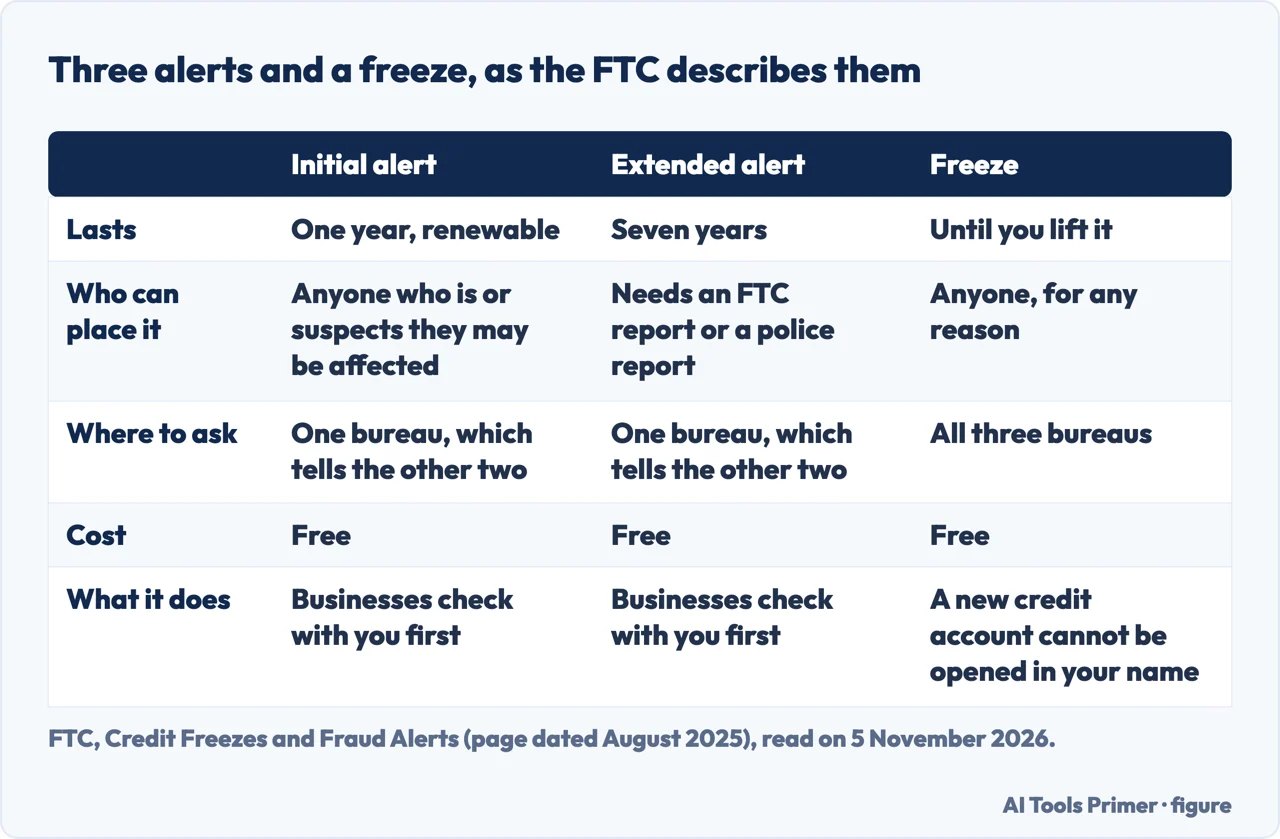
This page covers the United States, and the pages behind it come from the FTC, Experian, Equifax, TransUnion and the University of Wisconsin Extension. The FTC page, dated August 2025, describes a credit freeze like this: while it is in place, a new credit account cannot be opened in your name, and that includes you. It is free to place and to lift, it does not affect your credit score, and it lasts until you lift it. The FTC says anyone can place one, for any reason and without an identity theft, by contacting all three bureaus: Equifax, Experian and TransUnion.
A fraud alert works differently. The FTC says an initial fraud alert tells businesses to check with you before they open a new credit account in your name and, unlike a freeze, does not stop businesses from seeing your credit report. It is free, lasts one year and can be renewed. It is for anyone who is affected by identity theft or suspects they may be, and you ask one bureau, which must tell the other two. An extended alert lasts seven years and needs an FTC identity theft report or a police report; renewing it means submitting that report again. The FTC adds that an extended alert requires the bureaus to take you off their marketing lists for unsolicited credit and insurance offers for five years. An active duty alert lasts one year, can be renewed for the length of a deployment, and brings two years off those lists.
Experian’s page, dated 2 June 2026, puts the difference in a table. An alert instructs creditors to verify your identity before opening credit in your name; a freeze limits access to your credit report. Both are free and both can be renewed. For duration Experian gives one year for an initial or active-duty alert and seven for an extended one, against a freeze that is “indefinite until you remove it.” It says an alert set at one bureau is passed to the others, while all three bureaus must be told about a freeze separately, and that a freeze “requires a bit more management” from you. That matches the FTC. For the longer comparison, with credit locks and the freeze for children, the site has a separate page: credit freeze vs credit lock.
What the pages say neither does for an account that is already open
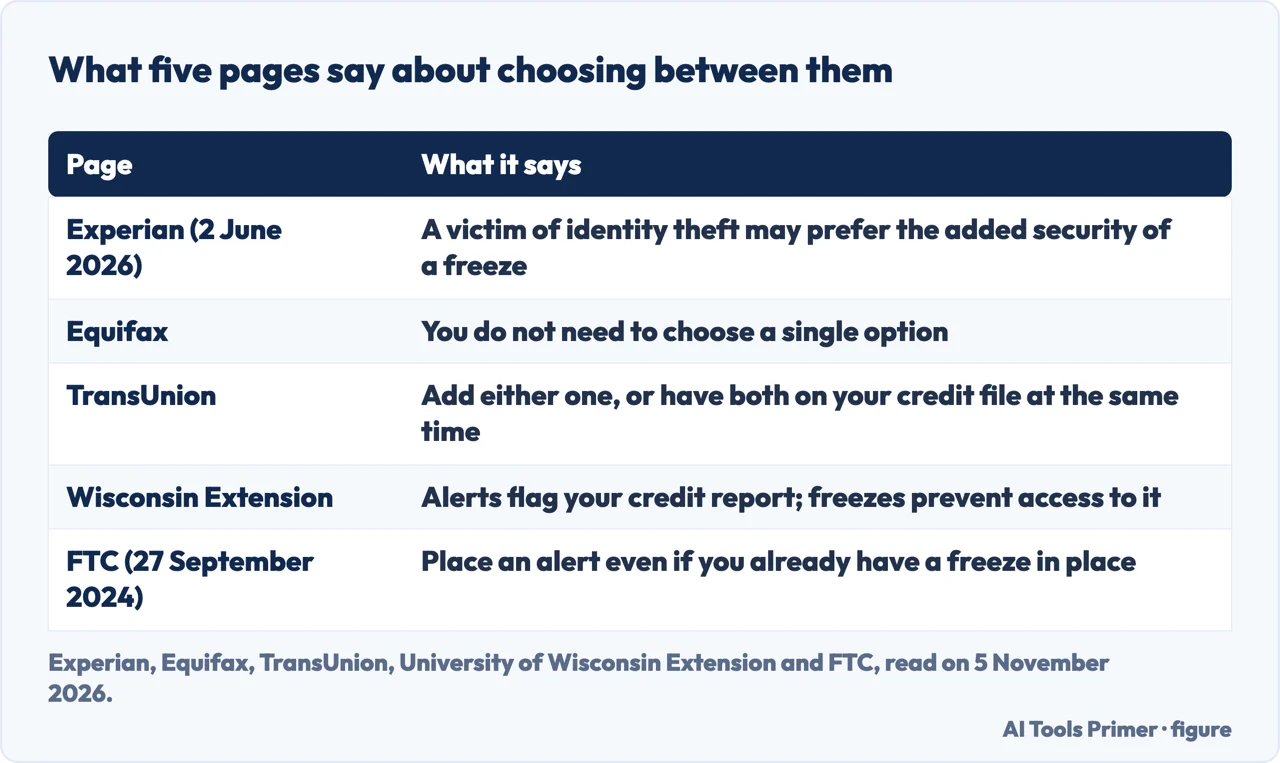
Experian says that both an alert and a freeze help against fraudulent credit accounts being opened in your name, but that neither protects your existing accounts or stops fraud that does not need a credit check. Its advice is to keep watching your credit reports and your financial accounts. The Wisconsin Extension page says the same about freezes: a freeze has no effect on existing accounts. It gives an example of what a freeze does not reach, which is a bank account. Someone could still open one in your name, the page says, because banks “typically” do not check your credit report when opening savings and checking accounts. For alerts it says that they, like freezes, only prevent identity theft that needs your credit report, such as applying for a loan, and that they are “less powerful than freezes”: an alert flags the report, while a freeze prevents access to it.
A freeze does not hide the report from everyone. Experian lists who can still see it during a freeze: you, current lenders and card issuers that run credit checks to manage your account, card issuers that have prescreened you for offers, landlords and rental agencies reviewing a rental application, employers you have authorized to run a background check, debt collectors pursuing a payment, child support agencies, and government agencies carrying out court orders or warrants. Equifax’s page says a freeze generally prevents access to your report to open new accounts, subject to certain exceptions. The FTC page, in its description of a freeze, does not list who can still see the report.
Equifax adds a product to the choice: a credit report lock, which it says generally has the same impact on your report as a freeze and which you switch on and off online or in its app. On Equifax you can have a freeze or a lock, not both. The page also says you do not need to choose a single option, and that Equifax recommends the ones that best suit your credit activity. Wisconsin lists among the issues to consider with a freeze that you must lift it each time you apply for new credit, which can potentially delay the application, and that you manage it with all three bureaus separately. Experian says that an unfreeze requested online or by phone must take effect within one hour.
The order for an account opened in your name
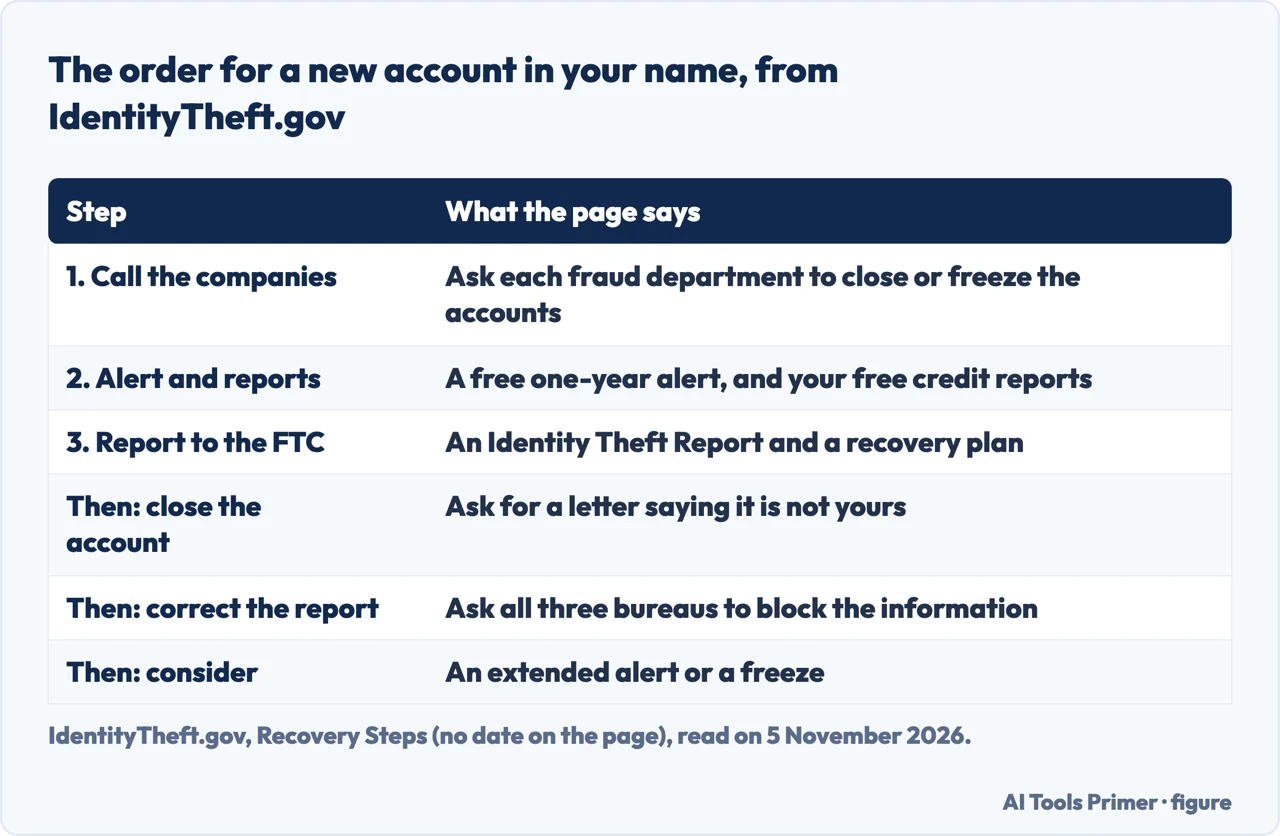
The FTC’s consumer alert of 27 September 2024 opens with the case this section is about: someone used your personal information to open new credit accounts in your name. It gives three steps, and the IdentityTheft.gov Steps page, which carries no date in the text we read, gives the same three with more detail.
Step 1 is a call to each company where you know the fraud happened. You ask for the fraud department, explain that someone stole your identity, ask the company to close or freeze the accounts, and change logins, passwords and PINs. IdentityTheft.gov adds that you might have to contact these companies again once you have an FTC Identity Theft Report.
Step 2 is the alert and the credit reports. You place a free one-year fraud alert by contacting one of the three bureaus, and that bureau must tell the other two. The FTC’s alert says to do it even if you already have a freeze in place, and adds that if you have not frozen your credit you should do that too. You get a letter from each bureau confirming the alert. The free reports come from AnnualCreditReport.com, where the page says you can check them every week for free, and you note any account or transaction you do not recognize, which helps when you report the theft.
Step 3 is the report to the FTC. You complete the online form on IdentityTheft.gov, or call 1-877-438-4338 (the number on the Steps page), with as many details as possible, and the site creates your Identity Theft Report and a recovery plan. The page says the report proves to businesses that someone stole your identity and guarantees you certain rights. With an account the site walks you through each step, tracks progress and pre-fills forms and letters; without one, the page says to print and save the report and plan right away, because once you leave the page you cannot get back to them. A police report is a separate choice, introduced with the words “You may choose”: you bring a copy of the FTC report, a photo ID, proof of your address and any other proof, and ask for a copy of the police report.
TransUnion orders it differently. Its page on reporting fraud on a credit report, which is marked as updated on 27 December 2024, lists the response as a freeze and an alert first, then contacting the company, then reporting to the FTC and local law enforcement, then disputing. The FTC puts the call to the company first. The pages do not say why, and we do not rank them.
The letter, and blocking the entry at the bureaus
Under “What To Do Next”, IdentityTheft.gov says that once you have the FTC report you call the fraud department of each business where an account was opened and ask it to close the account. You also ask for a letter confirming three things: the account is not yours, you are not liable for it, and it was removed from your credit report. The page says to keep the letter and use it if the account appears on your report later. The business may ask for a copy of the FTC report or for a special dispute form, and the page says to write down who you contacted and when.
The same page then covers the report itself. You write to each of the three bureaus with a copy of the FTC report and proof of your identity, such as your name, address and Social Security number, say which information came from the identity theft, and ask them to block it. The page calls this blocking: once the information is blocked it will not show on your report, and companies cannot try to collect the debt from you. With an FTC report the bureaus must honor the request. Without one you can still dispute incorrect information, but the page says it can take longer and there is no guarantee of removal.
TransUnion gives a time that the FTC pages do not. Its page says it can block fraudulent information if you send a valid identity theft report from the FTC or a law enforcement agency. Online, the dispute form has a box to check to say the documents relate to fraud; by mail you send the report, proof of identity and a letter that identifies the fraudulent information. If the request is acceptable, TransUnion says it will block the items within four business days of receipt, and if the information is also on your Equifax and Experian reports you dispute it with each of them separately. The Experian and Equifax pages we read give no number of days for blocking.
TransUnion also lists what fraud on a report can look like: hard inquiries you did not expect, open and active accounts you do not recognize, calls from dealers or lenders asking you to confirm personal information, and new loans you did not apply for. It says the lender’s contact details are in the account section of the report. For a checking account, IdentityTheft.gov says that if you think someone opened one in your name you can order a free copy of your ChexSystems report, which compiles information about your checking accounts, and then contact each institution where a new account was opened and ask it to close it. That is the case the Wisconsin page warns a freeze does not cover.
After the first steps: an extended alert or a freeze, and the debt
The “What To Do Next” list on IdentityTheft.gov asks you to consider an extended alert or a freeze, and puts them in a small chart. The extended alert is free to place and remove, is available if someone stole your identity, lasts seven years, and you ask one bureau and send a copy of the FTC report. The freeze is free to place and remove, is available to anyone, lasts until you lift or remove it, and you contact each of the three bureaus. The chart adds that parents, guardians and conservators can place a freeze for children under 16 or for adults under their care. The page ends this part with a reminder to review your credit reports often, free every week at AnnualCreditReport.com.
Which to choose is where the pages differ. Experian says a person who has been a victim of identity theft may prefer the added security of a freeze, and that an alert can be easier if you expect to apply for credit within the year, move or change jobs, because you do not have to keep freezing and thawing. It also says a freeze fits if you do not expect to apply for credit soon, and that you would need to thaw it if a cellphone or internet provider has to run a credit check. IdentityTheft.gov puts the one-year alert at Step 2 for everyone who reports a theft and the freeze or extended alert afterwards. The FTC’s consumer page says a freeze is always a good idea and matters even more after a breach or a misuse of your information. TransUnion says the choice is yours and you can have both on your file at the same time.
The pages also differ on the free reports and on removal. The FTC says that placing an initial alert gets you a free copy of your report from each of the three bureaus. TransUnion says you are entitled to one free report with an initial alert and two with an extended alert. TransUnion alerts you to one more point: when you remove an alert with TransUnion, it says it will not tell the other bureaus, and you contact Equifax and Experian yourself. Experian says lifting an alert means contacting each bureau individually. A TransUnion alert shows on your report the same day you place it, and TransUnion says lenders then call to verify a credit application. By phone it takes only an initial or an active duty alert; an extended one has to go online or by mail.
A debt that is not yours is covered under “Other Possible Steps” on the IdentityTheft.gov page. It says to write to the debt collector within 30 days of getting the collection letter, say someone stole your identity and you do not owe the debt, and send copies of your Identity Theft Report. You also contact the business where the account was opened, tell it to stop reporting the debt to the bureaus and ask for information about the debt, which the page says the business must give if you ask. If you have not yet asked the bureaus to block the information, it says to do that too. For a child, the FTC says a free freeze is available for under 16s and the bureaus give their own instructions; the site covers that case on child identity theft.
What we did not use
We did not open the pages of a bank and two credit unions that Google also listed, and we did not read the Google AI box. The pages we read do not say which of an alert, a freeze or the FTC report is the quickest. They do not give a time within which a business must close an account opened with fraud, and the only number of days for blocking is TransUnion’s four. They also do not say how many days after you find a credit account opened in your name you should report it; the deadlines for cards are on the page about card fraud.
On dates: the FTC page on freezes and alerts is dated August 2025, the FTC alert 27 September 2024 and Experian’s article 2 June 2026. The IdentityTheft.gov Steps text, the Equifax page, the TransUnion fraud alerts page and the Wisconsin article carry no date in the text we read; the TransUnion page on reporting fraud is marked as updated on 27 December 2024. The pages do not name the law behind either tool by section, so we name none. We left out the bureaus’ phone numbers and mailing addresses; they are on the IdentityTheft.gov Steps page. Tax, medical and child identity theft, and the steps for a lost Social Security card or a stolen passport, are on the same Steps page and are not covered here.
Where to start
Four ways in.
- “What is the difference?”
- Alert or freeze: what the pages say each one is — diff
- “Does it protect an account I already have?”
- What the pages say neither does — open
- “A new account is in my name.”
- The order for an account opened in your name — order
- “Which one should I keep?”
- After the first steps — after
Credit, cards and services
What a freeze, a card and a subscription each do.
Children and documents
Credit reports and monitoring.
Questions people also ask
Do I need a fraud alert if I have a credit freeze?
The FTC says you can place a fraud alert even if a freeze is already in place, and its recovery alert says to place one in that case too. Equifax says you do not need to choose a single option, and TransUnion says you can have both on your file at the same time.
Is there a downside to putting a fraud alert on your credit?
Experian and TransUnion say an alert does not affect your credit score. Experian lists wanting to avoid delays while rate shopping among reasons to remove one, and says lifting an alert means contacting each bureau. TransUnion says that removing its alert is not passed to the other bureaus.
What is the difference between a freeze and an alert?
The FTC says a freeze means a new credit account cannot be opened in your name, yours included, and lasts until you lift it, while an alert tells businesses to check with you first and does not stop them seeing your report. A freeze is asked for at all three bureaus, an alert at one.
What are the three types of fraud alerts?
The FTC lists an initial alert, which lasts one year, an extended alert, which lasts seven years and needs an FTC identity theft report or a police report, and an active duty alert for service members, which lasts one year and can be renewed for a deployment.
Not covered here. We placed no alert or freeze and tested nothing on a credit file. The statements come from two FTC pages, the IdentityTheft.gov Steps page, Experian, Equifax, two TransUnion pages and a University of Wisconsin Extension article, all read on 5 November 2026.
The search volume and difficulty behind this page come from an Ubersuggest reading of 5 November 2026 (United States), which gives search volume and its own SEO difficulty score, not Semrush’s. A Semrush measurement is still to be made.
Sources
- FTC — Credit Freezes and Fraud Alerts (August 2025) — consumer.ftc.gov, read 5 November 2026.
- IdentityTheft.gov — Recovery Steps — www.identitytheft.gov, read 5 November 2026.
- FTC — How to recover from identity theft (27 September 2024) — consumer.ftc.gov, read 5 November 2026.
- Experian — Fraud Alert vs. Credit Freeze: Key Differences Explained — www.experian.com, read 5 November 2026.
- Equifax — Fraud Alert vs. Security Freeze vs. Credit Lock — www.equifax.com, read 5 November 2026.
- TransUnion — Fraud Alerts — www.transunion.com, read 5 November 2026.
- TransUnion — How to Report Fraud on Your Credit Report — www.transunion.com, read 5 November 2026.
- University of Wisconsin Extension — Security Freezes and Fraud Alerts — finances.extension.wisc.edu, read 5 November 2026.
Written by Alberto Gulotta
Founder and editor of AI Tools Primer, writing from Palermo, Italy. Thirty-five years of taking computers apart, starting with a Commodore 64 — the long version is on the about page.
Something wrong on this page? Write to aitoolsprimer@gmail.com and it gets fixed.
Written on 6 November 2026.
Independence and limits
No affiliate links and no paid placements anywhere on this site. Nobody pays to appear here, and no company has seen this page before you did.
This is general information, not professional advice. Where a page touches money, health, safety or the law, it names its source and the date it was read — and your situation may still differ. See the privacy page and the cookie policy.