
Images · guide
How AI image generation works: the routes, the steps and the prompt
By Alberto Gulotta · Updated · 15 min read
AI image generation turns a written prompt into a picture, and the pages we read describe three routes to it: adversarial networks, diffusion and autoregression. The pages differ on which route most generators use. This page follows the diffusion route from noise to picture, then the parts that steer it.
| Question | Answer | Where it comes from |
|---|---|---|
| What is it? | A type of generative AI that builds images from a set of examples | Cloudflare |
| Which route do most generators use? | Cloudflare says adversarial networks; AWS and IBM describe diffusion as the newer method that improves on GANs; Zapier names diffusion and autoregression | Cloudflare, AWS, IBM, Zapier |
| How does diffusion work? | Noise is added to images in training, then a network learns to remove it step by step | AWS, IBM |
| How does the prompt steer it? | An encoder such as CLIP turns the prompt into instructions, and guidance pushes the result toward them | AWS, IBM |
| Why is it fast enough to use? | Latent diffusion works in a smaller space and a decoder restores the full size | AWS, IBM |
| Does it get things wrong? | Yes: Cloudflare gives an extra finger on a hand in a portrait as its example | Cloudflare |
What “generating” means on these pages
Cloudflare’s learning page defines AI image generation as a type of generative AI for producing visual content. It says the generators use mathematical analysis to identify and duplicate patterns within photos and illustrations, and sums that up as creating images based on a set of examples. They are built on a neural network, which Cloudflare describes as a collection of processing units called nodes that pass data to each other. Zapier gives the training side in its own words: billions of image-text pairs are used to train a neural network on what things are, so it learns what dogs, the color red and Vermeers are, and can then interpret almost any prompt, though Zapier adds that there is a skill in setting things up so it does so accurately.
Cloudflare’s picture of the result is a bet. Rather than an artist with a paintbrush, it says, an image generator is more like a gambler placing bets on probable sporting outcomes: what it produces is statistically likely to fulfill the request it received, and it is based on preexisting content. Cloudflare also notes that image models are trained on sets of visual images, as opposed to the large amounts of text used for large language models such as ChatGPT. As for the request itself, Cloudflare calls “Make an image of an elephant” a valid prompt that may need to be refined before it produces the image the prompter has in mind.
The older route and the newer ones
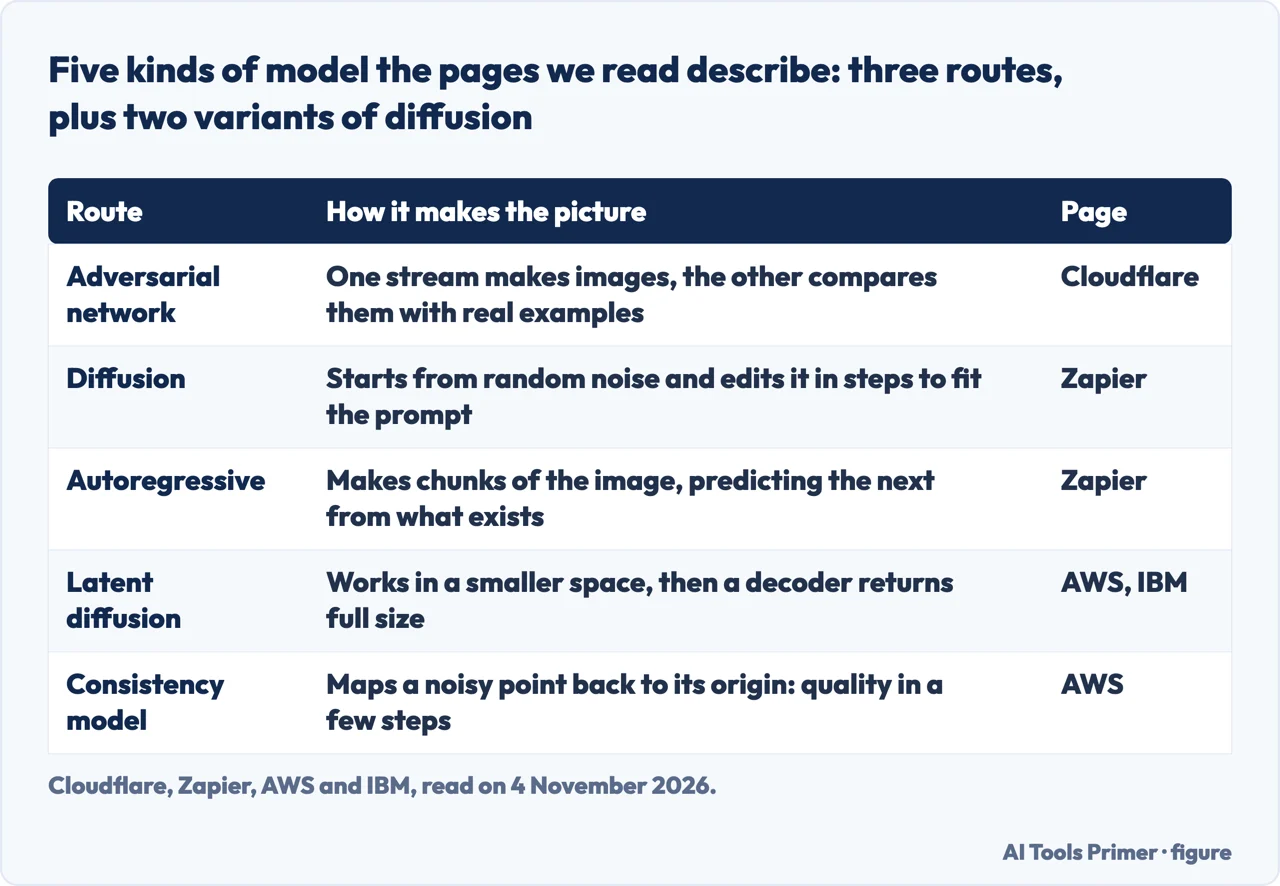
Cloudflare says the kind of neural network used by most image generating AI models is the generative adversarial network, or GAN. A GAN has two workstreams: one produces images, and the other compares those images to real-life examples and identifies errors, so the model can train itself and keep improving. Cloudflare compares it to a painter who learns by imitating famous paintings and checking the work against the real pieces. AWS, comparing the two routes, adds a trade-off: a GAN produces its output in a single pass and is faster than diffusion, but is more prone to mode collapse, while diffusion’s step-by-step denoising is slower but gives highly stable training and more diverse outputs. The Cloudflare text we read does not mention diffusion.
AWS tells a different story. Before diffusion models rose, it says, data scientists primarily used GANs and variational autoencoders, known as VAEs. GANs pit two networks against each other, which AWS says can make them unstable and open to “mode collapse,” where the model stops learning and produces only a narrow range of outputs. VAEs train more stably, but AWS says their compression typically produces less detail. Diffusion, in AWS’s account, addresses both problems with a sequential and highly stable training process. IBM agrees on the direction: it says diffusion improves on VAEs, GANs and autoregressive models such as PixelCNN, and names Stable Diffusion, DALL-E (beginning with DALL-E-2), Midjourney and Google’s Imagen as the popular text-to-image models it most notably represents. For the history it points to a 2020 result that diffusion probabilistic models could reach image quality competitive with GANs, then to a 2021 paper whose title says diffusion models beat GANs on image synthesis.
Zapier puts a third route beside diffusion. It says there are two primary ways of rendering the image: diffusion models start with a random field of noise and edit it in a series of steps to match their understanding of the prompt, while autoregressive models generate chunks of the image at a time, predicting the next chunk from what they have already created. Zapier says GPT Image 2.5, which is integrated with ChatGPT, uses an autoregressive model instead of diffusion, and that this is why it is a bit slower than the other generators on its list and produces a single image.
So the pages differ. Cloudflare names GANs as the type most models use, AWS and IBM describe diffusion as the newer method that overtook them, and Zapier sets diffusion and autoregression side by side. The pages carry different dates: the Cloudflare text we read shows none, IBM’s page is dated 21 August 2024, and Zapier’s was last updated in October 2026. From the pages alone we cannot say which description is current for a given service.
From noise to picture, step by step
IBM explains diffusion with an analogy from physics: treat pixels like the molecules of a drop of ink spreading out in a glass of water. As the ink disperses evenly, the random introduction of noise into an image leads to what looks like TV static. If a model can learn to reverse that process, IBM says, it can generate new images by denoising samples of random noise.
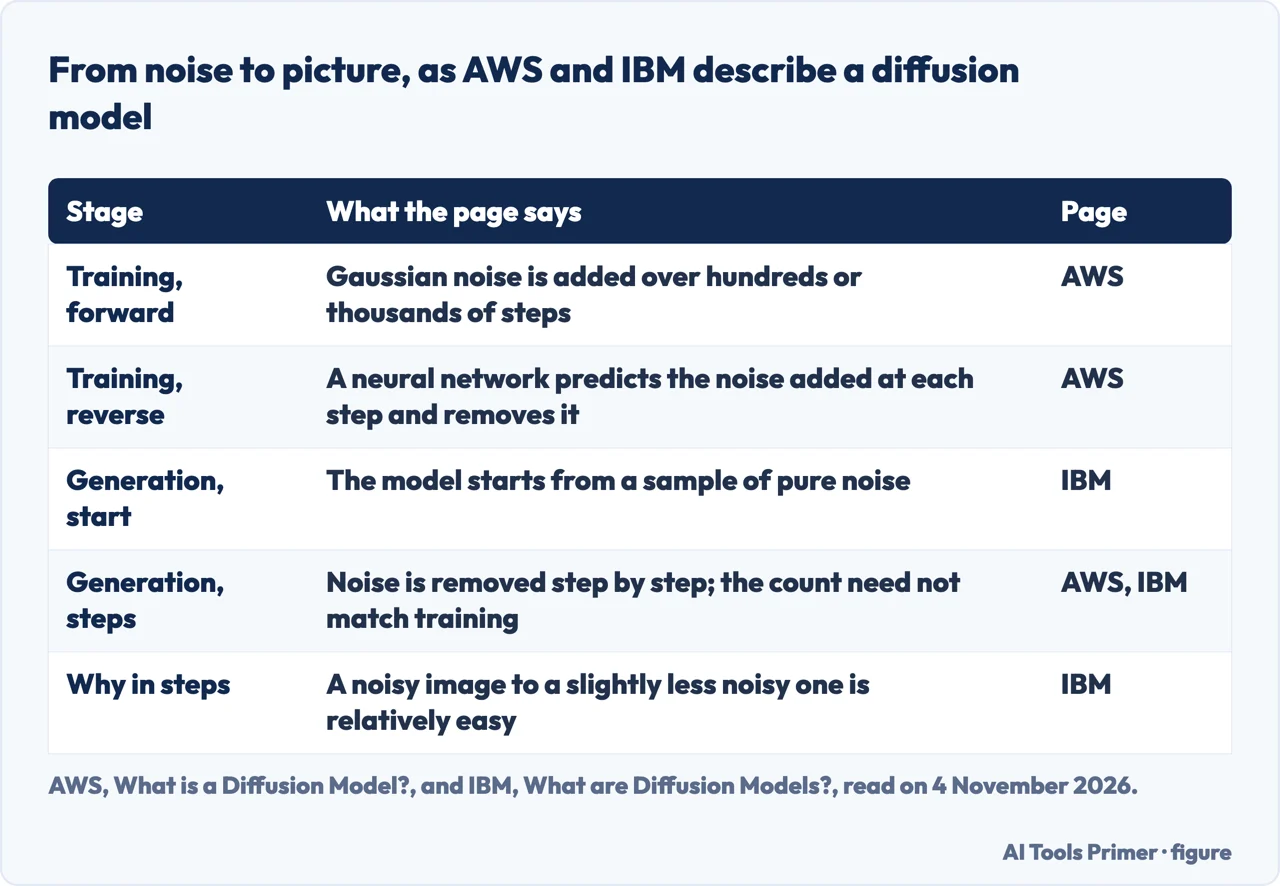
AWS describes the learning in two phases. In the forward process, the model takes an input such as a photograph and adds Gaussian noise over hundreds or thousands of timesteps until the image is unrecognizable. AWS calls this a Markov chain, meaning the noise added at a given step depends only on the state of the data from the step just before. In the reverse process a neural network, previously built on a U-Net architecture and now commonly on transformer architectures according to AWS, predicts the specific amount of noise added at each timestep and removes that estimate. IBM describes the U-Net as the typical choice for latent diffusion.
Why do it in steps? IBM says directly transforming random noise into a coherent image is extremely difficult, while transforming a noisy image into a slightly less noisy one is relatively easy. AWS adds that the schedule matters: early models added noise at a constant rate, which it says destroys the recognizable structure of an image too rapidly, and cosine schedules, which add Gaussian noise more gradually, improve both the stability of training and the quality of the output.
To generate, the system starts from a sample of pure noise and removes it step by step. IBM says a slight element of randomness in the sampling lets the model produce new images that resemble the training data rather than reproduce it, and that the number of steps in generation does not have to match the number used in training. AWS describes the standard approach, DDPM, as following every timestep used in training, which makes it relatively expensive. A variant called DDIM skips timesteps, which lowers processing cost and speeds up generation, with a slight loss of final image quality. Zapier’s page shows a dog-shaped cloud at 10, 20, 40 and 120 steps. The pages we read do not say how many steps any particular service uses. AWS does give orders of magnitude: DDIM and the DPM-Solver framework can generate images in 10 to 20 steps instead of hundreds or thousands, and consistency distillation can reach high-quality output in one or two.
Why a prompt steers the result
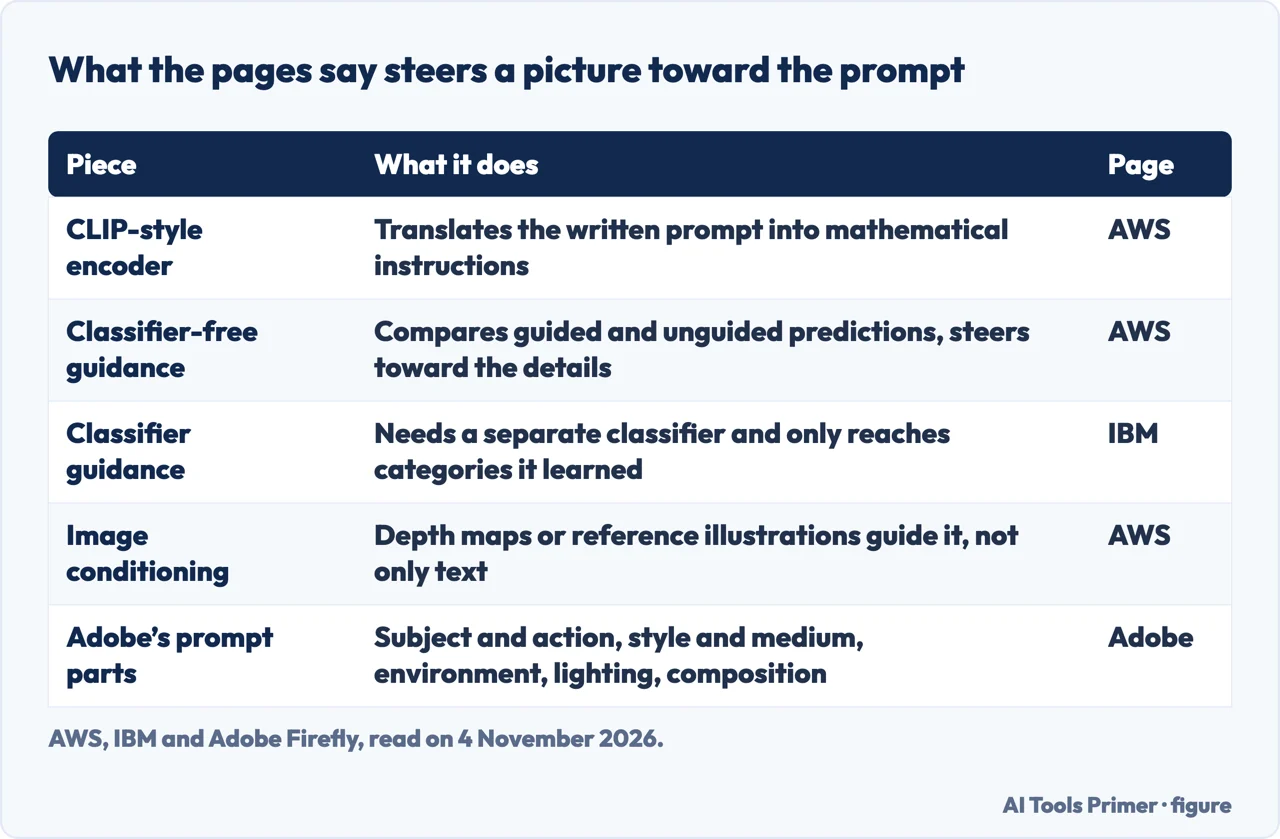
A diffusion model with nothing to follow would produce random output. AWS says the model has to be conditioned, and that systems use encoders such as CLIP to translate written prompts into mathematical instructions it can follow. IBM describes the most common guided model as text-to-image: the diffusion model is paired with a separate language model that interprets a prompt such as “a giraffe wearing a top hat,” an approach it traces to a Google paper.
Two ways of guiding appear on the pages. AWS describes classifier-free guidance as the technique that makes the model adhere to the prompt: during denoising it calculates the difference between a prediction guided by the prompt and an unguided one, then steers the final output closer to the details requested. IBM sets it against classifier guidance. The classifier version needs a separate classifier model and can only condition outputs on the categories that classifier learned; the classifier-free version needs no separate model but a two-stage model trained for the purpose, and IBM says its benefit is zero-shot guidance for image categories the model has not seen. AWS adds image conditioning, in which visual inputs such as depth maps or reference illustrations guide the output in place of relying solely on text.
On the writing side, the pages give plain advice. Cloudflare says a short prompt may need refining. Adobe’s Firefly page says to be as descriptive as possible and to cover subject and action, style and medium, environment, lighting and composition; its example is a product shot of a sushi roll underwater, with keywords such as lighting, angle or mood added after. Adobe’s prompt field shows a message that a prompt exceeds the maximum length of 750 characters, and the page says each prompt produces up to four image suggestions. The pages we read do not say why one word in a prompt counts for more than another; encoders and guidance are the mechanisms they give.
Why it is fast enough to use, and why it still gets things wrong
Working on full-resolution pixels at every step is costly. IBM says conventional diffusion models are slow and computationally expensive, and that latent diffusion models, beginning with Stable Diffusion, greatly reduced the problem. AWS explains the idea: compress the data into a smaller latent space, add and remove the noise entirely there, which reduces memory requirements and hardware costs, then use a decoder to expand the result back into a full-resolution image. AWS says this architecture is what makes it possible to run models like Stable Diffusion on consumer-grade hardware.
AWS also describes consistency models as a newer class designed for the slow sampling of traditional diffusion: they are trained to map any noisy data point back to its origin, which it says can produce high-quality output in only a few steps. Among uses of diffusion models it lists inpainting, which replaces or modifies specific areas of an existing image, and outpainting, which extends its borders. For editing an image you already have, our page on editing with AI compares two ways of doing it.
Faster does not mean correct. Cloudflare says hallucinations can occur with any type of generative AI model, and in images they show up as inaccuracies, for instance an extra finger on the hand of the subject of a portrait; it adds that with sufficient prompting and refining it is usually possible to remove them. Zapier raises bias: it writes that AI has a lot of the same biases as humans, which can lead to everything from stereotypes to harmful content, that it saw this in outputs from some of the apps it tested while others take deliberate steps to add diversity, and that people should review the content and refine their prompts. Our pages on confident wrong answers and bias and gaps cover the same two questions for ChatGPT’s text.
What the pages leave open
On training data, Adobe states that its Firefly models are trained on licensed images from Adobe Stock and on public domain content whose copyright has expired; that is Adobe’s statement about its own models. The page describes the general idea as a model that learns from thousands and thousands of pictures and then applies what it has learned to the everyday language in the prompt field. The pages we read do not say what data Midjourney, DALL-E or ChatGPT were trained on.
On rights, Adobe’s FAQ answers the question of owning copyright in what you generate with a single line: it depends on the laws of your local jurisdiction, and it points to a blog post by Adobe’s lead copyright attorney. Zapier writes that there aren’t clear laws on AI-generated images, that the U.S. Copyright Office suggests AI-generated content isn’t copyright-protected without significant human input, and that there aren’t rules to protect artists whose work was scraped for training. Those are Zapier’s words, not a legal ruling we checked.
On speed and cost, the explanations of how the models work give no figures for any named service; Zapier’s comparison table does list subscription prices for several services, and this page does not repeat them. And the second question in the table at the top of this page, which route most generators use, is answered differently by Cloudflare, by AWS and IBM, and by Zapier, as set out above. We have not tried to settle it, and we have not compared products or ranked them.
Where to start
Five ways in.
- “What is it doing when it generates?”
- What “generating” means on these pages — what
- “Is it GANs, diffusion or something else?”
- The older route and the newer ones — routes
- “How does noise become a picture?”
- From noise to picture, step by step — noise
- “Why does the prompt matter?”
- Why a prompt steers the result — prompt
- “Why does it get things wrong?”
- Why it is fast enough to use, and why it still gets things wrong — limits
Editing and retouching a picture
Changing a picture you already have.
Errors and bias
What chatbots get wrong, and where they lean one way.
Questions people also ask
Which is the best AI image generator?
This page does not rank generators; it covers how they work. Where the pages we read separate products, it is by route: Zapier says the model integrated with ChatGPT is autoregressive and a bit slower, while IBM lists Stable Diffusion, DALL-E, Midjourney and Imagen as diffusion examples.
Can ChatGPT make AI photos?
Zapier says GPT Image 2.5, integrated with ChatGPT, creates an image when you tell ChatGPT what you want to see, using an autoregressive model. Cloudflare says image generators can create realistic-seeming photographs. Our page on editing with AI covers changing a picture you already have.
Is any AI image generator free?
Adobe’s Firefly page says you can use its generator for free with an Adobe account, with free daily generations on a free account, and that paid plans exist for higher-volume use. Zapier’s comparison table lists subscription prices for several services, but this page is about how the models work and does not repeat them or compare plans.
Is the ChatGPT image generator free?
Our page on editing with AI covers the free limits, from OpenAI’s help pages. Zapier’s table lists GPT Image 2.5 as free with ChatGPT, with fewer restrictions on paid plans; the sections of the pages that explain how the models work do not cover its limits.
Not covered here. We generated no images and tested no service. The statements come from five pages (Cloudflare, AWS, IBM, Adobe Firefly and Zapier), all read on 4 November 2026; the IBM page is dated 21 August 2024 and Zapier’s was last updated in October 2026.
The search volume and difficulty behind this page come from a Semrush reading of 29 August 2026, older than the 60 days the site normally allows; that reading expired on 28 October 2026 and is used here with the owner’s authorization, so the figures should be read again.
Sources
- Cloudflare Learning Center — What is AI image generation? — www.cloudflare.com, read 4 November 2026.
- AWS — What is a Diffusion Model? — aws.amazon.com, read 4 November 2026.
- IBM Think — What are Diffusion Models? (published 21 August 2024) — www.ibm.com, read 4 November 2026.
- Adobe Firefly — Text to Image (product page) — www.adobe.com, read 4 November 2026.
- Zapier — The 6 best AI image generators in 2026 (updated October 2026) — zapier.com, read 4 November 2026.
Written by Alberto Gulotta
Founder and editor of AI Tools Primer, writing from Palermo, Italy. Thirty-five years of taking computers apart, starting with a Commodore 64 — the long version is on the about page.
Something wrong on this page? Write to aitoolsprimer@gmail.com and it gets fixed.
Written on 4 November 2026.
Independence and limits
No affiliate links and no paid placements anywhere on this site. Nobody pays to appear here, and no company has seen this page before you did.
This is general information, not professional advice. Where a page touches money, health, safety or the law, it names its source and the date it was read — and your situation may still differ. See the privacy page and the cookie policy.