
Scams · guide
Free cell phone number lookup with name no charge: three promises
By Alberto Gulotta · Updated · 19 min read
A free cell phone number lookup with name no charge is promised three different ways. Whitepages says cell numbers may require a fee, SpyDialer says the name is free when it is available, and Truecaller shows a name its users suggested after you sign in. The FTC says a name or a number can also buy a report.
| Question | Answer | Where it comes from |
|---|---|---|
| Is the name free for a cell number? | Whitepages says cell numbers may require a fee; SpyDialer says free when available; Truecaller says free after sign-in | The three services |
| Where does the name come from? | Public records on two pages, names suggested by users on Truecaller’s | Whitepages, SpyDialer, Truecaller |
| What can a name or number buy elsewhere? | A report with age, addresses, and the names and addresses of family members | FTC |
| Can I get my number out of such sites? | Most have an opt-out, which does not delete public records | FTC |
| Where do I report a bad call? | The FCC for unwanted calls; the FTC for phone scams and Do Not Call violations | FCC |
Three services, three promises about a cell number
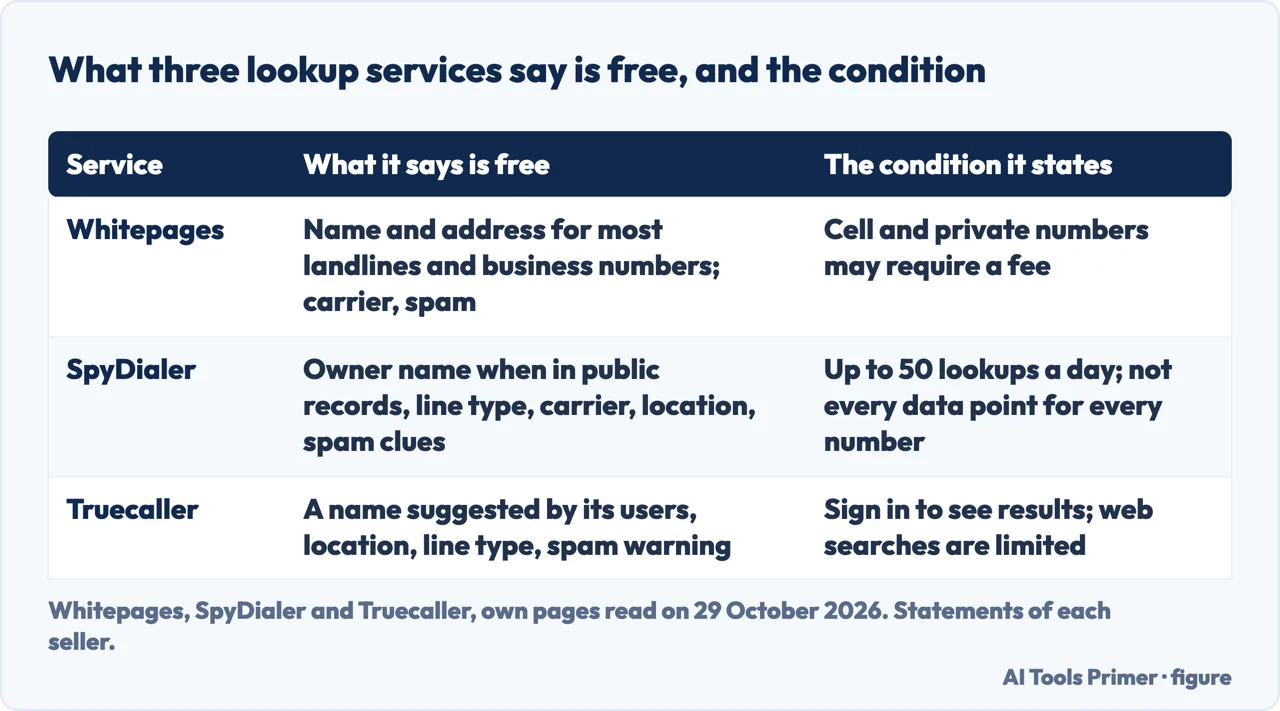
The three services we read all describe a lookup that starts from a number, and all three describe a free part. They do not describe the same free part for a cell phone. Whitepages says its reverse phone lookup covers 260 million U.S. phone numbers and returns a name, a line type (cellular, landline or VoIP), the last known carrier and a spam risk with a count of reports. Its list of free and premium lookups puts the owner’s name and address for most landlines and business numbers in the free column, and the full name for all phone numbers, the complete address, the exact age and the date of birth in the premium one. In its FAQ, Whitepages adds that cell phones and private phone numbers may require a fee.
The same page words the free coverage two ways. The comparison says “most landlines and business numbers”; the FAQ answer on whether lookups are free says they cover all landlines and business phone numbers. Another answer says a lookup works for cell phones, and the answer on finding an address from a phone number mentions a Premium monthly subscription or a one-time contact details report.
SpyDialer’s page says no sign-up is required. It says a result can show the owner’s name “when available in public records”, the line type (cell phone, landline or VoIP), the carrier, the city and state, and spam clues, and that you can run up to 50 lookups a day. It also says results vary by number and that not all data points are available for every lookup, and it states no charge, no credit card and no account. The page carries blocks labelled Advertisement.
Truecaller’s page is headed “100% Free Reverse Phone Lookup”, and a footnote says it has several free services and more advanced features for Premium users. Its FAQ says the name shown is the one its community of users suggests: if enough users report a caller as ‘Insurance spam’, that is the name the lookup shows. To see results you sign in, and the web tool allows a limited number of searches; for more free lookups the page points to its app. On the web you can only mark a number as spam, and blocking needs the app. Truecaller also says it is not a background check service.
Side by side, the first figure shows three different promises for the same kind of number: a fee may apply (Whitepages), the name is free when it is available (SpyDialer), and the name is free after you sign in (Truecaller). Each is the seller’s own statement, and the pages we read do not test them. Whitepages and Truecaller call their results accurate but give no figure for how often the name returned for a cell number is correct; SpyDialer says only that it returns owner name matches for the majority of U.S. numbers and that results are not guaranteed and may reflect outdated public data. Whitepages and SpyDialer each carry user comments that praise accuracy, but those are comments on the sellers’ own pages, not measurements, and Truecaller’s statement that it is highly effective at identifying unlisted cell numbers is its own comparison with paid directory sites.
Where the name comes from, and what a number can open
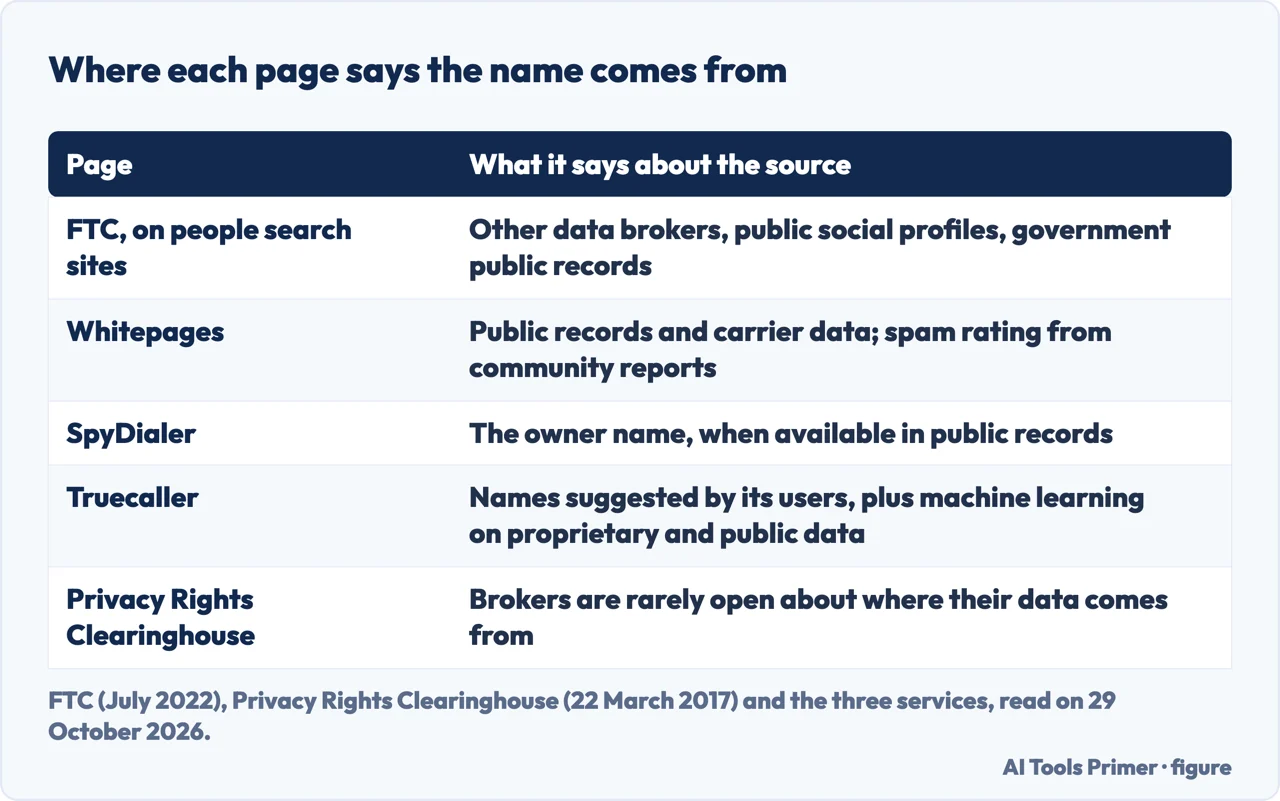
The FTC page, dated July 2022, describes the kind of business that sits behind many name lookups. People search sites, it says, collect personal information from a variety of sources, compile it into a report and sell the report to anyone willing to pay, and they are a type of data broker. To build a report they may buy information from other data brokers, collect it from social media profiles that are public, and compile it from federal, state and local public records: property, driving, voter registration, criminal and civil records, birth, marriage, divorce and death records, and professional licences.
The FTC adds that if someone has just one piece of information about you, such as a name or a phone number, they could buy a report with your age, date of birth and gender, other names you have used, current and previous addresses, properties, marital status, education and employment history, criminal and civil records including bankruptcies, liens and judgments, and the name and address of family members. It lists why people buy: to find an old friend, look up a potential love interest or connect with a neighbour. It also says that survivors of domestic violence or stalking may not want anyone to find out where they live.
The FTC page does not name Whitepages, SpyDialer or Truecaller. Consumer Reports, in an article of 8 August 2024, names Whitepages with Intelius and PeopleFinders as sites that display a birthday, home address, marital status and a list of relatives when you type a name, and says a few dollars more shows education and employment histories and public records of real estate transactions, marriages, divorces, lawsuits, bankruptcies and arrests. It says out-of-date and incorrect information often appears alongside current data. The risks it lists are that such sites make it simple for stalkers and harassers to find or call a person, let a scammer or identity thief dig into someone’s private life, and can reveal personal information to potential employers.
The second figure sets what each page says about the source of the name next to the FTC description. Whitepages and SpyDialer point to public records, with Whitepages also naming carrier data; Truecaller points to names suggested by its users and to machine learning that cross-references public and proprietary data. The Privacy Rights Clearinghouse, in a FAQ posted on 22 March 2017, says that online data brokers are very rarely transparent about where their data comes from.
That FAQ also reports that, according to the FTC, there were then no federal laws that prevent companies from publishing this kind of information, even if it is inaccurate. It lists ways to end up in these directories: buying a house, getting married, filing for divorce, filling out a survey, getting a driver’s licence, being arrested, creating a social media profile or voting. For victims of stalking, domestic violence and sexual assault, it describes California’s Safe at Home programme, which lets them request removal from people search sites, and says there are no federal laws to regulate what data brokers may publish about victims of crime or public officials. Because the FAQ dates from 2017, we give it as that year’s statement and not as today’s law. The Privacy Rights Clearinghouse also lists a service called Reverse Phone Lookup in its data broker directory, in the People Search category, with an opt-out form; we use that short entry only as an example that a lookup service can be a data broker. Our page on unknown numbers covers what carrier, line type and caller-name data can show; this page stays with the free-lookup services and what they gather.
What the services say about your search, and what we could not check
Each service says something about how it treats a search. Whitepages says it does not notify the owner of a number you look up, that lookups are private, anonymous and confidential, and that it uses secure encryption to keep searches protected. SpyDialer says it never notifies the person looked up, that the search is anonymous, and that it does not collect or sell personal data and never shares search history. Truecaller says it does not sell any user data and has a privacy policy, and it asks you to sign in to see results. These are statements by the sellers, and the FTC, Privacy Rights Clearinghouse and Consumer Reports pages we read do not test them.
Two details sit on the pages themselves. Truecaller’s results include a Look-ups figure, which it describes as how many times the number has been searched by Truecaller users in the app and on its website in the previous two months, so on that service a search is counted and shown for the number. Whitepages says it can notify you if the name or other information linked to a number changes. Both are descriptions of the service, and we did not run a search to see them.
We did not open the privacy policies of the three services, so what each one records about the number searched, or about the visitor, is not verified on this page. SpyDialer says it supports the service through advertising; whether any of the three earns money from affiliate links is not stated on the pages we read. SpyDialer closes with a disclaimer that its information comes from publicly available sources, is for informational purposes only and should not replace a professional background check or be used for any purpose regulated by the FCRA. Truecaller says it is not a background check agency. The Privacy Rights Clearinghouse FAQ says “Most people search sites are not designed to be used for employment screening purposes” and advises reading the terms of service.
Taking your own number out
The FTC page says “Most people search sites have a way for you to tell them to stop selling your information”, which it calls opting out. A site will let you opt out of certain types of information, such as an address or phone number, but not others, such as sex offender status. There are two ways: do it yourself, one site at a time, for free, or pay a service. After an opt-out the site stops selling your existing information. The FTC lists limits: your information may still appear in the reports of relatives, neighbours or associates, it can reappear for sale if the information in your public records changes, and opting out does not delete anything from public records. The process may ask you for information to verify your identity.
The FTC’s steps for doing it yourself are to search for your name or other identifying information, starting with a phone number or address; to look for an opt-out link on a report that has your information, or search online for the site’s name with phrases like “opt out” or “remove my information”; to repeat the steps for each site that lists you; and to check periodically and submit a new request if new information appears. Before you sign up for a paid service, it says to find out how many websites the service covers, whether it gives you a report about the sites it opted you out of, and how often it scans for information that has reappeared.
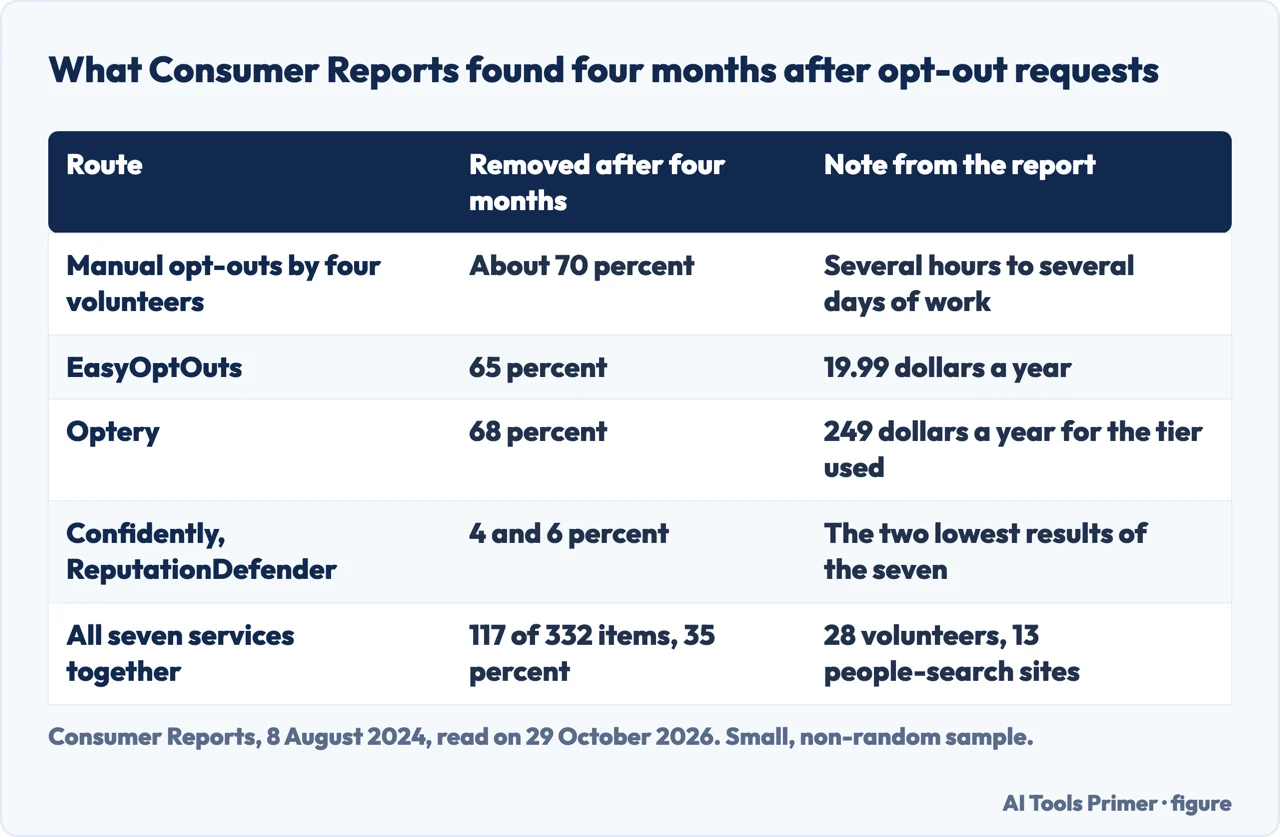
Consumer Reports tested this in a study with a digital safety organisation, Tall Poppy. It recruited 32 volunteers and tried to remove their data from 13 prominent people search sites, among them Whitepages, using seven removal services, plus a group of four volunteers who opted out by hand. The researchers found 332 pieces of information about the 28 volunteers they covered, and 117 of them, 35 percent, had been removed after four months. EasyOptOuts and Optery did best, at 65 and 68 percent; Confidently and ReputationDefender did worst, at 4 and 6 percent. The manual group reached about 70 percent. The services charged from 19.99 to 249 dollars a year.
The study states its own limits: a small sample, a non-random choice of volunteers, a limited amount of information given to the services to protect the volunteers, and no check on whether deleted profiles reappeared later. It also reports two conflicts of interest it saw: an advertisement for a removal service on a people search site, and a people search site that recommended a partner service after an opt-out request. The article says a manual opt-out takes anywhere from several hours to several days and suggests repeating it about twice a year. The tips it takes from Consumer Reports’ Grauer are to start from a list of more than 50 data brokers with opt-out links, or its 22 high-priority sites; to take notes on where you left off; to blacken out the driver’s licence number and Social Security number before sending an identity document; and to repeat the process. The Privacy Rights Clearinghouse says some brokers ask for a state-issued ID and that some people choose not to go on. This page does not recommend any removal service; the figures are given as Consumer Reports reported them. For the wider job of shrinking what is public about you, see our pages on your digital footprint and on the right to be forgotten; this page stays with the people-search sites a number can open.
Where to report, and what the FCC starts from
The FCC page on robocalls and texts, last updated on 27 February 2026, starts from the call rather than the caller: if you think a call has been spoofed, it says “don’t hang on, hang up!”. If someone says they are calling from a company or a government agency, it says to hang up and call back using a phone number from an account statement, if you have one, or from their website. It also says not to respond to texts or click links sent from numbers you do not recognise, to set a strong password for voicemail, and to talk to your phone company about call blocking tools.
To report, the FCC says you can file a complaint about illegal calls or texts, choose the “unwanted calls” category and note whether your number is being spoofed, blocked or mislabelled. It adds that the FCC does not resolve individual complaints but uses them to guide policy and possible enforcement under the Telephone Consumer Protection Act or the Truth in Caller ID Act, and that a complaint may be shared with other enforcement agencies. Phone scams and Do Not Call violations go to the FTC. The National Do Not Call Registry is free at donotcall.gov, and most mobile carriers let you forward a spam text to 7726 (SPAM), though the FCC says to check with your provider.
The FCC’s page on caller ID spoofing, dated 13 November 2024, defines spoofing as deliberately falsifying the information sent to your caller ID display to disguise identity, and describes neighbour spoofing, where a local-looking number is shown. It says the Truth in Caller ID Act prohibits misleading caller ID information with the intent to defraud, cause harm or wrongly obtain anything of value, with penalties of up to ten thousand dollars per violation, and that spoofing is not always illegal: a doctor calling from a personal phone while showing the office number is its example. It says a number blocked or labelled as a potential scam or spam may have been spoofed, and advises not answering questions that can be answered with yes or no. If your own number is being used, it suggests telling callers it is spoofed and recording a voicemail message to that effect, and notes that scammers usually switch numbers frequently and that it is likely they will no longer be using your number within hours. Showing “unknown” by blocking your own number is legal and is not spoofing.
Whitepages gives its own advice as a seller of lookups. It says that answering a spam call lets scammers confirm your line is active and sell it to other spam networks, that voice recordings can be used for impersonation, and that callers often spoof local numbers, so caller ID alone is not reliable. It lists four layers of defence: its lookup, the carrier protection offered by AT&T, Verizon and T-Mobile, a third-party blocker, and the Do Not Call Registry. The page you want next depends on what arrived: spoofed caller ID explains why a familiar number proves little, blocking and filtering covers the settings, and what a number alone can do covers what a stranger can reach with the number itself.
What we did not use
We tested no lookup: we entered no number into any of the three services. We did not open their privacy policies or terms. We did not read the pages of any other lookup service, including NumLookup, Social Catfish and TruePeopleSearch, so this page does not compare them with the three it covers. The FTC page was still online on 29 October 2026, and we did not check whether the Privacy Rights Clearinghouse FAQ of 2017 or the FTC page of July 2022 has a newer version.
Where to start
Four ways in.
- “Is it really free for a cell phone?”
- What the three services say is free — promises
- “Where does the name come from?”
- The source of the name, and what a number can open — name
- “How do I get my number off these sites?”
- Taking your own number out — remove
- “Who do I report a call to?”
- Where to report — report
Checking a number
What you can genuinely find out about who called — and what the lookup sites themselves are doing with the number you type into them.
The phone number
The attack that makes every other defence collapse, because the number is used as proof of identity far beyond what it was created for.
Questions people also ask
Where can I search for a phone number for free without paying for it?
SpyDialer says no sign-up is required and allows up to 50 lookups a day; Truecaller says its lookup is free but asks you to sign in and limits web searches; Whitepages lists carrier, line type and a spam rating as free, with name and address for most landlines and business numbers.
Is there a 100% free phone lookup?
Truecaller’s page is headed “100% Free Reverse Phone Lookup”, and its footnote adds that some features are for Premium users. The other two pages state conditions too: Whitepages says cell numbers may require a fee, and SpyDialer says results vary by number.
How to look up a phone number without getting charged?
Each service says which part is free: Whitepages names carrier, line type and spam rating, SpyDialer says no charge and no credit card, Truecaller says free after sign-in. The FTC describes the other side, in which a report can be bought from just a name or a phone number.
Does an actual free reverse phone lookup exist?
Each service describes a free part, but not the same one for a cell phone: Whitepages says cell numbers may require a fee, SpyDialer says the name is free when in public records, Truecaller says free after sign-in. SpyDialer says results are not guaranteed; no figure is given for how often the name is right.
Not covered here. We tested no lookup service. The statements come from pages of the FTC, the Privacy Rights Clearinghouse, Consumer Reports and the FCC, and, for what each says about itself, from the pages of Whitepages, SpyDialer and Truecaller, all read on 29 October 2026.
The search volume and difficulty behind this page come from a Semrush reading of 29 August 2026, older than the 60 days the site normally allows.
Sources
- FTC — What To Know About People Search Sites That Sell Your Information (July 2022) — consumer.ftc.gov, read 29 October 2026.
- Privacy Rights Clearinghouse — FAQ: Online Data Brokers & People Search Sites (22 March 2017) — privacyrights.org, read 29 October 2026.
- Privacy Rights Clearinghouse — Reverse Phone Lookup (data broker entry) — privacyrights.org, read 29 October 2026.
- Consumer Reports — Services That Delete Your Data From People-Search Sites (8 August 2024) — www.consumerreports.org, read 29 October 2026.
- FCC — Stop Unwanted Robocalls and Texts (updated 27 February 2026) — www.fcc.gov, read 29 October 2026.
- FCC — Caller ID Spoofing (13 November 2024) — www.fcc.gov, read 29 October 2026.
- Whitepages — Reverse Phone Lookup (a seller of lookups; read for what it says about itself) — www.whitepages.com, read 29 October 2026.
- Truecaller — Free Reverse Phone Number Lookup (read for what it says about itself) — www.truecaller.com, read 29 October 2026.
- SpyDialer — Free Phone Number Lookup (read for what it says about itself) — www.spydialer.com, read 29 October 2026.
Written by Alberto Gulotta
Founder and editor of AI Tools Primer, writing from Palermo, Italy. Thirty-five years of taking computers apart, starting with a Commodore 64 — the long version is on the about page.
Something wrong on this page? Write to aitoolsprimer@gmail.com and it gets fixed.
Written on 29 October 2026.
Independence and limits
No affiliate links and no paid placements anywhere on this site. Nobody pays to appear here, and no company has seen this page before you did.
This is general information, not professional advice. Where a page touches money, health, safety or the law, it names its source and the date it was read — and your situation may still differ. See the privacy page and the cookie policy.