
Work · guide
ATS friendly resume template: what that actually means
By Alberto Gulotta · Updated · 7 min read
Search for an ats friendly resume template and you will be told a great deal about algorithms, scores and secret keyword thresholds. Almost none of it comes from the companies that build these systems. This guide starts from what they publish themselves, because it is both duller and far more useful.
What actually breaks the parse
Greenhouse, one of the systems your document is fed into, on why a resume fails to parse.
- Resumes “uploaded as an image, rather than a document (such as a .docx or .pdf)”
- “graphics, photos, or word art”
- “Complex resumes with tables, headers, and footers”
- “Resumes with the name and contact information in the header, footer, or text box”
- “Resumes that have a columned layout”
- “A resume with spaces between the letters”
There is also a hard limit that has nothing to do with design: “Greenhouse Recruiting can’t parse resumes larger than 2.5MB.” A single high-resolution photograph will take a document past that on its own.
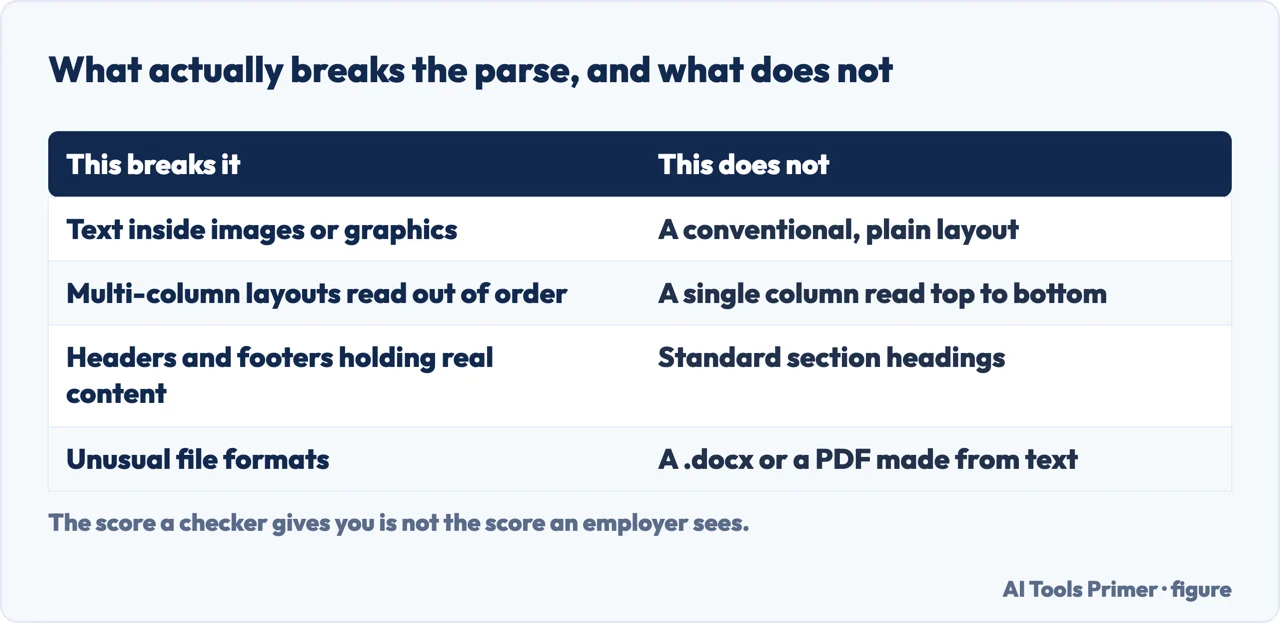
Read that list again and notice what it is not. There is nothing about keyword density, nothing about a score, nothing about a percentage of applications being silently discarded. Every item is a layout decision — and most of them are exactly the decisions that make a template look designed.
What actually happens when the parse fails is smaller than the folklore. Greenhouse describes the system as scanning an imported CV and auto-filling the candidate’s fields from what it detects. When that does not work, its own documentation says you “see a message that the resume has only been attached to the candidate.” The document is still there. Nobody deleted it and no gate closed — the fields simply stayed empty, and somebody has to open the file to read it. That is worth knowing precisely, because the fear the advice industry sells is rejection, and the documented consequence is inconvenience.
One cause is worth a warning of its own, because it is advice people are given in good faith. If you have anonymised your CV before sending it — placeholder employers, generic titles — you may have broken the parse. Greenhouse names the pattern directly: “more creative test data (such as Mycomp, Inc.) may bypass the parser”, and lists alongside it “fake company names (such as Company 1, Client 1, Any Company), job titles (such as employee 1), school names, or other poorly designed data.” It is written for recruiters testing their own system, which is precisely why it is useful here: a CV that disguises where you worked looks, to the machine, like a test file.
And what it is looking for
That is the list Greenhouse publishes, and it says it does not extract fields beyond it. Which reframes the whole exercise: an ATS-friendly template is not a template that pleases an algorithm. It is a layout that lets five ordinary pieces of information be read. Everything in the list above breaks one of the five — usually the dates, or your own name.
This is the part that changes how you choose a template. The two-column layout with a shaded sidebar, the name in a decorative header, the skills shown as little rating bars: those are the features that sell templates, and they are the features on the failure list. A plain document with ordinary headings, dates in the text and your name on the first line is not a compromise. It is the version that survives being read.
None of which means the document should be dull for the human who eventually opens it. Both things are true at once — the parser reads it first, a person reads it second — and the conflicting advice around this subject nearly always comes from arguing about only one of them.
The neighbouring searches show how unsettled this is. Ats resume and ats friendly resume are people trying to work out what the standard even is. Ats resume checker and ats resume template are people looking for a tool to tell them. And one query in this cluster is worth quoting on its own, because it is the honest question underneath all of them: is resume worded’s ats score accurate. Scores are the part of this subject with the least published evidence behind it, and that has a guide of its own below.
Where to start
Four ways in.
- “I am choosing a template.”
- Start at the layout
- “I want to know how it is read.”
- Go to how parsing works
- “A checker gave me a score.”
- Read scores and checkers
- “I need to write the content.”
- That is what goes in it
The layout
Formatting decisions, judged by whether a parser can read them. Every item here traces back to something a system vendor has published.
How parsing works
A short, unglamorous explanation of what happens to your file after you press send. Knowing it removes most of the anxiety.
Scores and checkers
The busiest commercial corner of this subject, and the one with the least published evidence. Handled sceptically, and openly so.
What goes in it
Once the layout is out of the way, the document still has to say something. This is the wing that decides whether a person calls you.
Not covered here. It will not quote a statistic without a source. The best-known numbers in this subject — the proportion of CVs supposedly rejected before a human sees them — are repeated everywhere and attributed almost nowhere, and this guide will say so rather than repeat them.
It will not promise that a layout guarantees anything. Vendors publish what breaks parsing; none of them publish a template that passes.
And it will not rank the checkers yet. That needs one real CV, in several layouts, through each of them, with the scores and the contradictions published side by side. What holds instead is simple: the parsing facts on this page are quoted from an applicant tracking system’s own documentation.
Step 1 of 24 in the job search
The order this is meant to be read in, from writing the CV to handing in notice.
- After this
- What to put on a resume, and what to leave off it
Sources
- Greenhouse Support — Unsuccessful resume parse, on what causes a parse to fail and the file size limit — support.greenhouse.io, read 21 August 2026.
- Greenhouse Support — Talent Matching data processing, on the fields extracted from a resume — support.greenhouse.io, read 21 August 2026.
- MIT Career Advising & Professional Development — Make your resume ATS-friendly (that most applicant tracking systems are designed like a database, with some able to rate or score applicants from what they parse and compare against the job posting, so the keyword game is not the only factor; and the formatting advice that images, text boxes, tables and graphics may be distorted, ignored or erased by an ATS, which may also recombine information in a way that does not reflect the candidate — with the exception it names, that a designed resume may still be right for an aesthetics-led industry when it is delivered directly rather than through an ATS) — capd.mit.edu, read 5 September 2026.
Written by Alberto Gulotta
Founder and editor of AI Tools Primer, writing from Palermo, Italy. Thirty-five years of taking computers apart, starting with a Commodore 64 — the long version is on the about page.
Something wrong on this page? Write to aitoolsprimer@gmail.com and it gets fixed.
Written on 21 August 2026 · last checked 5 September 2026.
Independence and limits
No affiliate links and no paid placements anywhere on this site. Nobody pays to appear here, and no company has seen this page before you did.
This is general information, not professional advice. Where a page touches money, health, safety or the law, it names its source and the date it was read — and your situation may still differ. See the privacy page and the cookie policy.