
Work · guide
What are good skills to put on a resume, and which ones count
By Alberto Gulotta · Updated · 9 min read
Search what are good skills to put on a resume and you get lists. Ten best skills. Twenty-five excellent skills. Fifteen unique skills — an interesting claim about a list published to millions of people. Every result on the first page today is one of these.
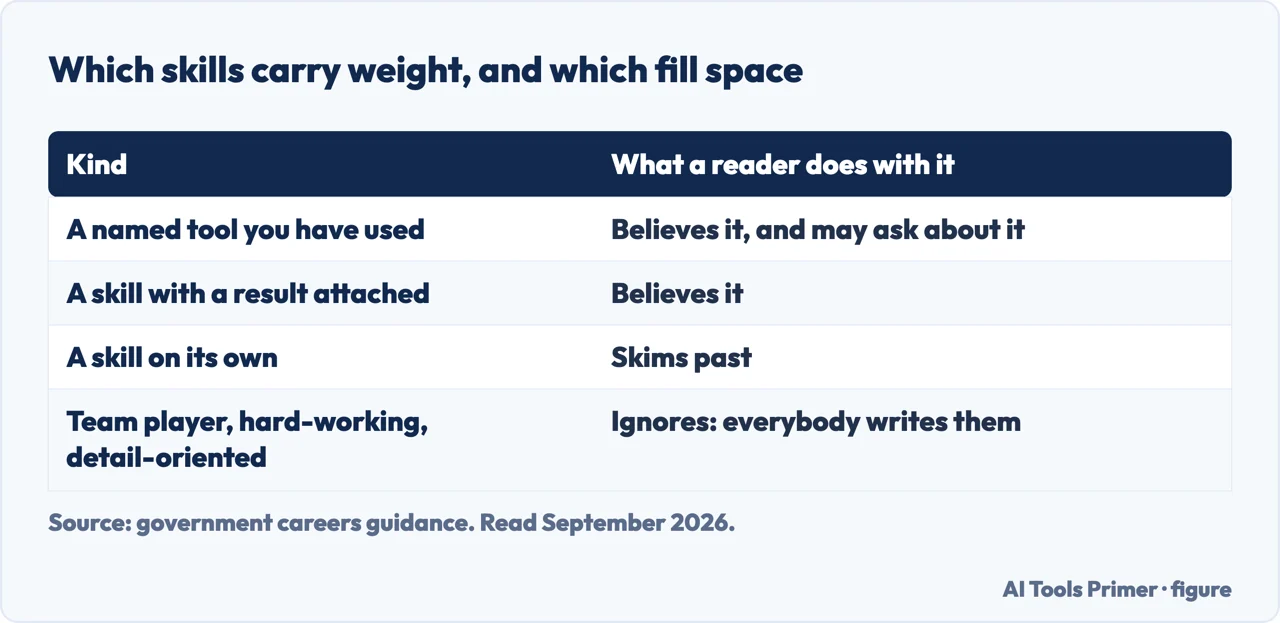
There is a structural problem with all of them, and it is the same problem the “safe weaknesses” lists have. A list published as an answer stops being an answer. A skills section that reads like the one in the article is a section that tells a reader nothing about you, which is the one job it has.
An employer states the alternative plainly.
“Use similar terms and address every required qualification. For example, if the qualifications section says you need experience with MS Project, you need to use the words MS Project in your resume.”
USAJOBS, the application system of the largest employer in the United States, read 21 August 2026. That is the whole answer to which skills to list, stated by an employer rather than inferred. The right skills are the ones named in the advert — and they have to appear in the words the advert used, not in yours.
That instruction does two things at once. It tells you which skills to list — the ones the advert names — and it tells you the terms to use, which matters more than it sounds. Applications are commonly screened by software matching text against the posting before a person reads anything, and a synonym you prefer is not a match. Writing “project management” when the advert says “MS Project” can cost you the reading.
That solves the selection problem. It does not solve the harder one, which is that a named skill convinces nobody on its own.
The difference a reader can actually act on
Every skill on a résumé is either an assertion or a piece of evidence. Assertions are free, which is why nobody believes them.
Assertion
Excellent communication skills
Evidence
Wrote the monthly report read by the regional board, twelve issues
Assertion
Strong attention to detail
Evidence
Reconciled supplier invoices; error rate fell from weekly to none in six months
Assertion
Team player
Evidence
Trained four new starters, two of whom now run their own shifts
The left column could be written by anybody about anybody. The right column could only be written by you, which is the only property that makes a skills claim worth reading.
The distinction is not stylistic. A reviewer comparing forty applications cannot verify “excellent communication skills” and has no reason to try, because every one of the forty says it. They can verify a monthly report read by a board. The claim in the right column is also harder to write, which is exactly why it works — it costs something to produce and therefore signals something.
How to build the section, in order
- Open the advert and list every skill it names. Not the ones you have — the ones it asks for. This takes five minutes and skips the guessing entirely.
- Mark the ones you can evidence. Somewhere in your history is a thing that happened. If nothing comes to mind, the skill is an assertion and belongs lower or nowhere.
- Use their exact wording. Not a synonym you prefer. The first reader is often software matching terms, and the second is a person checking against the same list.
- Put the evidence where the role is described, not only in a skills list. A list confirms; the bullet under the job proves.
- Cut anything the advert never mentions unless it is genuinely unusual and genuinely yours. Length is not the enemy — irrelevance is.
Hard skills and soft skills, and why the distinction is less useful than it looks. The categories are real: a named tool, language or certification on one side, and things like communication or organisation on the other. But the useful split is different. Some skills are checkable — a certification, a language, a system you can be asked about in the interview — and some are only demonstrable through a story. Checkable skills belong in a list, where they can be scanned. Demonstrable ones belong inside your work history attached to something that happened, and putting them in a list is where the padding comes from.
What the public careers services add. The United Kingdom’s National Careers Service, writing about how to talk about strengths, gives the same instruction in a different form — it pairs each quality with what it shows: “communication - to show you get on with others”, “problem solving - to show that you can find solutions”. The pairing is the point. A quality named without what it shows is half a sentence, and the half that was left out is the informative one.
How many to list. There is no published number, and anybody offering one is guessing. The test that works is coverage rather than count: every skill the advert names should be addressed somewhere in the document, and nothing else needs to be there. In practice that produces fewer entries than the lists recommend, and a shorter section that maps cleanly onto the posting beats a longer one that maps onto nothing.
What to leave out. Software so common that naming it says nothing, unless the advert asks for it by name. Skills you would not want tested in the interview, because they may be. Ratings out of five or progress bars, which are a design flourish rather than information, and which a parser reading for text has nothing to do with. And any skill you cannot attach to a single concrete thing you did — that one is not a skill you have, it is a skill you would like to have, and the difference shows.
Everything quoted here comes from a government application system and a national careers service, each with the date it was read. The assertion-versus-evidence framing is ours, and it is offered as a test you can apply rather than as a rule anybody published.
Where to start
Four ways in.
- “I do not know which of my skills matter.”
- The advert decides — see building the document
- “I have no work experience yet.”
- Go to when you are starting
- “Will software even read my skills section?”
- That is how it is read first
- “They asked about my strengths in the interview.”
- See the interview
Building the document
Where the skills go, how long the whole thing should be, and how far back it should reach. All three are decided by relevance rather than by convention.
When you are starting
The case where a skills section has to carry more weight, because there is less history underneath it to point at.
How it is read first
Software reads a skills section before a person does, and it reads text rather than design. What survives that pass and what does not.
The interview
Everything in the skills section is a promise that you can talk about it. These guides are where that promise is collected.
Not covered here. It will not give you a list of skills. A list published as the answer becomes a list that gets copied, and a copied skills section carries no information about the person it is on.
It will not tell you a number to aim for. The useful test is whether the advert is covered rather than whether a count is reached.
And it will not sell you a résumé builder. This site carries no affiliate links and no paid placements, which is a promise about this page rather than a claim about anybody else’s. What holds instead is simple: the instruction to use the employer’s own terms is quoted from a United States government application system, and the pairing of a quality with what it shows from a public careers service.
Step 3 of 24 in the job search
The order this is meant to be read in, from writing the CV to handing in notice.
- Before this
- What to put on a resume, and what to leave off it
- After this
- How far back should a resume go, and why that number exists
Sources
- USAJOBS Help Center — How do I write a resume for a federal job?, including the instruction to address every required qualification using the employer’s own terms — help.usajobs.gov, read 21 August 2026.
- National Careers Service (United Kingdom) — How to answer common interview questions, which pairs each strength with what it demonstrates — nationalcareers.service.gov.uk, read 21 August 2026.
Written by Alberto Gulotta
Founder and editor of AI Tools Primer, writing from Palermo, Italy. Thirty-five years of taking computers apart, starting with a Commodore 64 — the long version is on the about page.
Something wrong on this page? Write to aitoolsprimer@gmail.com and it gets fixed.
Written on 21 August 2026 · last checked 4 September 2026.
Independence and limits
No affiliate links and no paid placements anywhere on this site. Nobody pays to appear here, and no company has seen this page before you did.
This is general information, not professional advice. Where a page touches money, health, safety or the law, it names its source and the date it was read — and your situation may still differ. See the privacy page and the cookie policy.