
Work · guide
What are your weaknesses, and why the safe answers fail
By Alberto Gulotta · Updated · 9 min read
The reason what are your weaknesses is hard has almost nothing to do with the question and everything to do with the advice around it. Nearly every page answering it hands you a list of acceptable weaknesses to pick from — which is exactly what makes a prepared answer audible to somebody who has interviewed a hundred people.
There is a published alternative, it is two sentences long, and it comes from a source with nothing to sell.
Question
“Do you have any weaknesses?”
Answer
“I struggle with time management on projects. To make sure I stick to the time frame I’m creating a timetable of steps at the start of each project.”
The worked example published by the United Kingdom’s National Careers Service, a public body, read 21 August 2026. Read what is not in it. No perfectionism. No strength dressed as a flaw. No apology. A real difficulty, named plainly, followed by the specific thing being done about it — and the second half is longer than the first.
That is the whole structure. Everything below is an explanation of why it works and how to build your own version, but if you stop reading here you already have what you came for.
Part one
The weakness, said plainly
One sentence, in ordinary words, about something that is genuinely harder for you than for other people. The instruction from the careers service is short: “You should be honest when answering questions on your weaknesses.” Honest is doing the work in that sentence.
Part two
What you do about it
“Say how you’re working to improve them.” Not an intention — a mechanism. In the published example it is a timetable of steps written at the start of each project. Specific enough that somebody could picture you doing it.
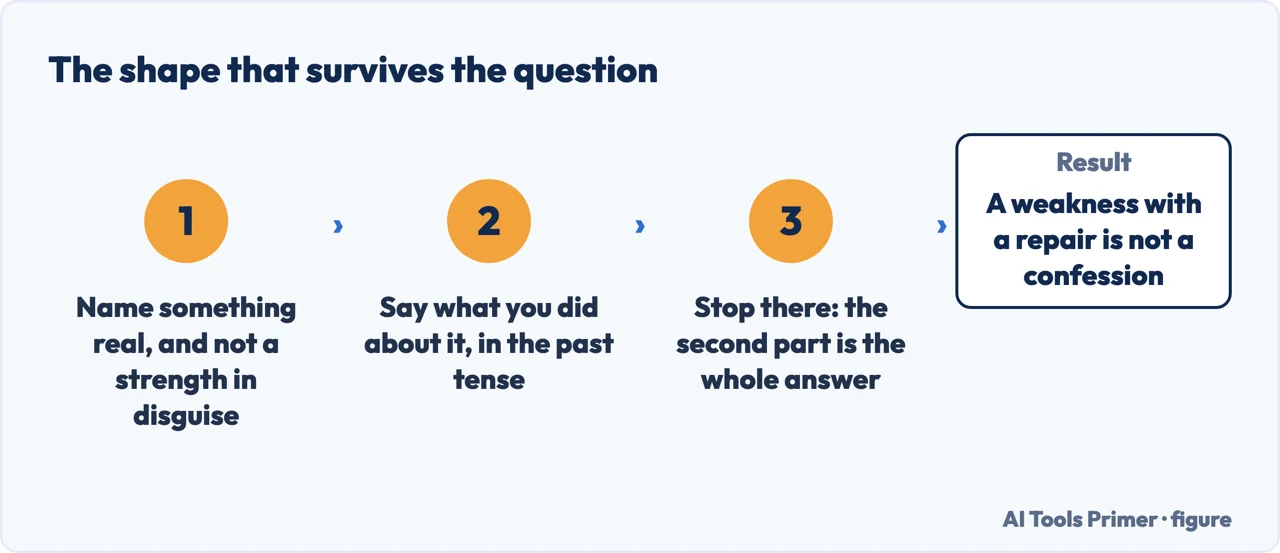
Why the second half carries the answer. The interviewer is not collecting a flaw. They are finding out whether you can look at your own work accurately and do something about what you see — which is the single most useful thing to know about somebody you are about to hire. A weakness with no remedy attached tells them you have noticed. A weakness with a mechanism attached tells them you have acted.
That is also why the remedy has to be real and already running. I’m working on it is an intention. I write out the steps at the start of each project is a practice with a beginning, and it can be described, which is the test.
Why the answers on page one stopped working
Almost every result for this question offers a list of example weaknesses to choose from. That is the mechanism by which an answer becomes recognisable.
- “I’m a perfectionist.” The oldest one, and by now it functions as an admission that you have prepared an evasion rather than an answer.
- A strength wearing a disguise. “I care too much.” “I work too hard.” The interviewer asked a question and received a compliment, which tells them something they did not want to learn.
- A weakness picked off a list. The person opposite has read the same articles. Reciting a listed weakness is detectable precisely because the list is public.
- Something disqualifying. Honesty is not the same as self-harm. A weakness that is the core of the job — “I find it hard to meet deadlines”, for a role that is entirely deadlines — is a real answer to a different question.
- “I don’t have any.” Refusing the question is itself an answer, and not one that helps.
How to find yours, if nothing comes to mind. Do not start from the question — start from the last year. What did you get feedback on more than once? What takes you longer than it takes the people around you? What do you avoid until it becomes urgent? Something in those three answers is true, and true is the only requirement, because the second half of the answer is where the work happens.
Then check it against the job. The weakness should be real but it should not be the core competence of the role you want, and there is nothing dishonest about that choice — you are being asked to pick one thing out of many, and picking the one that is both true and survivable is judgement rather than evasion.
The strengths question is its twin, and the same source is more specific about it. For strengths, the careers service says: “Plan your answers around 2 or 3 examples that are relevant to the job.” Note that it asks for examples rather than adjectives. The same discipline applies in both directions — a strength without an example is a claim, and a weakness without a remedy is a confession.
What if they ask for three? Some interviewers do, deliberately, because the second and third are the ones you have not rehearsed. Prepare two properly and be willing to think aloud for the third. Thinking aloud is not a failure here — it is a demonstration of the exact capacity the question is testing, and it beats producing a third polished answer that sounds like the first two.
On the pages ranking above this one. Several of them are good, and one is a university business school. But the dominant format is a list of example weaknesses, and lists are self-defeating for this particular question in a way they are not for others: the more widely a good example answer is published, the less it works. The structure above does not have that problem, because the specific content comes from you.
Everything quoted here is from a national careers service, on the date it was read, and the parts that are our reasoning rather than theirs are the ones about how to find your own answer.
Where to start
Four ways in.
- “I have the interview tomorrow.”
- The two-part structure above, then the other questions
- “My weakness is a gap in my CV.”
- That is different — see awkward history
- “What do I ask them?”
- Go to your turn
The other questions
The rest of the hour, grouped the way a public careers service groups them: by what the employer is trying to find out.
Awkward history
A gap or a short stay is not a weakness in the sense this question means, and answering it as one makes it sound worse than it is.
Your turn
The end of the interview is assessed too, and it is the part most candidates waste.
Not covered here. It will not give you a weakness to use. The whole argument of this page is that a published example answer stops working the moment it is published, and handing you one would be the fastest way to prove it.
It will not tell you to hide anything. The source quoted here says to be honest, and the structure works precisely because the first half is true.
And it will not sell you interview coaching, which is where several guides on this question ultimately lead. What holds instead is simple: the two-part structure and the worked example on this page are quoted from a public careers service, on the date they were read.
Step 15 of 24 in the job search
The order this is meant to be read in, from writing the CV to handing in notice.
- Before this
- How to answer tell me about yourself, when it is not a question
- After this
- Why do you want to work here, and what they are checking
Sources
- National Careers Service (United Kingdom) — How to answer common interview questions, including the weaknesses guidance with its worked example and the guidance on strengths — nationalcareers.service.gov.uk, read 21 August 2026.
- CareerOneStop (United States Department of Labor) — Interview tips (the advice to practise answering common questions with someone else or in front of a mirror, and to prepare stories about the skills the employer wants; the six things to emphasise — strengths, willingness to work and flexibility, leadership, ability and willingness to learn, contributions to organisations worked or volunteered for, and creativity in solving problems; the exercise of writing your qualifications against each requirement in the posting so you can see where a skill is missing and plan how to address it) — www.careeronestop.org, read 5 September 2026.
Written by Alberto Gulotta
Founder and editor of AI Tools Primer, writing from Palermo, Italy. Thirty-five years of taking computers apart, starting with a Commodore 64 — the long version is on the about page.
Something wrong on this page? Write to aitoolsprimer@gmail.com and it gets fixed.
Written on 21 August 2026 · last checked 5 September 2026.
Independence and limits
No affiliate links and no paid placements anywhere on this site. Nobody pays to appear here, and no company has seen this page before you did.
This is general information, not professional advice. Where a page touches money, health, safety or the law, it names its source and the date it was read — and your situation may still differ. See the privacy page and the cookie policy.