
Work · guide
Star interview method: what employers say it is for
By Alberto Gulotta · Updated · 8 min read
The star interview method is explained on a few thousand pages, almost all of them from the candidate’s side and almost all of them treating it as a recipe: four boxes, fill each one. The more useful explanation comes from the other side of the table, from an employer describing how it runs its own interviews.
“You may find yourself tempted to go into greater depth than is warranted to explain a situation. Using the STAR acronym reminds you to focus your answer.”VA Careers, on how the US Department of Veterans Affairs interviews — read 22 August 2026
That is an employer explaining what the method is for, and it is not what the acronym implies. STAR is not a formula for what to say. It is a discipline for when to stop. The failure it exists to prevent is a four-minute answer about the situation and twenty seconds about what you actually did.
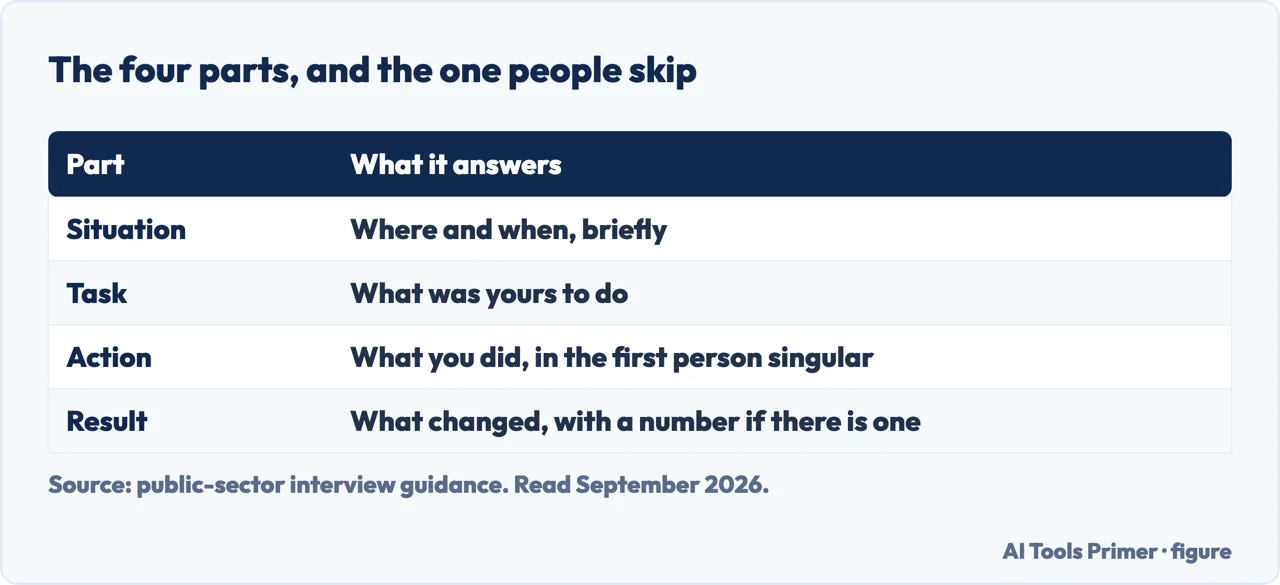
Once you read it that way the acronym stops being homework and becomes a timer. Situation and Task are scene-setting and should be brief. Action is the answer. Result is the evidence. A candidate who spends most of the minute on Situation has told the interviewer about a workplace, not about themselves — and the interviewer has nothing to score.
The second thing employers say and template sites do not is that there is no single acronym. VA lists three alternatives alongside STAR, in its own guidance to applicants.
They are not competitors so much as different emphases, and the differences are informative. PAR drops the scene-setting almost entirely. SOAR makes you name the obstacle, which forces a story with an actual difficulty in it rather than a description of a routine task done well. If you have ever given a STAR answer that felt flat, the missing ingredient was usually the O.
It also matters because the interviewer may have been trained on a different one. Being asked for the “challenge” rather than the “task” is the same request in another vocabulary, and recognising that saves a confused pause.
Then there is the version that adds two letters, from a county human-resources department rather than a careers blog — and the two additions change where a good answer ends.
What each letter is actually asking for
King County’s Career Support Services sets it out element by element — and adds two letters that are not in the acronym.
- S
- Situation. Which job or experience it was, the nature of the problem or opportunity — and your role in it. That third part is the one candidates skip.
- T
- Task. “What exactly were you trying to accomplish.” One sentence.
- A
- Actions. What you did and why. Name the skills you used, and the tools or technology if they are relevant. Their instruction on length: “seek a balance between too much vs. not enough details.”
- R
- Result. The impact, “and provide proof, if possible (quantify or qualify)”. Then the line nobody else includes: say how you created or maintained positive relationships with the people involved.
- L
- Learning. “As succinctly as possible, describe what you learned from this experience.”
- A
- Application. What you did with that learning afterwards.
Those last two are worth taking seriously even in a room where nobody has heard of STAR-LA. An answer that finishes on the Result finishes on a boast. An answer that finishes on what you learned and what you did with it afterwards finishes on self-awareness, and it is the difference between a candidate who had one good quarter and a candidate who improves.
The Result element carries the other underused instruction: quantify or qualify the impact, and say how you kept the relationships intact. It is possible to describe an outcome achieved by steamrolling colleagues without noticing you have said so.
One more distinction from VA, because using STAR on the wrong question is a common and avoidable mistake. Two kinds of question look similar and are not.
“Describe a time when… What happened? What did you do?”VA: based on the idea that “past behavior in similar situations is the best predictor of future behavior”. STAR is built for these.
“What would you do if…?”VA: based on the idea that “one’s intentions predict how they will behave in the future”. A different question needing a different shape of answer.
STAR fits the first. On the second, reaching for a past example when you were asked a hypothetical reads as evasion — the honest move is to answer the hypothetical, then offer the example as support if it genuinely fits.
On the phrasing: the same thing is searched as star method, as star method interview questions, and spelled out as situation task action result. They are one method. The spelled-out form is the most honest of the three, because it puts the four words in the order the answer has to follow — and it is the order, not the letters, that does the work.
And a preparation note from the same source, which is more actionable than most advice on this subject: study the job advertisement and make note of the competencies listed, because those competencies — “they’ll likely guide the interview questions.” In structured hiring the questions are not improvised. They are written against a list, and the list is usually published.
The guides below take it four ways: the method itself, preparing the stories in advance, the questions it is used on, and what to do when the interview is over.
Where to start
Four ways in.
- “Which questions is this for?”
- That is the questions
- “It is over and I fumbled one.”
- That is afterwards
The questions
The ones STAR is built for, and the ones it is not. Getting this wrong makes a prepared candidate sound evasive.
Afterwards
The interview ends and there is still something to do. One of these guides is the only sanctioned chance to improve an answer you gave badly.
Not covered here. It will not give you scripted answers. An employer that publishes its own method also publishes the reason: the point is what you did, and nobody can write that for you.
It will not pretend STAR is the only framework. Three others are named on a US federal careers page, and an interviewer may have been trained on any of them.
And it will not treat this as a trick. Structured interviewing exists to make hiring fairer and more comparable, and the method is the employer telling you how to be assessed accurately. What holds instead is simple: the purpose of the method and the alternative acronyms come from a US federal employer, with a county human-resources department quoted alongside.
Step 11 of 24 in the job search
The order this is meant to be read in, from writing the CV to handing in notice.
- Before this
- How to prepare for an interview that is being scored
- After this
- What to wear to an interview, and the rule underneath
Sources
- VA Careers (US Department of Veterans Affairs) — The interview process (the purpose of the STAR acronym, the distinction between behavioural and situational questions, the PAR, SOAR and CCAR alternatives, and the advice to note the competencies in the job announcement) — vacareers.va.gov, read 22 August 2026.
- King County Career Support Services — STAR-LA Interview Response Method (the element-by-element breakdown including your role, quantifying the result, maintaining relationships, and the Learning and Application steps) — cdn.kingcounty.gov, read 22 August 2026.
Written by Alberto Gulotta
Founder and editor of AI Tools Primer, writing from Palermo, Italy. Thirty-five years of taking computers apart, starting with a Commodore 64 — the long version is on the about page.
Something wrong on this page? Write to aitoolsprimer@gmail.com and it gets fixed.
Written on 22 August 2026 · last checked 23 September 2026.
Independence and limits
No affiliate links and no paid placements anywhere on this site. Nobody pays to appear here, and no company has seen this page before you did.
This is general information, not professional advice. Where a page touches money, health, safety or the law, it names its source and the date it was read — and your situation may still differ. See the privacy page and the cookie policy.