
Work · guide
How to negotiate a salary, and why the number compounds
By Alberto Gulotta · Updated · 10 min read
Advice on how to negotiate a salary is dominated by people with something to sell — coaching, courses, placement. There is a source with none of that, and it is direct: a state labour department.
“If you leave thousands of dollars on the table because you chose not to negotiate, it will affect you for the rest of your life… If you were underpaid in a previous position, chances are you’ll continue to be underpaid in the future.”
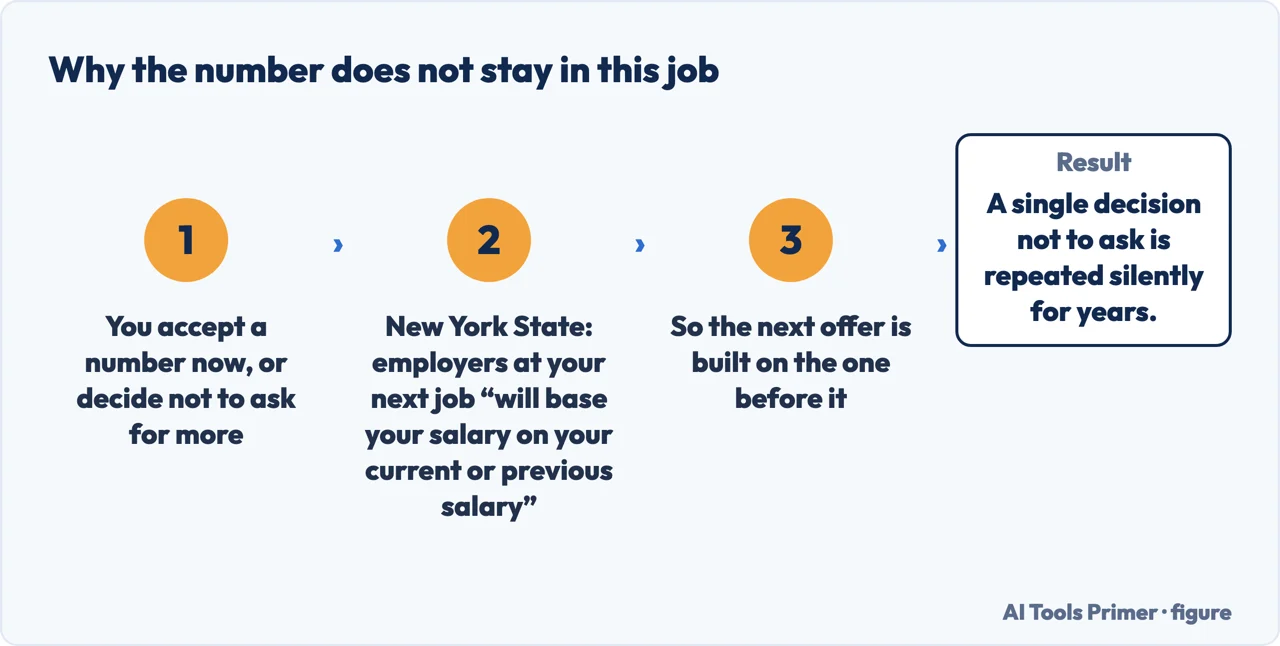
The New York State Department of Labor, read 21 August 2026. Not a coach, not a recruiter — the state labour department, putting the case more bluntly than the advice industry does. The reason is compounding: the same page notes that “in many cases, employers at your next job will base your salary on your current or previous salary”, so a number agreed once is quietly carried into every offer after it.
That mechanism is the real argument, and it is stronger than the usual one. The question is not whether a few thousand now is worth an awkward conversation. It is that the number you agree becomes the anchor for the next offer, and the one after that — so a single decision not to ask is repeated silently for years.
It is also why the salary-history question matters more than it appears. The department is careful about it: employers ask “although this is frowned upon and, in some cases against the law”. Several US states and cities now restrict or ban the question, and where it is banned, being asked is itself information about the employer. If you are asked and would rather not answer, the usable response is to give your expectation for this role rather than your history in the last one.
“In some cases against the law” has a concrete instance worth naming, because the same law also says what you are entitled to ask for. California’s Labor Commissioner’s Office, on the state Equal Pay Act, answers the question directly: an employer “cannot, orally or in writing, personally or through an agent, seek salary history information”. Then it turns the position around: “upon reasonable request, an employer must provide an applicant for employment the pay scale for a position”, and “an employer with 15 or more employees must include the pay scale for a position in any job posting”. That is one of the rules behind the ranges now appearing in postings — and where an employer is covered by it and the range is missing, asking for it is not a favour you are requesting.
What to do before you say anything
The department’s own preparation list, in its order. The warning attached to it is sharper than the list: entering the conversation without research “may appear entitled or come across as uninformed about the reality of the industry”.
- Research the company or organisationSize, funding, whether they are hiring or shrinking. The same number is ambitious at one employer and routine at another.
- Research salary trendsFor the role, in your location, this year. Postings in states with pay transparency rules increasingly publish a range, which is free research nobody had a decade ago.
- Know your worthWhat you have done, evidenced, rather than what you feel you deserve.
- Have a realistic salary rangeA range rather than a figure, and one you can justify out loud without changing your voice.
- Know your minimumThe number below which you decline. Deciding it in advance is what stops you agreeing to something on the phone that you regret by evening.
On timing, the department gives two acceptable answers rather than one: when the offer is made, or during the first interview. The traditional order “usually works well for entry-level or lower-paid positions”, while opening earlier is now acceptable — and if the posting already carries a range, the conversation has effectively started without you.
When the offer arrives
- Show enthusiasm first
- “Express excitement and interest in the job and your desire to discuss salary and benefits.” Negotiating is not the opposite of wanting the job, and saying so first removes the ambiguity.
- Never accept immediately
- The department’s wording, not ours: “Never accept an offer immediately.” Ask for a reasonable time — “for example, 24 or 48 hours” — and stick to it. Factor in weekends and holidays.
- Promise a specific time
- “It’s usually better to promise a response before a specific time and date.” It reads as organised rather than hesitant.
- Expect it to be normal
- “Most employers expect you to take time to consider.” The fear that asking will cost you the offer is the single most expensive belief on this page.
- Get it in writing
- “Whether your offer is initial or final, make sure you get the offer in writing before you commit.”
What to negotiate when the salary genuinely cannot move. Sometimes it cannot — a public pay scale, a banded structure, a fixed graduate rate. That is not the end of the conversation, and the department’s own framing is to “consider all aspects of the offer”. Start date, holiday above the minimum, a review at six months with a defined trigger, training paid for, equipment, remote days, a title that will read better on your next application. Several of those are worth real money and several cost the employer less than salary does, which is exactly why they are available.
How to say it. Briefly, once, and with a reason attached. A number with evidence behind it — what the role is paying elsewhere, what you bring that the posting asked for — is a proposal. The same number with nothing behind it is a request. Then stop talking. The most common mistake in this conversation is filling the silence after your own sentence, and negotiating against yourself before anybody has replied.
What not to do. Do not invent a competing offer; it is checkable often enough to be a bad bet and it changes the relationship if it lands. Do not argue from need — rent, childcare, debt — because it is true and irrelevant to what the role is worth, and it invites the wrong kind of sympathy. Do not accept on the phone in the first minute, which the department states plainly. And do not treat a first number as final when the same source describes countering as the traditional shape of the exchange.
Negotiating a raise is a different conversation and this guide is about offers, where you have the most leverage you will ever have with that employer — the moment after they have decided they want you and before you have said yes. The department covers raises separately, and so will this section.
Everything quoted here is from a state labour department, with the date it was read. It is written for New York and much of it is general, but pay-transparency and salary-history rules vary by state and by country — so the specific legal points are worth checking where you are rather than assuming. The parts that are our judgement — what to ask for when salary is fixed, how to phrase it, what not to do — are marked as such here rather than dressed up as rules.
Where to start
Four ways in.
- “I have an offer and I do not know what to say.”
- The section above — then preparing
- “They asked what I earn now.”
- That is the offer conversation
- “I have not got an offer yet.”
- Go to getting there
- “I am leaving my current job.”
- See the move
Preparing
The research the department puts before the conversation, and the reason it warns against skipping it.
The offer conversation
The moment after they decide they want you and before you say yes is the most leverage you will have with that employer.
Getting there
Everything that happens before an offer exists. Without one there is nothing to negotiate, which makes this the more urgent half.
The move
Accepting one offer means leaving something else, and that has its own document and its own rules.
Not covered here. It will not give you a script to read out. A number with your own evidence behind it is a proposal; the same number recited from a template is the thing the person opposite has heard before.
It will not tell you to invent a competing offer. It is checkable often enough to be a bad bet, and it changes the relationship if it lands.
And it will not sell you negotiation coaching, which is what most of the confident advice on this subject is ultimately for. What holds instead is simple: the preparation list and the instruction never to accept immediately are quoted from state labour authorities, with the date each was read.
Step 21 of 24 in the job search
The order this is meant to be read in, from writing the CV to handing in notice.
- Before this
- How to follow up after an interview without guessing the date
- After this
- How to quit a job, in the order that actually matters
The money conversations
Same subject, in no particular order.
- The same job, in the other places it comes up
- How to ask for a raise at work, and when to ask
Sources
- New York State Department of Labor — Salary Negotiation Guide, on why failing to negotiate compounds, the salary history question, what to research beforehand, and how to respond when an offer arrives — dol.ny.gov, read 21 August 2026.
- California Department of Industrial Relations, Labor Commissioner’s Office — California Equal Pay Act (that an employer may not seek salary history information, that the pay scale must be given to an applicant on reasonable request, and that an employer with 15 or more employees must include the pay scale in any job posting; Labor Code section 432.3) — www.dir.ca.gov, read 5 September 2026.
Written by Alberto Gulotta
Founder and editor of AI Tools Primer, writing from Palermo, Italy. Thirty-five years of taking computers apart, starting with a Commodore 64 — the long version is on the about page.
Something wrong on this page? Write to aitoolsprimer@gmail.com and it gets fixed.
Written on 21 August 2026 · last checked 23 September 2026.
Independence and limits
No affiliate links and no paid placements anywhere on this site. Nobody pays to appear here, and no company has seen this page before you did.
This is general information, not professional advice. Where a page touches money, health, safety or the law, it names its source and the date it was read — and your situation may still differ. See the privacy page and the cookie policy.