
Work · guide
Two week notice letter, and what to check first
By Alberto Gulotta · Updated · 7 min read
A two week notice letter is one of the shortest documents you will ever have to write, and the writing is not the difficult part. Three lines cover it. What is worth ten minutes is the assumption underneath it — that the two weeks are owed — because in the United States that turns out to be a custom rather than a law, and the custom does not run only one way.
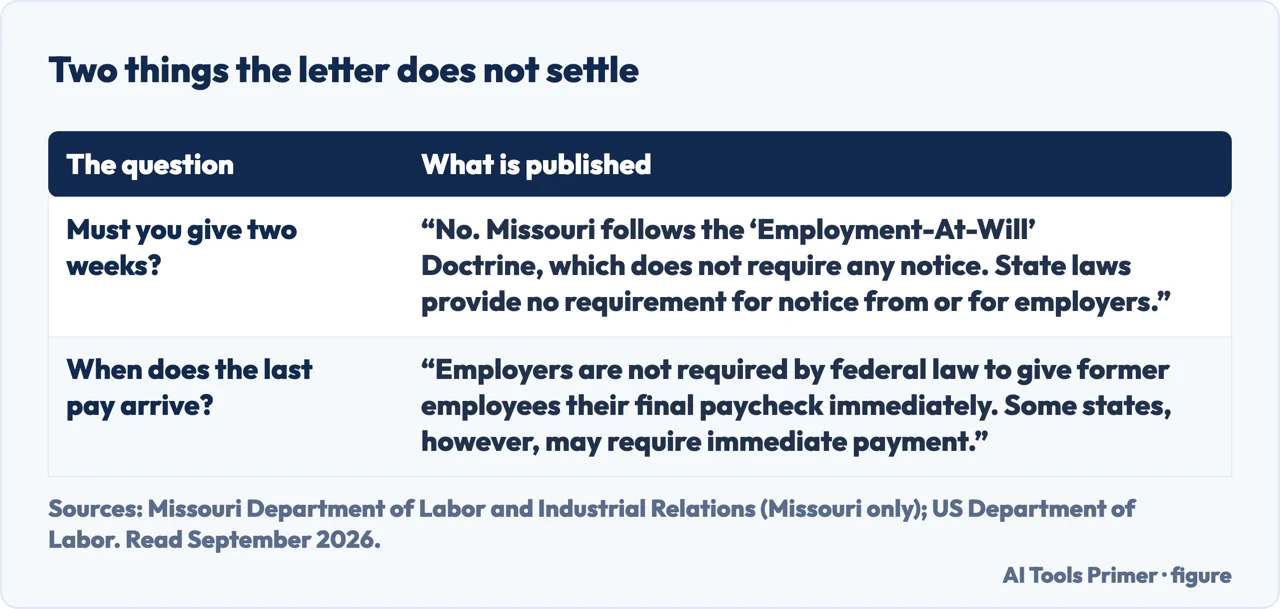
“No. Missouri follows the ‘Employment-At-Will’ Doctrine, which does not require any notice. State laws provide no requirement for notice from or for employers.”Missouri Department of Labor and Industrial Relations, answering “Is an employee required to give his/her employer two weeks notice when quitting a job?” — read 22 August 2026
Read the last sentence twice, because it is the half nobody quotes. No notice is required from you. No notice is required for you either. The same doctrine that means you may leave on Friday means they may end it on Tuesday, including on the Tuesday after you hand in a letter promising two more weeks.
That is one state department describing its own state. Employment law is state law in the US and this page cannot tell you about yours — but it can tell you the question is worth asking before you assume the two weeks are a rule rather than a custom.
This is not an argument for leaving without notice. Notice is a professional courtesy, it is what a decent handover requires, and the industry you work in is smaller than it feels. It is an argument for going in with your eyes open: you are offering something you are not obliged to offer, to somebody who is not obliged to accept it.
Which produces one concrete piece of planning that almost no page on this subject mentions. If losing two weeks of income would genuinely hurt, do not hand in the letter until you can absorb that outcome. Most employers work the notice. Some walk people out the same afternoon, particularly where the new job is a competitor or the role touches money or customer data, and they are entitled to.
What the letter needs, and what it does not
Three lines is a complete resignation. Everything beyond them is a choice with consequences.
In it
Not in it
The reason for the brevity is not politeness. This letter goes in a file that outlives your employment, and it is the document a future reference check is answered against. A short, warm, dateable letter is the version that helps you in two years’ time.
The date is the detail people get wrong. Two weeks from today is ambiguous the moment anybody counts weekends differently, and it is the sentence that turns into an argument about a final timesheet. Write the day and the date. If you want to be certain, name both: my last working day will be Friday the twenty-second.
One practical thing to settle before your last day, which people discover afterwards. The US Department of Labor: “Employers are not required by federal law to give former employees their final paycheck immediately. Some states, however, may require immediate payment.”
So the last payment normally arrives on the ordinary payday rather than as you walk out — and whether your state says otherwise is a question with a real answer. The same page adds what to do if it does not arrive: “If the regular payday for the last pay period an employee worked has passed and the employee has not been paid, contact the Department of Labor’s Wage and Hour Division or the state labor department.”
On the phrasing, since people write it both ways: two weeks notice letter and two week notice letter are the same document, and neither is the formal name. The letter is a resignation; the two weeks are the notice period inside it. Which is why searching how to write a two weeks notice letter and searching for a “resignation letter” both land on the same guidance under a title that reads as more serious than the situation usually is.
Two smaller things worth deciding before you send it rather than during. Send it to one person — your manager — and let them decide who else is told and when; a letter that arrives in three inboxes at once removes that choice from somebody who may have been on your side. And have the conversation first if you can. The letter then confirms something already said, which is a different and better document from one that breaks the news.
Finally, the handover offer in line three is worth meaning. It costs you nothing on the way out, it is the part colleagues remember, and it is the difference between a reference that says you left and one that says you left well.
The guides below take it four ways: the letter itself, the notice period and what the rules actually are, the last two weeks as a period of time, and what happens to the money.
Where to start
Four ways in.
- “I need to write it today.”
- Start at the letter
- “When do I get my final pay?”
- That is the money
The letter
Three lines, one recipient, and a date rather than a duration. These guides cover the wording and the things people put in that they later regret.
The money
Final pay, unused leave and anything that vests. Federal law says less here than state law does.
Not covered here. It will not tell you to leave without notice. The courtesy is worth something and the industry is small; the point is that it is a courtesy.
It will not give you legal advice. Employment law in the US is state law, one state department is quoted here for its own state, and yours is a question with its own answer.
And it will not give you a letter to paste. Three lines and a date is the whole document, and the sites offering fifty versions of it are padding. What holds instead is simple: the position on notice is quoted from a state labour department and the position on final pay from the US Department of Labor, with their dates.
Step 24 of 24 in the job search
The order this is meant to be read in, from writing the CV to handing in notice.
- Before this
- How to write a resignation letter, and what it is for
Sources
- Missouri Department of Labor and Industrial Relations — Is an employee required to give his/her employer two weeks notice when quitting a job? (the at-will answer, and the statement that state laws require notice neither from nor for employers). Missouri only — labor.mo.gov, read 22 August 2026.
- US Department of Labor — Last Paycheck (that federal law does not require immediate final payment, that some states do, and who to contact if the regular payday passes) — www.dol.gov, read 22 August 2026.
Written by Alberto Gulotta
Founder and editor of AI Tools Primer, writing from Palermo, Italy. Thirty-five years of taking computers apart, starting with a Commodore 64 — the long version is on the about page.
Something wrong on this page? Write to aitoolsprimer@gmail.com and it gets fixed.
Written on 22 August 2026 · last checked 23 September 2026.
Independence and limits
No affiliate links and no paid placements anywhere on this site. Nobody pays to appear here, and no company has seen this page before you did.
This is general information, not professional advice. Where a page touches money, health, safety or the law, it names its source and the date it was read — and your situation may still differ. See the privacy page and the cookie policy.