
Work · guide
How to write a resignation letter, and what it is for
By Alberto Gulotta · Updated · 9 min read
The good news about how to write a resignation letter is that it is the least demanding document in this whole section. It has one job, it is short, and three separate governments publish a template for it. The difficulty is not the writing — it is knowing what the letter does and does not do, and there is one situation in which the standard template is the wrong thing to send.
The document has two names and they are the same document: how to write a letter of resignation and how to write a resignation letter find the same four sentences. The longer form sounds more formal and is not; nothing about the wording changes with it.
“If you’ve made up your mind to leave, talk to your manager first to let them know. If you can, have this talk in person or on the phone.”
New Zealand’s government careers service, updated 6 January 2026. This is the instruction get backwards. The letter does not deliver the news — it records a conversation that has already happened. A resignation that arrives first as an email is a small avoidable insult, and the reference you may want in three years is written by the person who received it.
Once the conversation has happened, the letter is a formality in the useful sense: it fixes dates in writing so that nobody has to remember them later.
The official template, which is four sentences long
Published by Acas, the United Kingdom’s statutory workplace advice service, read 21 August 2026. Quoted rather than rewritten, because the brevity is the point.
Dear [name of manager],
Please accept this as notice of my resignation from the position of [your job title] at [business or organisation name].
Since my notice period is [X weeks/months], I believe my last day will be [date]. Please let me know if that is incorrect.
[Optional] Please let me know how much accrued holiday and pay I am owed.
[Optional] Thank you for the support you have given me during my time at [business or organisation name]. Please let me know if there is anything you need from me before I leave.
Yours sincerely,
[Your name]
Look at the third sentence, because it is the cleverest thing in the template and nobody writing resignation advice invents it. It states your understanding of the last day and invites correction. If the date is wrong you find out now rather than in a final payslip, and either way there is a written record of what both sides believed.
What the letter is not for. It is not the place to explain why you are leaving, and it is not the place to raise anything you were unhappy about. Both belong in the conversation, or in an exit interview, or in a separate process if the matter is serious. A grievance inside a resignation letter becomes a permanent document in a personnel file, written at the moment you had least to gain from writing carefully.
It is also not the place to name where you are going. You may want to say it in person, and often you should, but a written record of your next employer serves no purpose for you and occasionally serves one for somebody else.
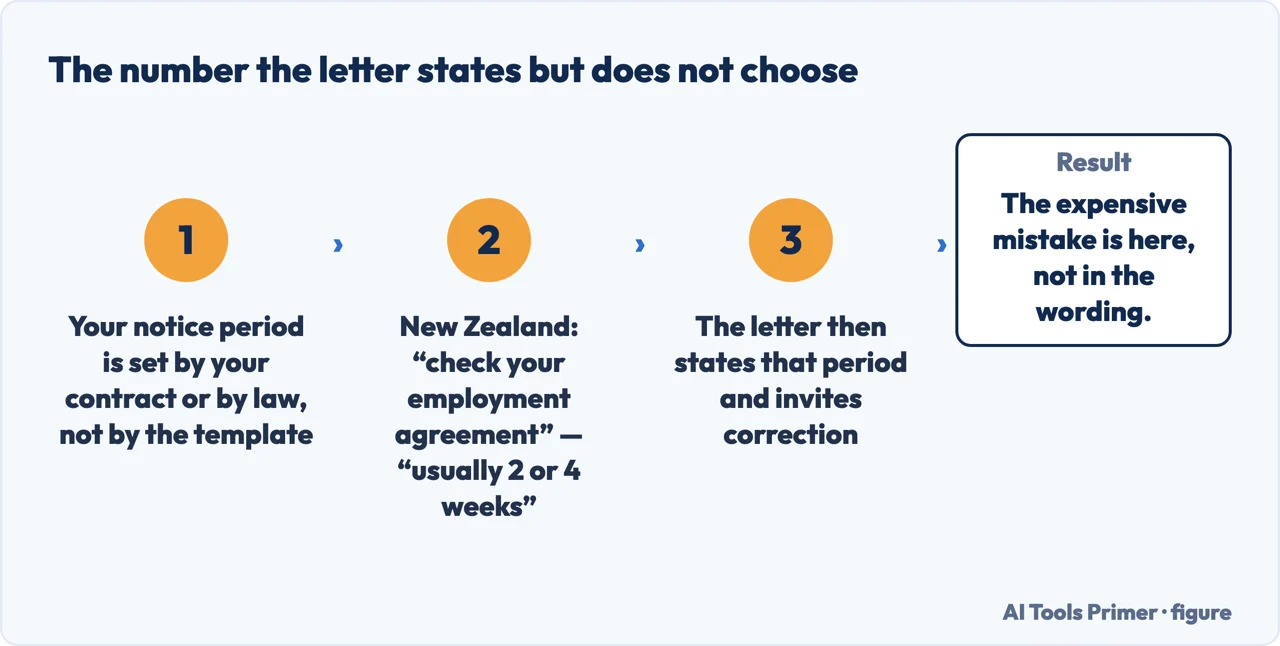
The part that actually matters is not in the letter at all. Your notice period is set by your contract or by law, not by what you write. New Zealand’s guidance says to “check your employment agreement to see how long you have to work there before you leave – usually 2 or 4 weeks”, and Acas treats the length of notice as a separate subject with its own advice. The letter states the period; it does not choose it. Getting that number wrong is the expensive mistake on this page, and it is the one thing worth checking before you send anything.
You can offer to work longer than the minimum, and the New Zealand service notes that you can if your employer agrees — which is worth knowing in reverse too. A handover that leaves your colleagues covered is the thing the reference remembers.
The warning the templates on page one do not carry
Acas puts this above its own template, in bold, before anything else: “Do not use this template if you believe you have no choice but to resign. This could be because of something your employer has done, for example if you believe there has been a serious breach of your contract.”
The reason is that resigning in those circumstances is a different legal act with different consequences, and how you word it matters. Acas notes that in such a case “you might not need to give any notice if there has been a serious breach of your contract”, and adds plainly: “This is a complex area of law.”
If that describes your situation, the useful next step is advice rather than a template — Acas runs a helpline in the UK, and equivalent services exist elsewhere. This guide is not that advice and does not attempt to be.
Email or paper? Acas says its template text can be copied “into an email or document”, so either is acceptable. Email is normal, and it has the practical advantage of timestamping itself. Send it to your manager, copy whoever handles personnel, and keep a copy somewhere that is not your work account — because access to that account frequently ends on your last day, sometimes earlier.
Holiday and final pay. The optional line in the official template asks how much accrued holiday and pay you are owed, and it is worth including even when you think you know. It puts the question in writing at the start of the notice period rather than at the end, when the answer is harder to change and you have less standing to ask.
Every sentence quoted on this guide comes from a statutory service or a government careers service, with the date it was read. The judgements — what to leave out, sending it from an address you will still have, asking about holiday early — are ours, and are marked as such rather than presented as rules.
Where to start
Four ways in.
- “I have a new job and just need to send this.”
- The template above — then before you send it
- “I feel I have no choice but to leave.”
- Stop and read when it is not simple
- “How much notice do I actually owe?”
- That is before you send it
- “I am still looking for the next thing.”
- Go to the search
Before you send it
The notice period, the handover and the final pay are decided outside the letter. These are the things worth settling before it goes.
When it is not simple
Resigning because you feel you have no choice is a different act with different consequences. The template is the wrong instrument, and advice comes before writing.
The search
The document you send when leaving is the shortest one in this section. The others are longer and matter more.
The next conversation
Leaving well is partly about what happens after the letter — the handover, the reference, and the interview where somebody asks why you left.
Not covered here. It will not tell you to explain yourself in the letter. Everything you might want to say belongs in a conversation, and a grievance written here becomes a permanent record made at the worst moment for writing one.
It will not give advice on constructive dismissal. The statutory service quoted above calls it a complex area of law and points to a helpline, and repeating that is more useful than paraphrasing it.
And it will not sell you a letter template, which is what several guides on this question are for — while three governments publish one for nothing. What holds instead is simple: the template and the warning above it are quoted from a statutory workplace advice service, with the guidance on talking first from a government careers service.
Step 23 of 24 in the job search
The order this is meant to be read in, from writing the CV to handing in notice.
- Before this
- How to quit a job, in the order that actually matters
- After this
- Two week notice letter, and what to check first
Sources
- Acas (United Kingdom) — Resignation notice letter template, including the warning about resigning when you believe you have no choice — www.acas.org.uk, read 21 August 2026.
- Tahatū, New Zealand Government careers service — How to resign from a job, updated 6 January 2026, on talking to your manager first and checking your employment agreement for notice — tahatu.govt.nz, read 21 August 2026.
Written by Alberto Gulotta
Founder and editor of AI Tools Primer, writing from Palermo, Italy. Thirty-five years of taking computers apart, starting with a Commodore 64 — the long version is on the about page.
Something wrong on this page? Write to aitoolsprimer@gmail.com and it gets fixed.
Written on 21 August 2026 · last checked 23 September 2026.
Independence and limits
No affiliate links and no paid placements anywhere on this site. Nobody pays to appear here, and no company has seen this page before you did.
This is general information, not professional advice. Where a page touches money, health, safety or the law, it names its source and the date it was read — and your situation may still differ. See the privacy page and the cookie policy.