
Work · guide
How to quit a job, in the order that actually matters
By Alberto Gulotta · Updated · 9 min read
Advice on how to quit a job covers the conversation — what to say, how to say it, how not to burn a bridge. That part is real and it is also the easy part. What costs people money is the order, because one step in this sequence is hard to undo and three things are much easier to establish before it than after.
The order, and the step that is hard to take back
This is about the order, not the wording.
- Get the new offer in writingSigned, with a start date. A verbal offer is not a job, and every step below assumes this one is done.
- Check what you lose on the last dayHealth cover, anything unvested, and whatever your employer provides that you have stopped noticing.
- Find out when the final payment landsFederal law does not require it on your last day; some states may. See below.
- Tell your managerThis is the one that is hard to undo. Everything before it can be taken back quietly.
- Send the letterThree lines confirming what you just said, with a date.
- Hand over properlyThe part colleagues remember, and the part a reference is written from.
Step four is the hinge. Before it you are a person considering something; after it you are a person who has resigned, and everything you did not check becomes something you find out. That is not a reason to delay — it is a reason to spend one evening on steps one to three first.
Step one deserves its own sentence because the others rest on it. A verbal offer is not a job. Offers can be withdrawn, budgets frozen, start dates moved and roles restructured. Written, signed, with a start date on it, and then you resign.
Steps two and three are the ones worth not skipping, and both have documented answers rather than opinions.
The step to check before you resign: health cover
- Quitting counts
- The US Department of Labor lists the qualifying circumstances as including “voluntary or involuntary job loss… transition between jobs”. Leaving by choice is not excluded: the Department of Labor’s list names voluntary job loss.
- But you pay for it
- “Qualified individuals may be required to pay the entire premium for coverage up to 102% of the cost to the plan.” Not only the share you saw on your payslip: the Department of Labor’s COBRA FAQ says “You usually pay the full premium for COBRA”, and adds that “some employers may agree to pay part or all of the cost as part of a severance package.”
- And it depends on the employer’s size
- COBRA “generally requires that group health plans sponsored by employers with 20 or more employees in the prior year” offer the continuation. The Department of Labor’s COBRA FAQ lists whose plans are covered: “A private-sector employer or employee organization, such as a union, with 20 or more employees”, “A state government” and “A local government”. Below twenty, a private employer’s plan is generally outside the federal rule, whatever your state may separately provide.
This is the calculation to do before step four rather than after it. If the new job’s cover starts on day one there may be no gap at all; if it starts after a waiting period, the size of that gap and the cost of filling it is a real number, and it is knowable in advance.
That 102% figure is the one to sit with, because it is the difference between an inconvenience and a genuine expense. What appeared on your payslip was your share; your employer was paying the rest without it ever crossing your desk. Continuing the same cover usually means paying “both the share you used to pay as an active employee and the amount your employer used to contribute, plus two percent”, in the words of the same FAQ.
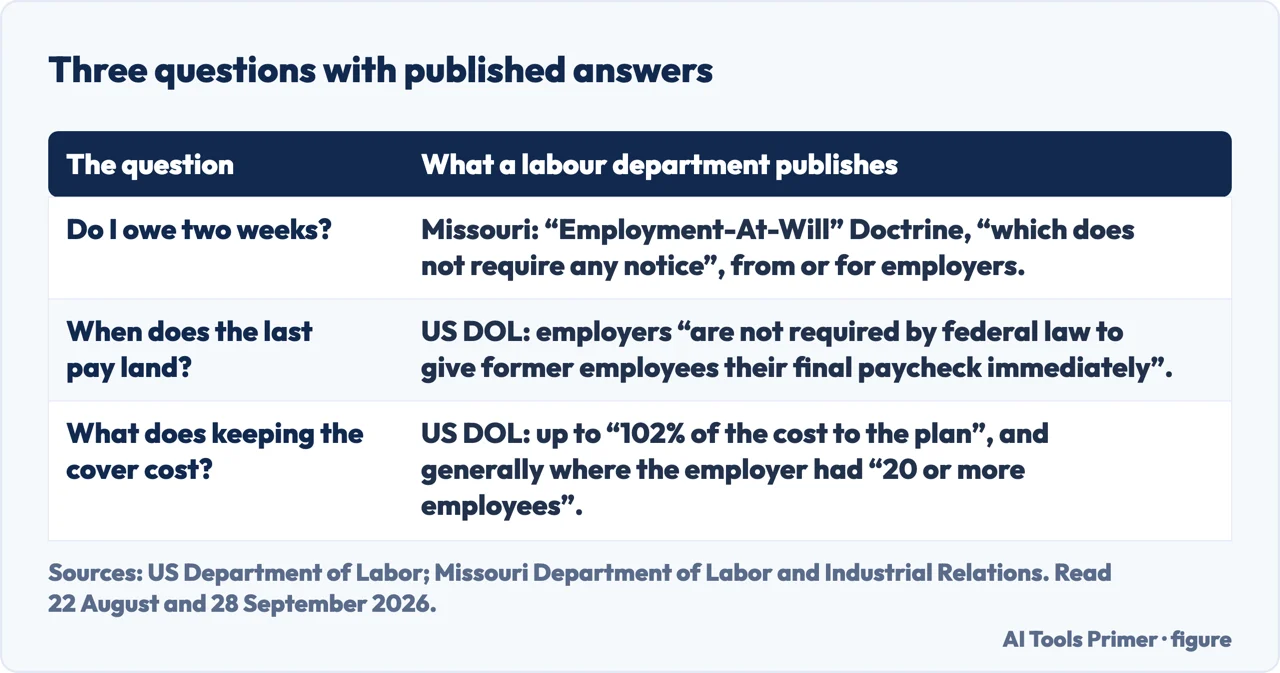
Those two facts pull in opposite directions and it is worth holding both. In Missouri you are not obliged to give notice — but the same doctrine means they are not obliged to keep you for it. In another state, or under a contract, check what applies to you. And the final payment may arrive on a payday that falls weeks later. If losing that stretch of income would genuinely hurt, that is a fact to establish before step four, not after.
Two phrasings in this family point at real and different situations. Searching how to professionally quit a job is asking about the conversation and the handover, which is the second half of this guide. Searching how to quit a job without notice is asking whether the two weeks are owed — and the answer above is that in at least one state they are documented as not being owed, in either direction. The second question has a real answer rather than a lecture.
On the conversation itself, the useful advice is short. Tell your manager first and in person if you can, before the news reaches them from anywhere else. Say that you are leaving and when — not why, unless you want to. Offer a proper handover and mean it. Then send the letter the same day, confirming what you said with a date on it, because a conversation is not a record.
And on the counter-offer, if one arrives: it is worth asking what exactly it changes. If the reasons you are leaving are about money, a counter-offer may genuinely solve them. If they are about the work, the manager or the direction, a counter-offer may not touch them, and it buys time during which your employer knows you were leaving.
The guides below follow the order of this page: before you say anything, then notice and the letter.
Where to start
Two ways in.
- “I have an offer and I am about to resign.”
- Start at before you say anything
- “How much notice do I owe?”
- That is notice and the letter
Before you say anything
The part of this process that can still be taken back quietly. Everything here is easier to establish while you are still an employee than afterwards.
Notice and the letter
Three lines and a date, plus the question of how many days you owe — which has a shorter answer than the phrase implies.
Not covered here. It will not tell you when to leave. That is not a question this guide can answer, and pages that answer it are guessing about your life.
It will not give you legal advice. Final pay rules can differ by state, as the Department of Labor notes; one state department is quoted here on notice, for its own state, and the federal position is quoted where there is one.
And it will not skip the boring steps. The health cover and the final payday are where quitting costs people money, and this guide covers both before the step that is hard to undo. What holds instead is simple: the position on notice, on final pay and on continuing health cover is quoted from a state labour department and the US Department of Labor, listed below.
Step 22 of 24 in the job search
The order this is meant to be read in, from writing the CV to handing in notice.
- Before this
- How to negotiate a salary, and why the number compounds
- After this
- How to write a resignation letter, and what it is for
The money conversations
Same subject, in no particular order.
- The same job, in the other places it comes up
- How to ask for a raise at work, and when to ask
Sources
- US Department of Labor — Continuation of Health Coverage (COBRA) (that voluntary job loss and transition between jobs are qualifying circumstances, that individuals may pay the entire premium up to 102% of the cost to the plan, and the twenty-employee threshold) — www.dol.gov, read 22 August 2026.
- US Department of Labor — Last Paycheck (that federal law does not require immediate final payment, that some states do, and who to contact if the regular payday passes) — www.dol.gov, read 22 August 2026.
- Missouri Department of Labor and Industrial Relations — Is an employee required to give his/her employer two weeks notice when quitting a job? (the at-will answer, and that state laws require notice neither from nor for employers). Missouri only — labor.mo.gov, read 22 August 2026.
- US Department of Labor, Employee Benefits Security Administration — FAQs on COBRA Continuation Health Coverage for Workers (that you usually pay the full premium, which includes both the share you used to pay and the amount your employer used to contribute, plus two percent; that some employers may agree to pay part or all of the cost as part of a severance package; and which employers’ plans are covered) — www.dol.gov, read 28 September 2026.
Written by Alberto Gulotta
Founder and editor of AI Tools Primer, writing from Palermo, Italy. Thirty-five years of taking computers apart, starting with a Commodore 64 — the long version is on the about page.
Something wrong on this page? Write to aitoolsprimer@gmail.com and it gets fixed.
Written on 22 August 2026 · last checked 30 September 2026.
Independence and limits
No affiliate links and no paid placements anywhere on this site. Nobody pays to appear here, and no company has seen this page before you did.
This is general information, not professional advice. Where a page touches money, health, safety or the law, it names its source and the date it was read — and your situation may still differ. See the privacy page and the cookie policy.