
Work · guide
How to ask for a raise at work, and when to ask
By Alberto Gulotta · Updated · 9 min read
The pages answering how to ask for a raise at work are mostly written by people who benefit from your career anxiety, and one of the first results today is a credit card company. There is a source with no stake in it at all, it is more specific than any of them, and nothing on the first page of Google links to it: a state labour department.
It starts with the question everybody skips, which is not how but when.
When to ask, according to a labour department
Most advice on this says “pick a good moment”. The New York State Department of Labor is specific, and the specificity is the useful part. Read 21 August 2026.
- At the annual review, after a year in the role “An annual review after you have been in your current position for one year may be the time to ask for a raise. This is the most appropriate time.”
- At six months, if you can show results “After you’ve been in your current position for six months is also acceptable if you can show specific results.” The condition is doing the work in that sentence.
- When you are handed something extra “Another opportunity is when you are given additional responsibilities.” This is the one people miss, because it arrives disguised as a favour being asked of you rather than as leverage.
That third moment deserves its own paragraph, because it is the one that passes unremarked. When your manager asks you to take on a project, train somebody, or cover a departure, the request arrives as a compliment and is answered with a yes. The department treats it as a negotiation point — and gives you the sentence.
The department’s own wording, for the moment you are given extra work
“I would really be interested in taking this on, but it appears it is going to result in additional preparation work for me, which I am excited about. Is there an opportunity to discuss maybe getting additional pay for this particular work, because I am going to have to devote more time to make that happen?”
A state labour department writing out a sentence you can say. Note its shape: enthusiasm first, the specific extra cost second, and the ask framed as a discussion rather than a demand. It also happens in the moment rather than being saved for a review months later, which is why it works — the extra work is visible to both of you right now.
The reasoning behind it is worth carrying even if you never use those exact words: “Although it may just be a shift in responsibilities, it could also mean additional work… You should ask yourself what it’s taking to do this additional work, compared to just doing your regular work in the past.” The test is not whether the new task is impressive. It is whether it costs you hours you were not spending before.
What to bring, in the department’s order
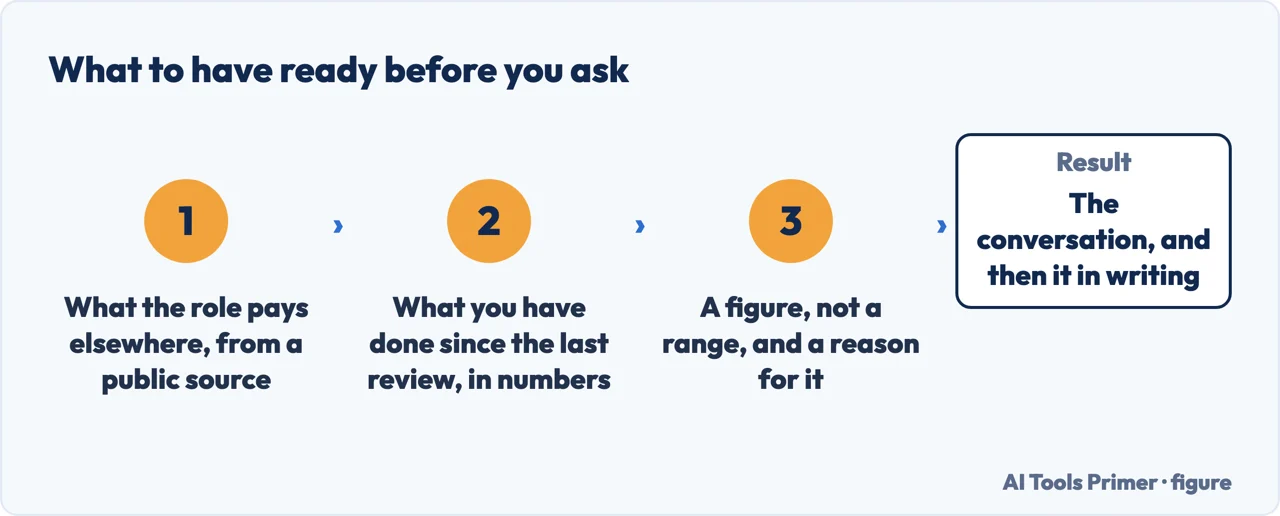
- Proof you have earned it. “First make sure you are prepared to prove why you have earned it.” Not that you deserve it — that you have earned it, which is a claim with evidence attached.
- How the job has changed. “Present your responsibilities and show how they’ve changed from when you started receiving your current salary.” The comparison is against the day the number was set, not against the job description.
- What more you could take on. “Articulate what more you could do or what other value-added duties would offset costs.” This turns the conversation from a cost into an exchange.
- Evidence from outside. “Research what other people in similar positions are doing and make sure what you’re asking isn’t out of line.” The second half of that instruction protects you as much as the first.
Two practical rules from the same source, both blunter than the usual advice. The first is to rehearse: “Practicing boosts your confidence and helps you stay calm and consistent during negotiations.” The second is one we have not seen stated so plainly anywhere else — “Don’t negotiate over text message: It is viewed as disrespectful and irresponsible.” By extension, this is a conversation, not a message. Writing can follow it and should, but it should not open it.
What to do when the answer is no. This is where most advice stops and where the useful part begins. A refusal is information if you make it specific: ask what would have to be true for the answer to be yes, and when it would be reasonable to raise it again. A manager who can answer both questions has given you a plan. A manager who cannot has told you something about the job that is worth knowing before you spend another year in it.
And if the answer is no because the budget is genuinely fixed — which is often true, particularly on banded pay scales — the same principle applies as with a job offer. Title, training, a defined review date, a change in duties that makes your next application stronger: several of these cost the employer less than salary and are worth real money to you.
The comparison that decides the whole thing. The department’s guidance on offers notes that employers frequently set your pay from your previous pay, and that being underpaid tends to persist. The blunt version is that a raise negotiated internally competes with the raise available by changing employer, and the two are rarely the same size. That comparison is not in the department’s guidance and is our own observation — but it is worth making honestly, because a page that only tells you how to ask is only telling you half of what you are choosing between.
And what happens after the conversation, if it does not go your way. Acas, the UK’s employment advisory service, sets out the part careers advice usually stops short of: an employee who cannot agree with the employer about a pay rise “can raise a grievance”, a formal complaint that can be made “even if their employment has ended”, and whose eligibility for a backdated rise “depends on their contract”. Its practical instruction is the one to borrow whatever country you are in: after the conversation, “confirm what they have discussed in writing”.
Everything in quotation marks on this guide comes from the New York State Department of Labor, read on the date given. It is written for New York; the timing, the evidence and the phrasing are general, while anything touching pay law varies by state and by country and is worth checking where you are.
Where to start
Four ways in.
- “I have been here a year and want to ask.”
- The timing above — then building the case
- “They just gave me extra work.”
- That is the sentence above — see the conversation
- “Maybe I should just leave.”
- See the other route
Building the case
Proof that you have earned it, in the department’s phrasing — which means evidence rather than a feeling about what you deserve.
The conversation
It is a conversation rather than a message, and the same source is explicit about that. What to say, and in what order.
The other route
Asking internally and moving are alternatives to the same problem, and an honest page has to say so.
Not covered here. It will not give you a percentage to ask for. The department says to check what comparable roles pay and make sure the request “isn’t out of line”, which is a better instruction than any number a stranger could give you.
It will not pretend asking always works. What to do when the answer is no is on this page because it is the more common outcome, and the follow-up question is where the value is.
And it will not sell you negotiation coaching — which, given that one of the pages ranking above this one is published by a credit card company, is worth saying about this subject in particular. What holds instead is simple: the worked sentence and the rule against negotiating by message are quoted from a state labour department, read on the date this page names.
The money conversations
Same subject, in no particular order.
- The same job, in the other places it comes up
- How to negotiate a salary, and why the number compounds
- How to quit a job, in the order that actually matters
Sources
- New York State Department of Labor — Salary Negotiation Guide, including the section on negotiating raises, when to ask, what to prepare, the worked sentence for additional responsibilities and the negotiation tips — dol.ny.gov, read 21 August 2026.
- Acas — Asking for and awarding pay rises: what a contract decides, what a grievance is, and the instruction to put the conversation in writing afterwards — www.acas.org.uk, read 4 September 2026.
Written by Alberto Gulotta
Founder and editor of AI Tools Primer, writing from Palermo, Italy. Thirty-five years of taking computers apart, starting with a Commodore 64 — the long version is on the about page.
Something wrong on this page? Write to aitoolsprimer@gmail.com and it gets fixed.
Written on 21 August 2026 · last checked 23 September 2026.
Independence and limits
No affiliate links and no paid placements anywhere on this site. Nobody pays to appear here, and no company has seen this page before you did.
This is general information, not professional advice. Where a page touches money, health, safety or the law, it names its source and the date it was read — and your situation may still differ. See the privacy page and the cookie policy.