
Work · guide
How to answer tell me about yourself, when it is not a question
By Alberto Gulotta · Updated · 10 min read
Most advice on how to answer tell me about yourself hands you a script: present, past, future, in ninety seconds. The formula is not wrong, and it is also the reason so many answers sound identical — because everybody in the room has read the same three articles.
The more useful starting point is noticing what kind of thing you have been asked.
What a national careers service lists as the common interview questions
The United Kingdom’s National Careers Service, a public body, groups them by what the employer is trying to find out. Read 21 August 2026.
- About the employer — what do you know about our company?
- About you — what do you do in your spare time?
- Work history — when have you faced a challenging situation?
- Strengths
- Weaknesses
- Why you left your last job
“Tell me about yourself” is not on that list. Not because the service overlooked it — it is probably the most frequently asked opener in the English-speaking world — but because it does not belong in a list of questions. It is not asking for a piece of information. It is handing you the guide and seeing what you do with it.
That distinction changes the whole problem. Every other opener has a correct subject: they asked about your last job, so you talk about your last job. This one has no subject at all, which is why it feels hard and why a script feels like relief. The interviewer has not asked you for information. They have given you the first ninety seconds of the conversation and let you choose what it is about.
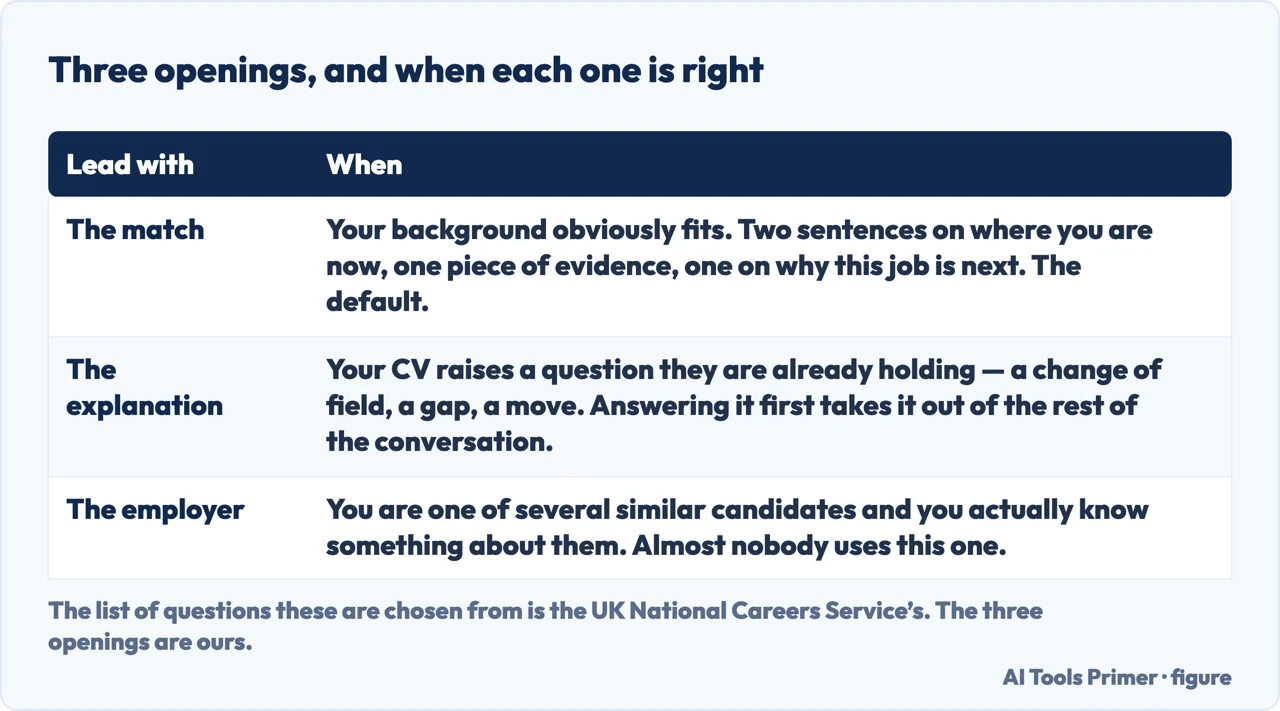
So the real question is not what to say. It is which of the things they actually want to know you want to spend the opening on — and the list above is that menu. In practice one of three choices is right, and which one depends on the situation rather than on taste.
Lead with the match when your background obviously fits the role. Two sentences on where you are now, one concrete piece of evidence, and a sentence on why this job is the next step. This is the default and it is right most of the time.
Lead with the explanation when something about your CV raises a question the interviewer is already holding — a change of field, a gap, a move between countries, a title that does not match the work. Answering it before they have to ask removes the awkwardness from the rest of the conversation, and it demonstrates a kind of composure no other answer can.
Lead with the employer when you are one of many similar candidates and the differentiator is that you actually know something about them. This is the version almost nobody uses, and it is disproportionately effective for exactly that reason.
Whichever you choose, the middle of the answer has to contain one specific thing that happened. That is the difference between an opener that gets a follow-up question and one that gets a polite nod.
The one structure worth borrowing
Also from the National Careers Service. It is written for behavioural questions, but the third part of your answer is a behavioural answer in miniature.
- Situation
- “The situation you had to deal with.”
- Task
- “The task you were given to do.”
- Action
- “The action you took.”
- Result
- “What happened as a result of your action and what you learned from the experience.”
Notice the last clause, because it is the part people drop: and what you learned from the experience. An example without a result is a story. An example with a result and no reflection is a claim. The full shape is what makes ninety seconds feel like evidence rather than a pitch.
What to leave out. Your entire chronology, which is on the CV they are holding. The word “passionate”, which every candidate uses and none of them demonstrate. Anything from your personal life that you would not want weighed in a hiring decision — the public careers service does list hobbies as fair game for the “about you” questions, and they are, but this particular opener is not the place to spend your one uninterrupted minute. And the phrase “as you can see from my CV”, which answers the question with a reference to a document.
How long. Around ninety seconds, and shorter is safer than longer. The reliable test is not the clock but the ending: stop on a sentence that invites a follow-up rather than trailing off. If you do not know how to end it, you have chosen too many subjects.
“Tell me about yourself. Prepare 1-2 sentences about your work background. Present yourself positively, and express enthusiasm and genuine interest in the job.”
That is CareerOneStop — the careers service of the United States Department of Labor — answering this exact question in fifteen words. Not ninety seconds. Two sentences.
And the same service’s interview pages state the risk plainly: “Do not volunteer information that is not asked. You might talk yourself out of a job.”
Two public careers services, no product to sell between them, and they do not agree on the length. That is worth showing rather than smoothing over, because the disagreement is the useful part: the guide is two sentences and the ceiling is about ninety, and where you land inside that range is a judgement about the room rather than a rule. What the two services do agree on is the subject matter — your work background, this employer, and why this job — and on the one thing to keep out, which is anything nobody asked for.
The American service also settles a question with no obvious answer. It lists “Tell me about your education and skills” as a separate question, with its own answer: degrees, certificates, training, and the skills that bear on the job. So the education paragraph, if you were trying to force it into your opener, is not homeless. It has a slot of its own later, and taking it early spends the slot twice.
One more line from the same service, aimed at the version of this answer that leads with the employer: “Try to use keywords from the job posting, and affirm the match of your skills to the company’s needs.” That is a concrete instruction where most advice offers an adjective. The posting is the only document in the room that tells you what words the person opposite has already decided matter.
Should you rehearse it? Yes, and not by memorising sentences. Memorised text is audible, and the moment you lose a line you lose the thread. Rehearse the three or four points and the one example, then let the words come out differently every time. The public careers service’s advice on examples applies here too: keep them short, and use ones that genuinely work for you rather than ones that sound impressive.
One thing worth knowing about the other guides on this question. The second result on Google for
this question sits on Harvard’s career services domain, which carries obvious authority. Opening it
shows a few opening sentences, a byline reading By Guest or External Blog, and a line
saying “Read the full article on The Muse” — a commercial careers site.
That is not dishonest; the attribution is right there. But it means the page you might trust because of the domain is a syndicated extract of somebody else’s article. Checked 21 August 2026. It is a good argument for looking at who actually wrote a page rather than which university it sits on.
A last note on where this advice comes from, because on this particular question it matters. Nearly every guide on it is from a careers company, a recruitment firm or a forum thread. The structure above is built from two public careers services that have no product to sell — and the parts that are our judgement rather than theirs are marked as such throughout.
Where to start
Four ways in.
- “I have a gap or a career change to explain.”
- That is the second option above — see the difficult cases
- “What else will they ask?”
- Go to the other questions
- “My CV is what got me here.”
- That is the document
The other questions
The rest of the opener’s siblings, grouped the way a public careers service groups them: by what the employer is trying to find out.
The difficult cases
When something on the CV raises a question the interviewer is already holding, the opener is the best place to answer it.
The document
The interviewer is holding your CV while you answer. What it says decides which of the three openings above is the right one.
Not covered here. It will not give you a script to memorise. Memorised answers are audible, and the pages offering one are the reason so many openings sound the same.
It will not pretend there is a single right answer. Which of the three openings is correct depends on what your CV makes the interviewer wonder, and that is different for everybody.
And it will not sell you an interview coaching service. What holds instead is simple: the STAR structure and the American two-sentence instruction are quoted from public careers services with no product to sell, on the dates they were read.
Step 14 of 24 in the job search
The order this is meant to be read in, from writing the CV to handing in notice.
- Before this
- Common interview questions, and what to do with them
- After this
- What are your weaknesses, and why the safe answers fail
Sources
- National Careers Service (United Kingdom) — How to answer common interview questions, which groups the common openers by what the employer wants to find out — nationalcareers.service.gov.uk, read 21 August 2026.
- CareerOneStop (United States Department of Labor) — Practice interview questions (the instruction to prepare 1-2 sentences about your work background, and the listing of education and skills as a separate question) — www.careeronestop.org, read 22 August 2026.
- CareerOneStop (United States Department of Labor) — Preparing for an interview, Veterans (the instruction not to volunteer information that is not asked, and the advice to use keywords from the job posting) — www.careeronestop.org, read 22 August 2026.
- National Careers Service (United Kingdom) — The STAR method, including the result step and what you learned from the experience — nationalcareers.service.gov.uk, read 21 August 2026.
Written by Alberto Gulotta
Founder and editor of AI Tools Primer, writing from Palermo, Italy. Thirty-five years of taking computers apart, starting with a Commodore 64 — the long version is on the about page.
Something wrong on this page? Write to aitoolsprimer@gmail.com and it gets fixed.
Written on 21 August 2026 · last checked 23 September 2026.
Independence and limits
No affiliate links and no paid placements anywhere on this site. Nobody pays to appear here, and no company has seen this page before you did.
This is general information, not professional advice. Where a page touches money, health, safety or the law, it names its source and the date it was read — and your situation may still differ. See the privacy page and the cookie policy.