
Work · guide
How far back should a resume go, and why that number exists
By Alberto Gulotta · Updated · 9 min read
Search for how far back should a resume go and you will be told ten to fifteen years, repeatedly and confidently, by pages that never explain where the figure comes from. One widely shared guide puts it in the title as “The 10–15 Year Rule”, as though somebody had passed it.
Nobody passed it. The number is a defensive habit, and it exists for a reason that the guidance pages almost never name.
“6 out of 10 older workers have seen or experienced age discrimination in the workplace and 90 percent of those say it is common.”
The US Equal Employment Opportunity Commission, in its own report on the fifty years since the Age Discrimination in Employment Act, read 21 August 2026. That sentence is the reason the ten-to-fifteen year convention exists. It is not a formatting rule and never was.
That is the honest foundation of this question, and it changes what you are actually deciding. You are not choosing a formatting convention. You are deciding how much of a real and documented risk you want to carry into a process where the decision is made in seconds by somebody you cannot see.
Which makes the legal position worth knowing precisely, because it is easy to carry only a vague sense of it.
What the law actually says, in the United States
- Who is protected
- “The Age Discrimination in Employment Act (ADEA) forbids age discrimination against people who are age 40 or older.” It “does not protect workers under the age of 40”.
- Where it applies
- “Any aspect of employment, including hiring” — so a decision made while reading your résumé is covered.
- Which employers
- Those with twenty or more employees.
- Neutral rules count too
- A practice “that applies to everyone, regardless of age, can be illegal if it has a negative impact on applicants or employees age 40 or older and is not based on a reasonable factor other than age”.
- If it happens to you
- 180 days to file a charge, which may be extended by state law. Federal employees have 45 days to contact an EEO counsellor.
Read those together and the shape of the problem is clear. The behaviour is unlawful, the protection starts at forty, and the same commission that enforces the law reports that most older workers have seen it happen anyway. The convention is not advice about what employers are allowed to do. It is a response to what they demonstrably do.
It is also specifically United States law. Age protections exist across Europe, in the United Kingdom and elsewhere, with different thresholds and different norms about what a CV contains — several countries expect a full chronology and some still expect a photograph, which would be unthinkable on an American résumé. If you are applying outside the US, the convention above is the wrong one to copy.
What to cut, in the order it should go
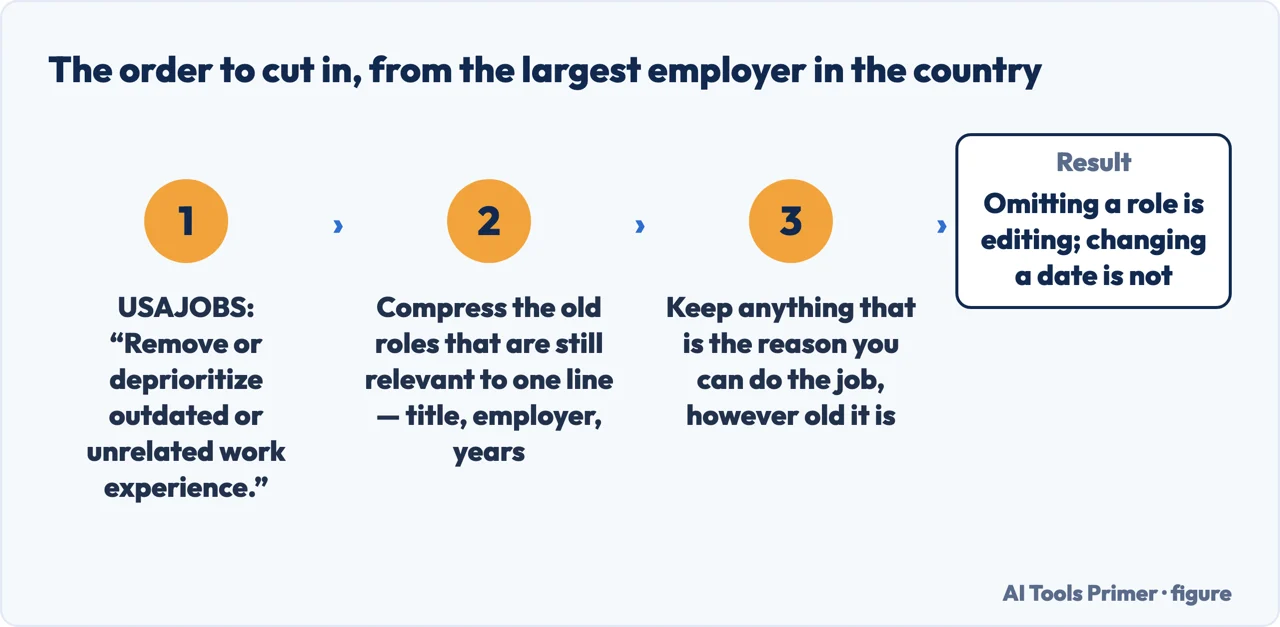
The federal government’s own instruction to applicants is the cleanest statement of the principle: “Remove or deprioritize outdated or unrelated work experience.” Note the two words — outdated or unrelated. Relevance does most of the work here, not the calendar.
- Cut firstRoles that are both old and unrelated A summer job from two decades ago in a field you left is taking space from evidence somebody is actually looking for. This is not concealment; it is editing.
- Then compressOld roles that are relevant They do not need the same three bullet points as your current job. A single line — title, employer, years — keeps the continuity without spending the page on it.
- Keep, alwaysAnything that is the reason you can do the job If your strongest example is from twelve years ago, twelve years ago is where your résumé goes. A rule that removes your best evidence is a bad rule.
- Consider droppingThe graduation year Nothing requires it, and it is one way an approximate age reaches a reader who has no business calculating it.
- NeverChange a date Omitting an old role is editing. Altering when something happened is a false statement on an application, and it is the one move here that can cost you a job after you have started.
That last distinction is the whole ethical content of this question. You are not required to publish your complete employment history — a résumé is a summary of relevant experience, not a sworn record. What you must not do is misstate what is on it.
The relevance answer, which is the better one. Strip the discrimination question away for a moment and the remaining question has a clean answer: your résumé goes back as far as your evidence is still evidence. In most fields that lands somewhere near ten to fifteen years, which is why the convention persists — it is roughly right for roughly everybody, in the way that conventions usually are.
It is wrong in the obvious cases. A researcher’s publication list runs the length of a career by design. A tradesperson’s licence from twenty years ago is still a licence. Somebody returning to a field they left in the meantime needs the earlier work more than the recent work, and cutting it would remove the entire argument. In each case the convention loses to the evidence, and it should.
The two-page constraint interacts with this. If you are applying for a US federal job, the form will not accept more than two pages, so how far back you go is decided partly by what fits. That is a real limit rather than a preference, and the guide on résumé length in this section quotes it.
What the pages ranking above this one are selling. Two of the first five results are job boards, which have a direct commercial interest in a steady supply of applications, and several of the rest lead to a résumé review or writing service. That does not make their advice wrong — the ten-to-fifteen figure is a reasonable default. It is worth knowing why nobody in that list wants to talk about age discrimination: it is a discouraging subject on a page whose job is to keep you applying.
The useful version is less comfortable and more actionable. There is no rule. There is a convention built on a documented problem, a legal protection that begins at forty and covers hiring, and an editing principle — remove what is outdated or unrelated — published by the largest employer in the country. Work from the third of those, use the first as a default, and know the second exists in case you ever need it.
Where to start
Four ways in.
- “How many pages does that leave me?”
- That is the length question
- “I have a gap I do not want to explain.”
- Go to awkward history
- “Will software read the old roles anyway?”
- That is how it is read first
The length question
How far back you go and how long the document runs are the same decision approached from two ends. One of them has an enforced answer for one kind of employer.
Awkward history
Gaps, short stays and roles you would rather not discuss. The handling is the same in each case, and it is not concealment.
How it is read first
Before a person applies any convention, a parser reads the file. What it extracts decides which of your years survive to be judged at all.
Not covered here. It will not tell you to hide your age. It sets out what the law protects, what the enforcing commission reports actually happens, and what editing principle a government employer publishes — and leaves the decision where it belongs.
It will not tell you to change a date. Omitting an old role is editing and altering a date is a false statement, and the difference between them is the only part of this question with real consequences.
And it will not sell you a résumé review, which is where most of the confident answers to this question eventually lead. What holds instead is simple: the legal position and the discrimination figures on this page are quoted from the United States Equal Employment Opportunity Commission, with the date they were read.
Step 4 of 24 in the job search
The order this is meant to be read in, from writing the CV to handing in notice.
- Before this
- What are good skills to put on a resume, and which ones count
- After this
- How long should a resume be, and who sets the rule?
Sources
- US Equal Employment Opportunity Commission — Age Discrimination, on the ADEA, who it protects, which employers it covers, and the time limits for filing — www.eeoc.gov, read 21 August 2026.
- US Equal Employment Opportunity Commission — The State of Age Discrimination and Older Workers in the U.S. 50 Years After the Age Discrimination in Employment Act — www.eeoc.gov, read 21 August 2026.
- USAJOBS Help Center — How do I write a resume for a federal job?, including the instruction to remove or deprioritize outdated or unrelated work experience — help.usajobs.gov, read 21 August 2026.
Written by Alberto Gulotta
Founder and editor of AI Tools Primer, writing from Palermo, Italy. Thirty-five years of taking computers apart, starting with a Commodore 64 — the long version is on the about page.
Something wrong on this page? Write to aitoolsprimer@gmail.com and it gets fixed.
Written on 21 August 2026 · last checked 5 September 2026.
Independence and limits
No affiliate links and no paid placements anywhere on this site. Nobody pays to appear here, and no company has seen this page before you did.
This is general information, not professional advice. Where a page touches money, health, safety or the law, it names its source and the date it was read — and your situation may still differ. See the privacy page and the cookie policy.