
Work · guide
Common interview questions, and what to do with them
By Alberto Gulotta · Updated · 7 min read
Common interview questions is one of the most searched phrases in the working world, and the results are remarkably uniform: a list of questions, each followed by an answer you are invited to adapt. This guide is built differently, and it is worth saying why before you read on.
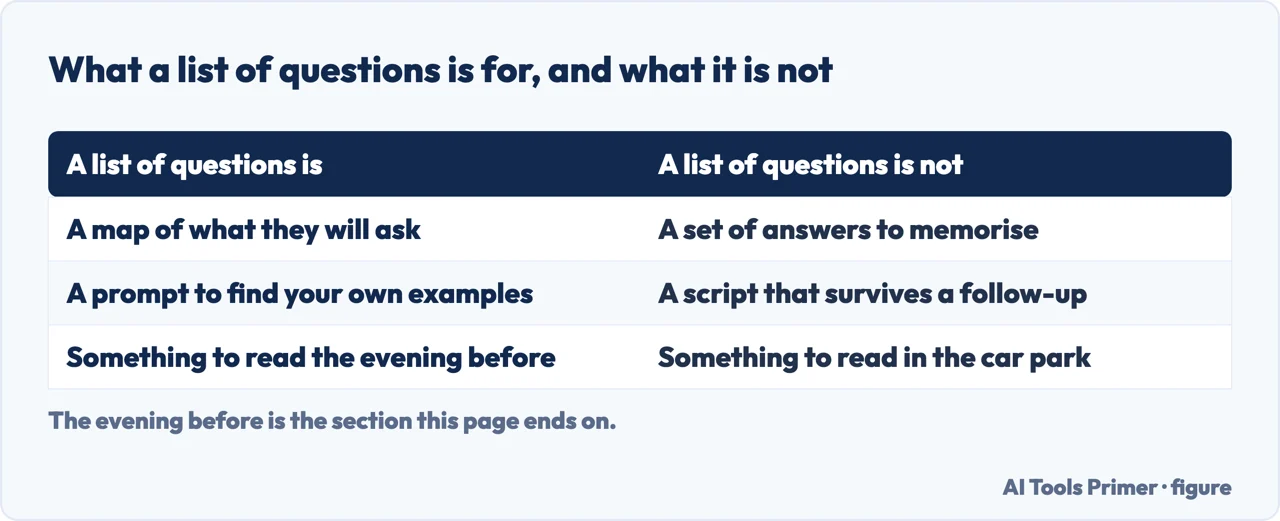
This guide will not give you answers to memorise
Every page competing for this question offers model answers, and they are the most popular thing on the internet about interviews. They are also, for the person using them, close to worthless — for a reason that has nothing to do with honesty and everything to do with how interviews work.
An interviewer has heard the model answers. They read the same pages. A candidate reciting one is recognisable within a sentence, and what it signals is not preparation but the absence of an example of your own. The question was never can you produce a good-sounding paragraph. It was has this person done the thing, and can they tell me about it.
So what follows is the questions that genuinely recur — taken from a government careers service rather than from a site selling interview coaching — and the documented structure for building your answer to any of them.
The questions, as a public careers service lists them
The UK National Careers Service, read 21 August 2026. Not a commercial site, and not a list assembled to fill a page.
About the employer
- “what do you know about our company?”
- “why do you want to work for us?”
- “why do you think you’re a good fit for our company?”
About your work history
- “when have you faced a challenging situation?”
- “can you tell us about a personal achievement at work?”
- “have you ever taken the initiative?”
- “have you ever failed at a task?”
About you
- “what are your main strengths?”
- “why should we hire you?”
- “Do you have any weaknesses?”
- “what do you do in your spare time?”
Read the middle group again. Four of the eleven ask for a specific occasion — a challenge, an achievement, an initiative, a failure. Those cannot be answered with a description of your character. They need an event, and the whole of the preparation worth doing is having four or five events ready.
The structure that turns an event into an answer
STAR, as the same service defines it.
The fourth letter is the one people truncate, and it is the one that matters most: not only what happened, but what you learned. It is also the letter that makes “have you ever failed at a task?” answerable — a failure with a result and a lesson is a good answer; a failure without one is just a failure.
Two pieces of guidance from the same source are worth having before you start. On strengths: “Plan your answers around 2 or 3 examples that are relevant to the job.” On weaknesses: “You should be honest when answering questions on your weaknesses. Say how you’re working to improve them.” And if your work history is short, the service is explicit that the examples need not come from work at all — “use examples that work for you — these could be from work, home or volunteering”.
Put the two together and the preparation that actually works takes an evening rather than a week. Write down four or five things that happened to you at work — a problem you solved, something you got right, something you started, something that went wrong. Put each one through the four letters. That is it. Those five stories, properly told, answer most of the questions in the list above and a good many that are not, because an interviewer asking an unexpected question is still asking for evidence and you now have five pieces of it.
The phrasings around this question are all the same request with different amounts of hope attached. Most common interview questions and what are the most common interview questions want the list. Common interview questions and best answers and common interview questions and answers want the list plus the script — and it is the script half that will not survive contact with a real interviewer. What are the 7 most common interview questions and answers wants a number, which no source can honestly supply: the questions vary by employer, by role and by country, and the eleven above are the ones a public service considered worth naming.
One last observation, and it cuts against most of what is written on this subject. The candidate who is easiest to interview is the one who has thought about their own work, not the one who has read about interviews. Everything on this guide is in service of the first thing. If you have half an hour, spend twenty-five minutes on your five stories and five on the list.
Where to start
Four ways in.
- “The interview is tomorrow.”
- Start at the evening before
The evening before
The preparation with the highest return per minute. Nothing here requires a coach and none of it is about what to wear.
Not covered here. It will not hand you answers to memorise. An interviewer has read the same pages you have, and a recited paragraph is recognisable in a sentence.
It will not claim there are seven questions, or ten. The number varies by employer and by country, and any page promising a fixed set is promising something no source can supply.
And it will not sell you interview coaching. The preparation that works here costs an evening and a piece of paper. What holds instead is simple: the questions and the structure on this page come from a public careers service, not a commercial one.
Step 13 of 24 in the job search
The order this is meant to be read in, from writing the CV to handing in notice.
- Before this
- What to wear to an interview, and the rule underneath
- After this
- How to answer tell me about yourself, when it is not a question
Sources
- National Careers Service (United Kingdom) — How to answer common interview questions — nationalcareers.service.gov.uk, read 21 August 2026.
- National Careers Service (United Kingdom) — The STAR method — nationalcareers.service.gov.uk, read 21 August 2026.
- CareerOneStop (United States Department of Labor) — Interview tips (that interviews also give you a chance to find out whether the job and the company are right for you; the advice to make a list of questions to ask, including commenting on something learned from the company website and asking about the day-to-day responsibilities of the job, how responsibilities and performance will be measured and by whom, the organisational structure, the equipment and software used, and the plan for the next five years; and the day-of list — arrive 10 to 15 minutes early, go by yourself, bring a notebook and pens, leave the coffee and backpack behind, and turn off your phone) — www.careeronestop.org, read 5 September 2026.
Written by Alberto Gulotta
Founder and editor of AI Tools Primer, writing from Palermo, Italy. Thirty-five years of taking computers apart, starting with a Commodore 64 — the long version is on the about page.
Something wrong on this page? Write to aitoolsprimer@gmail.com and it gets fixed.
Written on 21 August 2026 · last checked 5 September 2026.
Independence and limits
No affiliate links and no paid placements anywhere on this site. Nobody pays to appear here, and no company has seen this page before you did.
This is general information, not professional advice. Where a page touches money, health, safety or the law, it names its source and the date it was read — and your situation may still differ. See the privacy page and the cookie policy.