
Work · guide
What to wear to an interview, and the rule underneath
By Alberto Gulotta · Updated · 8 min read
Almost every answer to what to wear to an interview is a list of clothes, and a list of clothes cannot be right, because the correct answer at a law firm is wrong at a design studio and both are wrong in a laboratory. A university careers office states the rule instead, in one sentence, and it works everywhere.
“Once you have identified the standard level of attire for a normal day at the office, you should dress ‘up one level’ for an interview or career fair.”Duke University Career Hub, Attire Guide — read 22 August 2026
That is the whole answer, and it is a rule rather than an outfit. Duke counts “seven levels of dress that range from ultra casual to business formal”; you need to establish which one that particular workplace lives at on an ordinary Tuesday, and then go one step above it. A suit is right for some employers and actively wrong for others, and the rule tells you which without anybody having to guess.
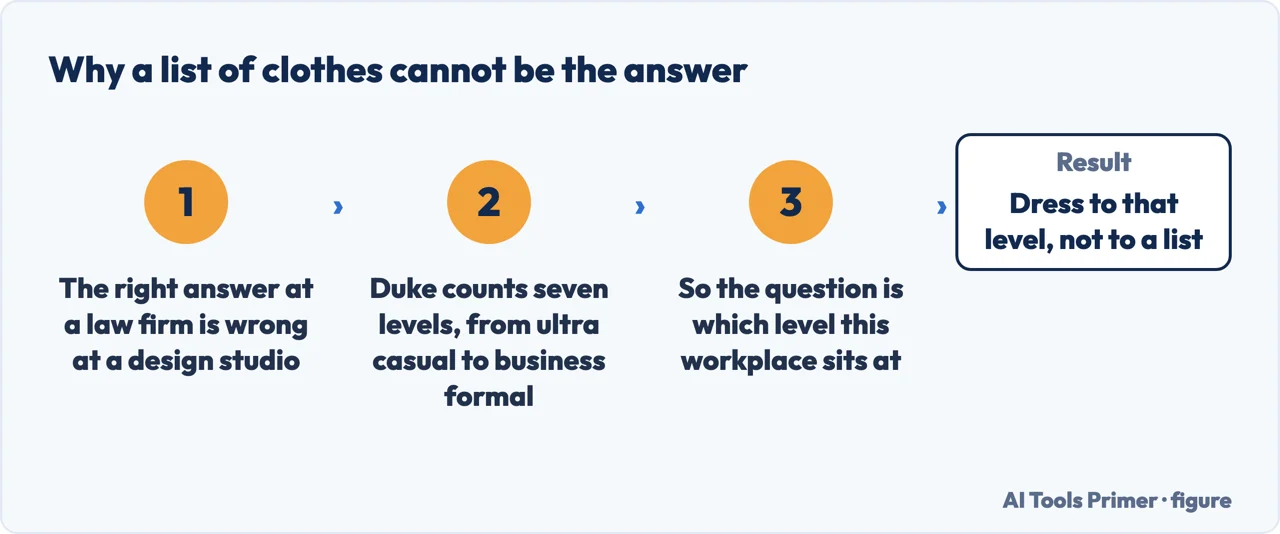
It is worth noticing what that rule does. It replaces an unanswerable question — what is smart enough? — with an answerable one: what do people here wear on a normal day? That second question has a factual answer you can go and find, and finding it is the whole preparation.
Establishing the normal level, which takes ten minutes
Duke’s instruction is “do your research”, and it names where to look.
- Review the company website — especially any team or about pages with photographs.
- Explore their social media, which shows the office on ordinary days rather than on photoshoot days.
- Speak with current employees if you can reach one. This is the reliable source and the one people are shyest about using.
Two variables sit on top of the industry, and Duke names both. Job title — the norm is not the same for a warehouse supervisor and a finance director at the same company. And location: their own example is that “bow ties might be appropriate for attorneys in the South but not for investment bankers in New York City”.
The one-level rule also explains the two failures people are afraid of, and shows that they are the same failure. Turning up in a suit to a workplace where nobody owns one reads as not having looked; turning up in a fleece to a firm where everyone wears a jacket reads the same way. Both say you did not check. Neither is really about the clothes.
With the level established, the remaining decisions are small and mostly not about money.
That third one deserves a line of its own, because it is the only item on this page that is a policy rather than a judgement. Visible tattoos and piercings are governed by written company guidelines in some workplaces and by nothing at all in others. It is a checkable fact rather than a matter of taste, and it is worth checking rather than agonising over.
If the obstacle is money rather than judgement, that is a solved problem, and the solution is rarely where people look for it. University career centres run and partner with clothing services, and they are not vague charity gestures — Temple’s career centre publishes a step-by-step booking procedure for appointments at a clothing organisation, down to the partner ID to enter and the street address to go to.
Duke’s guide adds the cheaper route for buying: rather than purchasing a full suit, look for stores that carry several cuts from one brand — because, as they note, a different cut can need a different size in a blazer than in trousers. If you are a student or a recent graduate, ask your careers office what it has before buying anything at all.
For a video interview the rule does not change, though the frame does: you are dressed from the chest up as far as the camera is concerned, and dressed completely as far as your own composure is concerned. Employers advising on video interviews ask for the same professional dress they would in a room, plus a quiet and well-lit place to sit.
A note on the words, because the same question is asked in three registers. What to wear for an interview is the same search with a different preposition. Interview attire and professional attire are the terms careers offices file it under, which is worth knowing when the open web is full of shops. If you are searching a university careers site rather than the open web, those two are the ones that find the guidance.
One last thought, from the Temple guidance and worth carrying in: “You’re interviewing them as much as they’re interviewing you.” If you have researched the ordinary level of dress and it tells you something you dislike about how that workplace operates, that is not a wasted ten minutes. That is information you went looking for and found.
The guides below take it four ways: establishing the level, the practical checks, doing it without spending money, and the rest of the preparation that matters more than the outfit.
Where to start
Four ways in.
- “I have the clothes, are they right?”
- Go to the practical checks
- “What actually matters more than this?”
- Almost everything — the rest of it
The practical checks
Once the level is settled these take a few minutes and none of them is about how much anything cost.
The rest of it
Clothes are the part people worry about most and the part that is scored least. These guides are the parts that are scored.
Not covered here. It will not give you an outfit. A careers office gives a rule that works in every industry, and a list of clothes cannot.
It will not tell you to buy a suit. One of the sources here explicitly suggests not buying one, and the other runs a service that lends clothes.
And it will not pretend this is the important part. It is the part people worry about most and the part that appears on no rating sheet anywhere. What holds instead is simple: the one-level rule and the practical checks are quoted from university careers offices, with the dates they were read.
Step 12 of 24 in the job search
The order this is meant to be read in, from writing the CV to handing in notice.
- Before this
- Star interview method: what employers say it is for
- After this
- Common interview questions, and what to do with them
Sources
- Duke University Career Hub — Attire Guide (the seven levels of dress, the instruction to dress up one level for an interview, the research method, the effect of job title and location, and the advice on buying separates rather than a full suit) — careerhub.students.duke.edu, read 22 August 2026.
- Temple University Career Center — Interview and Workplace Attire (the practical checks on condition and fit, the note on piercings and visible tattoos, the reminder that you are interviewing them too, and the published booking procedure for its clothing service partner) — careercenter.temple.edu, read 22 August 2026.
Written by Alberto Gulotta
Founder and editor of AI Tools Primer, writing from Palermo, Italy. Thirty-five years of taking computers apart, starting with a Commodore 64 — the long version is on the about page.
Something wrong on this page? Write to aitoolsprimer@gmail.com and it gets fixed.
Written on 22 August 2026 · last checked 23 September 2026.
Independence and limits
No affiliate links and no paid placements anywhere on this site. Nobody pays to appear here, and no company has seen this page before you did.
This is general information, not professional advice. Where a page touches money, health, safety or the law, it names its source and the date it was read — and your situation may still differ. See the privacy page and the cookie policy.