Search for a thank you email after interview and you will be offered templates by the dozen — ten examples, twelve templates, forty-five messages. What you will not easily find is anybody whose job is advising candidates saying what the email is actually for, which turns out to be a different and much more useful thing.
“Do not copy this letter directly. The most important quality you can convey in a thank
you letter is enthusiasm and this must be done in your own style.”
Columbia University, Center for Career Education — printed directly underneath its own
example letter, read 22 August 2026
That is a careers office giving you a template and telling you, in the same breath, not to use it
as one. The second half of that instruction is the part that does the work: the sentences that make a thank-you letter land are the ones only you can write, and no quantity of examples supplies them.
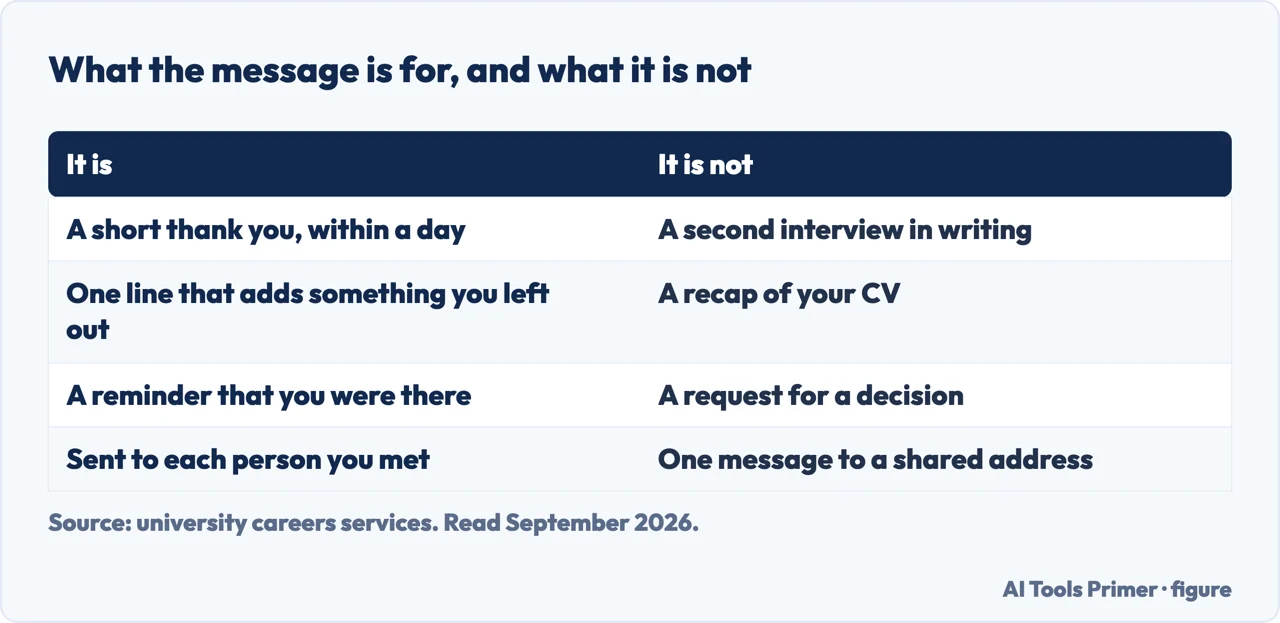
Short, quick, and not a second interview. Figure drawn by AI Tools Primer.
The rest of this guide is what those offices say, because their guidance is short, specific, and free — and specific in a way that template advice generally is not.
Start with timing, where two universities give the same number. Columbia: thank-you notes “should be sent via email within 24 hours of your interview or meeting.” Virginia agrees and adds the variant for paper: “within 24 hours after the interview, or a week if mailing a letter.” Columbia also suggests both are possible — email first, then “a more personalized card via postal mail” afterwards.
Then structure. Virginia sets it out as three paragraphs, and the middle one is where the value is.
First paragraph
Thank them, and refresh their memory — the University of Virginia’s careers centre is
specific about how: state “the time and date of your meeting as well as the position discussed
and the topics that were covered.”
Unglamorous, and it is what makes the email useful to somebody who saw six candidates that week.
Second paragraph — the one that matters
Reaffirm your interest, then add anything relevant that did not come up. And then the sentence
that justifies this whole page: “If you feel any of your responses were inadequate during your
interview, this is also the opportunity to provide a more well thought out response.”
That is the answer to the question people are really carrying when they search this. Not
“what do I write” — “can I fix the thing I said badly?” Yes. Here. Once, briefly, without
apologising for a paragraph.
Final paragraph
Wrap up, and give them a phone number for further questions. Then stop. Columbia’s instruction
for the whole thing is three words long: “short, concise, and to the point.”
Read that middle paragraph again if you have just come out of an interview thinking about one answer you gave badly. There is a sanctioned, ordinary, professional way to have a second attempt at it, and it is this email — sent the same day, in two or three sentences, without drawing attention to the fumble.
Columbia lists four purposes for the note, and the fourth is the same idea from another angle: reaffirm your interest, jog the interviewer’s memory, illustrate that you are courteous and professional, and “mention something that you may have omitted during the interview.” Three of those four are about being remembered accurately. Only one is about manners.
How many to send, with a number attached
One interviewer
One email, to them.
Two to eight
One each. Virginia: “you should extend a thank-you to each person
with whom you spoke.”
More than six to eight
You may thank “just the person who coordinated the interview” —
but the same page adds that “an individual email to each interviewer is always preferred.”
That threshold is worth keeping because it is a number rather than a principle. A panel of four gets four emails, and they will not be identical because the conversations were not.
Two smaller points from the same sources that change what people do. Columbia extends the occasions well beyond the job interview: notes are appropriate after informational interviews, and after anybody who “referred your resume to someone else” or offered contact information or advice. That is a wider list of occasions than the phrase “thank-you email” suggests, and none of them takes long.
And Virginia takes a position on the case where you have already decided against the job: “Even in cases where your interest in the company is low, a simple word of thanks as a follow-up to your interview can help keep your options open for the future.” The industry is smaller than it looks, and the person you did not want to work for this year hires again next year.
A note on the phrasing, since the search is often phrased as how to write a thank you email after an interview rather than for a thank you note. Columbia and Virginia both use the older word and both mean email: Virginia is explicit that “it used to be customary to send a handwritten letter, but today, an email is much more common and is perfectly acceptable.” The paper version is not required and not expected. It is an optional second gesture, and Columbia is the one that suggests it — after the email, not instead of it.
The guides below take it four ways: the writing itself, the timing and how many, what to do when the interview went badly, and the wider follow-up that comes after the thank-you and before an answer.
Not covered here. It will not give you forty-five templates. The one careers office that publishes an example prints “do not copy this letter directly” underneath it, and that is the more useful instruction.
It will not promise the email gets you the job. Three of the four purposes a careers office lists are about being remembered accurately, which is a smaller and more honest claim.
And it will not invent etiquette. Every rule on this guide — the timing, the structure, how many to send — is quoted from a university careers centre, with the page listed below. What holds instead is simple: the timing and the rule on how many to send are quoted from university careers offices, along with the instruction not to copy a template.
Step 19 of 24 in the job search
The order this is meant to be read in, from writing the CV to handing in notice.
Columbia University, Center for Career Education — Thank You Letter Basics (the four purposes, the occasions including informational interviews and referrals, the 24-hour rule, “short, concise, and to the point”, and the instruction not to copy the example letter) — www.careereducation.columbia.edu, read 22 August 2026.
University of Virginia Career Center — Post-interview Thank-you (the 24-hour and one-week timings, the three-paragraph structure including the opportunity to improve an inadequate answer, the rule on multiple interviewers, and the case for sending one even when your interest is low) — career.virginia.edu, read 22 August 2026.
AG
Written by Alberto Gulotta
Founder and editor of AI Tools Primer, writing from Palermo, Italy. Thirty-five years of
taking computers apart, starting with a Commodore 64 — the long version is on the
about page.
Written on 22 August 2026 · last checked 23 September 2026.
§
Independence and limits
No affiliate links and no paid placements anywhere on this site. Nobody pays to appear here,
and no company has seen this page before you did.
This is general information, not professional advice. Where a page touches money, health,
safety or the law, it names its source and the date it was read — and your situation may
still differ. See the privacy page and the
cookie policy.