
Work · guide
Why should we hire you, and where the answer is written down
By Alberto Gulotta · Updated · 8 min read
Why should we hire you sounds like a challenge, which is why it produces so many bad answers. People hear it as an invitation to argue their own case and start listing qualities, and the result is a paragraph of adjectives that could describe anybody in the building.
A public careers service classifies it differently, and the classification does most of the work.
“The strengths employers look for will depend on the job role. They may ask you questions like: what are your main strengths? why should we hire you?”
The United Kingdom’s National Careers Service, read 21 August 2026. It files this question under strengths rather than under persuasion, and that single classification is the most useful thing published about it. You are not being asked to argue. You are being asked which of your strengths are the ones this job needs — and the phrasing only sounds confrontational.
That reframing removes the pressure and replaces it with a task. The question is not convince me. It is which of your strengths did you decide were the relevant ones — and it is testing whether you understood the job well enough to choose.
Which means the answer exists before the interview, in a document you already have.
The answer is written down before you arrive
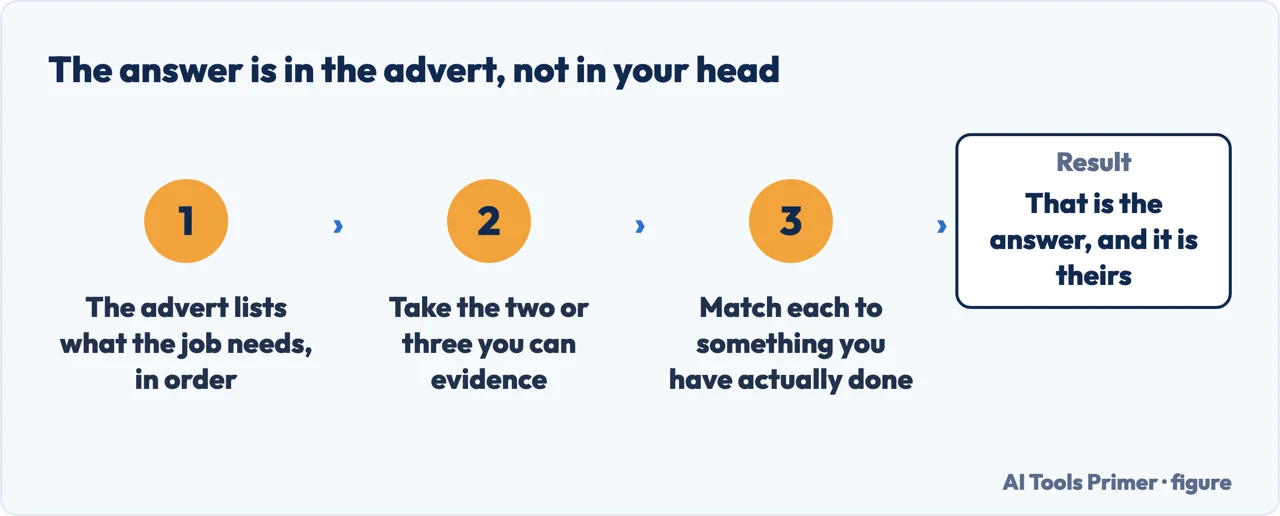
The employer has already published what they want. The advert is not a description of the job — it is a list of what they will judge you against, which makes it the answer key.
- Take the three requirements they listed first Order in a job advert is rarely accidental. The things at the top are usually the things the hire exists to solve.
- Find one concrete example for each Not a quality — something that happened. The careers service is specific about the number: “Plan your answers around 2 or 3 examples that are relevant to the job.”
- Use their words, not your synonyms The federal government tells its own applicants this outright about the equivalent document: “if the qualifications section says you need experience with MS Project, you need to use the words MS Project in your resume”. The same applies out loud.
- Back it with something checkable where you can “You can back these up with qualifications or training you’ve done.” A course, a certification, a shipped piece of work.
- End on the job, not on yourself One sentence saying what you would do with those strengths here. It is the part almost everybody leaves out, and it is what turns a list into an answer.
Two or three examples, in their vocabulary, ending on their problem. That is the entire answer, and it takes about ninety seconds.
Why the examples matter more than the claims. Every candidate says they are organised, reliable and a good communicator. Those words carry no information because their opposite is never claimed. An example carries information because it could have gone differently. If you find yourself asserting a quality, stop and replace it with the thing that happened.
The structure for those examples is published by the same source and is worth using here even though it was written for behavioural questions: situation, task, action, result — “and what you learned from the experience”. Keep it short. This question wants two or three compact examples, not one long story.
The three ways this answer usually goes wrong. First, listing qualities instead of evidence, which is the default failure. Second, describing why you want the job — that is a different question and answering it here wastes your best moment on your own motives rather than their problem. Third, comparing yourself to other candidates, which you cannot do because you have not met them, and which reads as bravado rather than confidence.
What to do when you are underqualified on paper. Some readers arrive at this question knowing they do not meet every requirement. The honest move is not to pretend otherwise but to be precise about which parts you do meet, with evidence, and to name the gap once with what you are doing about it. That is the same two-part structure that works for the weaknesses question, and it works here for the same reason: an accurate self-assessment is itself the quality being tested.
Who is answering this question on the first page of Google, checked 21 August 2026. Two recruitment agencies, a Reddit thread, a Quora thread, a LinkedIn post, a YouTube video and a student forum.
No university careers service. No public careers service. Not one institutional source, for a question asked in roughly every interview conducted in English. That is unusual — most of the questions in this section have at least one university page competing — and it is worth knowing while you read advice from a recruitment agency, whose business is placing candidates rather than preparing them.
A note on the sources, since there are few. The classification and the guidance on how many examples to prepare come from a national careers service with nothing to sell. The instruction to use the employer’s own vocabulary is quoted from a United States government application system, where it is written about résumés rather than interviews — we have extended it to spoken answers, and that extension is our judgement rather than theirs. The rest of the structure is ours too, built from those pieces, and the page says so rather than presenting it as received wisdom.
Where to start
Four ways in.
- “The interview is tomorrow.”
- The five steps above, then the other questions
- “What do I ask them at the end?”
- Go to your turn
- “Is my CV even getting read?”
- That is the document
The other questions
The rest of the hour, grouped the way a public careers service groups them: by what the employer is trying to find out.
Your turn
The end of the interview is assessed too, and what you ask is evidence in the same way your answers are.
The document
The advert is the answer key for this question, and it is also the answer key for the CV that got you into the room.
Not covered here. It will not give you a script. The answer is built from one specific job advert and your own examples, and a general answer to this question is the failure mode rather than the goal.
It will not tell you to compare yourself with the other candidates. You have not met them, and the attempt reads as bravado to the one person in the room who has.
And it will not sell you interview coaching, which — given that two of the first five results are recruitment agencies — is worth saying on this question in particular. What holds instead is simple: the classification of this question is quoted from a public careers service, and the parts built by us are marked in the text.
Step 17 of 24 in the job search
The order this is meant to be read in, from writing the CV to handing in notice.
- Before this
- Why do you want to work here, and what they are checking
- After this
- Questions to ask at the end of an interview, and what they are for
Sources
- National Careers Service (United Kingdom) — How to answer common interview questions, which files “why should we hire you?” under strengths and advises planning around two or three relevant examples — nationalcareers.service.gov.uk, read 21 August 2026.
- National Careers Service (United Kingdom) — The STAR method, for keeping each example compact and finishing on a result — nationalcareers.service.gov.uk, read 21 August 2026.
- USAJOBS Help Center — How do I write a resume for a federal job?, for the instruction to use the employer’s own terms rather than synonyms — help.usajobs.gov, read 21 August 2026.
Written by Alberto Gulotta
Founder and editor of AI Tools Primer, writing from Palermo, Italy. Thirty-five years of taking computers apart, starting with a Commodore 64 — the long version is on the about page.
Something wrong on this page? Write to aitoolsprimer@gmail.com and it gets fixed.
Written on 21 August 2026 · last checked 23 September 2026.
Independence and limits
No affiliate links and no paid placements anywhere on this site. Nobody pays to appear here, and no company has seen this page before you did.
This is general information, not professional advice. Where a page touches money, health, safety or the law, it names its source and the date it was read — and your situation may still differ. See the privacy page and the cookie policy.