
Work · guide
How long should a resume be, and who sets the rule?
By Alberto Gulotta · Updated · 9 min read
The answers to how long should a resume be arrive with a confidence nobody has earned. One page. Two if senior. Never three. The confidence is the tell, because for most jobs there is no authority that sets a length at all — and for one large category of job there is a hard limit that most of those same guides get wrong.
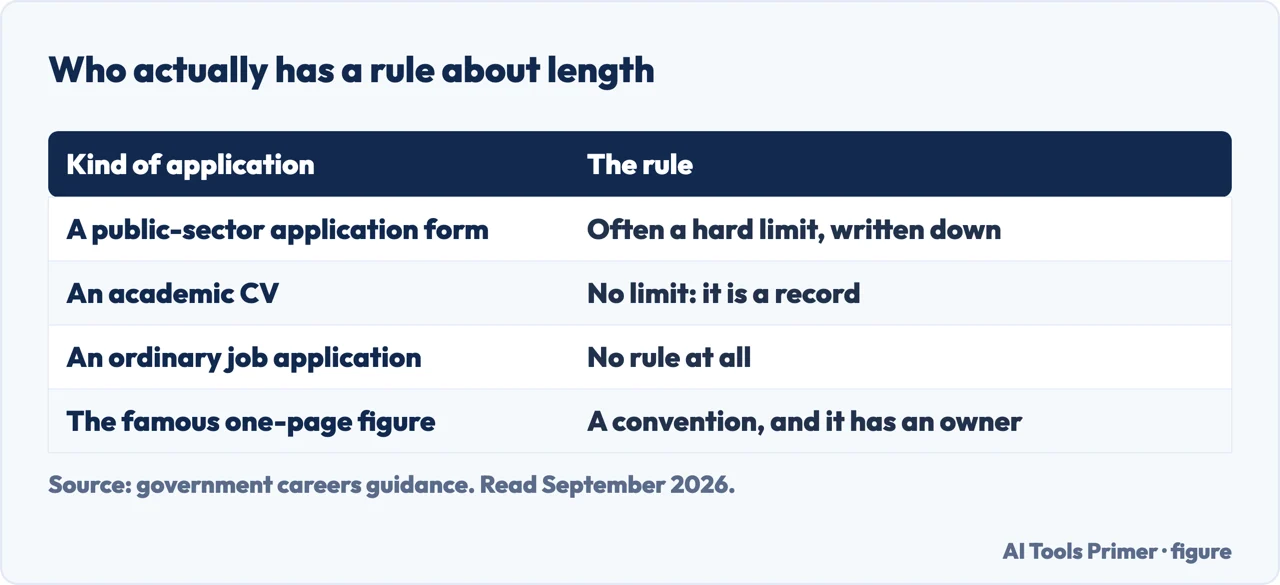
Start with the case where the question genuinely has an answer.
“Federal agencies only accept resumes up to two pages in length to comply with the Merit Hiring Plan. USAJOBS will not allow you to upload or build resumes longer than two pages.”
USAJOBS Help Center, read 21 August 2026. That is not advice and not a convention — it is a limit the upload form enforces. It is also the opposite of what most resume guidance says about federal applications, much of which still repeats that government resumes should run to four or five pages.
A US federal job
There is an actual answer
Two pages. Enforced. The system rejects a longer document, so the question is settled before you ask it.
The same page adds the requirement that makes two pages workable: “You must show how you meet the qualifications and requirements in the job announcement” — and “if the qualifications section says you need experience with MS Project, you need to use the words MS Project in your resume”.
Almost any other job
There is no rule at all
Nobody sets one. No law, no standard, no body that publishes a length. What exists is a convention that varies by country, industry and seniority, and a great deal of confident advice built on top of it.
Which is why the useful question is not “how long should it be” but “how long before it stops being read”, and that has a different and more answerable shape.
Why the private-sector answer cannot be a number. No such number is published, because no single body is in a position to publish one. Hiring is done by tens of thousands of independent organisations with different software, different conventions and different volumes of applicants. A page count that helps a graduate applying to a startup is the wrong advice for a consultant with fifteen years of client work, and both are wrong for an academic CV, where a publication list runs for pages by design and always has.
So the honest framing is not length but density. A résumé is too long when it contains material that does not help somebody decide to interview you — and by that test a padded single page fails while a dense second page passes. The page count is a symptom of the edit, not a target to hit.
The seven-second rule, and where the number comes from. This is the most repeated claim in the subject, and it is worth knowing who owns it before you organise your document around it. The figure traces to Ladders, a job-search company, which writes on its own site that it “launched a study in 2018 using eye-tracking software that found that recruiters can make up their mind about a job candidate in only 7.4 seconds”.
Two things about that. It is a real eye-tracking study, not an invention, and its central finding — that the top of the first page carries most of the weight — is sensible and matches what anybody who has sorted applications will tell you. But the number is produced by a company whose business is job seekers, it describes an initial scan rather than the whole reading, and the figure itself has moved: the article carrying the 7.4 second headline still sits at a web address that says six seconds, from the earlier version of the same research.
Set against it, the US government asks its own applicants a slower and more useful question: “Can a hiring agency see my main credentials within 10 to 15 seconds?” That is a design brief you can actually work to, and it says the same thing without the drama — the top of page one has to carry your case.
The one place the requirements are written down
USAJOBS publishes the specifics, in writing, as a condition of applying. Even if you are not applying for a federal job, this is the closest thing to a documented standard that exists in English.
- Length
- Two pages maximum, enforced at upload.
- File size
- “Your resume must be 5 MB or less.” PDF recommended “to maintain formatting and number of pages”.
- Page size
- “Use a standard 8.5x11-inch size for your document.”
- Margins
- “Make your page margins 0.5 inches.”
- Type size
- “Consider using 14-point size font for titles and 10-point for the main text.”
- Typeface
- A sans-serif face — Lato, Calibri, Helvetica, Arial, Verdana, Open Sans, Source Sans Pro, Roboto or Noto Sans.
- Never include
- Social Security Number, photographs of yourself, or “personal information, such as age, sex, religious affiliation”.
- The test they apply
- “Can a hiring agency see my main credentials within 10 to 15 seconds?”
So, practically. If you are applying for a US federal job, the answer is two pages and the form will hold you to it. If you are applying anywhere else, work to the ten-to-fifteen-second test rather than to a page count: put the strongest evidence in the top quarter of the first page, cut anything that does not help a decision, and let the length fall out of that edit. A second page is fine when it is earned. A third is usually a filing problem rather than a length problem — it means old roles are being described at the same level of detail as recent ones.
And two things worth removing whatever length you land on, because the federal guidance is explicit about them and the reasoning applies everywhere: your date of birth or age, and a photograph of yourself. In the United States both invite exactly the kind of judgement that hiring processes are supposed to exclude, and in several countries employers are instructed not to accept them. Norms differ elsewhere in Europe, so this is one of the places where copying an American template blindly can work against you, and the reverse is also true.
One last note on the sources, because it matters more here than usual. The two-page federal limit is quoted from a government help centre on the date it was read, and the timing figure is quoted from the company that produced it, named as such. Both are named here because the certainty of an answer to this question depends entirely on them.
Where to start
Four ways in.
- “I am applying for a US federal job.”
- The answer is above — then see building the document
- “Will software even read page two?”
- That is how it is read first
- “Is one page enough for a graduate?”
- See by career stage
Building the document
The parts that decide whether length is even the problem. In this category formatting is function rather than decoration, because the first reader is usually software.
How it is read first
Before a person sees it, a parser does. What that software takes from a document decides whether the second page exists at all.
By career stage
The one variable that genuinely changes the answer, and the reason a single number was never going to work for everybody.
Not covered here. It will not give you a page count for the private sector. Nobody sets one, and the pages that state a number with confidence are stating a preference and calling it a rule.
It will not repeat the seven-second claim as a fact. It is quoted above with the company that produced it and the year, which is the only responsible way to use a number that popular.
And it will not sell you a resume builder or a review service, which on this question is what most of the confident answers are ultimately for. What holds instead is simple: the two-page limit and the formatting requirements are quoted from a United States government help centre, with the timing figure from the company that published the study.
Step 5 of 24 in the job search
The order this is meant to be read in, from writing the CV to handing in notice.
- Before this
- How far back should a resume go, and why that number exists
- After this
- Are cover letters necessary, and who actually reads them?
Sources
- USAJOBS Help Center — How do I write a resume for a federal job?, including the two-page limit under the Merit Hiring Plan, the file and formatting requirements, what to leave out, and the ten to fifteen second review test — help.usajobs.gov, read 21 August 2026.
- Ladders — You have 7.4 seconds to make an impression, published 30 January 2020, describing the company’s own 2018 eye-tracking study — www.theladders.com, read 21 August 2026.
Written by Alberto Gulotta
Founder and editor of AI Tools Primer, writing from Palermo, Italy. Thirty-five years of taking computers apart, starting with a Commodore 64 — the long version is on the about page.
Something wrong on this page? Write to aitoolsprimer@gmail.com and it gets fixed.
Written on 21 August 2026 · last checked 23 September 2026.
Independence and limits
No affiliate links and no paid placements anywhere on this site. Nobody pays to appear here, and no company has seen this page before you did.
This is general information, not professional advice. Where a page touches money, health, safety or the law, it names its source and the date it was read — and your situation may still differ. See the privacy page and the cookie policy.