
Detect · guide
Is using ChatGPT cheating, or does it depend on the rule?
By Alberto Gulotta · Updated · 11 min read
Asking whether is using ChatGPT cheating feels like a moral question and is mostly not one. It is a question about which rule applies to you, and there are two very different regimes writing those rules right now — one for students, one for everybody publishing work under their own name. They disagree about the default, and both have written their reasoning down.
“At UGA, the default rule for student use of AI on their coursework is that it is not permitted unless it is explicitly authorized by the course instructor.”
University of Georgia, Center for Teaching and Learning, read 21 August 2026. One university, stated plainly, and it settles the question for anybody studying there: the default is no. The same page adds the part that makes the rest of this guide necessary — “the instructor of record can determine what constitutes acceptable use”, which means the rule that governs you may not be the rule that governs the student sitting next to you.
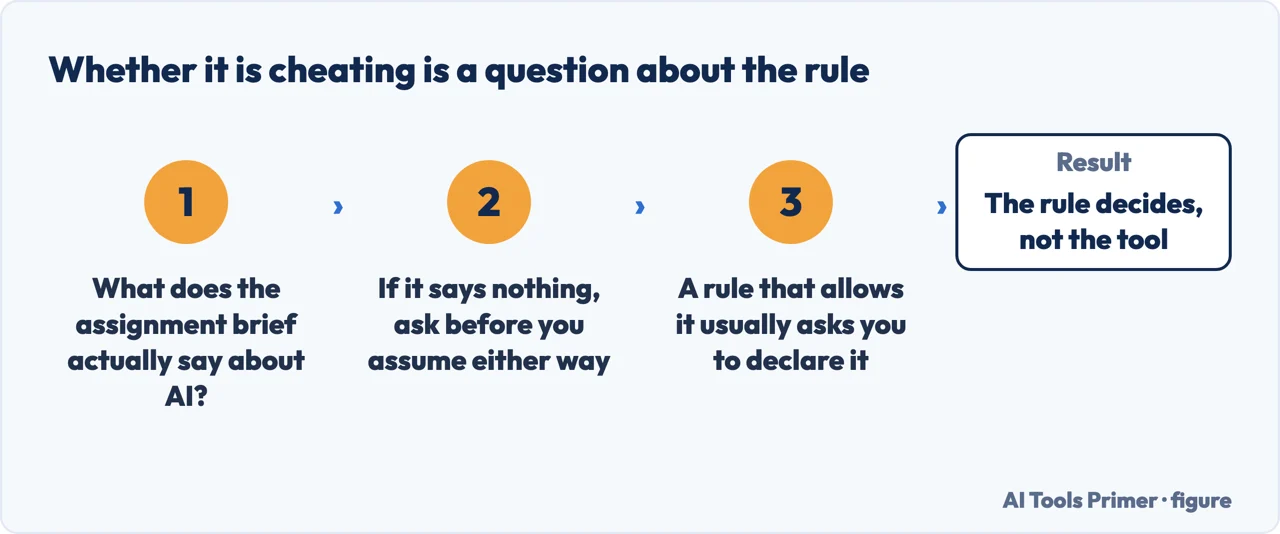
Notice what that policy does and does not say. It does not say the tool is dishonest, or that using it makes you a worse student. It says permission is not assumed, and the person who grants it is your instructor. Which means the genuinely useful move — before any argument about ethics — is to read your own course’s statement, because it exists and it is the only document that actually governs you.
“Q: Is it cheating to use ChatGPT? A: Sometimes.”
UC San Diego’s Academic Integrity Office, read 21 August 2026, answering the exact question in the exact words people type into Google. It then arrives at the same default as Georgia by a different route: “If your instructor did not say you could, then you can’t. Silence does not equal permission.” Two universities, on opposite sides of the country, independently landing on the same rule.
That convergence is worth more than either policy alone, because it tells you the safe assumption when you cannot find your own institution’s wording: absence of a rule is not permission. San Diego is explicit about the corollary too — if your instructor did authorise it, “don’t assume you can use it in ways not authorized or for other assignments or courses”. The permission is as narrow as it was given.
San Diego also makes an argument neither of the other two documents makes, and it is the sharpest thing said about this anywhere. The problem is not only permission — it is citability. “You can’t really ‘cite’ ChatGPT, because the professor can’t follow up on your citation, unless you submit your chat history to your professor.” A citation is a promise that somebody else can go and check. An output generated once, for you, in a conversation nobody else can open, cannot keep that promise. That is a structural point rather than a moral one, and it explains why so many policies land on disclosure rather than prohibition: telling somebody you used a tool is possible, whereas citing it in the ordinary sense is not.
And they offer the single best practical test on the subject, worth more than any threshold: can you “articulate where your words/ideas end and the machine’s begins”? If you can, you almost certainly have not crossed a line. If you cannot, you have — whatever any detector says.
The harder question is the one your instructor’s policy probably does not answer in detail: where inside “using it” the line actually falls. Running a spellchecker sits at one end of that range and submitting a generated essay at the other, and almost nothing that is genuinely in dispute sits at either end. Between them are the cases people actually search for — proofreading, a grammar check, ideas — and the most careful public answer comes from an unexpected direction.
The clearest published line anybody draws
Springer Nature’s risk framework for AI in research publishing, read 21 August 2026. It governs journal articles rather than coursework, but it is the most carefully reasoned public attempt to say where assistance stops and substitution begins — and the reasoning transfers.
- Green — permitted
“AI use that supports expression, organisation, or efficiency without influencing scientific, scholarly or evaluative judgement.” The test they apply: the use “does not introduce new intellectual content”.
polishing or refining the language · suggesting structure or formatting · translation · stress-testing a research question · data cleaning - Amber — permitted with oversight and disclosure
“AI use that may influence interpretation, framing, emphasis, or evaluative judgement, but remains under human control.” Here the framework accepts that AI “does introduce new intellectual content” and requires verification.
drafting explanatory summaries · extensive copy editing or writing support · suggesting analytical or methodological approaches · comparing results to existing literature - Red — not permitted
“AI use that is opaque or replaces accountable human contribution, generates unverifiable outputs, or compromises confidentiality or integrity.”
generating conclusions and presenting them as human-derived · fabricating data, citations or results · generating core reasoning without disclosure · assigning authorship to an AI
The principle holding all three bands together is one sentence, and it is the only sentence anybody really needs from this subject: “Human accountability is non-transferable” — and the line that follows it: “Accountability for scholarly content, evaluation, and editorial decisions cannot be delegated to AI systems.”
So, applied to the three questions people actually ask.
Proofreading and grammar. Green, on that framework, and comfortably so: it supports expression without introducing new intellectual content. The reasoning is sound for coursework too — with one caveat that matters more in a classroom than in a journal. If the thing being assessed is your command of the language, then handing that part to a machine removes the very skill being measured. In a language course, or a piece marked on written expression, a grammar tool sits closer to amber than to green, and the reason is not ethics but assessment.
Ideas and structure. This is where the framework gets genuinely interesting, because it splits the two. Suggesting the structure of a piece is green. Contributing to the reasoning is amber — permitted, but requiring “verification and oversight” and disclosure, because AI at that point “does introduce new intellectual content”. The distinction is a good one and worth carrying into your own work: arranging your thinking is not the same as doing your thinking.
Writing it. Red, and the framework names the act precisely: “generating hypotheses, analyses or conclusions and presenting them as human-derived”. The offence is not that a machine was involved. It is the presentation — the claim of authorship over reasoning you did not do. That is why disclosure moves so many uses out of the red band, and why concealment is what actually defines the violation.
The detector is a separate question, and a weaker one. Students often collapse “was this allowed” into “will I be caught”, which gets both wrong. The University of Georgia, which permits only one detector on campus, publishes three cautions about it that are worth knowing: Turnitin “reports a sentence-level false positive rate of 4%”, and studies show that rate “is higher for students who speak English as a second language”; unlike a similarity report, “it is not possible for any AI detection tool to offer such context or suspected source”, so there is nothing to check the flag against; and the detector “was trained on output from GPT-3.5”, so “those with the resources to access more sophisticated tools than GPT-3.5 are better able to avoid detection”.
Read that last one again. The tool is least effective against the people best resourced to evade it, and most likely to misfire on people writing in a second language. Whatever else it is, it is not an instrument of fairness — and it is a poor reason to decide what is acceptable. Decide that from the rule, not from the probability of being flagged.
The short version, if you want one. Find your course policy, because it outranks every general argument including this page. Assume permission is not automatic. Where you do use a tool, keep the reasoning yours and say so if asked — disclosure is what separates most amber from most red. And keep your drafts, which protects you from a false accusation far better than any argument about ethics ever will.
Where to start
Four ways in.
- “Is proofreading with it allowed?”
- The framework above says green — then see the tools
- “I have been accused and I did not do it.”
- Go to if you have been accused
- “How would they even know?”
- That is the detectors
- “What about my data, not my grade?”
- See what they keep
The tools
What each writing tool actually does to a text, which decides where it lands on the framework above. A checker and a generator are not the same category of help.
If you have been accused
A rules question turns into an evidence question the moment somebody makes an allegation. What helps, and what to assemble before replying.
The detectors
One guide per tool, each answering the same questions: what it claims, what independent testing found, and what a given score can honestly support.
What they keep
The other thing at stake when you paste your work into somebody else’s service, and the one that only comes up afterwards.
Not covered here. It will not give you a verdict that overrides your institution. Your course policy decides, this page does not, and any page that claims otherwise is selling you something.
It will not help anybody conceal anything. The whole framework above turns on disclosure, and the detector section is here because people deserve to know how weak that instrument is — including the staff relying on it.
And it will not carry an affiliate link to a writing tool or a detector, which on this particular question means turning down both sides of the argument at once. What holds instead is simple: the three documents quoted here come from two universities and an academic publisher, read on the dates this page names, and your course policy decides.
Sources
- University of Georgia, Center for Teaching and Learning — Academic Honesty & Generative AI, on the default rule for students and the published cautions about the AI writing detector — ctl.uga.edu, read 21 August 2026.
- UC San Diego, Academic Integrity Office — Using ChatGPT, on whether it is cheating, on silence not equalling permission, and on why an AI output cannot be cited in the ordinary sense — academicintegrity.ucsd.edu, read 21 August 2026.
- Springer Nature / Nature Portfolio — Artificial Intelligence editorial policy, the green, amber and red risk framework for AI use in research and publishing — www.nature.com, read 21 August 2026.
Written by Alberto Gulotta
Founder and editor of AI Tools Primer, writing from Palermo, Italy. Thirty-five years of taking computers apart, starting with a Commodore 64 — the long version is on the about page.
Something wrong on this page? Write to aitoolsprimer@gmail.com and it gets fixed.
Written on 21 August 2026 · last checked 23 September 2026.
Independence and limits
No affiliate links and no paid placements anywhere on this site. Nobody pays to appear here, and no company has seen this page before you did.
This is general information, not professional advice. Where a page touches money, health, safety or the law, it names its source and the date it was read — and your situation may still differ. See the privacy page and the cookie policy.