
Detect · guide
Turnitin AI detection: what the score is
By Alberto Gulotta · Updated · 10 min read
turnitin ai detection is the one nobody chooses. What the tool is, who buys it and what the similarity report actually says is the Turnitin page. Students meet it because their institution bought it, and instructors meet it because it appeared inside a tool they were already using. That makes it the most consequential detector in education, and the one where knowing what the number means matters most.
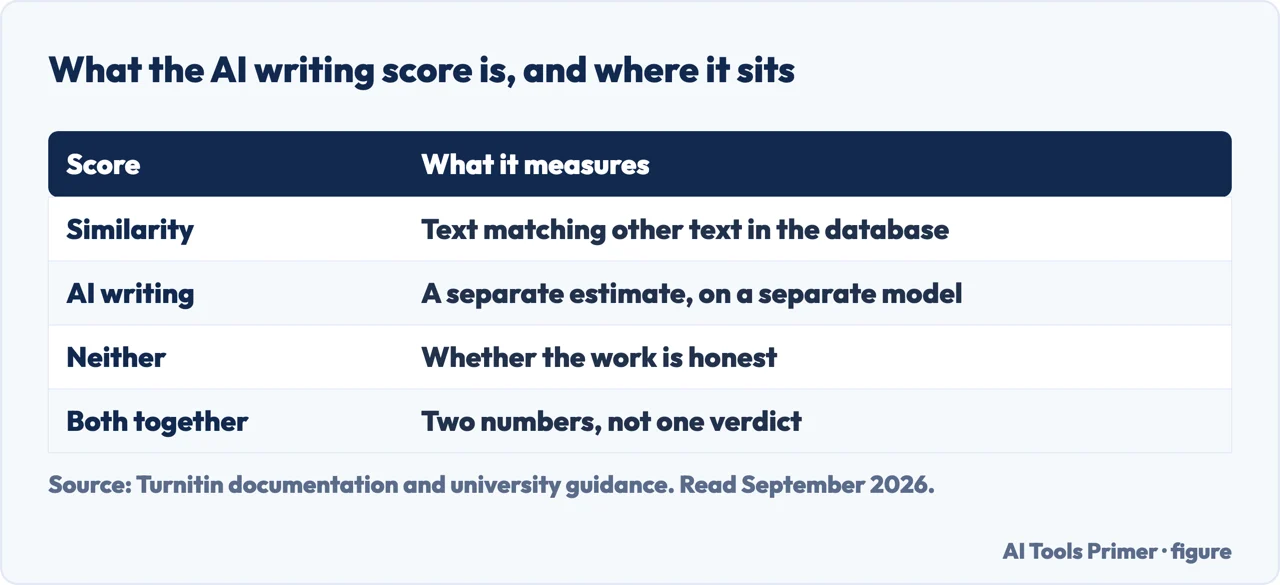
Turnitin publishes more about its own limitations than any other company in this field. Two of those published figures are the whole of this guide.
On a whole document
Turnitin: the document false positive rate — “incorrectly identifying fully human-written text as AI-generated within a document” — is “less than 1% for documents with 20% or more AI writing”.
On a single sentence
Turnitin: “Our sentence-level false positive rate is around 4%. This means that there is a 4% likelihood that a specific sentence highlighted as AI-written might be human-written.”
Both figures are published by Turnitin itself, read 21 August 2026. They are four times apart, and the smaller one comes with a condition attached — it applies to documents already scoring 20% or more. Almost every argument about a highlighted sentence is really an argument about which of these two numbers somebody has in mind.
Those are the vendor’s own figures, and they stay abstract until somebody multiplies them by a year of submissions. An institution that had bought the tool did exactly that, and then turned it off.
What 1% was, at one university
Vanderbilt did the arithmetic on its own volume: “Vanderbilt submitted 75,000 papers to Turnitin in 2022. If this AI detection tool was available then, around 750 student papers could have been incorrectly labeled as having some of it written by AI.”
What it did about it
It disabled the detector in August 2023 and published why. The first reason was not the rate but the silence around it: “Turnitin gives no detailed information as to how it determines if a piece of writing is AI-generated”.
That is the same 1% Turnitin publishes, applied to one campus’s volume, and the arithmetic changes what the number feels like: a rate is a property of the tool, a count is a property of a campus. Vanderbilt also names the fault line that runs under every detector on this section: “AI detectors have been found to be more likely to label text written by non-native English speakers as AI-written”. The study behind that finding tested several detectors and put it in one sentence — “these detectors consistently misclassify non-native English writing samples as AI-generated, whereas native writing samples are accurately identified” — and cautioned against their use “in evaluative or educational settings”, which is precisely where this one lives.
It is worth being precise about what this guide is and is not. An ai detector chosen by a writer is a private check; ai detection arriving through an institution is something else entirely, because a result can become a disciplinary matter without either party having chosen the tool. That difference is why this guide spends its time on how a number should be read rather than on how well the ai checker performs.
The second fact is even more important than the numbers, and it comes from Turnitin directly: the company states that it does not decide whether misconduct occurred. It supplies data; the judgement belongs to a person.
Turnitin gives a figure and the direction it was optimised in: “our efforts have primarily been on ensuring a high accuracy rate accompanied by a less than 1% false positive rate, to ensure that students are not falsely accused of any misconduct”, and the design goal behind it — “if we say there’s AI writing, we’re very sure there is”. That is a deliberate lean: a detector tuned this way will miss AI writing rather than accuse a human, which is the right trade for the person being accused and a poor one for anyone expecting it to catch everything.
Then the sentence that sets the ceiling on the whole report: “given that our false positive rate is not zero, you as the instructor will need to apply your professional judgment, knowledge of your students, and the specific context surrounding the assignment.” Not zero is doing the work there. Across a few hundred essays, under one per cent is still somebody — and the company says so rather than letting the percentage imply otherwise.
Turnitin also names what the decision should be measured against, and none of it is the score: “making that decision should include alignment with institutional policies, the expectations you have set for your course or assignment, and an understanding of exactly what you are seeking to evaluate through the assignment.” A report that arrives without those three things is not evidence yet — by the seller’s own account of what it sells.
Something to check before you paste your essay anywhere
Not everything called “Turnitin” is Turnitin
Searching this phrase on 21 August 2026, three of the first eight results were sites whose domain names contain the word Turnitin but which are not turnitin.com. Each offered a free, unlimited “Turnitin AI detector” with no sign-up.
We are not telling you what those sites do. We are telling you what is checkable in two seconds: on turnitin.com itself there is no free public AI checker. The product is presented to institutions — the page offers a login and a sales contact, because access comes through a school or university account. A student cannot run their own paper through the real thing.
So the check is the address bar, not the page title. A site can put any word in its name and its headline. And whatever the site turns out to be, remember what you would be handing over: the full text of an essay you have not submitted yet, to a service you found thirty seconds ago.
Turnitin also publishes something almost nobody links to, and it is written for the person with the most at stake. Alongside its guidance for educators there is a guide for students who have been confronted with a false positive — how to prepare for that conversation, and what evidence of your own process is worth keeping. If you are reading this guide because an accusation has already been made, that document is a better next step than any checker, and it is on the company’s own site.
Where to start
Four ways in.
- “What does Turnitin itself say about all this?”
- Go to what turnitin publishes
What Turnitin publishes
Quoted from Turnitin’s own posts, with the dates. This wing exists because the company’s published position is considerably more careful than the way its number is often used.
Not covered here. It will not tell you a Turnitin score proves anything. The company says so itself, in plainer language than most of its critics use: it provides data, and the instructor applies judgement.
It will not rank Turnitin against other detectors. Nobody outside these companies can run that test properly, and the published benchmarks all come from the firms selling the product.
And it will not take a side against teachers. The instructor looking at a report did not build the tool, was rarely trained on it, and is being asked to make a judgement the vendor explicitly declines to make. That is a bad position to be put in, and several guides here exist for them rather than for the student.
One last note on sourcing, because it is unusual here. Everything quoted on this guide was read directly from Turnitin’s own blog rather than from a summary, and both posts carry the name of the company’s Chief Product Officer. Where a figure has a condition attached — and the headline one does — the condition is quoted with it, because dropping it is how a careful published statement turns into a number that decides somebody’s degree. What holds instead is simple: every figure and every quotation on this guide comes from Turnitin’s own published posts.
When a detector has put a number on your work
A percentage appeared. What it means depends entirely on who is reading it and what they are allowed to do with it.
- The same job, in the other places it comes up
- Copyleaks: the detector inside your LMS
- Are ai detectors accurate enough to accuse somebody?
- GPTZero: what it claims, and what it means
- Originality AI: what it claims, and what it sells
- QuillBot and paraphrasing tools, honestly
- What is an acceptable AI detection score?
- Turnitin: what the similarity score really is
- AI detector false positive: what to do next
Sources
- Turnitin on understanding false positives in its AI writing detection — the under-1% rate, and that it does not determine misconduct — www.turnitin.com, read 21 August 2026.
- Turnitin on the sentence-level false positive rate — around 4%, and the 54% proximity figure — www.turnitin.com, read 21 August 2026.
- Turnitin — Handling false positives for students, the company’s own guide for a student facing an accusation — www.turnitin.com, read 21 August 2026.
- Vanderbilt University, Guidance on AI Detection and Why We’re Disabling Turnitin’s AI Detector — Brightspace, 16 August 2023 (that Turnitin claimed a 1% false positive rate at launch; that Vanderbilt submitted 75,000 papers to Turnitin in 2022 and that around 750 student papers could have been incorrectly labeled as having some of it written by AI had the tool been available; that AI detectors have been found more likely to label text written by non-native English speakers as AI-written; and that Turnitin gives no detailed information as to how it determines whether a piece of writing is AI-generated, saying only that the tool looks for patterns common in AI writing without defining them) — www.vanderbilt.edu, read 26 August 2026.
- GPT detectors are biased against non-native English writers — arXiv:2304.02819 (that the detectors evaluated consistently misclassify non-native English writing samples as AI-generated while native writing samples are accurately identified, and the authors’ caution against their use in evaluative or educational settings) — arxiv.org, read 26 August 2026.
Written by Alberto Gulotta
Founder and editor of AI Tools Primer, writing from Palermo, Italy. Thirty-five years of taking computers apart, starting with a Commodore 64 — the long version is on the about page.
Something wrong on this page? Write to aitoolsprimer@gmail.com and it gets fixed.
Written on 21 August 2026 · last checked 4 September 2026.
Independence and limits
No affiliate links and no paid placements anywhere on this site. Nobody pays to appear here, and no company has seen this page before you did.
This is general information, not professional advice. Where a page touches money, health, safety or the law, it names its source and the date it was read — and your situation may still differ. See the privacy page and the cookie policy.