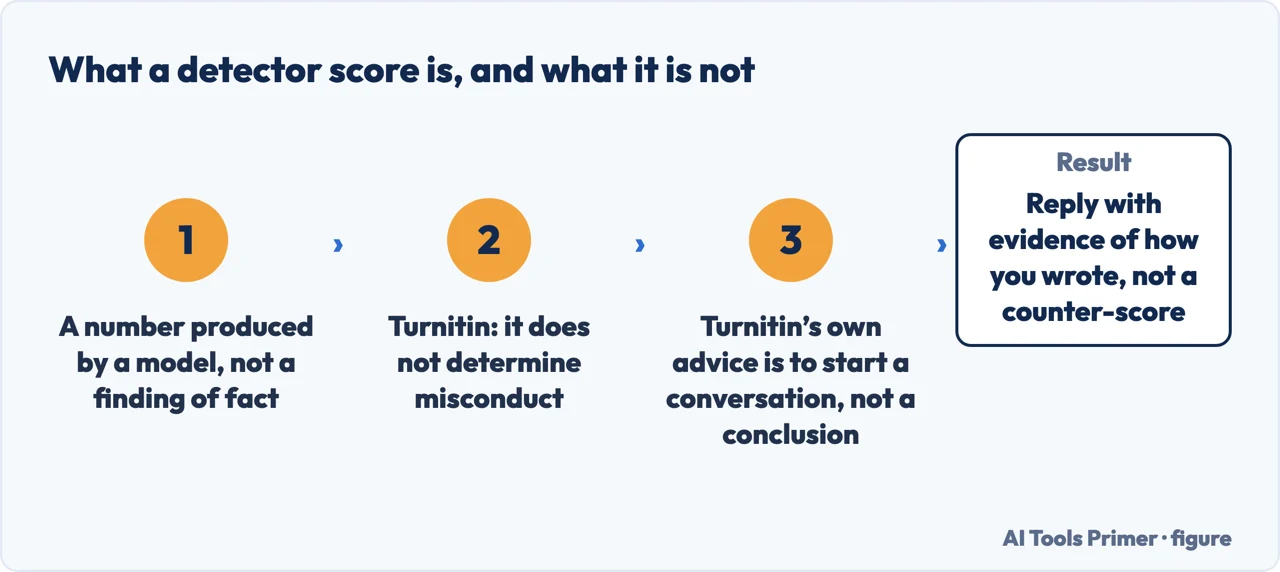
An ai detector false positive is a machine saying a person wrote something they did not write — except backwards: it says a person did not write something they did. If that has just happened to you, the most useful thing to know is that the companies selling these tools agree with you about what their number proves.
Turnitin
“Turnitin does not make a determination of misconduct… rather, we provide data for
educators to make an informed decision.”
And to instructors directly: “use the information to initiate a conversation, not to draw a
conclusion.” Read 21 August 2026.
GPTZero
“There always exist edge cases with both instances where AI is classified as human,
and human is classified as AI.”
Its own advice to teachers is to ask students to demonstrate understanding in a controlled
environment, “or through an editor that can track their edit history”. Read 21 August 2026.
Originality AI
Sells a “Writing Replay” offering “peace of mind for writers and students to show the
authorship of writing”.
A separate product, sold alongside the detector, for the job the detector cannot do. Read 21
August 2026.
None of those quotations comes from a critic. All three are from the companies that build and sell detection, read on their own sites and dated. Between them they say: the score is data, not a determination; errors happen in both directions; and the way to establish authorship is to show the process.
What “less than 1%” looks like from the other side
Essays marked across a department in one term2,000
Written honestly, with no AI involved2,000
Flagged anyway, at the rate the vendors publishup to 20
And the chance it is right about your
essay in particularunknown
Turnitin’s own words: a conversation, not a conclusion. Figure drawn by AI Tools Primer.
The words people type when this happens are specific in a way that says everything about the situation. Falsely accused of using ai. How to prove you didn’t use ai. Turnitin false positive. How accurate are ai detectors — asked after the accusation, not before. Nobody searches those phrases idly; they are typed by somebody with an email open in another tab.
The arithmetic is worth doing out loud. A false positive rate of one per cent sounds like precision. Across two thousand honest essays it means up to twenty people are asked to defend themselves — and it says nothing at all about which twenty.
Who this happens to, and what changed
The finding that made this a fairness question
In 2023 a team at Stanford ran seven detectors over essays by native and non-native English
writers. The result is the most cited thing in this whole subject, and it is not a small effect.
Liang, Yuksekgonul, Mao, Wu and Zou — Patterns, 2023Seven GPT detectors, run over TOEFL essays by non-native writers and over
essays by US eighth-graders.
61.22%false positives on TOEFL essays
18 of 91flagged by all seven detectors
near-perfectaccuracy on US 8th-grade essays
“Our findings reveal that these detectors consistently misclassify non-native English
writing samples as AI-generated, whereas native writing samples are accurately identified.”
Their explanation is uncomfortable and worth understanding, because it is not a
bug that can be patched away. The flagged essays “had significantly lower perplexity compared to
the others” — plainer vocabulary, more predictable sentence shapes. In other words the detectors
“may penalize non-native writers with limited linguistic expressions”. The thing being
measured is not honesty. It is linguistic range.
The authors’ own conclusion is a warning: their results “caution against their
use in evaluative or educational settings, particularly when they may inadvertently penalize or
exclude non-native English speakers from the global discourse.”
Al Ali, Helcl and Libovický — 2026, revisiting the same questionDetectors tested on Czech essays, Wikipedia articles, news and academic abstracts, plus a
re-run on the original English data with a current commercial detector.
This is the update that almost nobody has read, and it carries good news. On the same English
material, “the FPR improved from the reported 61.3% (mean) or 48% (best detector) to our
observed 23.1%”. In Czech they found that essays by non-native speakers “have entropy no
lower than essays by native speakers”, and that “none of the detectors exhibited a systematic
bias against non-native speakers of Czech”. Their conclusion: “the bias in GPT detectors is
language dependent and likely sensitive to the morphology of the specific language.”
Both things are true and neither cancels the other. The detectors have genuinely
improved, and the effect is not universal across languages. But 23.1% still means roughly one
non-native essay in four is flagged as machine-written by a current commercial tool — in a
class of forty, that is ten conversations that should never have started. If you are a non-native
English writer who has been accused, this is the research to bring with you, and the numbers are
from people with nothing to sell.
Which brings the arithmetic above into focus. It is not that a fixed small percentage of everyone gets caught by accident. The risk is not spread evenly, and it never was: it concentrates on people whose written English is plainer, which in practice means people writing in a language they learned second. That is why this guide treats a false positive as a fairness problem rather than a technical curiosity, and why the studies above matter more than any vendor’s headline figure.
Not covered here. It will not tell you detectors are useless. They are measuring something real, and the companies publishing their error rates deserve more credit than the ones that publish nothing.
It will not help anybody who did use AI and is looking for a script. The advice on this guide is the process evidence you either have or do not have, and it cannot be assembled after the fact.
And it will not pretend this is a small thing. A percentage produced by a company that says it is not a determination is being used, in practice, to determine outcomes — and the person on the receiving end usually has no idea that the vendor agrees with them. What holds instead is simple: every statement quoted here comes from a company that sells detection, not from a critic.
When a detector has put a number on your work
A percentage appeared. What it means depends entirely on who is reading it and what they are allowed to do with it.
Turnitin on false positives — that it does not determine misconduct, and its advice to assume positive intent — www.turnitin.com, read 21 August 2026.
Turnitin on the sentence-level false positive rate of around 4% — www.turnitin.com, read 21 August 2026.
GPTZero’s FAQ — edge cases in both directions, and its advice about edit history — gptzero.me, read 21 August 2026.
Originality AI’s own page — the Writing Replay sold for showing authorship — originality.ai, read 6 September 2026.
Liang W, Yuksekgonul M, Mao Y, Wu E, Zou J. GPT detectors are biased against non-native English writers. Patterns, 2023 (arXiv:2304.02819) — full text, which carries the perplexity finding and the sentence about limited linguistic expressions that the abstract page does not — arxiv.org, read 27 August 2026.
Al Ali A, Helcl J, Libovický J. Different Time, Different Language: Revisiting the Bias Against Non-Native Speakers in GPT Detectors, 2026 (arXiv:2602.05769) — arxiv.org, read 21 August 2026.
AG
Written by Alberto Gulotta
Founder and editor of AI Tools Primer, writing from Palermo, Italy. Thirty-five years of
taking computers apart, starting with a Commodore 64 — the long version is on the
about page.
Written on 21 August 2026 · last checked 5 September 2026.
§
Independence and limits
No affiliate links and no paid placements anywhere on this site. Nobody pays to appear here,
and no company has seen this page before you did.
This is general information, not professional advice. Where a page touches money, health,
safety or the law, it names its source and the date it was read — and your situation may
still differ. See the privacy page and the
cookie policy.