
Detect · guide
Originality AI: what it claims, and what it sells
By Alberto Gulotta · Updated · 9 min read
originality ai is the detector that is not primarily aimed at students. It is sold to publishers, agencies and enterprises — people buying writing and wanting to know what they bought — and that changes what the product is optimised for.
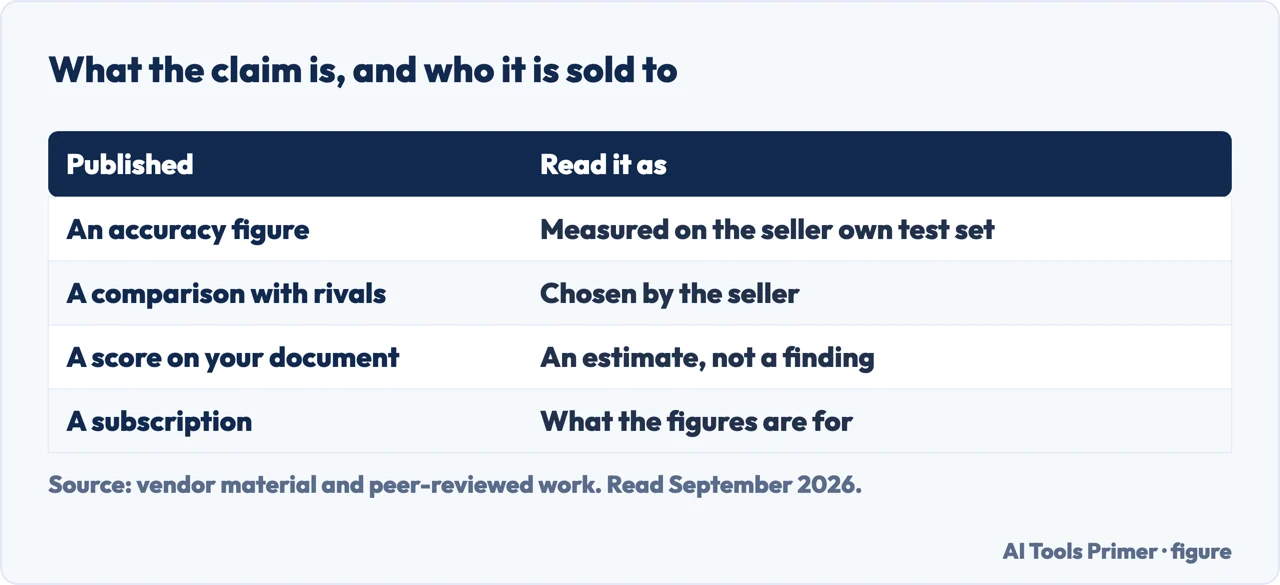
It is also direct about the contest it is in.
An arms race, described by one of the runners
Originality.ai states: “Our team actively tests AI tools that change, modify, or edit text (e.g. Quillbot or Grammarly) and continuously improves our AI detector to ensure attempts to hide AI-altered text are still detectable.”
QuillBot’s own product menu lists an AI Humanizer two items away from its AI Detector, and the privacy policy covering LanguageTool — the grammar checker named above — is issued by QuillBot’s parent company.
Both quotations were read on the companies’ own sites on 21 August 2026. Neither side is hiding anything. But a reader deciding how much to trust a percentage should know that the number is produced inside a contest where both sides are actively adapting to each other.
That candour is worth more than a marketing claim, because it tells you what a detector score actually is: a snapshot from a moving fight, not a measurement of a fixed property.
The words people search around it are a good guide to who is asking. Copyleaks and an ai content detector are usually businesses checking work they commissioned. A plagiarism checker is the older question, about copied text rather than generated text, and copyscape is the veteran name for exactly that job on the web. They are not the same question, and a tool that answers both in one report makes them easy to confuse.
Where to start
Five ways in.
- “How is it different from Turnitin or GPTZero?”
- Go to against the others
Against the others
Where this one sits among the detectors people meet. Descriptions of claims and audiences, not a ranking.
Not covered here. It will not tell you this detector is accurate. The company publishes claims and points at studies; verifying them would need our own controlled test with texts we wrote, and until that exists there is no verdict here.
It will not treat a scan as grounds for withholding payment or a grade. Even the companies selling these tools describe the output as a signal, and one of them explicitly sells a separate product for establishing authorship — which tells you what they think the score proves.
Where three competing companies quietly agree
The most useful sentence on Originality.ai’s own page is the one that limits the product: “An AI score shouldn’t be used alone for academic integrity discipline.” It is written by the company that sells the score, on the page that sells it, and it says the number is not sufficient grounds by itself.
The same page also spells out what a percentage next to the word AI means, and it is not a proportion of the text. “An AI detection score of 60% Likely Original and 40% Likely AI is not a false positive. It correctly predicted with 60% confidence that your content was Likely Original.” A percentage next to the word AI is a statement of confidence, not a measurement of how much of the text was machine-written — and a forty next to it is the tool saying probably not, not partly yes. There is also a guide below which it declines to be read at all: “shorter text may impact accuracy; we have a 100-word minimum at Originality.ai.”
Turnitin goes further, and writes to the person holding the report rather than the person accused of writing it. Its instructions are to “consider the possibility of a false positive upfront and have a plan for what your process and approach will be”, and then, in its own words: “Assume positive intent — in this space of so much that is new and unknown, give students the strong benefit of the doubt. If the evidence is unclear, assume students will act with integrity.” And the reason it gives is about the conversation, not the software: “if you don’t acknowledge that a false positive may occur, it will lead to a far more defensive and confrontational interaction that could ultimately damage relationships with students.”
Read together, the two companies are saying the same thing from opposite ends of the transaction. The score is an input to a conversation, and the companies that sell it say so in writing. Anyone shown a percentage as though it settled the matter is being told something the seller does not claim.
Both companies answer this in writing, and both give the same shape of answer: it depends which door you came through. Originality.ai: “Text input into the free AI detector may be used for training. Users with an Originality.ai account can opt out of data use for AI training.” GPTZero, asked whether it stores data from API calls: “No. We do not store or collect the documents passed into any calls to our API. We wanted to be overly cautious on the side of storing data from any organizations using our API. However, we do store inputs from calls made from our dashboard.”
Two companies, two products, and in both the paid or programmatic route is the private one while the free box on the web page is the one that keeps what you paste. Checking your own essay to reassure yourself can be the act that hands it over — and neither company hides this, it is written on the page next to the box.
The published accuracy is measured under laboratory conditions. Somebody outside the company measured what happens when a human article is merely tidied up.
What one independent test did to the number
And it will not carry affiliate links. Detection pays well, and on a guide about who is paying whom, that matters more than usual. What holds instead is simple: every claim on this guide is quoted from the company that made it, with the date it was read.
When a detector has put a number on your work
A percentage appeared. What it means depends entirely on who is reading it and what they are allowed to do with it.
- The same job, in the other places it comes up
- Copyleaks: the detector inside your LMS
- Are ai detectors accurate enough to accuse somebody?
- GPTZero: what it claims, and what it means
- QuillBot and paraphrasing tools, honestly
- What is an acceptable AI detection score?
- Turnitin: what the similarity score really is
- Turnitin AI detection: what the score is
- AI detector false positive: what to do next
Sources
- Originality.ai’s own AI detector page — the accuracy claim, the free scan limit, the audiences it names, and its statement about testing tools that modify text — originality.ai, read 6 September 2026.
- GPTZero’s FAQ — its recommendation that students demonstrate understanding through an editor that tracks edit history — gptzero.me, read 21 August 2026.
- Turnitin on false positives — that it does not make a determination of misconduct — www.turnitin.com, read 21 August 2026.
- AI Text Detectors and the Misclassification of Slightly Polished Arabic Text — arXiv:2511.16690 (that if a human-authored article is slightly polished by AI the detectors shift their borderline decision and treat it as AI-generated, which may result in falsely accusing authors of AI plagiarism and harm the credibility of AI detectors; the Ar-APT dataset of 400 Arabic human-authored articles polished by 10 models in 4 settings; and the result that the best performing commercial model, originality.AI, achieves 92% accuracy but drops to 12% for articles slightly polished by Mistral or Gemma-3) — arxiv.org, read 26 August 2026.
Written by Alberto Gulotta
Founder and editor of AI Tools Primer, writing from Palermo, Italy. Thirty-five years of taking computers apart, starting with a Commodore 64 — the long version is on the about page.
Something wrong on this page? Write to aitoolsprimer@gmail.com and it gets fixed.
Written on 21 August 2026 · last checked 4 September 2026.
Independence and limits
No affiliate links and no paid placements anywhere on this site. Nobody pays to appear here, and no company has seen this page before you did.
This is general information, not professional advice. Where a page touches money, health, safety or the law, it names its source and the date it was read — and your situation may still differ. See the privacy page and the cookie policy.