quillbot is the second most searched name on this islandsitend only the detectors themselves. It is worth being precise about what it is, because it sits exactly on the line this whole section is about.
The same tool, on both sides of the line. Figure drawn by AI Tools Primer.
The company describes it plainly: its paraphrasing tool “uses AI to find new ways to phrase sentences without changing their meaning or context. Think of it like a full-sentence thesaurus.” That is an accurate description, and a thesaurus is a legitimate thing for a writer to own.
QuillBot’s own product menu
Read from the site’s navigation on 21 August 2026, in the order it lists them.
Paraphraser
Grammar Checker
AI Detector
Plagiarism Checker
AI Humanizer
AI Chat
Summarizer
Citation Generator
Translate
Two items apart in the same menu: a tool that tells you whether writing looks
machine-made, and a tool for making machine-made writing not look that way. That is not a
contradiction the company hides — it is the shape of the whole market, and it is the most useful
thing to understand before trusting any number that comes out of either one.
The tool is not the question. What you do with it is, and the honest version of that answer is not the one either side of this argument gives.
The words people search around it show how mixed the intentions are. Paraphrasing tool and paraphrase are neutral: somebody wants a sentence to read better. A rewrite tool or a sentence rewriter is usually the same thing in blunter words. A summarizer is a different job altogether. And an ai humanizer is not ambiguous at all — it is sold to make machine writing pass as human, which is a fourth thing again. This guide is about the first three, and says so plainly.
What makes QuillBot worth examining rather than dismissing is that it is used overwhelmingly by people doing nothing wrong. Students rephrasing their own clumsy paragraph. Researchers writing in a second, third or fourth language. Professionals who know exactly what they mean and cannot make the sentence sit right. A tool with four million monthly searches is not four million cheats; treating it that way is both wrong and useless to the people asking.
Does rewriting actually defeat a detector?
Researchers tested exactly that, and published the answer
Sadasivan, Kumar, Balasubramanian, Wang and Feizi — “Can AI-Generated Text be Reliably
Detected?”, 2023Passages of roughly 300 tokens, run against watermarking schemes, neural-network
detectors, zero-shot classifiers and retrieval-based detectors.
“our recursive paraphrasing method can significantly reduce detection rates, it only
slightly degrades text quality in many cases, highlighting potential vulnerabilities in current
detection systems in the presence of an attacker.”
So the plain answer to the plain question is yes: rewriting reduces detection, and it does so
without wrecking the writing. Anyone claiming otherwise is selling something.
Which means a clean score proves very littleIf detection can be reduced by rewriting, then “this text was not flagged” is weak
evidence that a person wrote it. The score is more informative when it fires than when it
stays silent.
And it can be turned the other wayThe same paper examines “spoofing attacks aimed at misclassifying human-written text as
AI-generated”, and shows an attacker can do it “without white-box access to the detection
method”. Somebody else’s writing can be made to look machine-made.
The paper ends somewhere more uncomfortable than any individual result: a
theoretical framework “connecting the AUROC of the best possible detector to the Total Variation
distance between human and AI text distributions”. Translated, that says the ceiling on detection
is set by how different machine writing is from human writing — and that gap narrows every year.
This is not a problem better software fixes.
Defeating a detector and being allowed to do it are two different questions, and the second one has a published answer too.
Where the tool sits, according to the people who mark the work
The prohibition is written in the tool’s own vocabulary
University of Birmingham, guidance on proofreading and AI toolsWritten for students, naming the acceptable and unacceptable uses.
Do not use them to: “Rewrite or improve your arguments, explanations, or
ideas”; “Generate new content or suggestions that alter the meaning or
structure of your work”; “Generate or rephrase sentences, expand ideas,
or improve your arguments.”
Read that list beside the product description at the top of this page and there is no gap
between them. The verbs the university forbids are the verbs the tool is named after.
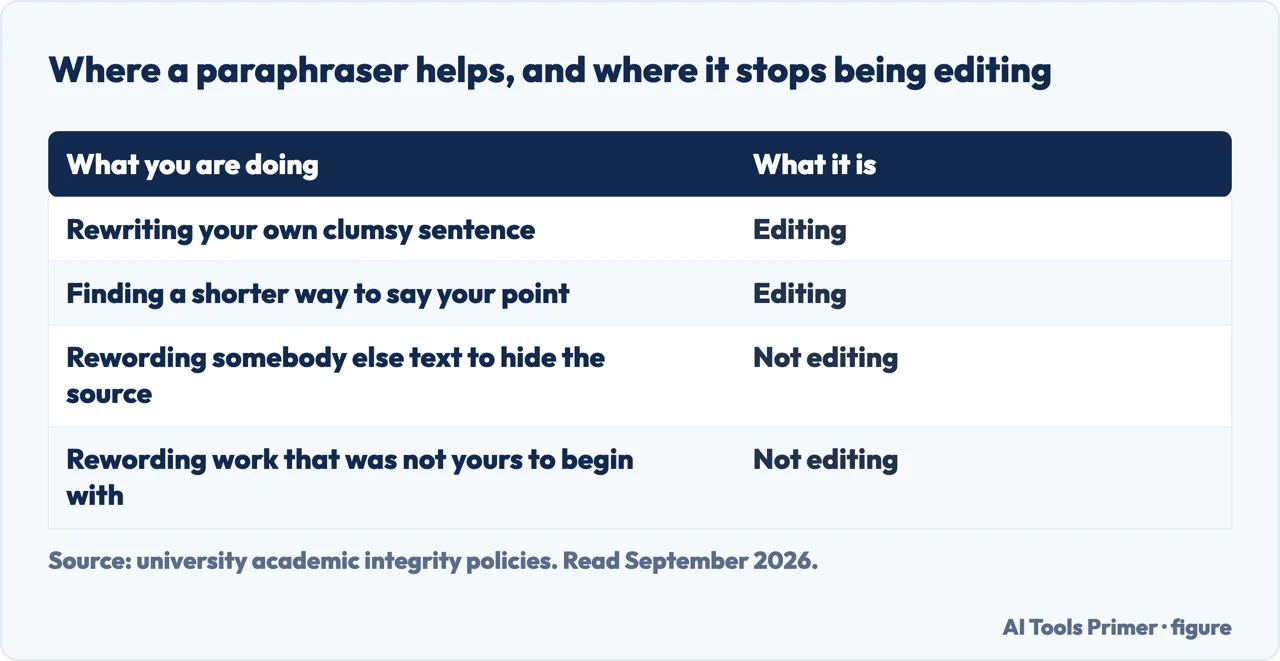
The rule is written as a rule about actions, not about apps, which is why it does not matter
whether a policy mentions this tool by name.
The university’s standard is stated once and covers the rest: “relying on another
individual or online software tools to rewrite, develop, or correct your ideas within
assessments and assignments is not permitted”. Also on its list:
“Shorten your work specifically to meet a word count”.
None of which tells you whether to use one. That is a question about your institution’s rules and about what you are trying to learn, and no research paper decides it for you. What the research does settle is the factual half: rewriting reduces detection, a quiet score is weaker evidence than a loud one, and the limits are structural rather than temporary. Anyone who tells you a detector is now reliable in both directions is describing a product, not a finding.
One last thing about where to read reviews in this category. One widely shared accuracy review of QuillBot’s detector is published by a competing detector company, and a review of that company is published elsewhere by another. Almost nobody assessing these tools is outside the market for them, which is why this guide quotes peer-reviewed work and the companies’ own documentation, and why it does not yet contain a verdict of its own.
Not covered here. It will not tell you that using a paraphrasing tool is cheating. It is a writing aid, millions of people use one honestly every day, and a page that says otherwise is not describing the world.
It will not help anybody disguise authorship either. The distinction this guide keeps returning to — your sentences versus somebody else’s — is the one institutions actually apply, and it does not become blurry because a tool was involved.
And it will not rank these tools yet. What a paraphraser is worth depends on the writing you bring to it, which means a real test needs real drafts over weeks, not a feature table.
A closing observation, and it is the reason this guide sits in this section rather than in the writing one. The same company that sells you a paraphraser also sells the detector that judges the result, and the humaniser that defeats the detector. None of that is hidden; it is printed in the product menu. But it should change how much weight anybody gives to a number produced anywhere inside that loop — including the reassuring one that says your own honest paragraph reads as human. What holds instead is simple: every description of the product here is quoted from the company that makes it.
When a detector has put a number on your work
A percentage appeared. What it means depends entirely on who is reading it and what they are allowed to do with it.
QuillBot’s own description of its paraphrasing tool — the full-sentence thesaurus wording and the modes — quillbot.com, read 21 August 2026.
Sadasivan VS, Kumar A, Balasubramanian S, Wang W, Feizi S. Can AI-Generated Text be Reliably Detected? 2023 (arXiv:2303.11156) — arxiv.org, read 21 August 2026.
University of Birmingham, Using Grammarly responsibly within your academic work — Academic Skills Centre (that relying on another individual or on online software tools to rewrite, develop or correct your ideas within assessments and assignments is not permitted; and the named unacceptable uses, including rewriting or improving your arguments, explanations or ideas, generating new content or suggestions that alter the meaning or structure of the work, generating or rephrasing sentences, and shortening work specifically to meet a word count) — intranet.birmingham.ac.uk, read 26 August 2026.
AG
Written by Alberto Gulotta
Founder and editor of AI Tools Primer, writing from Palermo, Italy. Thirty-five years of
taking computers apart, starting with a Commodore 64 — the long version is on the
about page.
Written on 21 August 2026 · last checked 7 September 2026.
§
Independence and limits
No affiliate links and no paid placements anywhere on this site. Nobody pays to appear here,
and no company has seen this page before you did.
This is general information, not professional advice. Where a page touches money, health,
safety or the law, it names its source and the date it was read — and your situation may
still differ. See the privacy page and the
cookie policy.