
Detect · guide
Turnitin: what the similarity score really is
By Alberto Gulotta · Updated · 11 min read
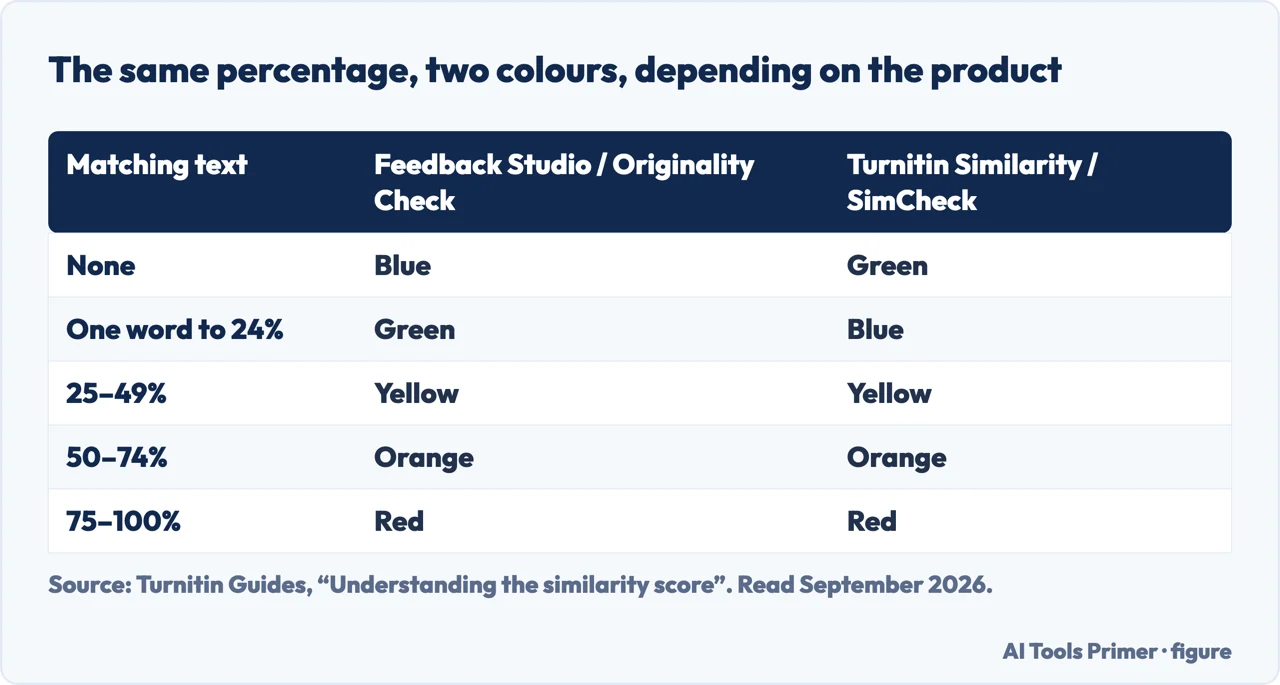
The Turnitin colours are bands of matching text: blue, green, yellow, orange, red, from nothing matched to three quarters of the submission. None of them means plagiarism. Turnitin corrects that belief in the first line of its own guide: it does not check for plagiarism.
| Matching text | Feedback Studio / Originality Check | Turnitin Similarity / SimCheck | Source |
|---|---|---|---|
| No matching text | Blue | Green | Turnitin |
| One word to 24% | Green | Blue | Turnitin |
| 25–49% | Yellow | Yellow | Turnitin |
| 50–74% | Orange | Orange | Turnitin |
| 75–100% | Red | Red | Turnitin |
“Turnitin does not check for plagiarism. What we actually do is compare your submission against our database.”
Turnitin’s own guide for students, read 21 August 2026. Everything that follows on this guide is a consequence of that sentence — including why a correctly quoted, properly referenced essay still comes back with matches.
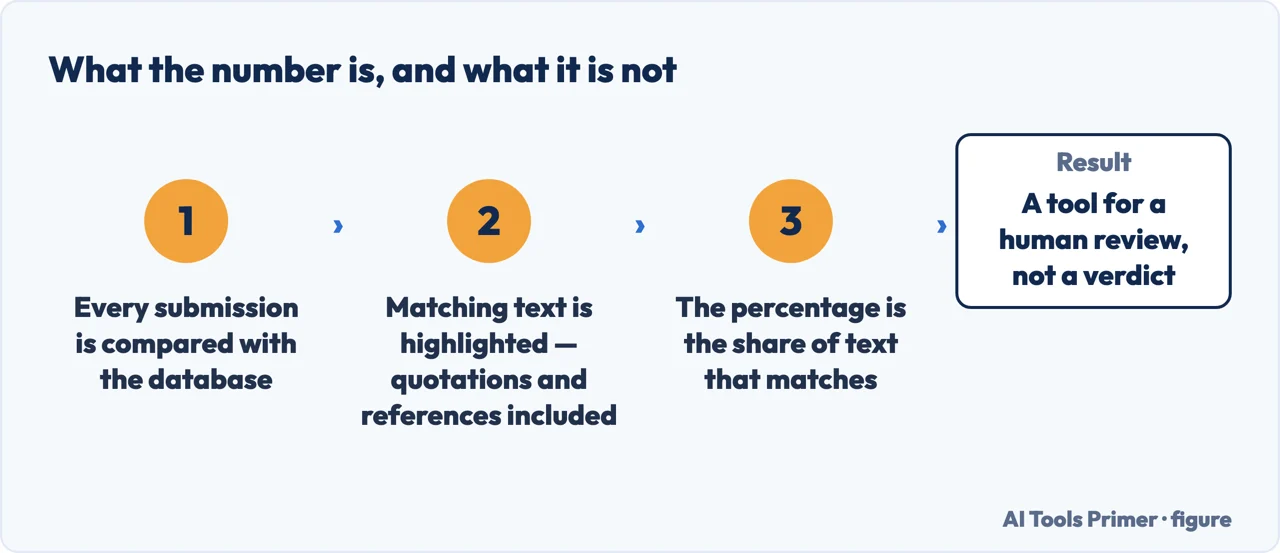
The score is not a plagiarism percentage. Turnitin explains the arithmetic: “The similarity score is the percentage of matched text your submission contains, or overall similarity. We calculate this by dividing the total words in a submission by the amount of words matched to outside sources.” Matched, not copied.
What the colours mean, in Turnitin’s own words
A colour is not a verdict. Turnitin states that “there is no fixed number to receive as a score”, and that the acceptable amount differs by school, instructor and assignment.
- Read the colour as a band, not a verdict. Turnitin’s own scale runs from no matching text to 75–100%, and the icon colour is only “based on the amount of matching text found”.
- Check which product you are looking at. Blue and green swap places between Feedback Studio and Turnitin Similarity, so the same submission can show blue in one and green in the other. Turnitin says so itself: the scheme “may vary depending on the integration”.
- Open the report and look at what is highlighted. The percentage is meaningless until you see whether the matches are quotations, references, or paragraphs.
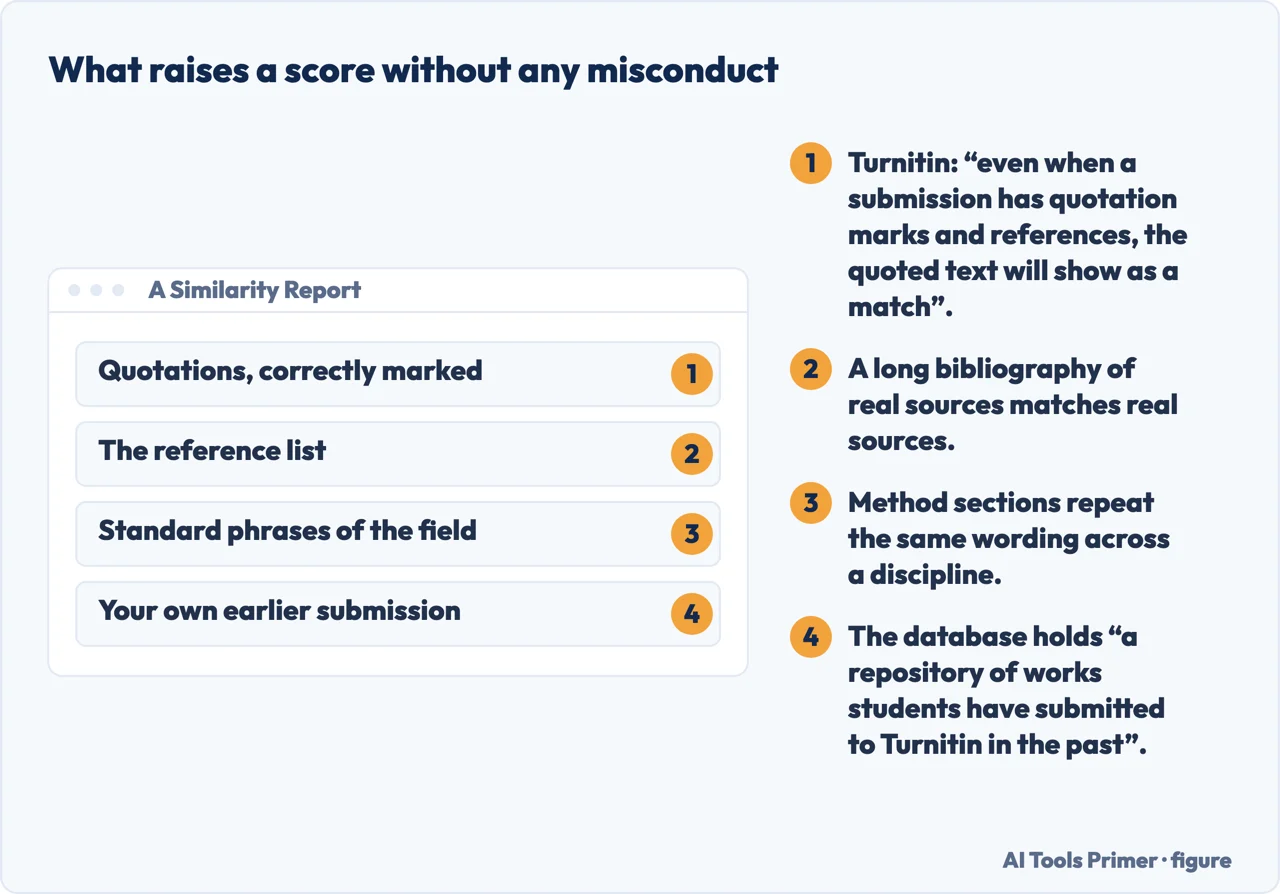
- Subtract what is supposed to match. Quoted material and the reference list match by design: “even when a submission has quotation marks and references, the quoted text will show as a match.”
- Compare what is left with your course’s rule, not with a number from the internet. Turnitin publishes no pass mark, and says the score is a tool for the marker “to make your own determination if any academic misconduct is present”.
And a question the score raises but cannot answer: how good is the matching underneath it? That has been measured from outside.
“Software cannot determine plagiarism, but it can work as a support tool for identifying some text similarity that may constitute plagiarism.”
Turnitin says the first half of that on its own guide. This is somebody else saying it after measuring: a study that put 15 web-based text-matching systems through the same test, “conducted by researchers from seven countries using test material in eight different languages”.
What it found about the matching itself is the part a score cannot show you: “although some systems can indeed help identify some plagiarized content, they clearly do not find all plagiarism and at times also identify non-plagiarized material as problematic.” So the percentage is not merely hard to interpret — the thing it counts is itself incomplete in one direction and over-eager in the other.
It is worth knowing what this guide is not. A plagiarism checker you choose is a private check on your own writing before you hand it in. This is the opposite: a report generated by your institution, that you often cannot see, feeding a percentage to somebody who will decide something about you. Understanding how does turnitin work is therefore not a technical curiosity — it is the difference between defending yourself with evidence and arguing with a number.
That is why a scrupulously honest essay comes back with matches. The company says so outright: “If you’ve used quotes and references correctly, that will still be highlighted as a match.” Quoting properly does not lower the number. It raises it.
What a university tells its own markers
The other half: a low score is not innocence either
Turnitin says there is no target number. A university has to go further, because somebody has to actually mark the paper. The University of Leeds publishes its guidance to staff, and two sentences in it are worth more than any colour band.
“This ‘at a glance’ guide should not be used as a measure of plagiarism. Even a 1% score could potentially be plagiarised content.”
“Always check the Similarity Report for each paper in order to make a judgement about plagiarism.”
Read those alongside the arithmetic above and the picture completes itself. A high score is not guilt, and a low score is not proof of anything. One sentence lifted from somewhere and passed off as your own is one per cent of a long essay — green, unremarkable, and still the thing the process exists to find. The number was never the evidence. The report is.
The same guide explains something that quietly changes what a score even means. Quotations and the bibliography can be excluded from the calculation, and often are — so the identical paper can produce two different percentages depending on settings chosen by somebody else. There is also automatic self-match exclusion: resubmit your own work to another assignment in the same module and “the submission will not match because of default self match exclusion”.
Which is the practical takeaway for a student staring at a percentage: you are looking at a number whose meaning depends on settings you did not choose and cannot see. Asking your department what it excludes, and what it considers worth a conversation, tells you more than any amount of refreshing.
There is one more consequence, and it is the reason this guide exists in a section about detection tools rather than in a guide to academic writing. Similarity and AI writing are two different reports, produced by two different systems, answering two different questions — and they are routinely spoken about as though they were one number. A paper can be entirely your own work and score high on similarity because you quoted well. A paper can be entirely machine-written and score zero on similarity because nothing in it was copied from anywhere. Confusing the two is the commonest error in this whole subject, and it is made by students and instructors in equal measure.
Where to start
Five ways in.
- “My score is high and I did not copy anything.”
- Start at reading your score
- “What number am I supposed to be under?”
- There is no such number — reading your score
- “Does re-using my own work count?”
- That is the grey areas
Reading your score
What the percentage is, what the colours mean, and why the question people ask about it has no answer. All of it quoted from Turnitin’s own student guide.
The grey areas
The questions that come up once the arithmetic is understood, and where the answer depends on your institution rather than on the software.
Questions people also ask
What do the colours on Turnitin mean?
They are bands of matching text, not grades. In Feedback Studio: blue is no matching text, green one word to 24%, yellow 25–49%, orange 50–74%, red 75–100%. In Turnitin Similarity the first two swap, so green is 0% and blue is 1–24%.
Is 25% on Turnitin too high?
Turnitin publishes no threshold, and does not describe one anywhere read for this page. 25% of correctly quoted and referenced material in a literature review is ordinary; 25% in one unquoted block is not. The only number that binds you is the one in your course’s own rules.
Does a high score mean plagiarism?
No. Turnitin opens its own guide with it: “Turnitin does not check for plagiarism in writing. We do check all submissions against our database.” The score is “simply the percentage of text in a submission that matches other sources”.
Why does my reference list count as matching text?
Because it does match — every entry names a real source that exists elsewhere. Turnitin documents the same thing for quotations: “even when a submission has quotation marks and references, the quoted text will show as a match.”
Not covered here. It will not tell you what a safe percentage is. Turnitin says there is no such number and that every institution differs; any page giving you a figure is inventing it.
It will not treat the similarity score as a plagiarism finding. The company that sells it opens its own student guide by saying it is not one, and that sentence is the reason this guide exists.
And it will not help anybody defeat it. The guides here explain what the number measures so that honest work is not mistaken for dishonest work — which is a different project from teaching people to hide.
One structural note, since it decides how the rest of this section is arranged. The similarity report and the AI writing report are two separate measurements with two separate error rates, produced by the same company inside the same interface. They are confused constantly, including by people acting on them, and the turnitin percentage somebody quotes in an email is frequently not the one they think it is. Each has its own guide here for that reason. What holds instead is simple: every quotation on this guide comes from Turnitin’s own guide for students.
When a detector has put a number on your work
A percentage appeared. What it means depends entirely on who is reading it and what they are allowed to do with it.
- The same job, in the other places it comes up
- Copyleaks: the detector inside your LMS
- Are ai detectors accurate enough to accuse somebody?
- GPTZero: what it claims, and what it means
- Originality AI: what it claims, and what it sells
- QuillBot and paraphrasing tools, honestly
- What is an acceptable AI detection score?
- Turnitin AI detection: what the score is
- AI detector false positive: what to do next
Sources
- Turnitin’s guide for students on understanding the similarity score — what it compares, how the percentage is calculated, the colour bands and the scenarios where the number misleads — guides.turnitin.com, read 3 September 2026.
- Turnitin Guides — Understanding the similarity score, for students: the same statement written for the person being marked — guides.turnitin.com, read 21 August 2026.
- University of Leeds — Interpreting Similarity Reports from Turnitin, staff guide — desystemshelp.leeds.ac.uk, read 21 August 2026.
- Testing of Support Tools for Plagiarism Detection — arXiv:2002.04279, published in the International Journal of Educational Technology in Higher Education 17, 46 (2020) (that software cannot determine plagiarism but can work as a support tool for identifying some text similarity that may constitute it; that 15 web-based text-matching systems were tested collaboratively by researchers from seven countries using material in eight languages; and the finding that while some systems help identify some plagiarised content, they clearly do not find all plagiarism and at times also identify non-plagiarised material as problematic) — arxiv.org, read 26 August 2026.
Written by Alberto Gulotta
Founder and editor of AI Tools Primer, writing from Palermo, Italy. Thirty-five years of taking computers apart, starting with a Commodore 64 — the long version is on the about page.
Something wrong on this page? Write to aitoolsprimer@gmail.com and it gets fixed.
Written on 21 August 2026 · last checked 4 September 2026.
Independence and limits
No affiliate links and no paid placements anywhere on this site. Nobody pays to appear here, and no company has seen this page before you did.
This is general information, not professional advice. Where a page touches money, health, safety or the law, it names its source and the date it was read — and your situation may still differ. See the privacy page and the cookie policy.