
Detect · guide
Self plagiarism: what it is, and when it actually counts
By Alberto Gulotta · Updated · 11 min read
Self plagiarism sounds like a contradiction, and that is why it is so widely dismissed. You cannot steal from yourself. The people who define it agree with that objection and define the offence somewhere else entirely.
“Self-plagiarism is the presentation of your own previously published work as original; like plagiarism, self-plagiarism is unethical.”
The American Psychological Association, read 21 August 2026. The definition contains the whole answer to the objection everybody raises — how can I steal from myself? — because the offence is not theft. It is misrepresentation.
APA sets out the harm precisely: it “deceives readers by making it appear that more information is available on a topic than really exists”, and “gives the impression that findings are more replicable than is the case or that particular conclusions are more strongly supported than is warranted by the evidence.”
Nobody is wronged by your reusing your own sentence. The reader is wronged by counting one piece of work twice.
A second body says the same thing in its own words, and adds a test you can run yourself.
COPE defines text recycling and self-plagiarism as “Reusing one’s own previous writing without being transparent about this or appropriately referencing/quoting from the original.”
The Committee on Publication Ethics is the body journals turn to when they have to decide one of these cases, and its definition puts the offence exactly where APA puts it: not in the reuse, in the silence about it.
It also carries a test precise enough to run on your own draft. Reuse counts, in the wording COPE quotes, when “the material in the new document is identical to that of the source (or substantively equivalent in both form and content)”, when “the material is not presented in the new document as a quotation (via quotation marks or block indentation)”, and when “at least one author of the new document is also an author of the prior document”. Three conditions, and the middle one is the one you control: quoting yourself, with the marks, ends the question.
There is also a distinction most discussions of this miss. Where the recycled text sits changes the answer. COPE tells editors to weigh “the degree of overlap in the text and data, where in the paper it is located (for example text recycled in the methods might be more acceptable than text recycled in the discussion), and the transparency in declaring or citing related papers.”
And then a third body, whose job is to define research misconduct for a government, declines to call it that at all.
“Self-plagiarism is NOT considered research misconduct in accordance to 42 CFR 93.”
That is the US Office of Research Integrity, on its own page about self-plagiarism, in a note set apart from the text. The federal definition of research misconduct covers fabrication, falsification and plagiarism — plagiarism of other people. Reusing your own work does not fall inside it.
Put the three together and the shape of the subject appears. APA calls it unethical, COPE tells editors how to handle it, and the federal rulebook does not classify it as misconduct at all. That is not a contradiction to be smoothed over: it is why the advice you find on this question is so confident and so contradictory. The people being quoted are answering different questions.
ORI does not treat that as a licence. The same page says the situations it goes on to describe are ones “where reuse should be carefully reconsidered”, and names the harm that recurs everywhere in this subject — recycling the same conference paper raises concern about “possible skewed perceptions of authors’ productivity”. The same objection APA makes about readers, made about a CV.
Understanding that shifts the whole question. It stops being am I allowed to reuse my own sentences — a question about ownership — and becomes is anybody being led to believe this is new work — a question about the reader. Those two questions have different answers in almost every real case, which is why the blanket verdicts circulating on this subject are so often wrong in both directions.
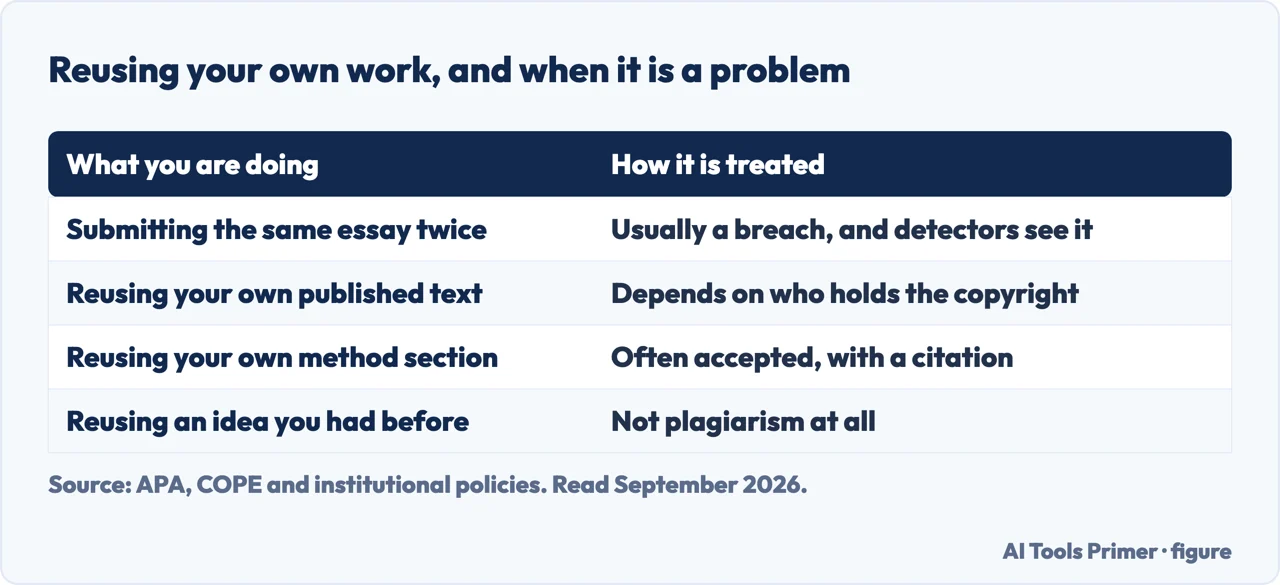
Which situation are you in
APA distinguishes several, and they do not have the same answer.
The word that appears in every permissible case
Read the four situations again and one thing runs through all of them: permission, asked for in advance. Not a technique, not a percentage, not a rewording strategy — a conversation.
APA ends its own guidance the same way: “Seek clarification from your journal editor or course instructor if you are concerned about duplicate publication or self-plagiarism.” That single sentence resolves more cases than any rule could, because the rule genuinely differs between institutions and the person who decides is reachable by email.
It is also, in practice, an easy conversation to have before and a difficult one to have after. The same reuse, disclosed in advance, is usually fine; discovered afterwards, it looks like concealment even when it was not.
Where prior circulation actually gets disclosed
Both of the exceptions APA states share a mechanism that sits outside the citation system altogether. For a thesis becoming an article, “authors would not cite their dissertation or thesis in the article text but rather acknowledge in the author note that the work was based on their dissertation or thesis.”
The second exception works the same way. An article based on research the authors had already described in “an abstract published in a conference program or proceeding does not usually constitute duplicate publication”, and APA asks the author to “acknowledge previous presentation of the research in the article’s author note.”
So the disclosure is real, but it is not a citation. You are not citing yourself. You are telling the reader where this work has been before. That distinction is most of the difference between the cases APA permits and the one it does not.
It is worth being equally clear about what APA does not treat as misconduct at all. On the same page, writing about plagiarism generally, it separates mistakes from intent. Using incorrect citations — “misspelling an author’s name, forgetting or mistyping an element in a reference list entry, or citing a source in the text that does not have a corresponding reference list entry” — is “not considered plagiarism if the error is minor and attributable to an editorial oversight rather than an intentional attempt to steal someone’s ideas.” APA adds, drily, that such errors “may still result in deductions on an academic assignment”. Sloppiness is not an offence against ethics. It is still marked.
And one honest limit on all of the above: the free page does not quantify “limited in scope”. APA says the “general guidelines for using an acceptable amount of duplicated material are in the Publication Manual in Sections 1.16 and 8.3”, which is the paid manual. Anyone who gives you a percentage for this is not quoting APA, because on the free pages APA does not publish one.
A practical note about the software, since this guide sits in a section about detection. Similarity checkers will find your earlier work if it is in their database, and they do not know it is yours: to the report it is simply matching text. That is not the system accusing you of anything — it is the system doing exactly what it does. The judgement about whether a match matters belongs to a person, and this is the clearest case of that principle on the whole site.
The searches around this one are almost all definitional, which tells you the state of public understanding. What is self plagiarism and self plagiarism definition are people meeting the term for the first time. Can you plagiarize yourself and is self plagiarism a thing are people meeting it with the objection above. And why is self plagiarism bad is the question this guide is really built to answer, because the answer is not about you at all.
One last thing worth stating plainly, because a page like this can read as a warning and should not. Building on your own previous work is what a body of work is. Researchers return to their own findings; students develop an idea across a degree; writers revisit a subject. None of that is misconduct. The line APA draws is not around reuse — it is around presenting the reused thing as new, without telling anybody.
Where to start
Four ways in.
- “A checker flagged my own work.”
- Go to when software finds it
- “What do I actually do?”
- That is asking first
When software finds it
A similarity report cannot tell your work from anyone else’s. What that means for the conversation that follows.
Asking first
The step that resolves nearly every case in this subject, and the reason it is so much easier before than after.
Not covered here. It will not tell you that reusing your own work is always wrong. APA lists several situations in which it is explicitly permissible, and this guide quotes them.
It will not tell you your institution’s rule. That is set locally, it differs, and the person who decides it can be emailed today.
And it will not treat a similarity match against your own earlier work as an accusation. The software found matching text, which is all it can do. What it means is a judgement, and judgements belong to people. What holds instead is simple: every definition and exception on this page is quoted from the APA’s own style guidance.
Sources
- APA Style — Plagiarism and self-plagiarism, including the definition, what counts, the permissible cases and the stated exceptions — apastyle.apa.org, read 21 August 2026.
- COPE, Handling text recycling (also known as self-plagiarism) — Committee on Publication Ethics position statement, last reviewed 20 August 2024 (that COPE defines text recycling and self-plagiarism as reusing one’s own previous writing without being transparent about it or appropriately referencing or quoting the original; the three-part definition it quotes from the Text Recycling Research Project — material identical or substantively equivalent to the source, not presented as a quotation, and at least one shared author; and the guidance that editors weigh the degree of overlap, where in the paper the recycled text sits, with text recycled in the methods possibly more acceptable than in the discussion, and the transparency in declaring or citing related papers) — publicationethics.org, read 26 August 2026.
- US Office of Research Integrity, Self-plagiarism Within and Across Various Other Dissemination Domains — ORI (the note that self-plagiarism is not considered research misconduct in accordance with 42 CFR 93; the statement that the situations discussed are ones where reuse should be carefully reconsidered; and the concern, raised where the same conference paper is presented repeatedly, about possible skewed perceptions of authors’ productivity) — ori.hhs.gov, read 26 August 2026.
Written by Alberto Gulotta
Founder and editor of AI Tools Primer, writing from Palermo, Italy. Thirty-five years of taking computers apart, starting with a Commodore 64 — the long version is on the about page.
Something wrong on this page? Write to aitoolsprimer@gmail.com and it gets fixed.
Written on 21 August 2026 · last checked 4 September 2026.
Independence and limits
No affiliate links and no paid placements anywhere on this site. Nobody pays to appear here, and no company has seen this page before you did.
This is general information, not professional advice. Where a page touches money, health, safety or the law, it names its source and the date it was read — and your situation may still differ. See the privacy page and the cookie policy.