
Study · guide
APA in text citation: the two forms it takes
By Alberto Gulotta · Updated · 8 min read
Every apa in text citation is one of two shapes. The American Psychological Association states it in a single line: “In-text citations have two formats: parenthetical and narrative.” Almost everything else in this subject follows from knowing which one you are writing.
Parenthetical
Falsely balanced news coverage can distort the public’s perception of expert consensus on an issue (Koehler, 2016).
APA: “Both the author and the date, separated by a comma, appear in parentheses.” It can sit inside the sentence or at the end of it.
Narrative
Koehler (2016) noted the dangers of falsely balanced news coverage.
APA: “The author’s surname appears in running text, and the date appears in parentheses immediately after the author’s name.” The name can go wherever it reads naturally.
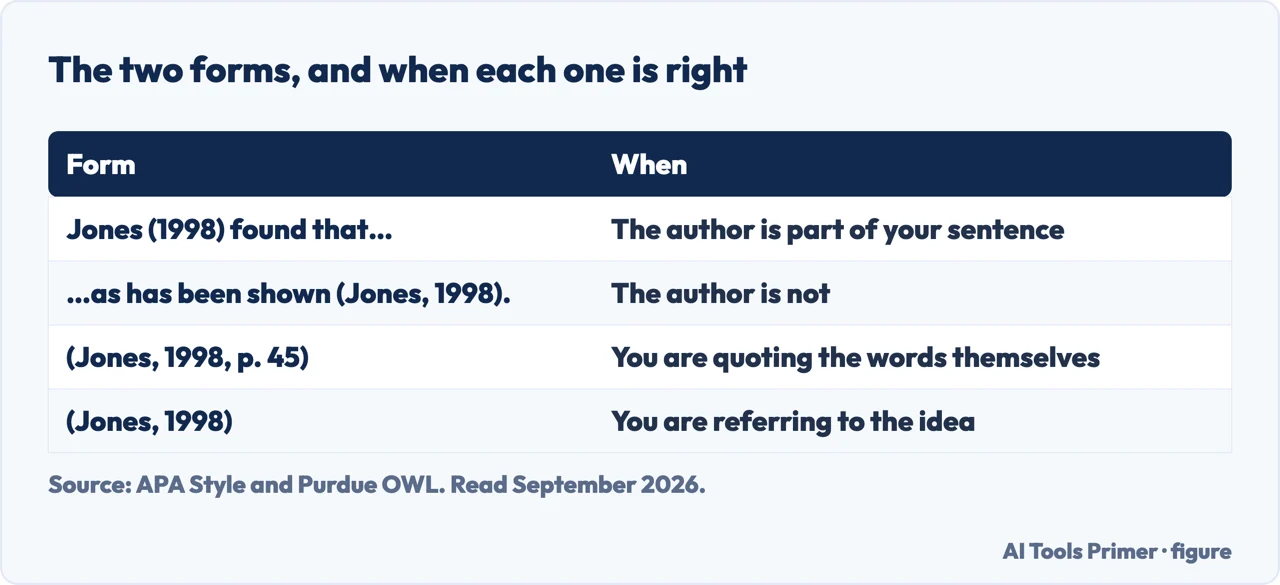
The choice is not decorative. A parenthetical citation keeps the author out of your sentence, so the sentence stays about the finding. A narrative citation puts the author into the sentence, so the sentence becomes partly about who said it. Writers use the second when the source itself matters — a disagreement between two studies, say — and the first the rest of the time.
How many authors changes the shape
APA’s own table of basic in-text citation styles, read 21 August 2026.
| Author type | Parenthetical | Narrative |
|---|---|---|
| One author | (Luna, 2020) | Luna (2020) |
| Two authors | (Salas & D’Agostino, 2020) | Salas and D’Agostino (2020) |
| Three or more | (Martin et al., 2020) | Martin et al. (2020) |
| Group, with abbreviation | (National Institute of Mental Health [NIMH], 2020), then (NIMH, 2020) | National Institute of Mental Health (NIMH, 2020), then NIMH (2020) |
| Group, no abbreviation | (Stanford University, 2020) | Stanford University (2020) |
Two details are visible in that table and are the ones most often got wrong. The ampersand only appears inside the brackets — APA: “In narrative citations, always spell out the word ‘and’.” And for three or more authors you use “et al.” in every citation, including the first one.
Then there is the part that generators cannot help with at all, because it happens inside your prose rather than in the list at the end.
“When repeating a citation, show the entire citation; do not, for example, include only a page number (the abbreviation ‘ibid.’ is not used in APA Style).”
The American Psychological Association, read 21 August 2026. Worth knowing if you have moved across from a footnote style, where ibid. is normal — this is one of the differences that a generator will never flag, because it happens in your sentences rather than in your reference list.
A reassuring fact for anyone worried about editions: on the parenthetical-versus-narrative distinction, APA says plainly that “this guidance is the same as in the 6th edition”. The wider author–date system did change — APA marks that page “this guidance has been revised from the 6th edition” — and the best-known change is the one in the table above, where three or more authors now shorten to “et al.” from the very first citation.
One rule lives entirely inside your sentences: what to do the second time you cite the same work. Here the two forms part company, though everywhere else they run in parallel.
The second parenthetical
(Koehler, 2016) … (Koehler, 2016)
APA: “Include the author(s) and year for every parenthetical in-text citation.” The year never drops out, however many times it comes round.
The second narrative
Koehler (2016) noted … Koehler went on to argue …
APA: “Do not repeat the year for narrative in-text citations the second and subsequent times they appear in a single paragraph.” A new paragraph starts the count again.
There is an exception to the narrative half of that, and it is the one worth remembering, because it is where dropping the year changes the meaning. APA: “if you cite multiple works by the same author or authors, regardless of the publication years, include the date in every in-text citation to prevent ambiguity.” Their own example is a paper citing both Mohammed and Mahfouz (2017) and Mohammed and Mahfouz (2019). Once two works share an author, the year is the thing telling them apart, and a bare “Mohammed and Mahfouz” has stopped pointing at either.
That same instinct — a citation has to point at exactly one entry — is behind three collisions APA writes separate rules for.
When two citations would come out identical
APA’s exceptions to the basic in-text citation styles, read 24 August 2026.
| The collision | What APA asks for |
|---|---|
| Two works shorten to the same “et al.” | “spell out as many surnames as needed to disambiguate” |
| Same author, same year | “append letters to the years” — 2020a, 2020b |
| First authors share a surname, different initials | “use initials in the in-text citations” |
All three exist for one reason, which APA states as a flat requirement: “Each in-text citation must correspond to only one reference list entry.” A generator builds the entries. Keeping each of them reachable from exactly one citation happens in your sentences, where the generator cannot see.
Inside the brackets, there are two smaller rules. If anything else joins the citation in the parentheses, the year takes a comma on both sides: APA’s example is “(see Koehler, 2016, for more detail)”. And when a phrase and a citation share one set of brackets they are separated by a semicolon rather than nested — “(e.g., falsely balanced news coverage; Koehler, 2016)” — because APA does not put parentheses inside parentheses.
Two fields have fixed abbreviations for when a source will not supply them. APA asks for “n.d.” in the in-text citation for a work with no date, and “in press” for one that has been accepted for publication but has not yet been published. The year you do have should match the reference list entry and should stay a year: APA asks for only the year “even if the reference list entry contains a more specific date”, so a source dated 12 March 2020 is still (Author, 2020) in your sentence.
The same two forms, described by somebody who is not APA. Purdue’s writing lab states the rule as a method rather than a format: “when using APA format, follow the author-date method of in-text citation. This means that the author’s last name and the year of publication for the source should appear in the text, like, for example, (Jones, 1998).” And it draws the line this page is built around: referring to an idea needs only author and year, while quoting directly needs the page as well. Two forms, one distinction, and it is about what you did with the source rather than about where the brackets go.
The related searches show where people get stuck. Apa reference page and apa format example are people working on the document rather than the sentence. Apa cover page is the title page, which has its own rules. And apa style and apa citation website are the broadest of all — usually somebody who has been handed a requirement and has not yet been told that APA is an author–date system with two in-text forms, which is the whole of this guide.
Where to start
Four ways in.
- “I am writing a sentence and need the citation.”
- Start at in the sentence
In the sentence
The in-text citation itself: the two forms, and every variation the number of authors and the type of source can force on them.
Not covered here. It will not paraphrase a rule it has not read on APA’s own pages. A great deal of what circulates about APA is a summary of a summary, and the seventh-edition changes are exactly where that goes wrong.
It will not tell you your department’s preferences. The title page alone has two official versions, and a course picks one.
And it will not rank the citation tools yet. That verdict needs a work with fifteen authors, a report by an organisation, and a source with no date, put through each tool and the errors published. What holds instead is simple: every rule and example on this page is quoted from the APA’s own free style pages.
The night the reference list is due
Which style you were told to use decides everything below it.
- The same job, in the other places it comes up
- Chicago style citation: two systems, not one
- MLA format: the one template it all runs on
- How to write a bibliography, and whether you need one
- Footnote citation: inserting one, and what goes in it
- How to cite a website when the three styles disagree
Sources
- APA Style — Parenthetical versus narrative in-text citations — apastyle.apa.org, read 21 August 2026.
- APA Style — Author–date citation system, including the table of basic in-text citation styles — apastyle.apa.org, read 21 August 2026.
- Purdue OWL — In-text citations, the basics: the author-date method stated independently of APA, and the difference between referring to a source and quoting it — owl.purdue.edu, read 4 September 2026.
Written by Alberto Gulotta
Founder and editor of AI Tools Primer, writing from Palermo, Italy. Thirty-five years of taking computers apart, starting with a Commodore 64 — the long version is on the about page.
Something wrong on this page? Write to aitoolsprimer@gmail.com and it gets fixed.
Written on 21 August 2026 · last checked 4 September 2026.
Independence and limits
No affiliate links and no paid placements anywhere on this site. Nobody pays to appear here, and no company has seen this page before you did.
This is general information, not professional advice. Where a page touches money, health, safety or the law, it names its source and the date it was read — and your situation may still differ. See the privacy page and the cookie policy.