How to cite a website has no single answer, and the reason is more interesting than the formatting. The three major style bodies do not merely differ over commas — they disagree about whether “a website” is a kind of source at all, and each of them says so in its own documentation.
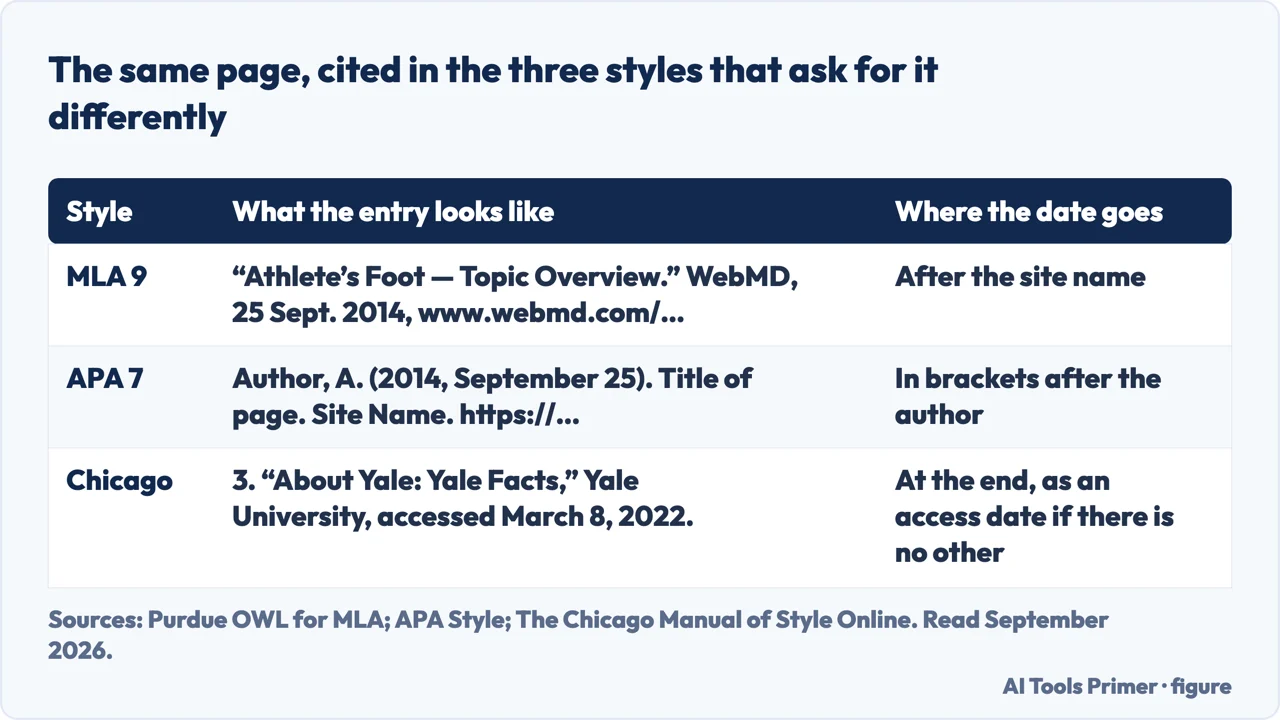
The same page, three styles, three places for the date. Figure drawn by AI Tools Primer.
MLANo such category
Entries “are created using the MLA template of core elements — facts common to most
sources, like author, title, and publication date.”
The instruction is to “evaluate the work you’re citing to see which elements apply to the source.”
There is no website format because there are no formats.
APAA category, with a condition
APA does publish “Webpage on a Website References”, with worked examples for news sites,
government agencies, organisations and individuals.
And one rule that decides the fiddly part: “When contents of a page are designed to change
over time but are not archived, include a retrieval date in the reference.”
ChicagoPerhaps no citation
Chicago starts by questioning the premise, and then gives two different shapes depending on
whether you are writing a note or a bibliography entry.
In notes “the title will usually come first”; in a bibliography “the source should be listed
under the owner or sponsor of the site.”
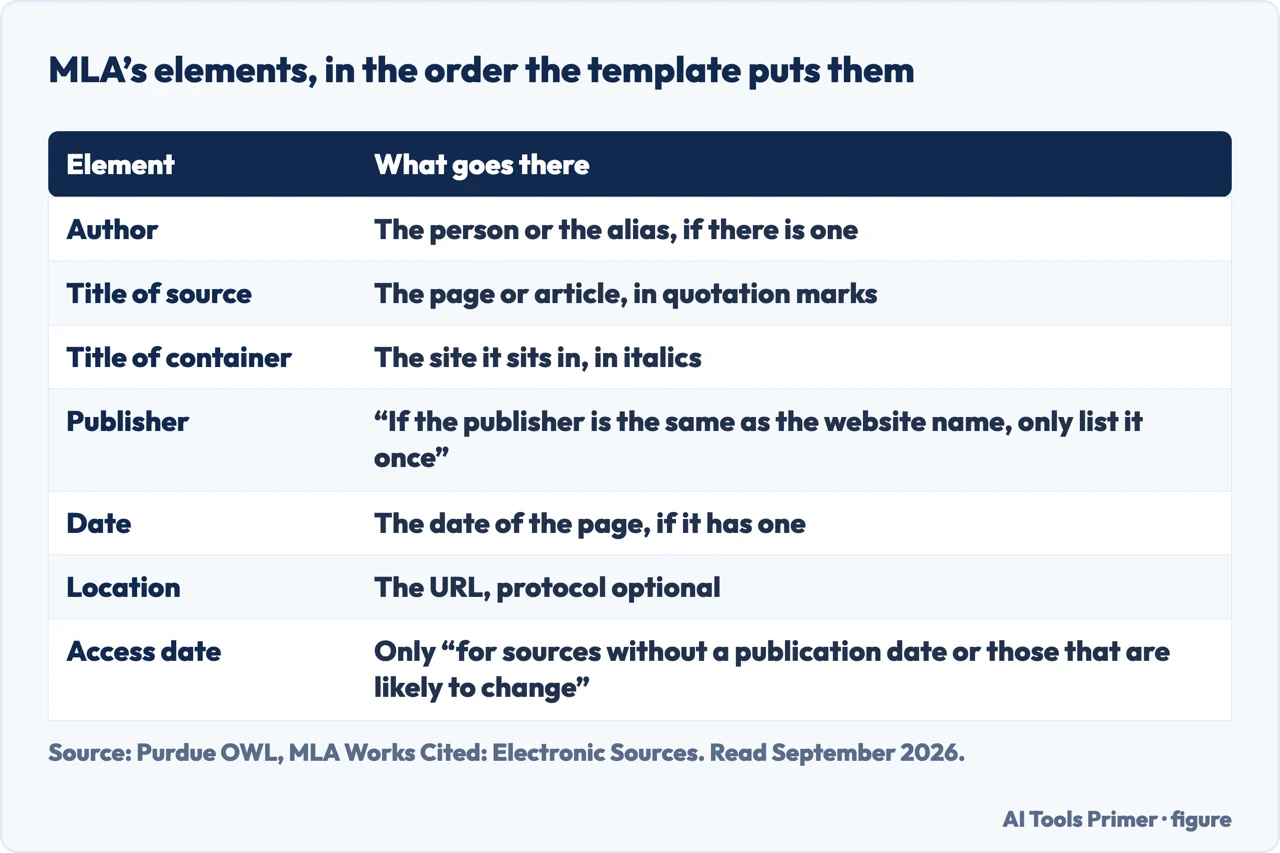
MLA’s elements for a page on a website, in the order the template puts them
Element
What goes there
Source
Author
The person, “or alias if known”
Purdue OWL
Title of source
The page or article, in quotation marks
Purdue OWL
Title of container
The site it sits in, in italics
Purdue OWL
Publisher
“If the publisher is the same as the website name, only list it
once”
Purdue OWL
Date
The date of the page, when it has one
Purdue OWL
Location
The URL. “You may also omit the protocol (http:// or https://) from
URLs”
Purdue OWL
Access date
“Optional and should only be included for sources without a
publication date or those that are likely to change”
Purdue OWL
One order of elements, and the empty ones are simply left out. Figure drawn by AI Tools Primer.
Find out which style you are writing in before anything else. MLA, APA and Chicago do
not disagree about commas here; they disagree about whether a website is a kind of source at
all.
Name the thing you are actually citing, not the site. In MLA the page is the source and
the site is the container: an article on a site, or a book on a site, not “a website”.
Fill the elements in the template’s order, and skip the ones that do not exist. An
element with nothing to put in it is left out — it is not invented and not marked absent.
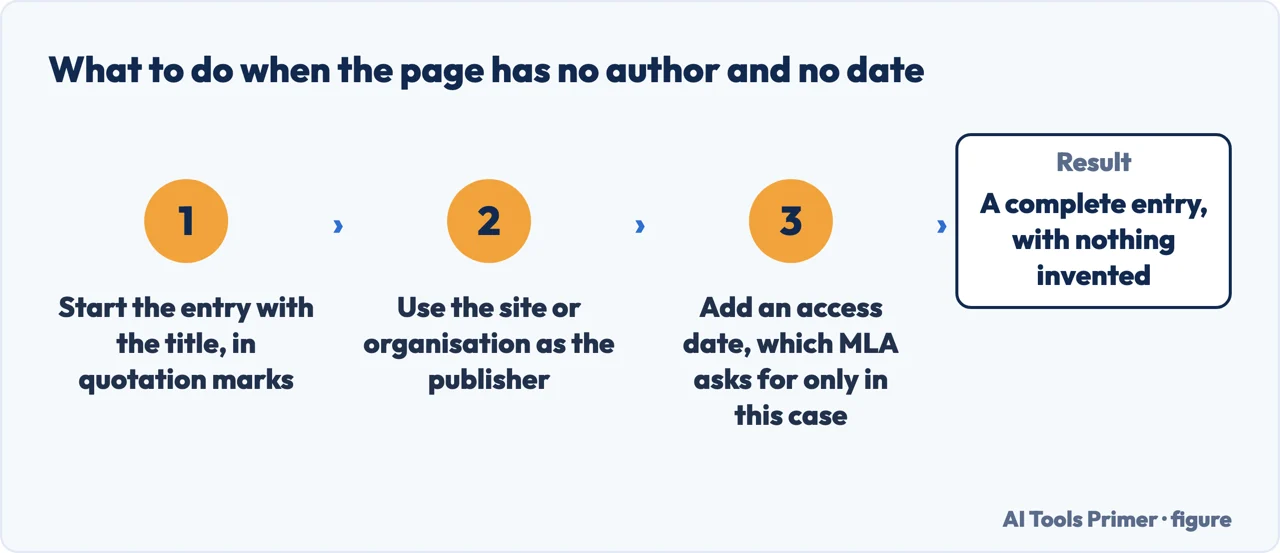
If there is no author, start with the title. The entry still works, and it will
alphabetise under the first significant word of that title.
Add an access date only where the style asks for one. In MLA that is for a page with no
publication date, or one “likely to change (e.g., a wiki)” — not as a habit on every entry.
The case with the least to work from, and it still needs nothing invented. Figure drawn by AI Tools Primer.
Take the first card seriously, because it changes what you are looking for. MLA does not have a website format that you look up; it has one template that you apply to everything, and a website is a container rather than a category. Its own examples say so in their headings: not “a website”, but “Article on a website” and “Book on a website”. What you are citing is the work. The site is where you found it.
That single idea is why the rule is hard to find in MLA: there is no rule for websites, because the question the template asks is what the thing is — an article, a report, a post, a page of an organisation — and the site is one field among several.
“It is often sufficient simply to describe web pages and other website content in the
text (‘As of November 15, 2023, Google’s privacy policy stated . . .’). If a more formal
citation is needed, it may be styled like the examples below.”
That is the Chicago Manual of Style, on its own citation guide, telling you that the citation you
came here to construct may not be required at all. Note the word sufficient: Chicago is not
saying the citation would be wrong, it is saying a sentence naming the page and the date can carry
the same information — and for prose rather than a formal paper, that is worth knowing before you
start formatting anything.
Chicago’s guide also offers something the other two do not on their own website pages: if the content might change, and “a publicly available archive of the content has been saved using the Internet Archive’s Wayback Machine or similar service, the link for that version may be cited.” Citing the archived copy rather than the live page solves the problem at its root.
The same kind of source, in each style’s own example
MLA
Deresiewicz, William. “The Death of the Artist—and the Birth of the Creative Entrepreneur.”
The Atlantic, 28 Dec. 2014, theatlantic.com/magazine/…
APA
Bologna, C. (2019, October 31). Why some people with anxiety love watching horror movies.
HuffPost. https://www.huffpost.com/entry/…
Set those three side by side and the shape of each style shows through. MLA leads with the author and puts the container in italics. APA leads with the author and then the date, which is the shape its in-text citations take too. Chicago, in a bibliography, leads with the owner or sponsor of the site — which is why the Google example begins with the word Google rather than with the title of the page.
The access date, which is conditional in all three
MLA. The website examples on MLA’s own Citations by Format page carry an author, a
title, a container, a date and a URL — and no access date.
APA. Required only in one case: contents “designed to change over time but are not
archived”. APA’s own example is a population clock, cited as “Retrieved January 9, 2020, from”.
Chicago. Conditional too, and on a different condition: “If a source does not list a
date of publication or revision, include an access date.”
That table is worth reading twice, because it is narrower than the rule this usually gets taught as. The access date is not required by default in any of the three. MLA’s website examples do not carry one. APA attaches it to a specific condition about changing, unarchived content. Chicago attaches it to a different condition — the absence of a publication or revision date. Three bodies, three answers, and none of them is “always”.
One practical consequence for anybody citing a page like this one. If the page shows a date, use it and you are past the whole question. If it does not, you are in the condition Chicago describes and an access date becomes the fallback. And if the page is the sort of thing that will be different next month — a price, a policy, a live figure — APA’s rule and Chicago’s archive suggestion are pointing at the same worry from two directions.
The guides below take it four ways: each style’s own answer, and the access date that connects them.
Cite the page, not the site. Author, then the page title in quotation marks, then the site name in italics, then the date and the URL — Purdue’s own example is: “Athlete’s Foot - Topic Overview.” WebMD, 25 Sept. 2014, followed by the address.
How do I cite a website with no author?
Begin with the title of the page. Nothing else changes, and the entry alphabetises under that title. For an entire site with no single author, MLA asks you to “include a compiler name if no single author is available”.
Do I need an access date?
In MLA, only sometimes. It “is optional and should only be included for sources without a publication date or those that are likely to change (e.g., a wiki)”. Purdue also notes that the word “Accessed” is no longer used before it in every case.
Should I include http:// in the URL?
Not usually. Purdue: “you may also omit the protocol (http:// or https://) from URLs unless you are hyperlinking your source in software that requires the full protocol.” The exception is a DOI, where https:// is always included.
Not covered here. It will not give you one universal format. The three bodies publish three different answers, and the honest page shows all three rather than picking.
It will not tell you an access date is required. None of the three requires one by default, and each attaches it to a different condition.
And it will not send you to a citation generator before explaining the shape. A generator that fills a template you do not understand produces errors you cannot see. What holds instead is simple: every rule and example on this guide is quoted from the style bodies themselves — the MLA Style Center, APA Style and the Chicago Manual of Style — on the date they were read.
Step 3 of 5 in a term of coursework
The order a student meets these in, from the lecture to the reference list.
The MLA Style Center — Citations by Format (the statement that entries are created using the MLA template of core elements and that you evaluate which elements apply, and the worked examples headed “Article on a website” and “Book on a website”) — style.mla.org, read 22 August 2026.
APA Style — Webpage on a Website References (the published category and its worked examples for news websites, government agencies, organisations and individuals, and the rule that a retrieval date is included when contents are designed to change over time but are not archived). Page states: last updated June 2026 — apastyle.apa.org, read 22 August 2026.
The Chicago Manual of Style Online — Notes and Bibliography citation guide, Web page section (the statement that it is often sufficient to describe web pages in the text, the access-date condition when no publication or revision date is listed, the Wayback Machine alternative, and the different orders for notes and bibliography entries) — www.chicagomanualofstyle.org, read 3 September 2026.
Purdue OWL — MLA Works Cited: Electronic Sources, for the elements of a page on a website, the rule on the protocol in URLs and the condition for an access date — owl.purdue.edu, read 3 September 2026.
AG
Written by Alberto Gulotta
Founder and editor of AI Tools Primer, writing from Palermo, Italy. Thirty-five years of
taking computers apart, starting with a Commodore 64 — the long version is on the
about page.
Written on 22 August 2026 · last checked 3 September 2026.
§
Independence and limits
No affiliate links and no paid placements anywhere on this site. Nobody pays to appear here,
and no company has seen this page before you did.
This is general information, not professional advice. Where a page touches money, health,
safety or the law, it names its source and the date it was read — and your situation may
still differ. See the privacy page and the
cookie policy.