
Study · guide
How to take good notes, and the four steps after the lecture
By Alberto Gulotta · Updated · 8 min read
The best-known answer to how to take good notes is a page divided into three areas — and the divisions are the part that travels. Go to the university that publishes the system and the layout turns out to be scaffolding for five numbered steps, only the first of which happens during the lecture.
Narrow, on the left. Filled in after class, with the questions of step two.
Wide, on the right. This is the only part written during the lecture.
Cornell’s instruction, verbatim: “After class, use this space at the bottom of each page to summarize the notes on that page.”
That is the shape people copy. Here is what the same handout says to do with it.
The five steps, in Cornell’s own words
Note where each one happens. Only the first is in the room.
- Record.during “During the lecture, use the note-taking column to record the lecture using telegraphic sentences.”
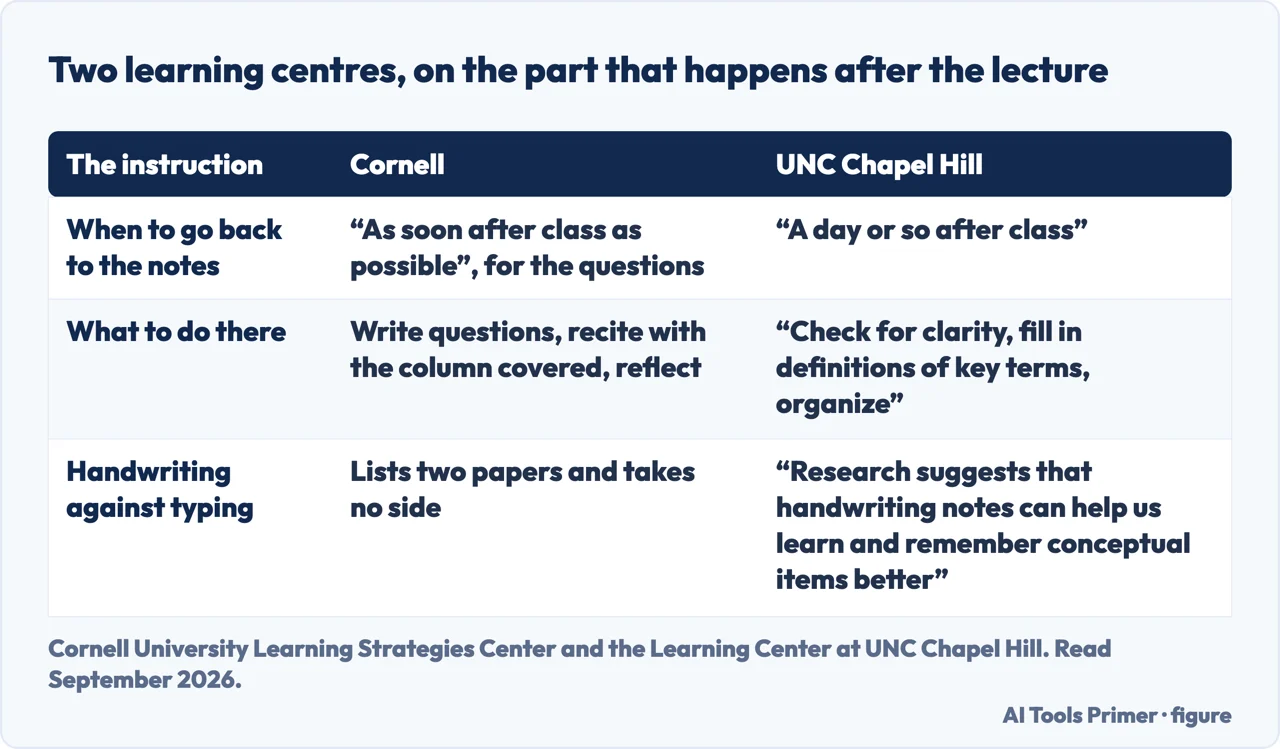
- Questions.same day “As soon after class as possible, formulate questions based on the notes.” Cornell gives four reasons: it “helps to clarify meanings, reveal relationships, establish continuity, and strengthen memory.”
- Recite.later “Cover the note-taking column with a sheet of paper. Then, looking at the questions or cue-words … only, say aloud, in your own words, the answers.”
- Reflect.later “Reflect on the material by asking yourself questions, for example:… How can I apply them? How do they fit in with what I already know?”
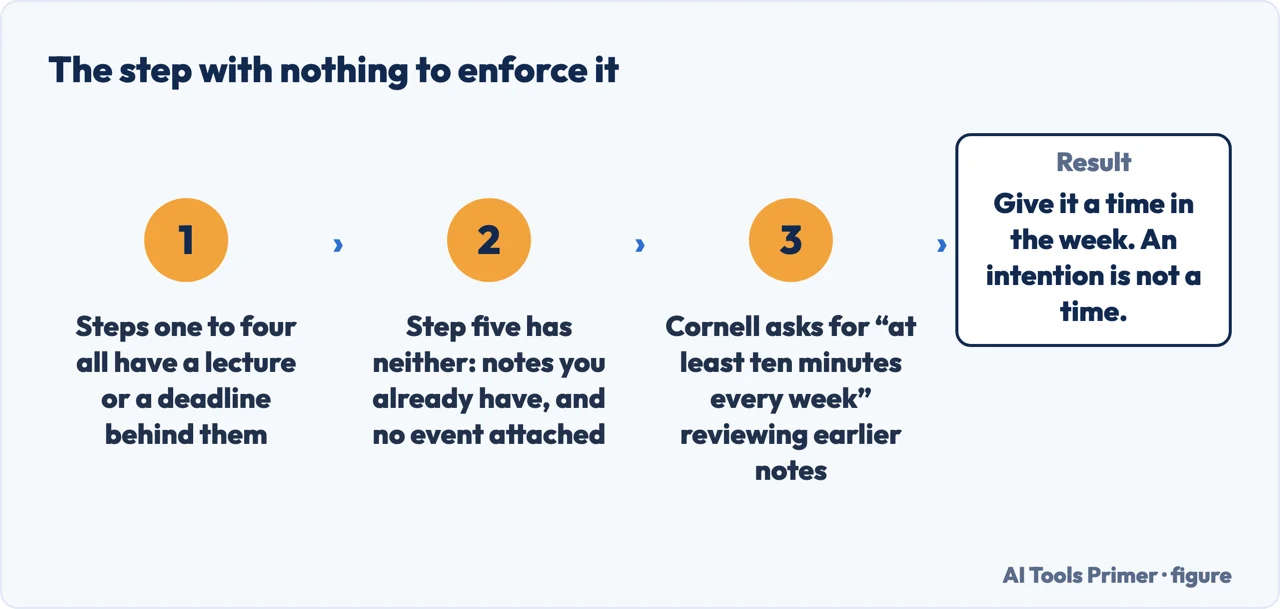
- Review.weekly “Spend at least ten minutes every week reviewing” your earlier notes.
Read down the right-hand labels and the system reorganises itself in front of you. Four of the five steps are after the event. Drawing the lines and filling the wide column is step one of five, and a page of notes that never got steps two to five is a transcript rather than a study method.
Step three is the one that does the work, and it is the one with a test built into it. Cover the notes; look only at your own questions; say the answer aloud in your own words. Everything you cannot say is a gap you have just found, at a moment when finding it is still cheap.
Step two explains why the cue column is narrow and empty during the lecture. The handout gives it one job: the questions you write afterwards, which is what turns a page of statements into something you can be tested on. Cornell’s own four reasons for it are worth keeping: clarify meanings, reveal relationships, establish continuity, strengthen memory.
“The Cornell Note-Taking System was originally developed by Cornell education professor, Walter Pauk.”
Cornell’s Learning Strategies Center, on its own page, naming the author and the book: How to Study in College, chapter 10, “The Cornell System: Take Effective Notes”. The handout the steps above come from carries its own note — “Adapted from How to Study in College 7/e by Walter Pauk” — which is worth knowing because it means the version you are reading is the university’s own summary of the original, rather than somebody’s summary of a summary.
A word about the one instruction in step one that people skip past. Telegraphic sentences. Not full sentences, not everything the lecturer said — the compressed form you would use in a telegram charged by the word. It is the only guidance the handout gives about what to write during the lecture, and it is guidance about writing less, which is the opposite of what a page of blank paper suggests.
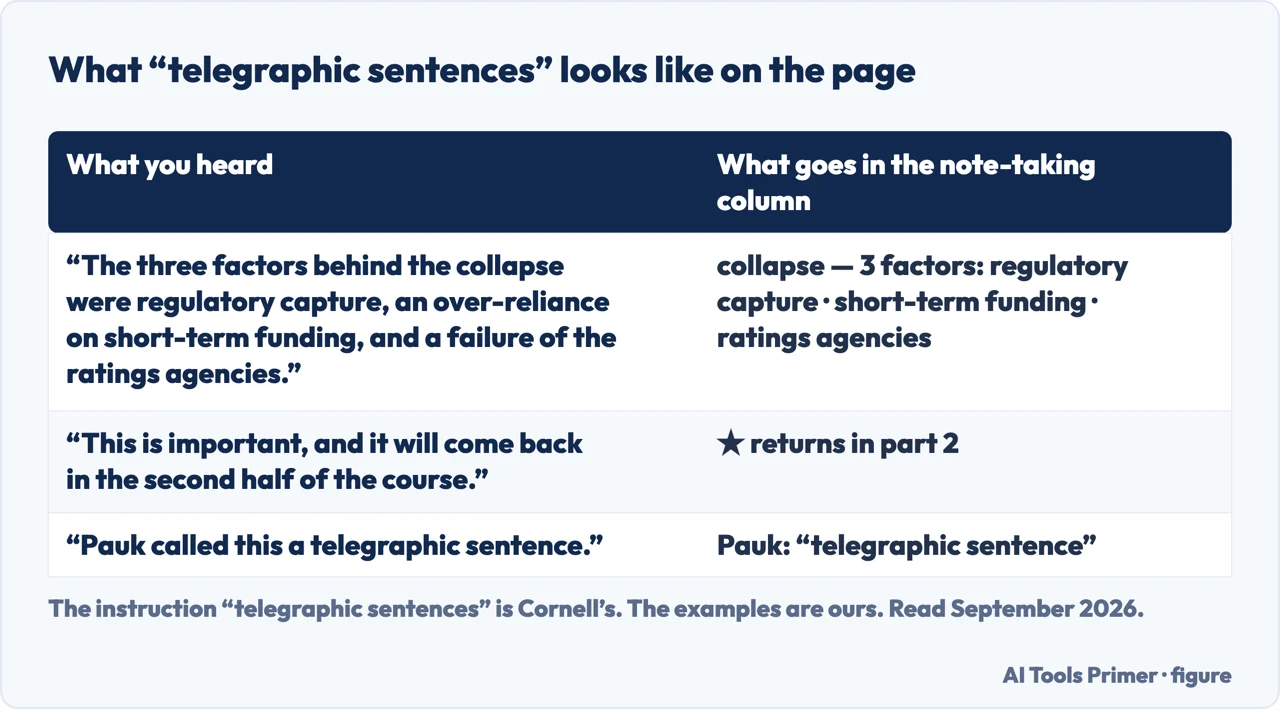
One thing worth reporting exactly as it stands. Cornell’s note-taking page lists its references, and two of them are studies about writing by hand against typing. This guide has not read those papers, so it will not tell you what they found — but the title of the first is itself a claim, and it is Cornell that cites it:
“The Pen is Mightier Than the Keyboard: Advantages of Longhand Over Laptop Note Taking”, Mueller, P., and Oppenheimer, D., Psychological Science 25(6), April 2014. The second is “Note-taking With Computers: Exploring Alternative Strategies for Improved Recall”, Bui, Myerson and Hale, Journal of Educational Psychology, 2013 — whose title suggests the question is less settled than the first one sounds.
A second university states the timing as a rule rather than as a step, which is worth having because the timing is the part people drop. The Learning Center at the University of North Carolina at Chapel Hill, in “Effective Note-Taking in Class”: “Part of good note-taking includes revisiting your notes a day or so after class. During this time, check for clarity, fill in definitions of key terms, organize, and figure out any concepts you may have missed or not fully understood in class.” On the handwriting question the same page is more careful than the paper title above, and the caution is the quotable part: “Research suggests that handwriting notes can help us learn and remember conceptual items better than digital notes.”
The last step is the one with nothing to enforce it. Ten minutes a week, on notes you already have, with no lecture and no deadline attached to it — which is an argument for giving it a time in the week rather than an intention.
The guides below take it four ways: the page itself, the four steps that come after the lecture, what to write while it is happening, and where the system came from.
Where to start
Four ways in.
- “I cannot write fast enough.”
- That is during the lecture
- “Where does this come from?”
- That is the source
During the lecture
One instruction, and it is about writing less rather than faster. Everything else in the system is designed to happen when you are not under time pressure.
The source
A named professor, a named book, a chapter number — the system has an address, and it is worth visiting.
Not covered here. It will not present the three-part page as the method. Cornell publishes five steps, and the page is where step one goes.
It will not tell you what the handwriting studies found. This guide has not read them; it reports that Cornell cites them, and their titles.
And it will not promise the system works for everybody. Cornell’s own module asks you to “assess which strategies work best for you in different situations”, which is a more honest framing than a method that claims to suit every subject. What holds instead is simple: the five steps and the origin of the system are quoted from Cornell University’s Learning Strategies Center, with a second reading from the Learning Center at UNC Chapel Hill.
Step 2 of 5 in a term of coursework
The order a student meets these in, from the lecture to the reference list.
- Before this
- How to study effectively, in two techniques rather than ten
- After this
- How to cite a website when the three styles disagree
Getting the material down
Four ways of getting the material down so you can work from it later.
- The same job, in the other places it comes up
- How to transcribe audio to text, without paying for it
- How to extract text from image files, without uploading them
Sources
- Cornell University, Learning Strategies Center — The Cornell Note-taking System (printed handout, PDF), which sets out the note-taking column, cue column and summary area and the five steps Record, Questions, Recite, Reflect and Review in the wording quoted here, and states that it is adapted from How to Study in College 7/e by Walter Pauk — lsc.cornell.edu, read 22 August 2026.
- Cornell University, Learning Strategies Center — The Cornell Note Taking System (the statement that the system was developed by Cornell education professor Walter Pauk, the book and chapter reference, and the module’s aim of assessing which strategies work best for you) — lsc.cornell.edu, read 22 August 2026.
- Cornell University, Learning Strategies Center — Note Taking Strategies (the reference list from which the two study titles on handwriting against typing are quoted) — lsc.cornell.edu, read 22 August 2026.
- The Learning Center, University of North Carolina at Chapel Hill — Effective Note-Taking in Class (the instruction to revisit notes a day or so after class and what to do during that review, and the wording of its claim about handwriting against digital notes) — learningcenter.unc.edu, read 5 September 2026.
Written by Alberto Gulotta
Founder and editor of AI Tools Primer, writing from Palermo, Italy. Thirty-five years of taking computers apart, starting with a Commodore 64 — the long version is on the about page.
Something wrong on this page? Write to aitoolsprimer@gmail.com and it gets fixed.
Written on 22 August 2026 · last checked 23 September 2026.
Independence and limits
No affiliate links and no paid placements anywhere on this site. Nobody pays to appear here, and no company has seen this page before you did.
This is general information, not professional advice. Where a page touches money, health, safety or the law, it names its source and the date it was read — and your situation may still differ. See the privacy page and the cookie policy.