Most answers to how to study effectively are lists of tips, and the tips are not wrong so much as undifferentiated — a good night’s sleep sits beside a highlighter colour scheme as though they were comparable. University learning centres are narrower, and the narrowness is the useful part: they keep naming the same two techniques, and they define both against the thing most students actually do.
The familiar methodand what a learning centre calls it
Reading the notes again. Highlighting. Going over the same chapter until it feels familiar.
Duke’s Academic Resource Center describes this as “simply glancing over our notes, or
passively underlining key words” — the thing retrieval practice is defined against.
Indiana University puts rereading in the same bracket: studying “the same material over and
over… or reread the same piece of text several times… We often refer to this as cramming.”
What the research centres recommendtwo techniques, not ten
Retrieval practice — “the active process of trying to recall concepts and big ideas,
even before we completely know our material.”
Spaced practice — “learning that takes place over time with rest periods between
practice sessions”, as opposed to one long session.
That is the whole of it. Everything else on this guide is detail about doing those two
properly.
That framing is worth pausing on, because it is not a criticism of effort. Somebody rereading a chapter for the third time is working hard. The problem is that the effort goes into recognising the material rather than producing it, and recognition is exactly what an exam does not ask for. The page looks familiar; that feeling is not the same as being able to write the answer with the page shut.
Retrieval practice, as a procedure
Duke’s Academic Resource Center, on what self-quizzing actually involves.
Read through your slides, notes and textbook.
Set everything aside and, without looking, try to remember what you just learned.
Check your answers immediately — “follow up immediately with feedback or self-checking”.
Go back into the notes on whatever you got wrong, “to understand what we still need to solidify”.
Repeat “in multiple episodes scattered throughout our daily and weekly study sessions”.
Two of those steps are the ones people drop. Step two has to be done with the material closed
— glancing at it turns the exercise back into rereading. And step three is not optional: Duke calls
checking your answers “a necessary step between quizzing episodes”, because
“mistakes are valuable — they show you where to focus”.
The instruction to start recalling “even before we completely know our material” inverts the sequence you would expect. Rather than learn the material first and test yourself once you are ready, Duke’s guidance is to push yourself “to recall something that we barely know yet”, get it wrong, and use the wrongness as the map.
The second technique is simpler and harder, because it is about the calendar rather than the evening.
Spaced against massed, in the words of a university teaching centre
Spaced (or distributed) practice
“Learning that takes place over time with rest periods between practice sessions.” In practice:
several subjects in a row, or something else entirely between study periods.
Massed (or blocked) practice
“Learning that happens in a single session with no rest period” — the same material over and
over. “We often refer to this as cramming.”
Why the gap does the work
Indiana’s explanation is mechanical rather than moral: “our brains need time to move
information from short-term (or working) memory to long-term memory”. Cramming is
described there as “a less effective way to acquire and retain information in the long term”.
What makes spacing difficult is that it has to be decided in advance. On the night before, there is no spaced option left — the only available choice is how to cram. The decision is made two weeks earlier, by somebody who does not yet feel any urgency, which is why it is the harder of the two to adopt even though it requires no technique at all.
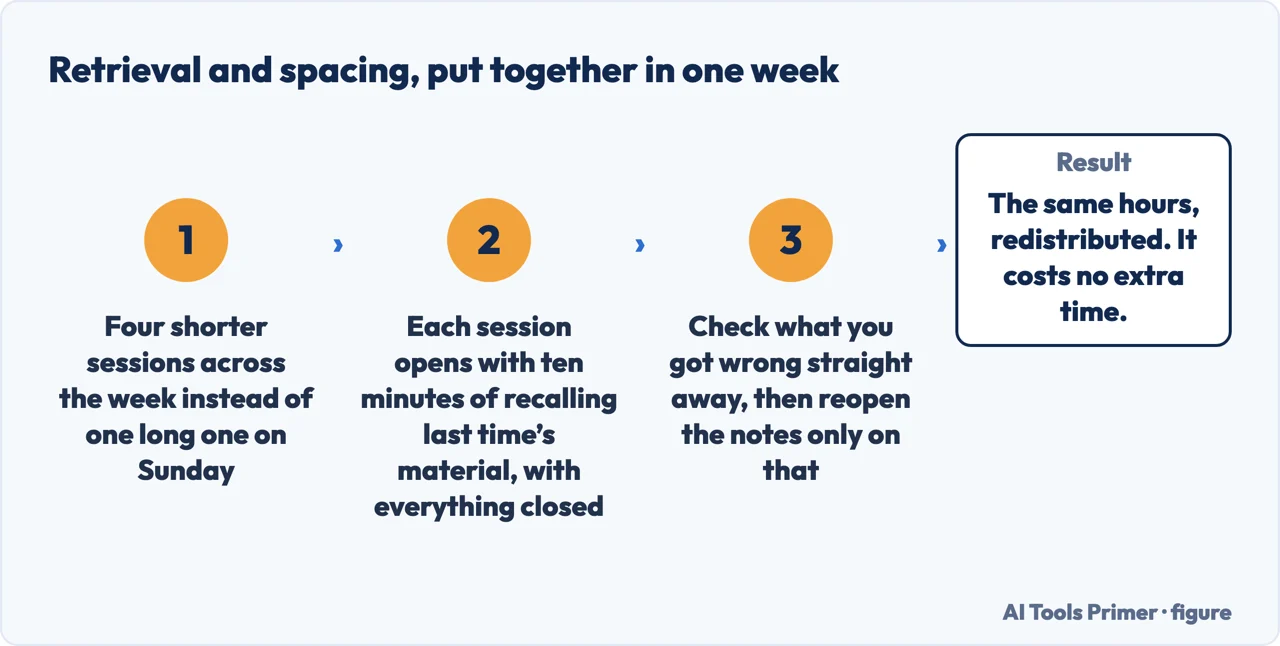
Combining them is the practical version of both: rather than one long session on Sunday, four shorter sessions across the week, each of which starts with ten minutes of trying to recall last time’s material before opening anything. That is retrieval and spacing at once, and it costs no extra hours — it redistributes the ones you were going to spend.
Retrieval and spacing at the same time, out of the hours you were going to spend anyway. Figure drawn by AI Tools Primer.
Indiana’s page is written for instructors rather than students, and one line in it is worth reading from the other side: courses can be structured “to help students learn course material over time and steer students away from cramming” through low-stakes practice assessments and scaffolded deadlines. If your course already has small weekly quizzes, they are not busywork. They are the spacing being done for you.
One variant is worth naming because it is the situation the research is friendliest to: searching how to study for finals effectively means several subjects and a fixed date — and Indiana describes spaced practice as looking exactly like that: students “might break down study time to do work on several different courses consecutively”. The week with four exams in it is the week where distributing the sessions costs nothing extra and gains the most — provided the distributing starts before the last weekend.
A last note on what this guide does not claim. Neither source says these two techniques are the only things that matter, and neither says other methods are worthless — Duke recommends practising retrieval “in different formats (visual, textual, and graphic)”, which is where diagrams, summaries and teaching somebody else come back in. The claim is narrower and better supported: of the things students actually do, the two most common are the two the evidence supports least.
The guides below take it four ways: the two techniques in detail, the note-taking that feeds them, the exam-week situation where the options have already narrowed, and the writing that comes after the studying.
The essay, the citations and the submission. This is the rest of this section, and it is where the marks are usually lost for reasons unrelated to knowing the material.
Not covered here. It will not give you twenty study tips. Two university centres keep naming the same two techniques, and a longer list would be padding.
It will not sell you an app. Both techniques work with a pen, a closed book and a calendar.
And it will not tell you rereading is useless. It is what the sources define the effective methods against, which is a narrower and more defensible claim. What holds instead is simple: the definitions of retrieval and spaced practice, and the procedures for both, are quoted from two university learning and teaching centres, listed below.
Step 1 of 5 in a term of coursework
The order a student meets these in, from the lecture to the reference list.
Duke University Academic Resource Center — Retrieval Practice (the definition, the contrast with glancing over notes and passively underlining, the five conditions under which it works best, the self-quizzing procedure, and the value of mistakes) — arc.duke.edu, read 22 August 2026.
Indiana University Bloomington, Center for Innovative Teaching & Learning — Spaced Practice (the definitions of spaced and massed practice, rereading as cramming, and the working-memory explanation for why the gap matters) — citl.indiana.edu, read 22 August 2026.
AG
Written by Alberto Gulotta
Founder and editor of AI Tools Primer, writing from Palermo, Italy. Thirty-five years of
taking computers apart, starting with a Commodore 64 — the long version is on the
about page.
Written on 22 August 2026 · last checked 5 September 2026.
§
Independence and limits
No affiliate links and no paid placements anywhere on this site. Nobody pays to appear here,
and no company has seen this page before you did.
This is general information, not professional advice. Where a page touches money, health,
safety or the law, it names its source and the date it was read — and your situation may
still differ. See the privacy page and the
cookie policy.