
Study · guide
MLA format: the one template it all runs on
By Alberto Gulotta · Updated · 8 min read
mla format is searched by people who believe they have to memorise a different pattern for every kind of source. They do not. Since the eighth edition the style has run on one template, and the Modern Language Association publishes it free.
MLA is one template, not a list of rules to memorise
The order of elements, as the Modern Language Association publishes it, read 21 August 2026.
MLA states that each entry “is composed of facts common to most works—the MLA core elements”, and that “they are assembled in a specific order”. You do not learn a separate pattern for a book, a journal article, a film and a tweet. You learn one order and fill in what exists.
The idea that makes it work is the container. MLA: “When the source being documented forms part of a larger whole, the larger whole can be thought of as a container that holds the source. For example, a short story may be contained in an anthology. The short story is the source, and the anthology is the container.” A song sits in an album, which sits on a streaming service — and that is why the template has room for more than one.
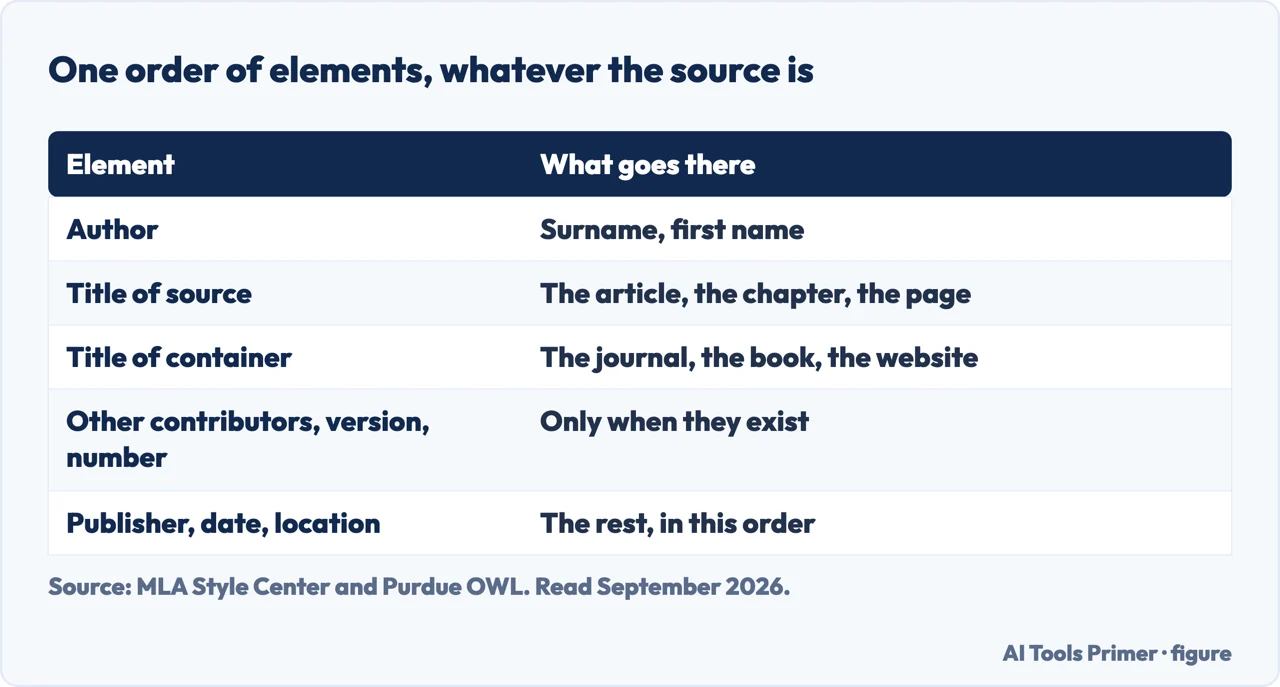
Once that clicks, most of the anxiety in this subject disappears. A source you have never cited before is not a new rule to look up — it is the same seven slots, with different things in them.
“The template is a tool for teaching and learning MLA style, not a citation generator. To verify that your entry is correct, consult the MLA Handbook.”
The Modern Language Association, about its own interactive template, read 21 August 2026. Worth holding on to when most of what you find is a citation generator — including the ones that produce an entry in under a second and never mention checking it.
MLA states it as the central concept rather than a detail: “The concept of containers is crucial to MLA style. When the source being documented forms part of a larger whole, the larger whole can be thought of as a container that holds the source. For example, a short story may be contained in an anthology. The short story is the source, and the anthology is the container.”
That is why the template has two container slots rather than one, and MLA’s own examples show why the second is needed. A story read online: “Poe, Edgar Allan. ‘The Masque of the Red Death.’ The Complete Works of Edgar Allan Poe, edited by James A. Harrison, vol. 4, Thomas Y. Crowell, 1902, pp. 250–58. HathiTrust Digital Library, hdl.handle.net/2027/coo.31924079574368.” The story sits in the collected works; the collected works sit in HathiTrust. Two containers, listed outward.
The same shape appears for a journal article found through a library: “Goldman, Anne. ‘Questions of Transport: Reading Primo Levi Reading Dante.’ The Georgia Review, vol. 64, no. 1, spring 2010, pp. 69–88. JSTOR, www.jstor…”. The article is in the review; the review is in JSTOR. Anyone who has ever wondered whether to name the database or the journal has been asking the wrong question — MLA’s answer is both, in that order.
And the method itself is two steps rather than a form to fill in: “to use the template, evaluate the work you’re citing to see which elements apply to the source. Then, list each element relevant to your source in the order given on the template.” The elements that do not apply are simply absent — there are no blanks to leave empty and no placeholders to invent, which is precisely where an automatic generator, working from a form, produces the tell-tale n.d. and n.p. that a reader notices.
And the first slot changes shape rather than staying empty, which is the other place a form-filling tool goes wrong. With no author, MLA’s own example puts the title first and nothing else: “Beowulf. Translated by Alan Sullivan and Timothy Murphy, edited by Sarah Anderson, Pearson, 2004.” No Anonymous, no Author unknown. And where an editor stands in for the author, the role is named rather than implied: “Sánchez Prado, Ignacio M., editor. Mexican Literature in Theory. Bloomsbury, 2018.” The slot is for whoever is responsible for the work — and it says which kind of responsibility it was.
The same template, explained by somebody who does not publish the handbook. Purdue’s writing lab documents MLA’s general format independently of the Modern Language Association, which matters for a practical reason: the handbook is a book you buy, and the free page you are sent to is often a university one. Where the two agree — and on the order of elements and the container idea they do — you can rely on it without owning the edition.
The words people search show the same misunderstanding from several angles. Mla citation and mla works cited are people building the list at the end. Mla format example is somebody who wants to copy a shape rather than learn the order. A works cited page is the thing due tomorrow, and mla 9th edition is the careful student checking they are using the right version — which, as the last wing of this guide explains, is a better question than it sounds.
Where to start
Five ways in.
- “I need to cite something unusual.”
- Start at the template
- “I need in-text citations, not the list.”
- That is the template
The template
The core of the style, and the free official tools for practising it. Everything here is published by the MLA itself rather than paraphrased from a study site.
Not covered here. It will not print a rule without saying where it came from. The authoritative source for MLA paper formatting is the handbook, which is not free — and that is precisely why so much of the web repeats these rules second-hand, sometimes from an edition that is no longer current.
It will not tell you a generator’s output is ready to submit. The MLA’s own template carries the warning; the commercial generators do not.
And it will not rank the citation tools yet. That verdict needs the same awkward sources — a chapter, a podcast episode, a dataset, a translated novel — run through each of them, with the errors published. What holds instead is simple: every rule quoted here comes from the Modern Language Association’s own free pages.
The night the reference list is due
Which style you were told to use decides everything below it.
- The same job, in the other places it comes up
- Chicago style citation: two systems, not one
- APA in text citation: the two forms it takes
- How to write a bibliography, and whether you need one
- Footnote citation: inserting one, and what goes in it
- How to cite a website when the three styles disagree
Sources
- MLA Style Center — Citations by Format (that entries are created using the MLA template of core elements, that you evaluate the work to see which elements apply and then list each relevant element in the template’s order, with worked examples showing a work inside a collection inside a digital library, and an article inside a journal inside a database) — style.mla.org, read 24 August 2026.
- The MLA Style Center on works-cited entries — the core elements and the concept of containers — style.mla.org, read 21 August 2026.
- The MLA interactive practice template — the order of elements, and the MLA’s statement that it is not a citation generator — style.mla.org, read 21 August 2026.
- The MLA Style Center on formatting a research project, which directs readers to the MLA Handbook — style.mla.org, read 21 August 2026.
- Purdue OWL — MLA general format: the same template documented independently of the association that publishes the handbook — owl.purdue.edu, read 4 September 2026.
Written by Alberto Gulotta
Founder and editor of AI Tools Primer, writing from Palermo, Italy. Thirty-five years of taking computers apart, starting with a Commodore 64 — the long version is on the about page.
Something wrong on this page? Write to aitoolsprimer@gmail.com and it gets fixed.
Written on 21 August 2026 · last checked 4 September 2026.
Independence and limits
No affiliate links and no paid placements anywhere on this site. Nobody pays to appear here, and no company has seen this page before you did.
This is general information, not professional advice. Where a page touches money, health, safety or the law, it names its source and the date it was read — and your situation may still differ. See the privacy page and the cookie policy.