
Study · guide
Chicago style citation: two systems, not one
By Alberto Gulotta · Updated · 10 min read
The first thing to know about chicago style citation is that there is no single Chicago style of citing. The Chicago Manual of Style publishes two systems, and they look nothing alike. Picking the one your department does not use is the error that costs marks, and no generator will catch it for you.
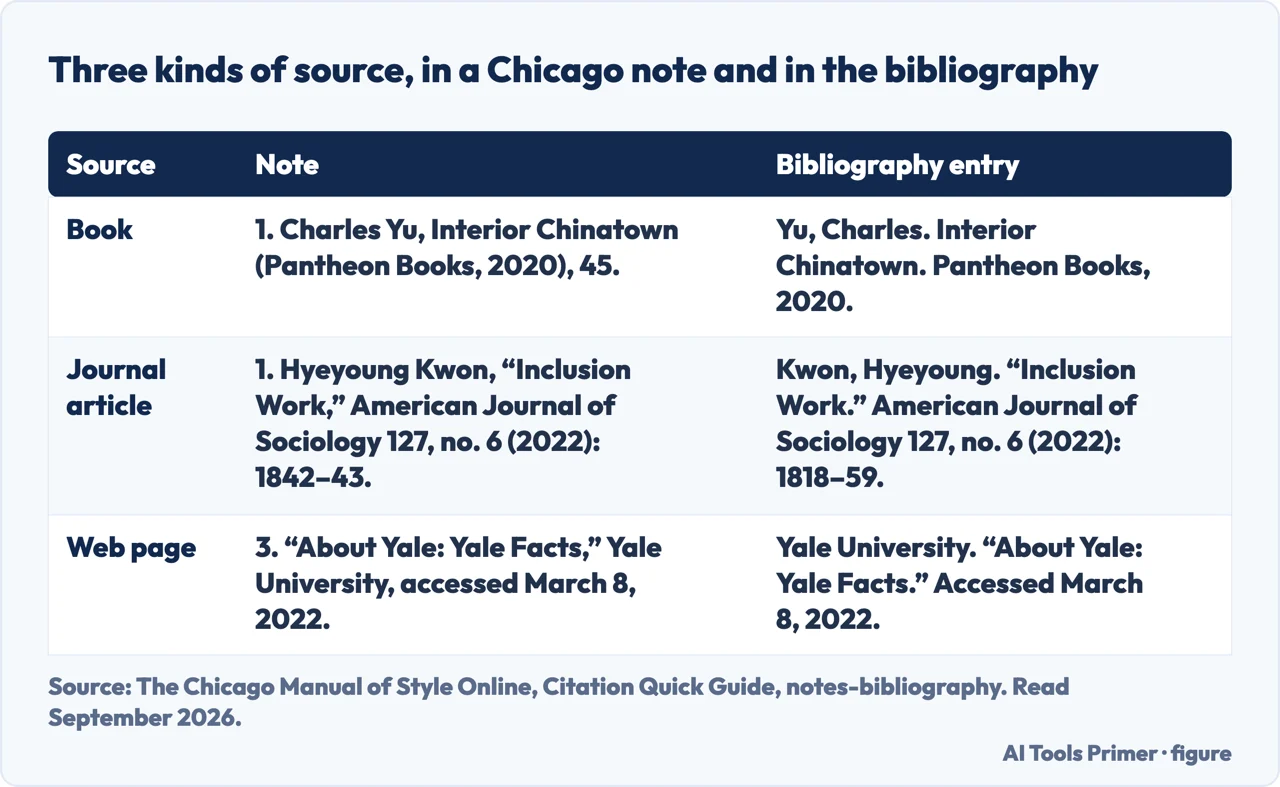
| Source | Note | Bibliography entry |
|---|---|---|
| Book | 1. Charles Yu, Interior Chinatown (Pantheon Books, 2020), 45. | Yu, Charles. Interior Chinatown. Pantheon Books, 2020. |
| Journal article | 1. Hyeyoung Kwon, “Inclusion Work: Children of Immigrants Claiming Membership in Everyday Life,” American Journal of Sociology 127, no. 6 (2022): 1842–43. | Kwon, Hyeyoung. “Inclusion Work: Children of Immigrants Claiming Membership in Everyday Life.” American Journal of Sociology 127, no. 6 (2022): 1818–59. |
| News article | 1. Dani Blum, “Are Flax Seeds All That?,” New York Times, December 13, 2023. | Page numbers “can be cited in a note but are omitted from a bibliography entry” |
| Web page | 3. “About Yale: Yale Facts,” Yale University, accessed March 8, 2022. | Often not needed at all: the Manual says it is “often sufficient simply to describe web pages and other website content in the text” |
System one
Notes and bibliography
Chicago: sources are cited “in numbered footnotes or endnotes”, and the system is “preferred by many working in the humanities, including literature, history, and the arts”. This is the one with the little raised numbers.
System two
Author-date
Chicago: sources are “briefly cited in the text, usually in parentheses, by author’s last name and year of publication”, and it is “preferred by many in the sciences and social sciences”. Closer to what APA looks like.
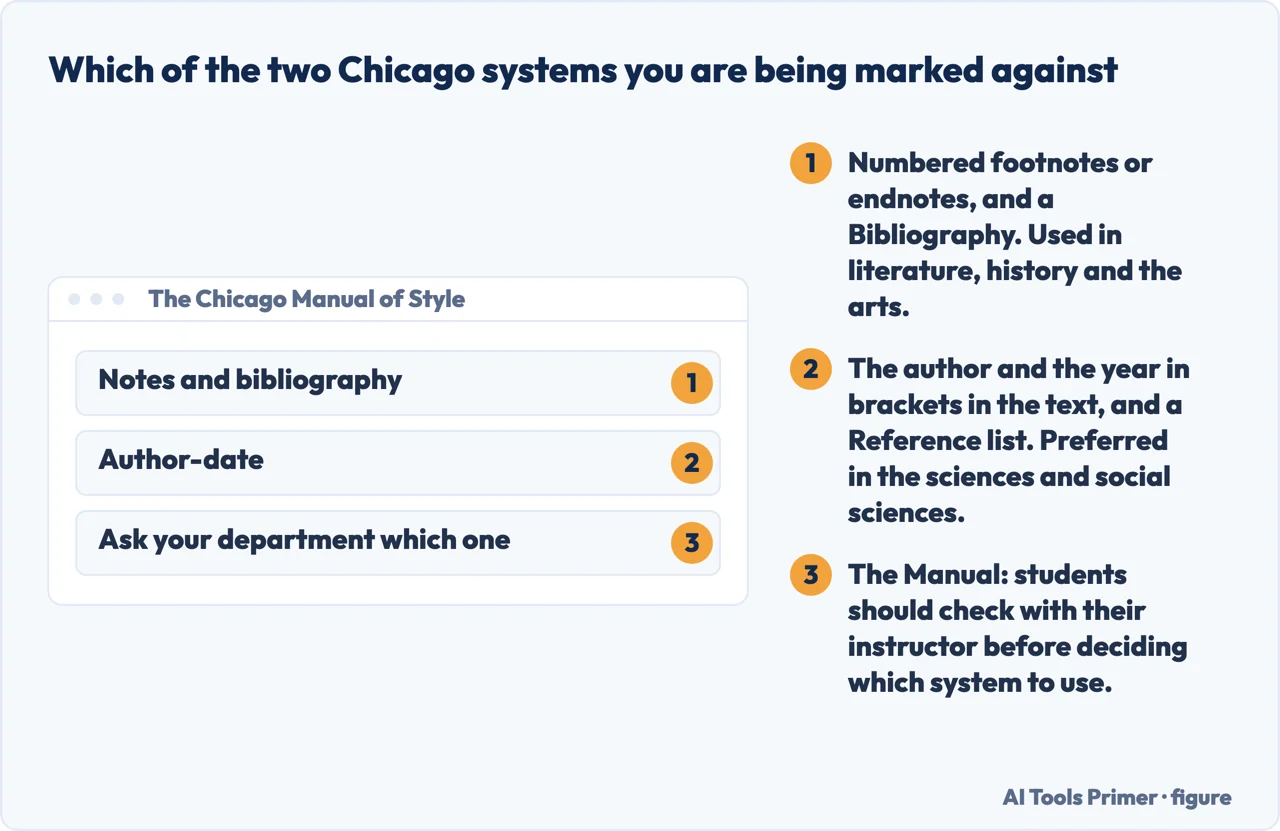
- Find out which of the two systems you are being marked against. Not which one you prefer: the Manual itself says “students should check with their instructor before deciding which system to use.”
- For notes-bibliography, put a note at every use of a source. Purdue’s summary of the rule: “include a note (endnote or footnote) each time you use a source, whether through a direct quote, paraphrase, or summary.”
- Write the first note in full, and every later one short. Full: author’s name in normal order, title, publication details in brackets, page. Short: surname, shortened title, page.
- Build the bibliography from the same sources, alphabetically. The name turns round, the brackets go, the page number goes, the page range of an article arrives.
- Check the one rule that dates a citation. The Manual’s guide now states that “a place of publication is no longer required in book citations”: a city before the publisher marks the entry as belonging to an earlier edition of the style.
So the honest first step is not how to format the entry but which of the two systems you are being marked against. A history essay and a psychology paper can both be in Chicago and share almost nothing on the page.
One rule changed, and it is the one that dates a citation. Alongside its book examples the Manual’s own guide now carries the note that “a place of publication is no longer required in book citations”, pointing at CMOS 14.30. Anyone taught Chicago a few years ago learned to put the city before the publisher, and a marker who has read the current edition sees the older shape immediately. It is not wrong in the sense of being unreadable; it is simply the previous edition, which is exactly the impression a citation is supposed not to give.
The second thing the guide shows, and generators rarely do, is that a note is not written the same way twice. The sample notes give “full citations followed by shortened citations for the same sources” — the first mention carries everything, and every mention after it is cut down. A paper where every footnote is the full entry is a paper written by a tool that only knows one form, and it reads that way. Whichever system you are in, the sample pages are the place to check the shape: the Manual points beyond them to chapters 13 and 14 for the cases the samples do not cover.
If you genuinely do not know which one you are in, the Manual gives a reason rather than a coin toss. It describes notes and bibliography as “Chicago’s oldest and most flexible”, able to “accommodate a wide variety of sources, including unusual ones that don’t fit neatly into the author-date system”, and says that “for this reason, it is preferred by many working in the humanities, including literature, history, and the arts.” Author-date does the opposite job: the source is named briefly in the text, in parentheses, by surname and year, and each of those matches an entry in a reference list. So the question is not really which looks better. It is whether your sources are the kind that fit a form — and whether your field expects the reader to glance down at a footnote or across at a surname and a year.
The same book, three times
Chicago’s own sample for a book by one author, notes-bibliography system, read 21 August 2026.
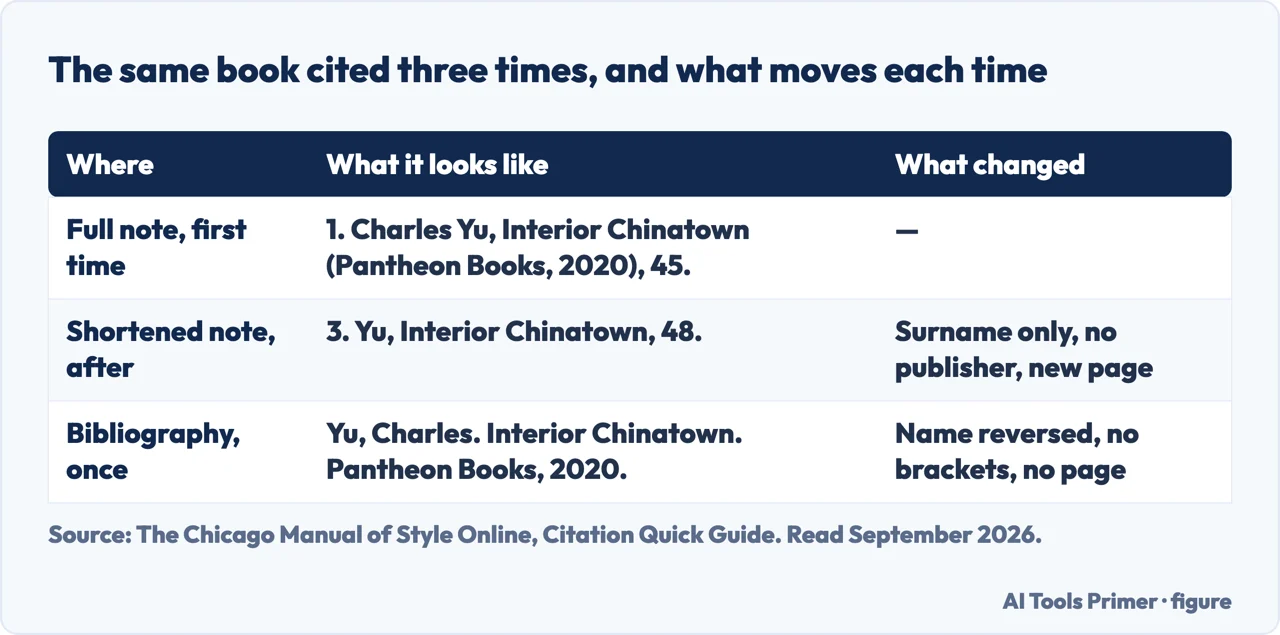
- Full note — the first time you cite it
- 1. Charles Yu, Interior Chinatown (Pantheon Books, 2020), 45.
- Shortened note — every time after that
- 3. Yu, Interior Chinatown, 48.
- Bibliography entry — once, at the end
- Yu, Charles. Interior Chinatown. Pantheon Books, 2020.
Read down the three lines and the pattern is visible without any rule being quoted. The note keeps the author’s name in normal order; the bibliography turns it round to put the family name first. The note wraps the publication details in brackets; the bibliography separates them with full stops. The note carries a page number; the bibliography does not. Nothing else moves.
Both systems are set out in the manual’s free Citation Quick Guide, which reflects the 18th edition. Chicago itself points beyond that guide: “For a more comprehensive overview of Chicago’s two systems of source citation, see chapter 13 of The Chicago Manual of Style. For many more examples organized by type of source, consult chapter 14.” Those chapters are in the manual, which is not free — the same gate that sits in front of MLA’s handbook.
The searches around this one show the same two-systems confusion. Chicago citation and chicago style format are people who have not yet been told there is a choice. Footnote citation is somebody already inside the first system, wanting the mechanics. Chicago manual of style is often someone looking for the book itself. And turabian is the student adaptation of the same manual, which is a guide of its own below.
One more thing worth saying before the guides, because it explains why this subject feels harder than it is. Almost nobody meets Chicago by choosing it. It arrives in a course handbook, usually as a single line, sometimes without naming which of the two systems is meant, and often alongside a sample essay that was formatted under an earlier edition. So the reader arriving here is rarely trying to learn a style — they are trying to match something they have been shown, without being able to see the rule behind it. Every guide below is written for that person: it shows the form first, says where the form comes from, and marks clearly the point at which the free guide stops and the book begins.
Where to start
Four ways in.
- “Notes and bibliography.”
- Go to notes and bibliography
Notes and bibliography
The footnote system: full note, shortened note, and the list at the end. The mechanics people search for most.
Questions people also ask
What is the Chicago style format?
Two formats, not one. The Chicago Manual of Style publishes a notes-bibliography system, used in “literature, history, and the arts”, and an author-date system “preferred by many in the sciences and social sciences”. They carry the same information and look nothing alike.
Is Chicago style different from MLA?
Yes, and in a way that shows on every page. MLA puts a short parenthesis in the text and a Works Cited list at the end. Chicago’s commoner system puts a numbered footnote or endnote at every use of a source, and a Bibliography at the end.
Which of the two systems should I use?
The one your department marks. The Manual is explicit that “most authors choose the system used by others in their field or required by their publisher”, and that “students should check with their instructor before deciding which system to use.”
Do I still need the city of publication in a Chicago book citation?
No. The Manual’s own guide now states that “a place of publication is no longer required in book citations”. A city before the publisher is not unreadable — it just marks the entry as written to an older edition of the style.
Not covered here. It will not tell you which system to use. Your department does that, and any page that answers it for you is guessing about your course.
It will not quote a rule from an edition it has not read. The Quick Guide is free and current; much of what circulates online is a paraphrase of an older edition, and the difference is not always visible.
And it will not rank the citation tools yet. That needs the awkward sources — an archive box, a podcast, a translated work — put through each of them in both systems, with the mistakes published. What holds instead is simple: every sample on this page is Chicago’s own, from the free Citation Quick Guide.
The night the reference list is due
Which style you were told to use decides everything below it.
- The same job, in the other places it comes up
- APA in text citation: the two forms it takes
- MLA format: the one template it all runs on
- How to write a bibliography, and whether you need one
- Footnote citation: inserting one, and what goes in it
- How to cite a website when the three styles disagree
Sources
- The Chicago Manual of Style Online, Citation Quick Guide — the two systems and which disciplines use each — www.chicagomanualofstyle.org, read 21 August 2026.
- Citation Quick Guide, notes-bibliography samples — the full note, shortened note and bibliography entry quoted here — www.chicagomanualofstyle.org, read 3 September 2026.
- Purdue OWL — Chicago Manual of Style 17th edition: the two systems named side by side, and the rule that a note goes at every use of a source, quote or paraphrase or summary — owl.purdue.edu, read 3 September 2026.
Written by Alberto Gulotta
Founder and editor of AI Tools Primer, writing from Palermo, Italy. Thirty-five years of taking computers apart, starting with a Commodore 64 — the long version is on the about page.
Something wrong on this page? Write to aitoolsprimer@gmail.com and it gets fixed.
Written on 21 August 2026 · last checked 3 September 2026.
Independence and limits
No affiliate links and no paid placements anywhere on this site. Nobody pays to appear here, and no company has seen this page before you did.
This is general information, not professional advice. Where a page touches money, health, safety or the law, it names its source and the date it was read — and your situation may still differ. See the privacy page and the cookie policy.