
Study · guide
How to write a bibliography, and whether you need one
By Alberto Gulotta · Updated · 9 min read
Before how to write a bibliography can be answered, there is a question that decides the whole shape of the answer and that almost no page asks: are you sure a bibliography is what you were asked for?
It is a fair question rather than a pedantic one. Much of what is written on the subject is about annotated bibliographies — a different thing again — or comes from a citation generator. The word gets used loosely, and the lists it gets used for are not the same list.
“A reference list contains works that specifically support the ideas, claims, and concepts in a paper; in contrast, a bibliography provides works for background or further reading and may include descriptive notes.”
The American Psychological Association, on its own style site, read 21 August 2026. And the sentence before it decides the matter for a great many students: “APA publications and other publishers and institutions using APA Style generally require reference lists, not bibliographies.” If your course uses APA, you were probably never asked for a bibliography at all.
Which list you have actually been asked for
Three different lists, defined by the bodies that own the styles. The names are not interchangeable, and choosing the wrong one changes what goes in it.
- Works Cited — MLA “The list titled ‘Works Cited’ identifies the sources you borrow from—and therefore cite—in the body of your research project.” Only what you cited. Nothing else. MLA Style Center, quoting the MLA Handbook
- Works Consulted — MLA, if you want the extras “If you wish to list additional works and your instructor has no objection, create a separate list.” A second list, not a longer first one — and permission is assumed rather than given. MLA Style Center
- References — APA Works that “specifically support the ideas, claims, and concepts in a paper”. The same principle as Works Cited under a different name. APA Style
- Bibliography — Chicago, and background reading generally MLA notes that other citation manuals, Chicago among them, “allow the title ‘Bibliography’ for a list that includes both works cited and works consulted and both print and nonprint sources”, while recommending “References” or “Works Cited” for its author-date system. MLA Style Center, citing The Chicago Manual of Style
So the honest first answer to “how do I write a bibliography” is a question back: does your assignment want everything you read, or only what you cited? Those are two different documents, and the word on the brief tells you which.
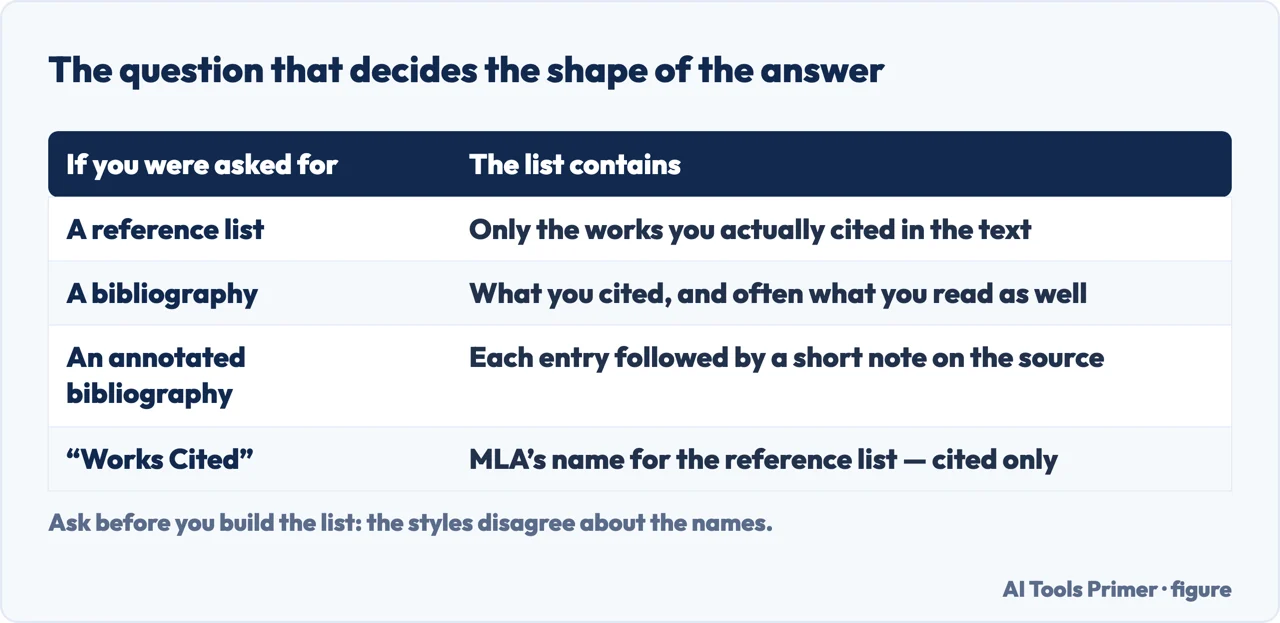
That distinction is not a formality. If the brief says Works Cited and you hand in everything you read, you have included sources you never used, which reads as padding. If it says bibliography and you list only what you quoted, you have left out the reading that shows where your thinking came from. The list is an argument about your research, and the title tells you which argument.
What goes in an entry, whichever list it is. The elements are the same across styles even where the punctuation is not: who made it, what it is called, where it appeared, who published it, when, and where to find it. MLA’s reasoning for preferring “Works Cited” over “Bibliography” is worth borrowing here, because it explains the modern shape of these lists — the seventh edition noted that “Works Cited is most appropriate, since research papers often draw not only on printed books and articles but also on films, recordings, web publications, and other nonprint sources”. A bibliography, literally, is a “description of books”, and most research has not been only books for a long time.
Order. Alphabetical by the first element of the entry, which is usually the author’s surname and is the title when there is no author. This is the same in all three styles, and it is the part people most often get wrong by sorting on the wrong word.
Should you use a generator? Two of the pages ranking above this one are generators, and they are genuinely useful for the mechanical part — assembling elements into a pattern with the right punctuation. What they cannot do is the part this guide is about: knowing which list you are building and what belongs in it. A generator will produce a beautifully formatted entry for a source you should not have listed.
They also make specific, repeated mistakes — a website’s name where the publisher belongs, a missing author it could not detect, a date that is the day you visited rather than the day it was published. Checking a generated list against the elements above takes a few minutes and catches nearly all of it.
A caveat the source states about itself, and we are repeating rather than hiding. The MLA page quoted above opens with a note: “This post relates to content in the eighth edition of the MLA Handbook. For up-to-date guidance, see the ninth edition of the MLA Handbook.”
The distinction between the lists has not changed, which is why it is quoted here. But if you are formatting entries — punctuation, order of elements, how to handle a source with no author — check the edition your course requires rather than any summary, including this one. Style manuals are revised, and an assignment marked against the ninth edition will be marked against the ninth edition.
And the thing worth doing first, which costs nothing. Read the brief again and note the exact word it uses. If it says “bibliography” but the course teaches APA, ask — because “APA publications and other publishers and institutions using APA Style generally require reference lists, not bibliographies”, and that mismatch is a sign the word was used loosely rather than that a different document is wanted. Two minutes of asking beats an evening of formatting the wrong list.
Everything quoted on this guide is from the MLA Style Center or from APA Style, on the date it was read, and where a source flags its own edition we have flagged it too.
Where to start
Four ways in.
- “I do not know which list I was asked for.”
- The section above — then the styles
- “I have the list, I need the format.”
- Go to the styles
- “I used a generator and do not trust it.”
- See checking the work
- “The sources are websites, not books.”
- That is awkward sources
The styles
Each style owns its own rules, and each publishes them. These guides take the rules from the bodies rather than from a summary.
Checking the work
Generators do the mechanical half well and the judgement half not at all. What to check before you hand it in.
Awkward sources
Most of the difficulty in a source list is not books. It is the thing with no author, no date, or no obvious publisher.
Writing it up
The list sits at the end of a document, and the document has its own problems worth solving before you get there.
Not covered here. It will not give you one format to use everywhere. Three styles define three different lists, and the differences are quoted above from the bodies that set them.
It will not tell you a generator is enough. It does the punctuation and not the judgement, and the judgement is the part that is marked.
And it will not paraphrase a style manual and present it as current. Where the source flags its own edition, this page flags it too, and points you at the edition your course requires. What holds instead is simple: the definitions of each list are quoted from the MLA Style Center and from APA Style, with the date each was read and the edition each refers to.
Step 4 of 5 in a term of coursework
The order a student meets these in, from the lecture to the reference list.
- Before this
- How to cite a website when the three styles disagree
- After this
- Footnote citation: inserting one, and what goes in it
The night the reference list is due
Which style you were told to use decides everything below it.
- The same job, in the other places it comes up
- Chicago style citation: two systems, not one
- APA in text citation: the two forms it takes
- MLA format: the one template it all runs on
Sources
- APA Style — Reference lists versus bibliographies, on what a reference list contains and why APA generally requires one rather than a bibliography — apastyle.apa.org, read 21 August 2026.
- MLA Style Center — What is the difference between source lists titled “Works Cited,” “Bibliography,” and “References”?, which notes that it relates to the eighth edition of the MLA Handbook — style.mla.org, read 21 August 2026.
Written by Alberto Gulotta
Founder and editor of AI Tools Primer, writing from Palermo, Italy. Thirty-five years of taking computers apart, starting with a Commodore 64 — the long version is on the about page.
Something wrong on this page? Write to aitoolsprimer@gmail.com and it gets fixed.
Written on 21 August 2026 · last checked 5 September 2026.
Independence and limits
No affiliate links and no paid placements anywhere on this site. Nobody pays to appear here, and no company has seen this page before you did.
This is general information, not professional advice. Where a page touches money, health, safety or the law, it names its source and the date it was read — and your situation may still differ. See the privacy page and the cookie policy.