Detect · guide
Copyleaks: the detector inside your LMS
By Alberto Gulotta · Updated · 9 min read
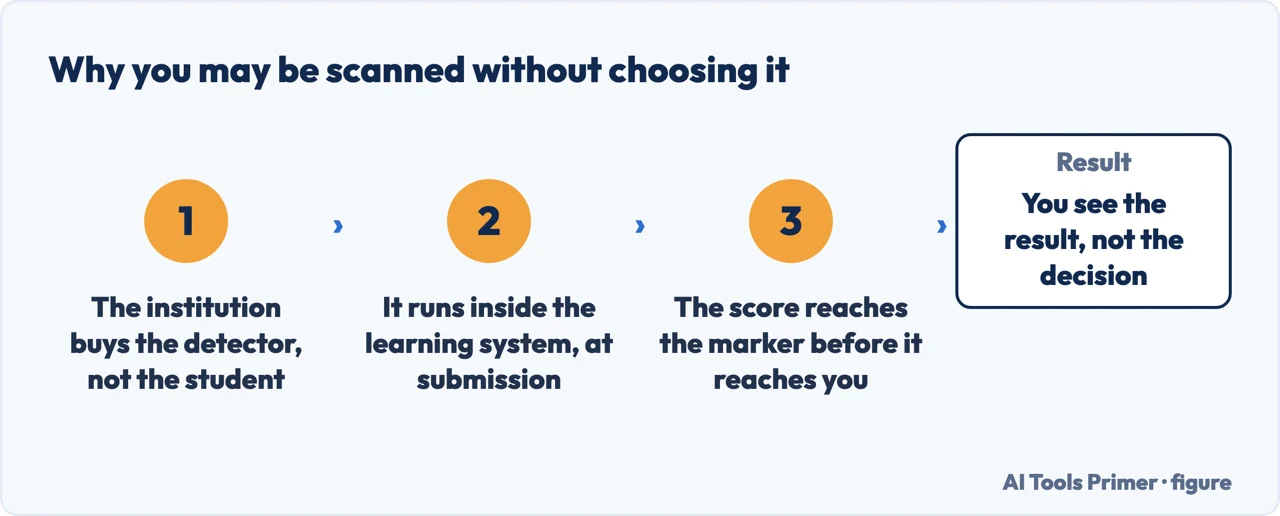
copyleaks is a detector you are more likely to meet than to visit. It plugs into the learning platforms universities already run, which means the first time many students encounter it is inside a result.
It also publishes something the others do not, and it belongs at the top of this guide rather than buried in a features list.
The warning worth reading before anything else here
“For writers and students, certain platforms, like Grammarly, use ChatGPT and other genAI models for key functionalities and can be flagged as potential AI content.”
Copyleaks, on its own AI detector page, read 21 August 2026.
That is a detector company telling you that one of the most widely installed writing tools in the world can cause your own writing to be flagged. It is not a fringe claim either: a competing detector, Originality AI, states separately that it “actively tests AI tools that change, modify, or edit text (e.g. Quillbot or Grammarly)” in order to keep detecting them.
Set that against the arithmetic on the rest of this section and a picture emerges that nobody selling these tools states in one sentence: the writing most likely to be flagged is careful, plain, edited prose — which is exactly what a student is told to produce.
“Over 99% accuracy, even when it’s carefully blended with human writing”, across “over 30 supported languages”, and “low false-positive rates for non-native English text”.
The company lists integrations with Canvas, D2L, Moodle, Blackboard, Schoology, Edsby and Sakai — which is how most students meet it, without choosing it.
“AI Logic demystifies detection by showing you why text has been flagged”, through AI Phrases and AI Source Match — unusual, because most detectors show only a number.
The company advertises scanning “up to 25,000 characters without logging in, a higher limit than most major AI detection tools”.
“Our findings reveal that these detectors consistently misclassify non-native English writing samples as AI-generated, whereas native writing samples are accurately identified.”
Everything else on this guide comes from companies that sell detection or sell writing tools. This does not. It is a study published on arXiv in 2023, which ran several widely used GPT detectors over writing by native and non-native English speakers. The failure it found was not random noise — it landed on one group of people. The same paper reports that the effect is easy to run in reverse: “simple prompting strategies can not only mitigate this bias but also effectively bypass GPT detectors”, which its authors read as evidence that the detectors “may unintentionally penalize writers with constrained linguistic expressions”.
Their conclusion is addressed to exactly the place this detector lives. The authors “caution against their use in evaluative or educational settings, particularly when they may inadvertently penalize or exclude non-native English speakers from the global discourse”. A detector plugged into a university’s learning platform is an evaluative setting by definition — and it is the setting in which the person being measured has the least room to answer back.
Copyleaks warns that Grammarly “can be flagged as potential AI content”. Grammarly’s reply is to split its product in two, and the split is the whole answer. The older layer — spelling, grammar, clarity, conciseness, tone — “does not change the substance of the writing, and it cannot be turned off separately from Grammarly product offerings”. The generative features added in 2023 are the other kind: they “can generate content and meaningfully change writing”, they are “not turned on by default”, they are “available on-demand”, and “any user can turn off generative AI in the Feature customization tab in their account settings”.
Which reframes the warning rather than denying it. The part of Grammarly that runs whether you ask or not is the part its maker says does not change what the text says; the part that does change it is opt-in and switchable off. “I used Grammarly” and “this was generated” are not the same statement, and the person holding a flagged report cannot tell them apart from the score.
Then Grammarly says something about the whole category, on a page where it also sells a detector of its own: “while AI detectors can help assess whether text appears AI-generated, none today can reliably and conclusively determine whether AI was used to produce text. These tools should be considered a single data point rather than the sole source of evidence when investigating AI use.” Its recommendation is “combining automatic AI detection with manual review”. That is a detector vendor placing its own product below the level of proof — the third one on this site to do so in writing.
One consequence deserves stating on its own, because it is the practical upshot of this whole section. If two competing detector companies both say that mainstream editing tools change how text scores, then a detector result is not measuring whether a person wrote something. It is measuring how closely the finished text resembles the statistical middle — and careful editing moves writing toward that middle by design. That is not a defect anybody is hiding; it is what the technology does, described by the people selling it.
Where to start
Five ways in.
- “I use Grammarly. Am I at risk?”
- Start at the grammarly problem
- “My university uses this and I was flagged.”
- Go to if it flagged you
- “What does Copyleaks claim about itself?”
- That is what it claims
- “I write in more than one language.”
- Read what it claims
- “I want to check my own work first.”
- That is using it yourself
The Grammarly problem
Two competing detector companies say, independently, that mainstream editing tools interfere with detection. That has consequences for millions of people who did nothing wrong.
What it claims
Quoted from the company, with the date. Claims are described here rather than judged, because judging them needs a controlled test we have not run.
If it flagged you
The practical wing. This detector is usually met through a learning platform rather than through a search for a product.
Using it yourself
Checking your own work before somebody else does. Free, within limits, and worth understanding before you rely on the number.
Not covered here. It will not tell you Copyleaks is accurate or inaccurate. The company publishes a figure; verifying it needs a controlled test with texts we wrote ourselves, and until that exists there is no verdict here.
It will not tell you to stop using a grammar checker. Two detector companies say editing tools interfere with detection, and the answer to that is not to write worse — it is to keep the record of how you wrote.
And it will not pretend the choice was yours. This detector is generally there because an institution installed it, which is precisely why what it says about itself should be public and quoted rather than left in a marketing page. What holds instead is simple: the company’s claims are its own and the finding about non-native English writers is the arXiv paper’s, quoted with the caution it carries.
When a detector has put a number on your work
A percentage appeared. What it means depends entirely on who is reading it and what they are allowed to do with it.
- The same job, in the other places it comes up
- Are ai detectors accurate enough to accuse somebody?
- GPTZero: what it claims, and what it means
- Originality AI: what it claims, and what it sells
- QuillBot and paraphrasing tools, honestly
- What is an acceptable AI detection score?
- Turnitin: what the similarity score really is
- Turnitin AI detection: what the score is
- AI detector false positive: what to do next
Sources
- Grammarly Support — How can I turn off AI in the Grammarly product offerings? Does the use of Grammarly trigger AI detectors? (the distinction between the foundational AI for spelling, grammar, clarity, conciseness and tone, which does not change the substance of the writing and cannot be turned off separately, and the generative features introduced in 2023, which can generate content and meaningfully change writing, are not on by default, are available on demand and can be switched off in the Feature customization tab; and the statement that no AI detector today can reliably and conclusively determine whether AI was used, that such tools should be considered a single data point rather than the sole source of evidence, and the recommendation to combine automatic detection with manual review) — support.grammarly.com, read 6 September 2026.
- Copyleaks’ own AI detector page — the Grammarly warning, the accuracy and language claims, AI Logic, the LMS integrations and the free scan limit — copyleaks.com, read 21 August 2026.
- Originality AI’s statement that it actively tests tools which modify text, naming QuillBot and Grammarly — originality.ai, read 6 September 2026.
- GPT detectors are biased against non-native English writers — arXiv:2304.02819 (that the detectors evaluated consistently misclassify non-native English writing samples as AI-generated while native writing samples are accurately identified; that simple prompting strategies can both mitigate this bias and effectively bypass the detectors, suggesting they may unintentionally penalize writers with constrained linguistic expressions; and the authors’ caution against their use in evaluative or educational settings, particularly where they may inadvertently penalize or exclude non-native English speakers from the global discourse) — arxiv.org, read 26 August 2026.
Written by Alberto Gulotta
Founder and editor of AI Tools Primer, writing from Palermo, Italy. Thirty-five years of taking computers apart, starting with a Commodore 64 — the long version is on the about page.
Something wrong on this page? Write to aitoolsprimer@gmail.com and it gets fixed.
Written on 21 August 2026 · last checked 23 September 2026.
Independence and limits
No affiliate links and no paid placements anywhere on this site. Nobody pays to appear here, and no company has seen this page before you did.
This is general information, not professional advice. Where a page touches money, health, safety or the law, it names its source and the date it was read — and your situation may still differ. See the privacy page and the cookie policy.