Detect · guide
Does Grammarly count as AI? The honest answer
By Alberto Gulotta · Updated · 7 min read
The question underneath the question
“Does using Grammarly count as AI?”
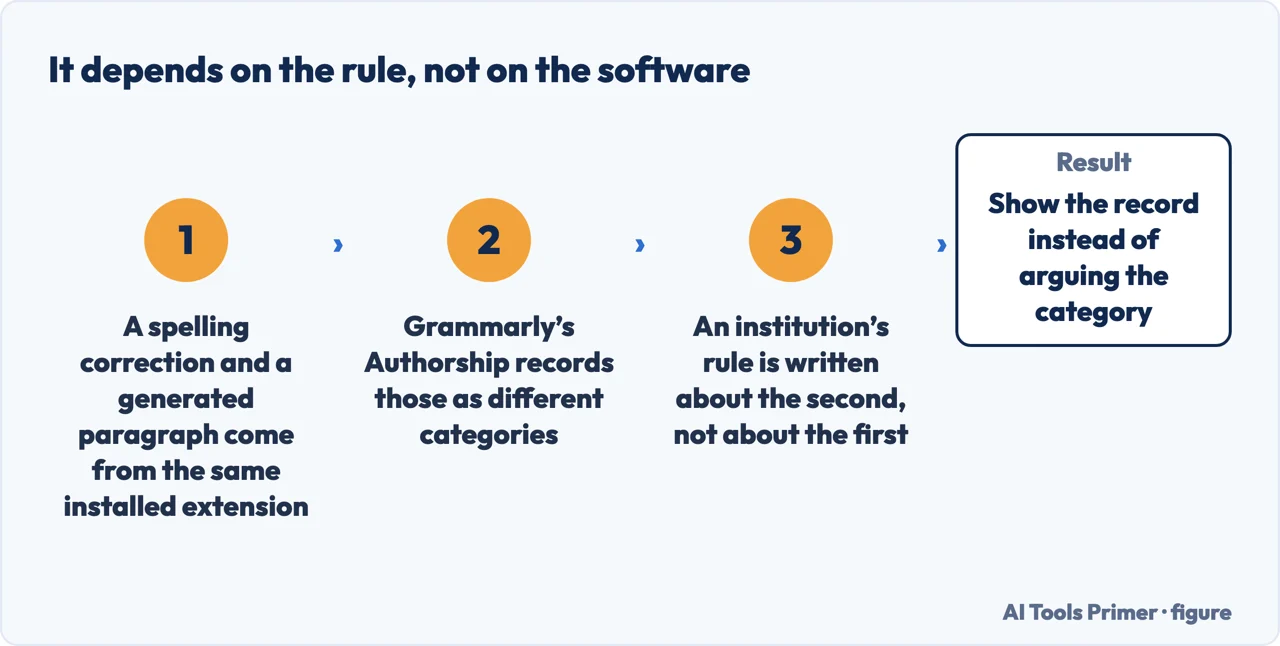
It is asked a thousand times a month in the United States alone, and the honest answer is that it depends on the setting you were given, not on the software. A spelling correction and a generated paragraph are both produced by the same installed extension, and an institution’s rule is written about the second, not the first.
Which is why the useful move is not to argue about the category. It is to be able to show what actually happened — and Grammarly ships a feature for exactly that, which the question as usually asked does not lead you to.
What Grammarly’s Authorship records, in its words
- “Typed by human”
- “Copied from a source” — including AI-generated text
- “Copied from an unknown source”
- Text typed and then “modified with our on-demand AI rephrasing”
- Text edited by “grammatical error correction, clarity rewrites, and word choice suggestions”
That last category is the one that answers the question directly. A correction is recorded separately from a generation. If your work was typed and then tidied, the record says so; if a paragraph arrived from somewhere else, the record says that too.
Two limits worth knowing before relying on it. The distinction between a paste from ChatGPT and a paste from Wikipedia requires clipboard access: with it, Grammarly says it can “determine whether text was copied from a generative AI source such as ChatGPT or Claude, or from a more traditional online source such as Wikipedia”. Without it, pasted text is only ever categorised as an unknown source. And it works in Google Docs, Microsoft Word and Grammarly’s own editor — not everywhere you might write.
The part that makes it usable by the people who need it most: reports are on every plan. Grammarly states that all plans, “including the Free plan”, allow you to “Generate an unlimited number of Authorship reports” and to share them. Data is stored on the device while you write, and shared reports are kept “for 12 months or until you delete your account”.
Before anything else on this guide: does grammarly count as ai is the question people actually arrive with, and it has an answer. The thing to notice about Grammarly is where it runs. Installed as a browser extension, it sits in the text boxes you type into rather than in a program you open — and that single fact is the most important thing on this guide.
An extension that corrects your writing wherever you write has to be able to read wherever you write. That is not a flaw or a scandal — it is what the feature requires. But it is worth seeing stated plainly, by the companies themselves.
What a grammar-checking extension can see
“Content we collect also includes information about your browsing session and the content of websites visited when using our browser extensions. Depending on the service you’re using, this may include the content and metadata of all websites you’re visiting during your active browser session (e.g. website text, media, publisher and author names, URLs).”
From the privacy policy covering LanguageTool, read 21 August 2026. It is quoted here not as an accusation but as a description: this is what a browser extension that checks your writing everywhere has to be able to do. The permission is the product.
Two of the biggest names here belong to the same company
LanguageTool’s privacy policy is issued by Learneo, Inc. — the same business behind QuillBot, whose product menu carries a paraphraser, an AI detector and an AI humaniser. Read on their own sites on 21 August 2026. Worth knowing before treating any two of those tools as independent second opinions.
The searches split by how far along somebody is. Grammar check and english grammar check are people who want a sentence looked at once. A grammar checker or a free grammar checker is somebody choosing a tool to keep. Grammarly is the name that has become the category, and a punctuation checker is the narrowest and most answerable request of the lot.
With that established, the rest of the guide is the ordinary question: what these tools actually catch, what they miss, where the free versions stop, and the point at which a checker stops improving your writing and starts sanding it down.
One phrase in this cluster is worth answering plainly, because it is the one typed at midnight: does grammarly count as ai cheating. Nobody outside your institution can answer it, and any page that claims to is guessing about rules it has not read. What this guide can do is tell you what the software records, so that the conversation is about evidence rather than about impressions.
Where to start
Five ways in.
- “Which one should I install?”
- Start at what they catch
- “English is not my first language.”
- Read what they catch
What they catch
Three different jobs sold under one name: mechanical correctness, clarity, and style. Only the first has right answers.
Not covered here. It will not tell you to install an extension without saying what it can see. The quotation at the top is from the company’s own policy, and anybody choosing one of these tools deserves to read it before the install button, not after.
It will not rank the checkers yet. That needs the same set of real documents run through each of them over weeks, with the misses and the false corrections counted — which is a test, and it is the only thing worth publishing here.
And it will not treat a suggestion as a correction. A great deal of what these tools flag is preference rather than error, and a writer who accepts everything ends up sounding like every other writer who accepted everything.
One closing note on how this guide was researched, since it is the reason it says what it says. The quotation at the top was not taken from a review or a summary; the policy pages of these companies block automated reading, so they were opened in an ordinary browser and read the way a customer would read them. That is also how the second observation surfaced — that two of the largest names in this section share a parent company. Neither fact is hidden, and neither one appears in the comparison articles that rank above this page. What holds instead is simple: the policy quotations here were read on the companies’ own sites, with the date.
Sources
- The privacy policy covering LanguageTool, issued by Learneo, Inc. — what is collected from browser extensions and from content you provide — languagetool.org, read 21 August 2026.
- QuillBot’s product menu, listing a paraphraser, an AI detector and an AI humaniser under the same company — quillbot.com, read 21 August 2026.
- Grammarly Support — Introducing Authorship, the categories it records, the clipboard limit and what free plans include — support.grammarly.com, read 6 September 2026.
Written by Alberto Gulotta
Founder and editor of AI Tools Primer, writing from Palermo, Italy. Thirty-five years of taking computers apart, starting with a Commodore 64 — the long version is on the about page.
Something wrong on this page? Write to aitoolsprimer@gmail.com and it gets fixed.
Written on 21 August 2026 · last checked 5 September 2026.
Independence and limits
No affiliate links and no paid placements anywhere on this site. Nobody pays to appear here, and no company has seen this page before you did.
This is general information, not professional advice. Where a page touches money, health, safety or the law, it names its source and the date it was read — and your situation may still differ. See the privacy page and the cookie policy.