Detect · guide
Is Grammarly Premium worth it, now that it is called Pro?
By Alberto Gulotta · Updated · 11 min read
Before answering whether is Grammarly Premium worth it, there is a fact that changes what you should be reading, and none of the guides on this question mention it.
The plan you are searching for, checked on 21 August 2026
- grammarly.com/premium→grammarly.com/pro
The company’s own pricing page carries the migration question in its FAQ: “What will happen to my Premium subscription if I switch to Pro?” So the paid individual plan is now called Pro, and most reviews you will find are reviewing a plan under its former name — several of them dated two years ago, at prices from a different pricing page.
That matters practically rather than pedantically. A review written against the old plan may be describing a feature split that has since moved, at a price that has since changed, for a company that has since been renamed — the enterprise tier on that same page is now described as “available through Superhuman Go”. So start from the current page rather than from anybody’s summary of it, including this one, and here is what it says.
What the two tiers actually contain
Taken from the comparison table on grammarly.com/plans, read 21 August 2026. The price below appeared in euro, because that page prices by region — check your own before deciding anything.
Free
€0 per month
- Write without mistakes
- See your writing tone
- Generate text with 100 AI prompts per month
Pro
€12 per month · “Everything in Free, plus:”
- Rewrite full sentences with a click
- Adjust your writing tone with ease
- Write fluently in English
- Unlimited personalized suggestions
- Detect plagiarism and AI generated text
- Generate text with 2,000 AI prompts per member per month
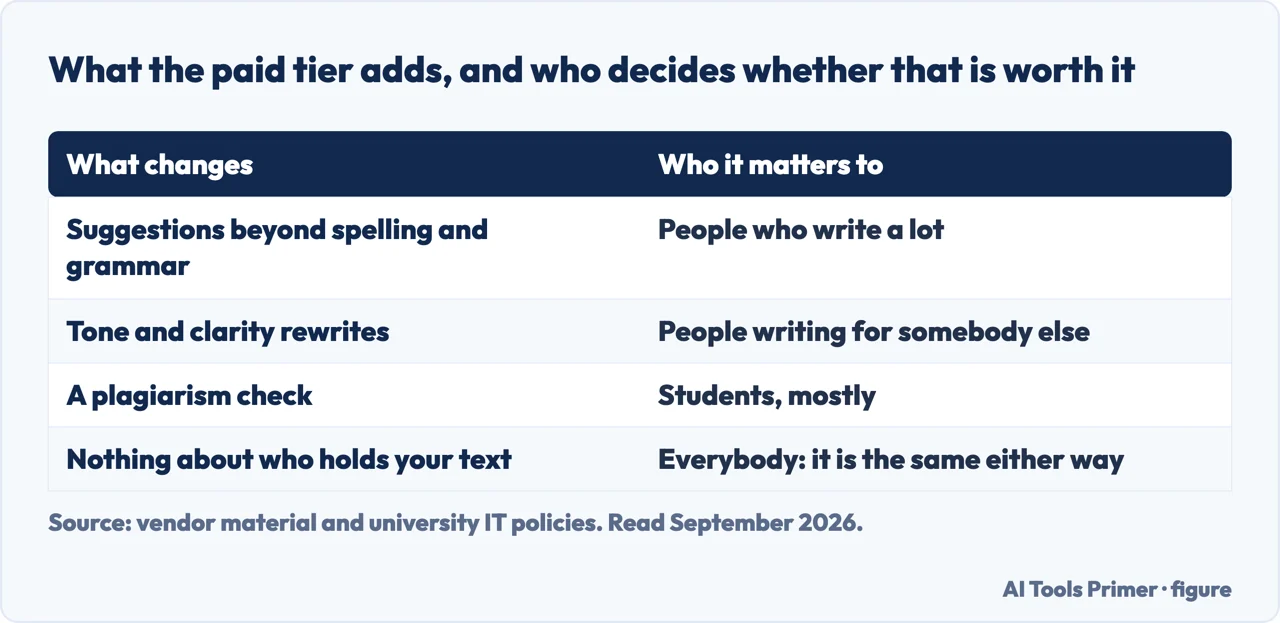
Six additions. That is the entire question, and it is a far smaller list than the length of the average review of it suggests. The honest way to decide is to read the six and count how many describe something you have actually wanted in the last month — not how many sound useful.
Reading the six honestly. Two of them are about volume rather than capability. “Unlimited personalized suggestions” means the free tier shows you that corrections exist and withholds some of them, which is the oldest pattern in this business and the one that generates most upgrades. And the prompt allowance rises from one hundred a month to two thousand, which is a real difference only if you are using it as a writing generator rather than as a checker.
And there is a place where that dividing line stops being a matter of taste. If the writing is going to be assessed, the paid tier’s headline features are the ones the rules name.
Where the paid features are not allowed at all
- Rewriting for tone→not permitted
- Restructuring your work→not permitted
- Shortening to hit a word count→not permitted
That list is not this page’s opinion: it is the University of Birmingham’s guidance, written about Grammarly Free and Grammarly Pro by name. Its rule is that “relying on another individual or online software tools to rewrite, develop, or correct your ideas within assessments and assignments is not permitted”, and among the actions it names as violations are “Rewriting for tone or academic style”, applying a tone filter “(for example ‘make this sound more confident’ or ‘make this more impactful’)”, and “Shorten your work specifically to meet a word count”.
Read that against the feature list above and the overlap is close to exact: the abilities the paid tier is sold on are the ones a university names when it defines misconduct. The University of Illinois Chicago states the underlying reason in one line: “Grammarly uses generative AI in any operation that rewrites text the student has already written.” Not a judgement about the product — a description of what rewriting is.
Three are about rewriting rather than correcting: rewriting full sentences, adjusting tone, and “write fluently in English”. This is the genuine dividing line between the tiers, and it is worth naming plainly. The free tier fixes what is wrong. The paid tier changes what is right into something different. Whether that is worth paying for depends entirely on whether you want your sentences altered — and there is a real cost on the other side of it, which is that heavy suggestion-taking flattens a voice into the same competent, frictionless register everybody else’s tool produces.
The sixth is the one this section has the most to say about: “detect plagiarism and AI generated text”. Read that as a feature you are being sold, not as a service you are receiving. A plagiarism check compares your words against an index and reports overlap, including the quotations you cited correctly; an AI writing score is a probability presented as a percentage. Both are useful and neither is a verdict, and the guides below set out exactly what each can and cannot support. If those two features are the reason you are considering paying, read them first — it is the single most expensive misunderstanding in this section.
Who the answer is usually different for. If you write in English as a second language, the rewriting features address the thing you actually want help with, and the free tier addresses much less of it. That is the group for whom the gap between the tiers is widest, and it is worth saying because those reviews rarely separate it out.
If you write professionally and your work is edited by somebody else, the paid rewriting is mostly redundant — you already have the thing it approximates. If you write occasionally, the free tier covers the case almost entirely. And if you are a student, check your institution’s policy on writing assistance before paying for a tool that rewrites sentences, because the question of whether you may use it is separate from the question of whether it is any good, and it is the one with consequences.
Why this guide does not end with a verdict. Because we have not run the test yet. Deciding whether a paid writing tool earns its subscription — and, if it does not, cancelling it from the phone rather than from inside the app — requires putting the same texts through the free and paid tiers over weeks, keeping what each one caught and what each one changed, and publishing the results — and until that exists, a verdict here would be somebody’s impression dressed as a finding. Every page above this one in the search results has a verdict. Several of them also have an affiliate link to the thing they are recommending, which is worth knowing while you read the verdict.
What this guide gives you instead is the current feature split from the company’s own table, the current plan name, the note that the price is regional, and the six differences stated plainly enough to check against your own month. That is enough to decide, and it is more than most of the pages ranking above it can honestly claim.
One practical note that costs nothing. The paid tier is offered with a trial and the pricing page states “Email reminder 2 days before trial ends” — so the low-risk version of this decision is to use the trial deliberately on real work, not on a test sentence, and to answer the question with your own documents rather than with anybody’s review. Set your own reminder as well as theirs.
Where to start
Four ways in.
- “I only want to know what the paid tier adds.”
- That is the table above — then see the tools
- “I am paying for the plagiarism check.”
- Read this first — what you are buying
- “What does it do with my writing?”
- Go to before you subscribe
- “Is there a free way to do this?”
- See the free options
The tools
What each writing tool actually catches, and where suggestions stop improving a text and start standardising it.
What you are buying
Two of the six paid features are whole subjects in themselves, and both are more limited than the feature list implies. Worth understanding before the subscription rather than after.
Before you subscribe
The questions that are not about features at all: what the company keeps, what it trains on, and whether you are permitted to use it for the work you had in mind.
The free options
What you can do without paying anybody, including the parts of this job that were solved long before the current wave of tools.
Not covered here. It will not tell you to buy it. We have not run the comparison that would justify saying so, and a verdict without that test is an opinion wearing a lab coat.
It will not tell you to avoid it either. The feature list above is real, and for some readers — particularly anybody writing in a second language — the gap between the tiers is genuinely large.
And it will not carry an affiliate link, which on this exact search is the reason most of the pages above it exist. What holds instead is simple: the plan names and the trial terms are quoted from the company’s own pricing page, read on the date this page names.
Sources
- Grammarly — Prices and Plans, the current Free, Pro and Enterprise comparison table, the trial terms, and the FAQ entry on switching from a Premium subscription to Pro — www.grammarly.com, read 21 August 2026.
- University of Birmingham, Using Grammarly responsibly within your academic work — Academic Skills Centre (that academic integrity requires submitted work to reflect your own thinking and writing; that relying on another individual or on online software tools to rewrite, develop or correct your ideas within assessments is not permitted; that the guidance covers Grammarly Free and Grammarly Pro by name; and the named violations, including rewriting for tone or academic style, applying a tone filter such as make this sound more confident or make this more impactful, restructuring an assignment, and shortening work specifically to meet a word count) — intranet.birmingham.ac.uk, read 26 August 2026.
- University of Illinois Chicago, A Student Guide to Using Grammarly — Learning Technology Solutions (that Grammarly uses generative AI in any operation that rewrites text the student has already written, with the example of options such as make this more persuasive or make this more informative, and that students are responsible for the accuracy of generated text and its sources) — learning.uic.edu, read 26 August 2026.
Written by Alberto Gulotta
Founder and editor of AI Tools Primer, writing from Palermo, Italy. Thirty-five years of taking computers apart, starting with a Commodore 64 — the long version is on the about page.
Something wrong on this page? Write to aitoolsprimer@gmail.com and it gets fixed.
Written on 21 August 2026 · last checked 23 September 2026.
Independence and limits
No affiliate links and no paid placements anywhere on this site. Nobody pays to appear here, and no company has seen this page before you did.
This is general information, not professional advice. Where a page touches money, health, safety or the law, it names its source and the date it was read — and your situation may still differ. See the privacy page and the cookie policy.