
Work · guide
Are cover letters necessary, and who actually reads them?
By Alberto Gulotta · Updated · 9 min read
Whether are cover letters necessary has an answer depends on a question you can settle in ten seconds before any advice becomes relevant: what does this particular application ask for? Every posting falls into one of three cases, and only one of them is a decision.
Required
The application lists it under required documents. Write one. There is no judgement call here, and omitting it can end the application before anybody reads your résumé.
Optional
The form accepts one but does not demand it. This is the only real decision, and the rest of this guide is about it.
No field at all
Many application forms have nowhere to put one. Do not send it anyway by email — an unsolicited attachment to a process that did not ask for it rarely reaches the person deciding.
That trichotomy removes most of the anxiety, and it is the part almost no page about this subject leads with. Check the posting first. If it says required, the discussion is over.
“You may include a cover letter if you want to share skills or goals that are relevant for the job you are applying to. Or anything you want to highlight that is not included in your resume.”
USAJOBS, the application system of the largest employer in the United States, read 21 August 2026. Two things in one sentence: it is optional there, and its purpose is what your résumé does not already say. If your letter repeats your résumé in paragraphs, it has no function — and that, rather than any statistic, is why so many of them get skimmed.
Which brings us to the optional case, where people actually get stuck — and to the evidence, which exists, is better than the folklore, and comes with a caveat that has to be read alongside it.
What the largest experiment found, and who ran it
A field experiment run between 15 July 2019 and 10 January 2020: 7,287 fictitious applications sent to real openings on job boards, split into three groups — no letter, a generic letter, and a letter tailored to the specific job — alongside a survey of 236 hiring professionals.
- 53%
- Higher callback rate for applications with a tailored cover letter, compared with applications sending no letter at all.
- 87%
- Of the surveyed hiring professionals said they do read cover letters, which contradicts the most common piece of folk wisdom on this subject.
- 81%
- Said they valued tailored letters significantly over generic ones — which is the finding that actually changes what you should do.
Now the part that belongs next to those numbers. The study was run by ResumeGo, which describes itself in the same report as “a company that offers resume writing services”. That is a disclosed conflict rather than a hidden one, and the experiment’s design is sound and public. But a company selling written applications has an interest in the answer, the survey respondents are self-selected people who agreed to answer questions about cover letters, and the fieldwork is now over six years old. Treat it as the best available evidence, not as a settled fact.
What those numbers mean if you accept them at face value. The gap that matters is not between sending a letter and not sending one. It is between a tailored letter and a generic one. Eighty-one per cent of the surveyed professionals distinguished sharply between the two, which fits the USAJOBS description of purpose: a letter earns its place by carrying something the résumé does not. A generic letter carries nothing new by definition, so it costs you time and returns very little.
That reframes the practical question completely. It is not “should I write a cover letter”. It is how many applications can I afford to tailor — and the honest answer is fewer than they are currently sending. Ten applications with real letters will beat forty with a template, and it is less work.
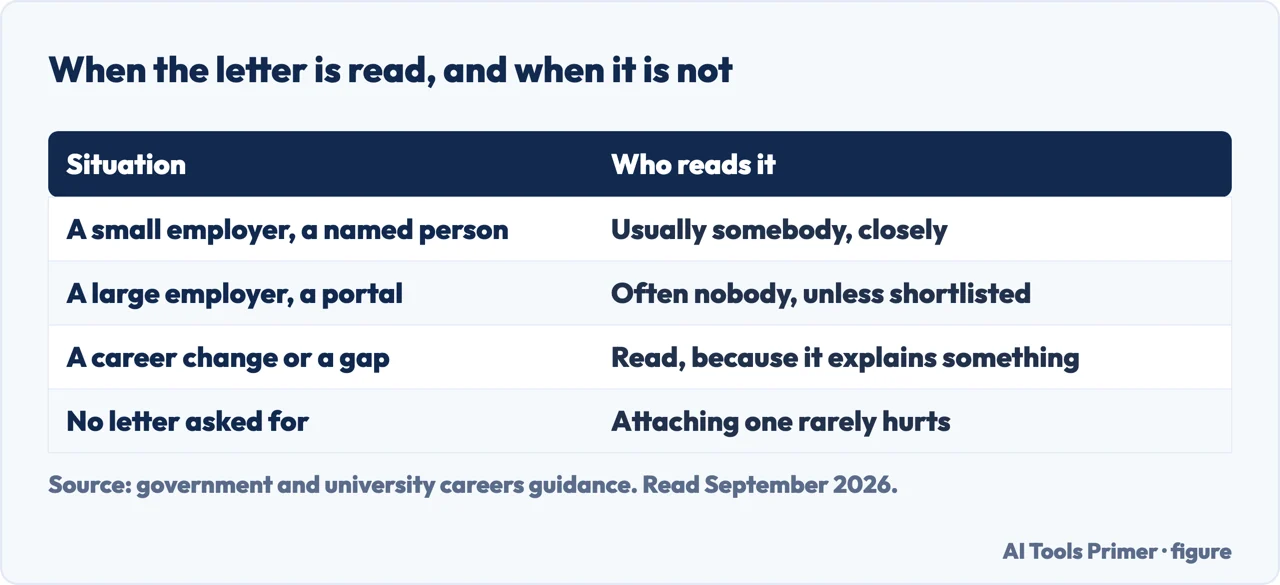
What to put in one, given all of the above. The purpose statement does the work here. Anything that is on your résumé is the wrong material. What belongs is the part a list of roles cannot carry: why this employer rather than a similar one, how a piece of your experience maps onto something specific in the posting, and an explanation for anything on the résumé that raises an obvious question — a change of field, a gap, a move to a different country. That last use is the one people underuse most, and it is where a letter is genuinely irreplaceable.
Length is not the interesting variable, but since people ask: it should be shorter than the résumé it accompanies, and it should be readable in one screen. If it takes longer to read than the document it is introducing, something has gone wrong with the idea.
Should AI write it? That question belongs to a different guide, but the short version follows directly from everything above. The evidence says a generic letter is worth little, and the fastest way to produce a generic letter is to ask a model for one and send what comes back. Used to draft from material you supply about a specific posting, the tools are useful. Used to generate a letter from the job title alone, they are an efficient way to produce exactly the thing the research says does not work.
Who is telling you that you need one. Two of the five results currently above this page on Google are companies that sell cover letter builders. That does not make them wrong — the evidence above broadly supports writing one — but it is worth knowing that the pages most confident about the answer are the ones with a product attached to it. The same is true in reverse of the advice to skip letters entirely, which tends to come from people applying at volume.
The position this guide takes is narrower and, we think, more defensible. Check the posting, because that settles most cases. Where it is optional, write one only if you have something to say that the résumé does not already carry — and if you do not, that is a real answer rather than laziness. And treat the fifty-three per cent figure as what it is: the best measurement anybody has published, six years old, funded by a firm that sells the service.
Where to start
Four ways in.
- “I have something awkward to explain.”
- A letter is the right place — the difficult cases
- “Can I get AI to write it?”
- Read using ai on it
- “I am sending a lot of applications.”
- Go to applying at volume
The difficult cases
The situations where a letter is genuinely irreplaceable, because a résumé raises a question it has no room to answer.
Using AI on it
The fastest route to exactly the kind of letter the evidence says does not work — and the narrower use where the tools genuinely help.
Applying at volume
If tailoring is what works, then how many applications you send is a real constraint rather than a detail. These guides are about the arithmetic of that.
Not covered here. It will not tell you cover letters are dead. The only large experiment on the question says the opposite, and the pages saying otherwise are usually describing high-volume applying rather than evidence.
It will not present the fifty-three per cent figure as a fact either. It is quoted above with its date, its sample and the disclosed commercial interest of the firm that produced it.
And it will not sell you a cover letter builder, which is what two of the five pages currently above this one on Google are ultimately for. What holds instead is simple: the purpose statement comes from a US government application system, and the experiment is quoted with its dates, sample size and disclosed commercial interest.
Step 6 of 24 in the job search
The order this is meant to be read in, from writing the CV to handing in notice.
- Before this
- How long should a resume be, and who sets the rule?
- After this
- How to write a cover letter, which is not a CV in prose
The reason this employer rather than another one
The one thing a generated answer has to leave blank, asked in four places.
- The same job, in the other places it comes up
- Why do you want to work here, and what they are checking
- Questions to ask at the end of an interview, and what they are for
Sources
- USAJOBS Help Center — What documents do I need to provide when I apply?, on required and optional documents and on what a cover letter is for — help.usajobs.gov, read 21 August 2026.
- ResumeGo — Cover Letters: Just How Important Are They?, a field experiment of 7,287 applications between 15 July 2019 and 10 January 2020 with a survey of 236 hiring professionals, published by a company that states it offers resume writing services — www.resumego.net, read 21 August 2026.
Written by Alberto Gulotta
Founder and editor of AI Tools Primer, writing from Palermo, Italy. Thirty-five years of taking computers apart, starting with a Commodore 64 — the long version is on the about page.
Something wrong on this page? Write to aitoolsprimer@gmail.com and it gets fixed.
Written on 21 August 2026 · last checked 23 September 2026.
Independence and limits
No affiliate links and no paid placements anywhere on this site. Nobody pays to appear here, and no company has seen this page before you did.
This is general information, not professional advice. Where a page touches money, health, safety or the law, it names its source and the date it was read — and your situation may still differ. See the privacy page and the cookie policy.