It “briefly states your skills, knowledge, experience, and (most importantly) what you have achieved using your abilities.”
A list, in reverse order, with dates. Nothing on it explains why any of it points at this particular job.

Work · guide
By Alberto Gulotta · Updated · 8 min read
The commonest failure in how to write a cover letter is not bad writing. It is writing the CV again in sentences — the same jobs, the same order, joined up with “additionally” and “furthermore”. A university careers office draws the distinction in a way that makes the mistake obvious once you have read it.
It “briefly states your skills, knowledge, experience, and (most importantly) what you have achieved using your abilities.”
A list, in reverse order, with dates. Nothing on it explains why any of it points at this particular job.
It “gives you an opportunity to create a narrative that shows the path you have taken in your career or education, emphasizing the skills you’ve used along the way, and explaining why the position you are applying to is the next desirable step on this path.”
The CV states. The letter argues. Written as a CV in prose it does neither.
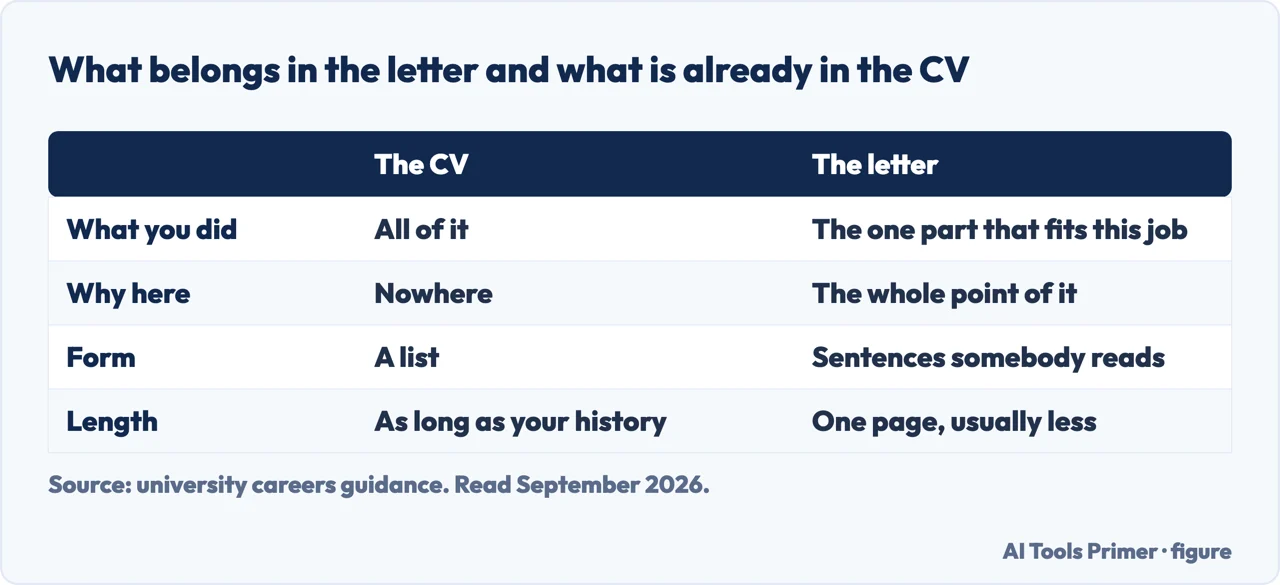
That distinction is worth holding in mind while you write, because it tells you what to leave out. Anything already legible on the CV does not need repeating; what is missing from the CV is the argument — the reason those things lead here, to this job, at this organisation. Nobody else can supply that, and no template contains it.
With the purpose settled, there is one instruction that reorganises the whole letter, and it comes from a university writing centre rather than a careers blog.
“Assess the employer’s needs and your skills. Then try to match them in the letter in a way that will appeal to the employer’s self-interest.”University of Wisconsin–Madison Writing Center — read 22 August 2026
That last phrase is the whole operation, stated more plainly than anywhere else. A letter written around what I want — the role, the growth, the opportunity — is asking for a favour. A letter written around what this solves for them is making an offer. The same experience appears in both; only the direction changes, and the direction is what gets read.
Applied honestly, that sentence changes almost every paragraph. I am looking for a role where I can develop my project management skills becomes you are running three overlapping deliveries with one coordinator; I have done exactly that at this scale. The experience is identical. The first version is about you. The second is about them, and it is the one that answers the question they are actually holding.
What a careers writing centre asks for, specifically
Short, checkable instructions rather than encouragement.
Two of those deserve emphasis because they are the ones people resist. One page is not a guideline that a really good candidate may exceed; a letter that runs to two pages has usually reverted to being the CV again. And tailoring is the difference between a letter and a circular — “demonstrate, if possible, some knowledge of the organization” is checkable in the first paragraph, and its absence is equally checkable.
Then there is the fact that makes this document unlike anything else in the application, and the Writing Center states it in one line: the letter “not only tells of your accomplishments but also reveals how effectively you can communicate.” It is simultaneously the argument and the evidence for the argument. Claiming excellent written communication in a paragraph with three subordinate clauses and a spelling mistake settles the question in the wrong direction.
Which is also why both sources say the same unwelcome thing about effort. Penn: “You will likely have several drafts before you come up with a final version.” Wisconsin recommends asking people “who have had experience in obtaining jobs or in hiring in your field to critique a draft”. One pass is rarely enough, and the second reader is the cheapest improvement available.
A vocabulary note that saves confusion when you are looking for guidance. Penn records that the same document is “sometimes called a ‘letter of intent’ or ‘letter of interest’”, and elsewhere it is a letter of application. Searching how to write a cover letter for a job finds the same guidance again under a fourth name. Where the phrase differs, the requirement does not.
And one genuine exception, flagged by Penn and worth knowing before you follow generic advice: letters for faculty positions follow different conventions from letters for everything else. If you are applying into academia, the general guidance on this guide is the wrong shape.
The guides below take it four ways: whether the letter is needed at all, writing it, the specific situations that change it, and the tools people reach for.
Four ways in.
Not every application wants one, and the answer changes what you should spend the evening on. This wing is about deciding before writing.
One page, four or five paragraphs, and a direction. These guides cover the structure, the opening, and the instruction that reorganises everything.
The general advice has exceptions, and two of them are common enough that following the general version actively hurts.
Templates and AI both help with the parts that do not matter and cannot do the part that does. These guides are about where the line falls.
Not covered here. It will not give you a letter to fill in. Both sources here say the same thing in different words: the part that works is the argument, and the argument is specific to you and to them.
It will not tell you the letter does not matter. It is read as a writing sample whether or not it is read as an argument.
And it will not pretend one draft is enough. The two universities quoted here both say it is not. What holds instead is simple: the distinction between CV and letter and the self-interest rule are quoted from two university guides.
The order this is meant to be read in, from writing the CV to handing in notice.
The one thing a generated answer has to leave blank, asked in four places.
Written by Alberto Gulotta
Founder and editor of AI Tools Primer, writing from Palermo, Italy. Thirty-five years of taking computers apart, starting with a Commodore 64 — the long version is on the about page.
Something wrong on this page? Write to aitoolsprimer@gmail.com and it gets fixed.
Written on 22 August 2026 · last checked 23 September 2026.
Independence and limits
No affiliate links and no paid placements anywhere on this site. Nobody pays to appear here, and no company has seen this page before you did.
This is general information, not professional advice. Where a page touches money, health, safety or the law, it names its source and the date it was read — and your situation may still differ. See the privacy page and the cookie policy.