
Work · guide
Questions to ask at the end of an interview, and what they are for
By Alberto Gulotta · Updated · 10 min read
Search for questions to ask at the end of an interview and you get lists. Fifteen questions. Twenty-one questions. Seven killer questions. What almost none of them tell you is what the moment is for — which is the thing that decides whether a question is a good one.
“At the end of a job interview, employers will usually ask if you have any questions for them. This is a good chance to show your interest in the company and your enthusiasm for the job.”
The United Kingdom’s National Careers Service, a public body with nothing to sell, read 21 August 2026. Read what it says the moment is for: showing something. Not gathering information — showing. The interview has not ended, and this part is assessed like the rest of it.
That reframes the whole exercise. You are not primarily collecting information, although you should collect some. You are being asked to demonstrate, in about three minutes, that you have understood what this job is and thought about it seriously. A question does that or it does not, and no list can tell you which because it depends on the conversation you have just had.
Virginia Tech’s careers team puts the effect plainly, quoting its director of professional development: “Asking questions at the end of an interview makes you look interested, enthusiastic and engaged – all qualities that employers want.” Note that all three are qualities rather than facts. This part of the interview is character evidence.
Five families, not a list of twenty-one
Almost every guide on this question hands you a numbered list. A list is hard to use under pressure, because you cannot tell which items fit the conversation you have just had. Families are easier: pick one question from two or three of these, chosen after the interview has happened rather than before.
- The role, as it actually is This one is our suggestion rather than a quotation from a careers service: what would you want somebody in this role to have achieved after six months? It is the strongest question in the set. It is specific, it cannot be answered from the job advert, and the answer tells you what you would really be judged on.
- The team you would join Virginia Tech publishes it as “Can you tell me more about the team I would be working with?” — these, it notes, are the people you will work most closely with. The National Careers Service has a plainer version, “what does a typical day involve?”, which does the same job and is easier to ask.
- The person interviewing you “What is it like to work here?” Listed by the careers service, and it works because it invites a real answer rather than a rehearsed one. How readily somebody answers is itself informative.
- Where the organisation is going “How do you see the company developing over the next few years?” Also from the careers service. It shows you are thinking past the first month, which is the quality this whole moment is meant to demonstrate.
- What happens next Virginia Tech suggests saying it plainly: “What are the next steps in the hiring process?” Not impressive, and not meant to be. It ends the conversation cleanly and it saves you a fortnight of wondering.
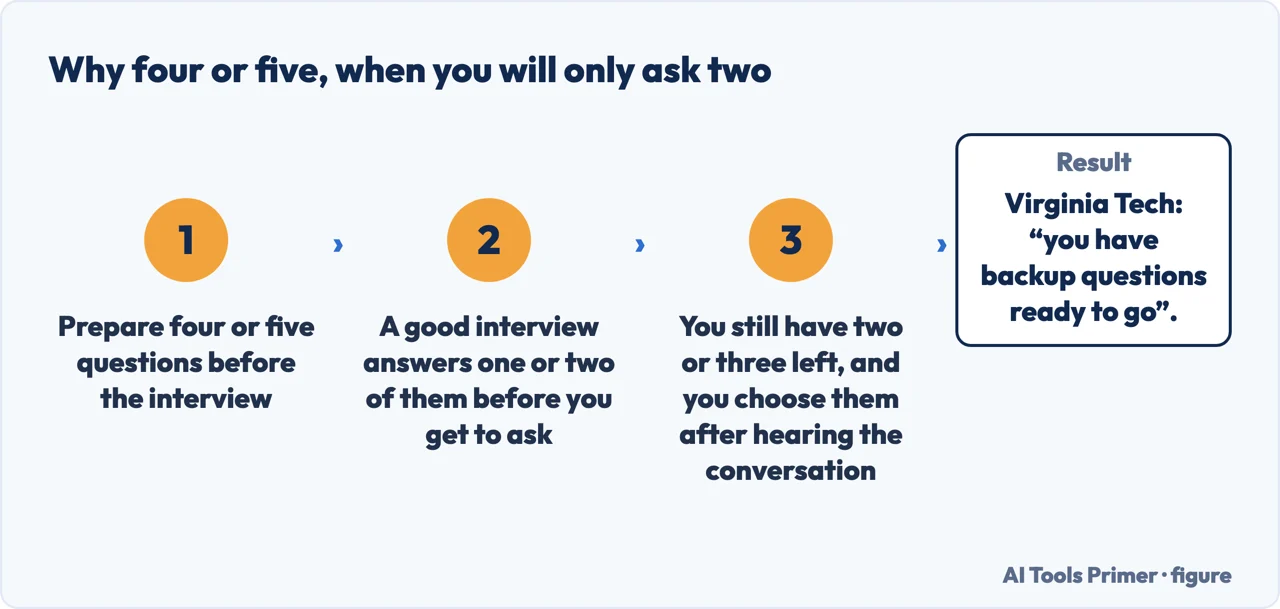
How many to prepare has a specific published answer. Virginia Tech’s Career and Professional Development team advises: “It’s best to come up with four or five questions to ask the interviewer. If one or two of them are answered during the earlier discussion, you have backup questions ready to go.” That is the practical reason for over-preparing — a good interview answers half your list before you get to ask it.
The same source makes a second argument that is worth taking seriously, though it is advice rather than a finding: use the time you were given. If you have an hour, “take the hour. In general, the longer you spend with the recruiter, the better the outcome.” That is one professional’s experience rather than a measured effect, and we have not seen it tested — but the mechanism is plausible, and the cost of asking one more genuine question is close to zero.
What actually costs you something
- Saying you have none. The most common answer and the worst one. It reads as indifference whether or not you feel any, and the sources above agree on what the moment is testing.
- Asking something the careers page answers. It demonstrates the opposite of research, which is precisely the thing you were hoping to demonstrate.
- Asking a question you do not want answered. Anything designed to sound impressive rather than to be useful is audible, and it usually leads somewhere you cannot follow.
- Opening on holiday, hours or pay in a first interview. These are legitimate questions and they belong later, when there is an offer to discuss. Asking them first tells a story about priorities that you may not intend.
- Reading four questions off a phone in sequence. One good question that follows from what they just said beats four prepared ones delivered as a list.
The one that is worth more than the rest. If you take a single thing from this guide, take the six-month question. Ask what somebody in this role would need to have achieved after six months for the hire to be considered a success. It is the only question in common use that cannot be answered from the advert, and the answer is genuinely useful to you: it tells you what the job is measured on, which is frequently not what the job description describes. That recommendation is our judgement rather than a quotation, and it is marked as such because the rest of this page is not.
Listen to how it is answered, too. A clear, specific answer means somebody has thought about what this role is for. Hesitation, or an answer assembled on the spot, is information about the organisation that no careers page will give you — and you are allowed to use it.
When they say there is no time. Interviews overrun and sometimes the offer to ask is a formality. Have one question ready that works in fifteen seconds — the next-steps question does — and ask if you may send the others by email. That is not a fallback; it is a second contact with somebody who has just met you, and it is rarely unwelcome.
Where this differs from the pages above it. The lists are not wrong, and several of the questions on this page appear on them. The difference is that a list gives you twenty-one options and no way to choose, at the exact moment when choosing is the whole task. Two sources are quoted here — a national careers service and a university careers team — and where the advice is ours rather than theirs, the page says so.
Where to start
Four ways in.
- “I have an interview tomorrow.”
- The five families above, then preparing
- “What will they ask me?”
- Go to their questions
- “How do I open when they say tell me about yourself?”
- That is the opening
- “It is on a video call.”
- See remote and after
Preparing
The work that happens before, which is what makes a question at the end sound like thought rather than like a list.
Their questions
The other side of the same hour, grouped the way a public careers service groups them: by what the employer is trying to find out.
The opening
The first ninety seconds set what the rest of the hour is about. The questions you ask at the end should follow from it.
Remote and after
What changes when the conversation happens through a camera, and what to do in the days that follow it.
Not covered here. It will not give you twenty-one questions to read out. A list is the wrong tool for a moment whose whole difficulty is choosing, and it is why so many candidates sound rehearsed here.
It will not claim the longer-interview advice is proven. It is quoted as one careers professional’s experience, named, with the date — because that is what it is.
And it will not sell you interview coaching, which is where several guides on this question ultimately lead. What holds instead is simple: the purpose of this moment and the example questions are quoted from careers services, with the parts that are our own judgement marked in the text.
Step 18 of 24 in the job search
The order this is meant to be read in, from writing the CV to handing in notice.
- Before this
- Why should we hire you, and where the answer is written down
- After this
- Thank you email after interview: what the templates leave out
The reason this employer rather than another one
The one thing a generated answer has to leave blank, asked in four places.
- The same job, in the other places it comes up
- How to write a cover letter, which is not a CV in prose
- Why do you want to work here, and what they are checking
- Are cover letters necessary, and who actually reads them?
Sources
- National Careers Service (United Kingdom) — How to answer common interview questions, including what asking questions at the end is for and four example questions — nationalcareers.service.gov.uk, read 21 August 2026.
- Virginia Tech News — Questions to ask at the end of the interview to make you shine, published 20 February 2025, quoting Becca Scott, director of professional development and experiential initiatives at Career and Professional Development — news.vt.edu, read 21 August 2026.
Written by Alberto Gulotta
Founder and editor of AI Tools Primer, writing from Palermo, Italy. Thirty-five years of taking computers apart, starting with a Commodore 64 — the long version is on the about page.
Something wrong on this page? Write to aitoolsprimer@gmail.com and it gets fixed.
Written on 21 August 2026 · last checked 23 September 2026.
Independence and limits
No affiliate links and no paid placements anywhere on this site. Nobody pays to appear here, and no company has seen this page before you did.
This is general information, not professional advice. Where a page touches money, health, safety or the law, it names its source and the date it was read — and your situation may still differ. See the privacy page and the cookie policy.